
LPN Program NYC: Complete 2026 September Guide to Practical Nursing Schools, Costs, Requirements & Licensure in New York City
📝 Find the best LPN program NYC offers in 2026 September. Compare tuition, admission requirements, NCLEX-PN pass rates, and licensure steps for New York City schools.
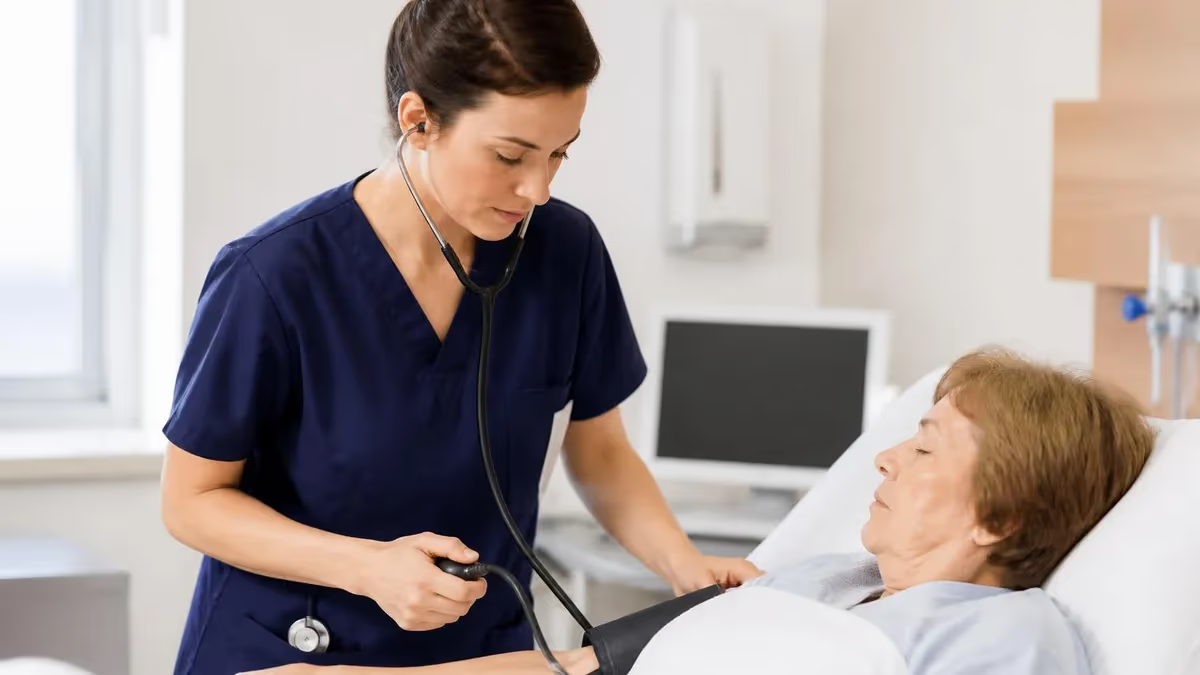
Choosing an LPN program NYC residents can actually complete while juggling rent, family, and a side job is one of the most consequential career decisions you will make in your twenties or thirties. New York City offers a dense network of approved practical nursing programs spread across the five boroughs, from CUNY community colleges and BOCES-affiliated tracks to private career schools and hospital-based diploma programs. Each pathway feeds into the same NCLEX-PN exam and the same New York State Education Department licensure process, but the experiences differ wildly in cost, scheduling, and clinical placement quality.
In 2026, the demand for licensed practical nurses across NYC's five boroughs has climbed sharply. Long-term care facilities in Queens, dialysis centers in the Bronx, and outpatient clinics throughout Manhattan are posting LPN openings with sign-on bonuses ranging from $2,500 to $7,500. The Bureau of Labor Statistics projects 5% national growth for LPNs through 2032, but New York metro area projections sit closer to 9% because of the aging population and the post-pandemic shift toward home-based care.
A typical LPN program in New York City runs 12 to 18 months full-time or 18 to 24 months part-time. Tuition ranges from roughly $8,000 at CUNY-affiliated programs to over $35,000 at private institutions like ASA College replacements or Manhattan Institute of Management. Students complete approximately 1,050 to 1,200 clock hours, including didactic coursework, skills lab simulation, and supervised clinical rotations at NYC Health + Hospitals facilities, Northwell sites, or smaller skilled nursing facilities.
Beyond tuition, prospective students need to budget for a TEAS or HESI entrance exam, criminal background checks through IdentoGO, a 10-panel drug screen, immunization documentation including a two-dose MMR and annual flu shot, BLS certification through the American Heart Association, uniforms, a stethoscope, and roughly $1,400 in NCLEX and licensure fees. These hidden costs often add $2,000 to $3,500 on top of advertised tuition, which catches many first-time applicants off guard during enrollment.
This guide walks through every approved LPN program NYC currently offers, breaks down realistic admission timelines for fall 2026 and spring 2027 cohorts, compares tuition and clinical placement quality, and lays out the exact licensure steps after graduation. We pull from the New York State Education Department Office of the Professions database, current NCLEX-PN pass rate reports, and direct outreach to admissions offices. Where data conflicts between school marketing pages and state records, we default to state records.
If you are still deciding whether practical nursing is the right entry point versus an lpn vs adn RN program, a direct-entry BSN, or a medical assistant certificate, the cost-to-earning ratio for LPNs in NYC remains compelling. Median LPN wages in the New York-Newark-Jersey City metropolitan statistical area sit at roughly $61,200 in 2026, with experienced LPNs in specialty settings like dialysis or correctional health earning $75,000 to $84,000. Compared to the $12,000 to $18,000 total program investment, the payback period is typically under nine months of employment.
We also cover what happens if your first NCLEX-PN attempt does not go well, how to handle clinical clearance issues, and what employers in NYC actually look for when hiring new LPN graduates. By the end, you should have a clear shortlist of programs to apply to, a realistic budget, and a roadmap from application through your first paycheck as a licensed practical nurse in New York City.
LPN Programs in NYC by the Numbers
Top Approved LPN Programs in New York City
A 14-month full-time LPN program located in midtown Manhattan with day and evening cohorts. Clinical rotations are placed at Mount Sinai-affiliated long-term care facilities. Tuition approximately $32,500 with Title IV federal aid eligibility.
Several Queens-based private career schools absorbed ASA's former LPN cohorts. Programs run 15 months with rotations at Jamaica Hospital and Flushing Hospital Medical Center. NCLEX-PN pass rates hover near 78%.
Many NYC residents commute to BOCES programs in Suffolk and Nassau for tuition under $14,000. The 11-month adult LPN program has the highest reported pass rate in the metro at 94% and accepts NYC applicants.
Several CUNY community colleges partner with Health + Hospitals to guarantee clinical placements at Bellevue, Kings County, and Elmhurst. These cohorts are smaller, more competitive, and feed directly into hiring pipelines.
Located in Harlem, Helene Fuld offers an accelerated LPN-to-RN bridge after completion of the 18-month practical nursing track. Strong reputation for clinical rigor and post-graduation employment.
Admission requirements for an LPN program NYC schools enforce are stricter than most prospective students expect. At minimum, you need a U.S. high school diploma or GED, a passing score on either the TEAS (Test of Essential Academic Skills) Version 7 or the HESI A2, official transcripts from any post-secondary institution attended, and proof of legal authorization to work in the United States. Most schools also require you to be at least 18 years old by the start of clinical rotations, which generally begin in month three or four of the program.
The TEAS Version 7 is the most common entrance exam used by NYC programs in 2026. Schools typically set a minimum composite score between 58.7% (the national proficient benchmark) and 70%. Helene Fuld, CUNY-affiliated cohorts, and Mildred Elley sit at the higher end. The exam covers reading, math, science, and English language usage, with science (especially anatomy, physiology, and basic chemistry) being the section that trips up the most applicants. Plan four to eight weeks of dedicated TEAS prep before testing.
Background checks and fingerprinting through IdentoGO are non-negotiable. Any felony conviction, certain misdemeanors involving violence or controlled substances, and unresolved immigration issues can disqualify you from clinical placement even if a school admits you. New York State Education Department conducts a separate moral character review at licensure. If you have any record, request a pre-application moral character determination from NYSED before investing in tuition. This protects you from spending $20,000 only to be denied licensure 18 months later.
Health and immunization requirements include documentation of two MMR doses, two varicella doses or titer, hepatitis B series or titer, Tdap within ten years, an annual flu shot during flu season, a negative two-step PPD or QuantiFERON-Gold within the past 12 months, and COVID-19 vaccination status that meets your assigned clinical site's policy. NYC Health + Hospitals sites still require either full vaccination or a documented medical or religious exemption as of early 2026.
Prerequisite coursework varies by program. CUNY-affiliated tracks and Helene Fuld typically want one college-level anatomy and physiology course with a C or better, plus English composition. Private career schools often waive the A&P prerequisite and instead build it into the first semester. If you are a career changer with a bachelor's degree in an unrelated field, your existing English and humanities credits usually transfer, shortening the program slightly.
Some programs require an admissions interview, especially the more selective hospital-affiliated tracks. Expect questions about why you chose practical nursing over RN, how you handle stress, your availability for 12-hour clinical shifts, and your familiarity with the realities of bedside care. Bring a printed resume, a list of three professional or academic references, and arrive 15 minutes early. Dress in business professional attire — scrubs are inappropriate for the interview stage even though you will live in them later.
Finally, English language proficiency requirements apply to internationally educated applicants. Programs typically require a TOEFL iBT score of 79 or higher, or an IELTS Academic score of 6.5 with no band below 6.0. New York State also imposes its own English proficiency requirement at licensure, so passing the program's threshold does not automatically clear NYSED. Plan accordingly if English is your second language.
LPN Practice Test Questions
Prepare for the LPN - Certified Practical Nurse exam with our free practice test modules. Each quiz covers key topics to help you pass on your first try.
LPN - Certified Practical Nurse Basic Care...
LPN Exam Questions covering - Certified Practical Nurse Basic Care and Comfort. Master LPN Test concepts for certification prep.
LPN - Certified Practical Nurse Coordinate...
Free LPN Practice Test featuring - Certified Practical Nurse Coordinated Care. Improve your LPN Exam score with mock test prep.
LPN - Certified Practical Nurse Health Pro...
LPN Mock Exam on - Certified Practical Nurse Health Promotion and Maintenance. LPN Study Guide questions to pass on your first try.
LPN - Certified Practical Nurse Pharmacolo...
LPN Test Prep for - Certified Practical Nurse Pharmacological Therapies. Practice LPN Quiz questions and boost your score.
LPN - Certified Practical Nurse Physiologi...
LPN Questions and Answers on - Certified Practical Nurse Physiological Adaptation. Free LPN practice for exam readiness.
LPN - Certified Practical Nurse Psychosoci...
LPN Mock Test covering - Certified Practical Nurse Psychosocial Integrity. Online LPN Test practice with instant feedback.
LPN - Certified Practical Nurse Reduction ...
Free LPN Quiz on - Certified Practical Nurse Reduction of Risk Potential. LPN Exam prep questions with detailed explanations.
LPN - Certified Practical Nurse Safety and...
LPN Practice Questions for - Certified Practical Nurse Safety and Infection Control. Build confidence for your LPN certification exam.
LPN Ethical, Legal & Professional Standards
LPN Test Online for Ethical, Legal & Professional Standards. Free practice with instant results and feedback.
LPN Health Evaluation & Monitoring
LPN Study Material on Health Evaluation & Monitoring. Prepare effectively with real exam-style questions.
LPN Program NYC Tuition, Costs & Financial Aid Options
CUNY community college LPN tracks and BOCES-affiliated commuter programs sit at the lowest end of the tuition spectrum. Total cost typically runs $8,000 to $14,000 for the entire program, including fees but excluding books, uniforms, and licensure expenses. New York State residency unlocks the lowest tier of pricing, and the Excelsior Scholarship and TAP (Tuition Assistance Program) can cover a significant portion for income-qualified applicants.
Waitlists at public programs can stretch six to 18 months, and admission is increasingly competitive. Most CUNY-affiliated cohorts admit only 24 to 36 students per intake despite hundreds of applications. The trade-off for lower tuition is delayed start dates, so applicants often apply to two or three public programs simultaneously while keeping a private backup option active.
Pros and Cons of Becoming an LPN in NYC
- +Faster entry to nursing workforce than ADN or BSN paths, typically 12-18 months
- +Lower total tuition than RN programs, often under $15,000 at public institutions
- +Strong NYC job market with sign-on bonuses up to $7,500 in long-term care
- +Median NYC metro wages of $61,200 with overtime and shift differentials common
- +LPN-to-RN bridge programs available locally for future career growth
- +Diverse practice settings: clinics, dialysis, corrections, schools, home health
- −NYC living costs remain among the highest in the country during the program
- −Scope of practice is narrower than RN — limits hospital-based bedside roles
- −Some Manhattan hospitals are phasing out LPN positions in acute care units
- −Clinical placement quality varies sharply between programs
- −NCLEX-PN preparation requires 6-12 weeks of dedicated post-graduation study
- −Background check and immigration issues can derail otherwise strong applicants
LPN Program NYC Application Checklist
- ✓Confirm program is approved by NYSED Office of the Professions before applying
- ✓Schedule and pass the TEAS V7 or HESI A2 entrance exam with required minimum score
- ✓Request official high school or GED transcripts sent directly to admissions
- ✓Order official transcripts from every post-secondary institution attended
- ✓Complete IdentoGO fingerprinting and submit results to NYSED
- ✓Gather immunization records including MMR, varicella, hep B, Tdap, and flu
- ✓Schedule a two-step PPD or QuantiFERON-Gold tuberculosis screening
- ✓Obtain current American Heart Association BLS Provider certification
- ✓Submit FAFSA early — NY state aid deadlines often differ from federal
- ✓Prepare a professional resume and three references for admissions interview
- ✓Budget an additional $2,000-$3,500 for uniforms, books, and licensure fees
- ✓Request pre-licensure moral character determination if you have any record
Verify NYSED Approval — Not Just Accreditation
Several LPN programs marketed online to NYC residents are accredited by national bodies but not approved by the New York State Education Department. Graduates of non-approved programs cannot sit for the NCLEX-PN in New York. Always verify your target program on the NYSED Office of the Professions website before paying any deposit or signing enrollment paperwork.
Once enrolled, the curriculum of any LPN program NYC schools deliver follows a remarkably similar arc dictated by NYSED regulations and the NCLEX-PN test plan. The first semester centers on foundational sciences — anatomy and physiology, basic microbiology, growth and development, and an introduction to nursing concepts. You will spend significant time in the skills lab learning bed making, vital signs, hand hygiene, sterile technique, and basic patient transfers. Most programs require demonstrated competency on each skill before advancing.
The second semester typically introduces medical-surgical nursing, pharmacology, and maternal-child health. Pharmacology is consistently identified by students as the most challenging course because it requires memorizing drug classes, mechanisms, side effects, and patient teaching points across roughly 200 medications. Dosage calculation tests are usually pass-fail with a 90% minimum — fail twice and you typically must repeat the course. Invest in a dedicated dosage calculation workbook before this semester starts.
Clinical rotations begin around the end of the first semester or start of the second. NYC programs typically place students in long-term care facilities first to build foundational skills, then progress to medical-surgical units, mental health settings, pediatrics or maternity, and finally a capstone preceptorship in an area of interest. Common NYC clinical sites include the Hebrew Home at Riverdale, Coler Specialty Hospital on Roosevelt Island, Wartburg in Mount Vernon, and various NYC Health + Hospitals facilities depending on program affiliation.
Expect to be in clinical eight to 12 hours per day, two to three days per week, often beginning at 6:30 or 7:00 a.m. NYC commute times are real — students placed at outer-borough facilities from a Manhattan campus often add 90 minutes each way to their day. Map out commute logistics before accepting an admission offer, especially if you have child care obligations or work a second job. Some programs allow you to request a specific borough but cannot guarantee it.
The third semester or final block focuses on more complex medical-surgical content, advanced pharmacology, leadership and delegation, and NCLEX-PN preparation. Most NYC programs integrate ATI or HESI standardized testing throughout the curriculum, with a comprehensive predictor exam in the final weeks. Scoring below a designated threshold on the predictor often triggers a mandatory remediation plan and sometimes delays graduation eligibility until you re-test successfully.
Beyond didactic and clinical hours, expect approximately two to three hours of independent study for every hour of class time. Full-time programs translate to a 50- to 60-hour weekly time commitment. Working more than 20 hours per week during a full-time program correlates with significantly higher attrition rates. If you must work, hospital-sponsored or part-time LPN tracks are designed for working students and stretch the program to 24 months to keep the weekly load manageable.
Programs also enforce strict attendance policies. Missing more than 5% of class or clinical hours often triggers automatic course failure regardless of academic standing. Document any absence with medical notes, court summons, or other verifiable evidence, and communicate proactively with instructors. NYSED rules require programs to verify minimum clock hours for graduation, so missed time must usually be made up through additional clinical shifts or skills lab hours.
Do not wait until graduation to start the NCLEX-PN application process. Register with Pearson VUE and apply to NYSED for licensure during your final semester. The Authorization to Test (ATT) can take six to eight weeks to issue, and every week of delay is a week of lost LPN-level wages. Programs that strongly encourage early application typically have higher first-time pass rates.
After completing your LPN program, the path to working as a licensed practical nurse in New York requires three distinct steps: applying to NYSED for licensure, registering with Pearson VUE for the NCLEX-PN exam, and passing the exam. The NYSED application opens online through their Office of the Professions portal. You submit Form 1 (the basic application), Form 2 (which your program's director completes to certify your education), and the moral character section. Total NYSED licensure fees in 2026 are $143 covering both the license and first registration period.
The NCLEX-PN registration with Pearson VUE costs $200 and is paid separately. You complete the registration online, choose a testing window, and wait for NYSED to verify your eligibility and forward authorization to Pearson VUE. Pearson then emails your Authorization to Test (ATT), which contains a window of typically 90 days during which you must sit for the exam. Schedule the exam as early as possible after receiving the ATT because Manhattan and Brooklyn testing centers often book three to five weeks out.
The NCLEX-PN itself is a computer-adaptive test ranging from 85 to 150 questions, with most candidates seeing between 95 and 115. The exam stops when the system determines, with 95% confidence, that you are either above or below the passing standard. Items cover four major client need categories: Safe and Effective Care Environment, Health Promotion and Maintenance, Psychosocial Integrity, and Physiological Integrity. You have five hours total, including breaks, but most candidates finish in three.
National first-time NCLEX-PN pass rates hover around 84% to 86% in recent years, with New York test takers tracking close to the national average. Pass rates vary dramatically by program — top NYC programs report 90%+ first-time pass rates while struggling programs sit below 70%. Always check published pass rates on the NYSED program approval page before enrolling, and ask the school directly about their three-year trend. A declining pass rate is a red flag that often signals deeper curriculum or faculty issues.
If you do not pass on the first attempt, NYSED allows you to retake the NCLEX-PN after a 45-day waiting period. Pearson VUE caps attempts at eight per year. Most candidates who fail score in the 80-90 question range with the exam ending on borderline performance, meaning they were close. Targeted review using NCSBN's official Learning Extension or commercial programs like UWorld, Kaplan, or ATI typically resolves the gap within four to eight weeks. Resist the urge to study endlessly — diagnose specific weak areas and drill those.
Once licensed, your initial NY LPN registration lasts three years, then renews every three years thereafter for $73 per cycle. New York currently does not mandate continuing education hours for LPN renewal, though this is under periodic legislative review. Most employers expect ongoing competencies in BLS, infection control, and HIPAA at minimum. If you plan to work in long-term care, additional in-service training on dementia care, fall prevention, and pressure injury staging is typically completed during employer orientation.
New York is not a member of the Nurse Licensure Compact as of 2026, which means your NY LPN license does not automatically allow you to practice in compact states. If you plan to relocate, you must apply for licensure by endorsement in the destination state, which typically takes four to 12 weeks. Maintain detailed records of your education, employment history, and continuing education throughout your career — endorsement applications often request documentation going back to graduation.
Practical tips from recent NYC LPN graduates consistently point to a few habits that separate top performers from those who struggle. First, build a study group of three to five classmates during week one and meet at a consistent time and location every week. NYC has limited quiet study space, so reserve study rooms at branch libraries — the Mid-Manhattan Library at 42nd Street, Brooklyn Central Library, and Queens Central Library all allow free room reservations for groups. The accountability of a recurring study session prevents the procrastination spiral that derails many students.
Second, master dosage calculations early and never let your skills lapse. Spend 15 minutes every single day doing five practice problems, even after passing the official course. Dosage calculation is the highest-stakes daily LPN skill — a decimal point error can kill a patient — and NCLEX-PN now embeds calculation items in adaptive ways that punish weak math fundamentals. ATI's calculation modules and free online tools like Pharm-D Live are excellent for daily drills.
Third, do not skip clinical post-conferences. The hour after clinical when your instructor debriefs patient cases is where genuine clinical reasoning develops. Bring written notes about anything you saw that day — unusual lab values, medication errors witnessed, communication breakdowns — and ask specific questions. Instructors track engagement during post-conference, and strong participation often translates into stronger reference letters when you apply for jobs in your final semester.
Fourth, network with hospital-based recruiters before graduation. NYC Health + Hospitals, Northwell, Mount Sinai, and Montefiore all run nurse recruitment events specifically targeting LPN students in their final semester. Sign up for their talent communities by month nine of your program. Many positions are pre-filled by candidates who built relationships months before graduation. A 30-minute coffee meeting with a recruiter in November can translate into a guaranteed job offer in May.
Fifth, get comfortable with electronic health records before you need them on the job. Most NYC facilities use Epic, Cerner, or Meditech. Free Epic training is available through some hospital pre-employment programs, and YouTube tutorials cover the basics. Walking into your first job already familiar with EHR navigation removes one of the biggest stressors of new-graduate orientation and accelerates your transition off probation, which typically affects shift selection and bonus eligibility.
Sixth, prepare a realistic personal budget for the months between graduation and your first paycheck. From the day you submit your NYSED application to the day you receive your first direct deposit as a working LPN, expect eight to 12 weeks of zero income. Many graduates work as CNAs or patient care technicians on a graduate permit or temporary basis during this window. Save two months of expenses before graduation, or arrange for a hospital sign-on bonus to cover the gap.
Finally, treat your first year as an LPN as a continuation of your education rather than the end of it. Most NYC employers offer tuition assistance for LPN-to-RN bridge programs after 12 months of employment. The fastest paths to RN involve completing the bridge while working part-time as an LPN. Within three to four years of starting your LPN program, you can realistically earn $80,000+ as an RN with a clear pathway to BSN completion paid largely by employer benefits.
LPN Questions and Answers

LPN Practice Test PDF (Free Printable 2026)
Wound Care Certification for LPN: 2026 Complete Guide to WCC, CWCA & Specialty Credentials
LPN Program Cost: Complete 2026 Tuition & Fees Guide
LPN Programs Near Me 2026: Find Accredited Schools & Costs
Macomb LPN Program: Complete 2026 Guide to Specific LPN Programs, Admission Requirements, Cost & Career Outcomes
About the Author

Registered Nurse & Healthcare Educator
Johns Hopkins University School of NursingDr. Sarah Mitchell is a board-certified registered nurse with over 15 years of clinical and academic experience. She completed her PhD in Nursing Science at Johns Hopkins University and has taught NCLEX preparation and clinical skills courses for nursing students across the United States. Her research focuses on evidence-based exam preparation strategies for healthcare certification candidates.
Join the Discussion
Connect with other students preparing for this exam. Share tips, ask questions, and get advice from people who have been there.
View discussion (7 replies)