
Free LPN Programs 2026: How to Get Your License at No Cost
Free LPN programs guide: 🧠 discover scholarships, employer sponsorships, federal grants, and state-funded training that pay your full LPN tuition in 2026.
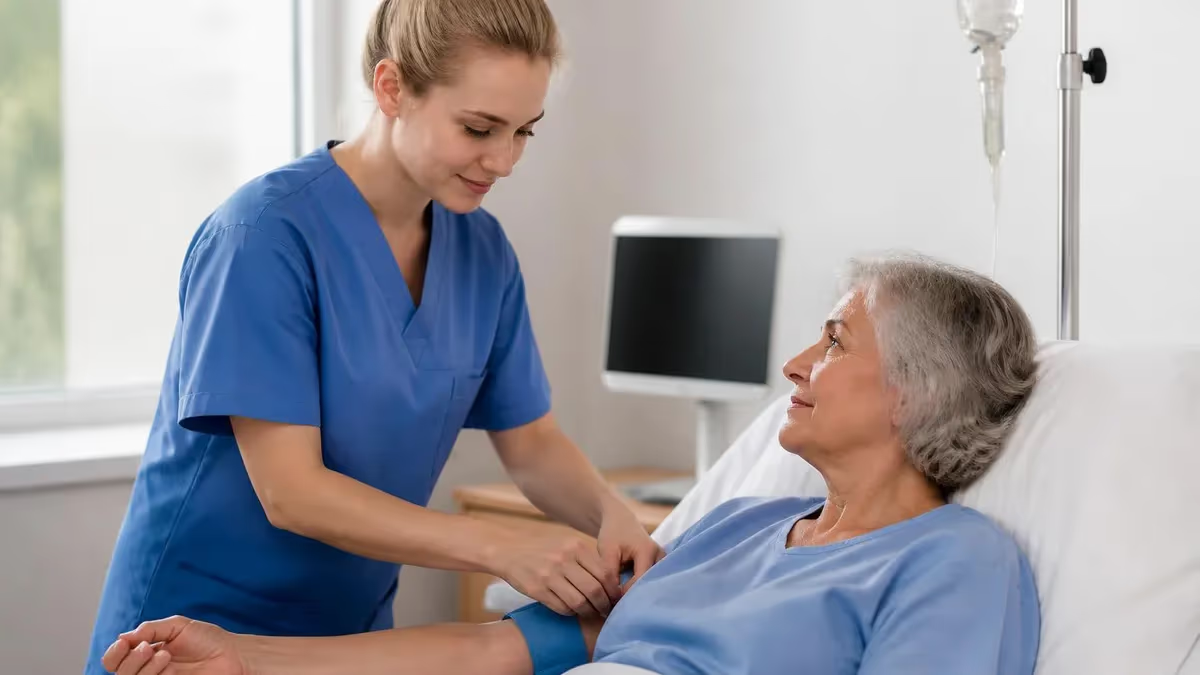
Free LPN programs are not a myth, and in 2026 more candidates than ever are graduating without taking on a single dollar of nursing debt. Hospitals, long-term care chains, the Workforce Innovation and Opportunity Act, state shortage funds, and a growing list of community colleges have pooled enough money to cover tuition, books, uniforms, NCLEX-PN test fees, and sometimes even living stipends. If you know where to apply, the path from civilian to licensed practical nurse can cost you almost nothing beyond your time and effort. Practice with the free Certified Practical Nurse practice test on PracticeTestGeeks (550+ questions with answer explanations).
The catch is that free training is rarely advertised as boldly as paid programs. You have to dig through workforce board pages, hospital career sites, union benefit portals, and Pell-eligible community college catalogs. This guide walks you through every legitimate funding channel that currently exists, what each one demands in return, and how to stack benefits so that a $18,000 practical nursing program ends up costing you zero out of pocket when you walk across the stage.
You will also learn how to spot the red flags. Some operators advertise free LPN programs but quietly require you to sign multi-year work contracts at below-market wages, while others bill themselves as tuition-free but charge thousands in fees, exam-prep packages, or mandatory equipment. We will show you exactly how to read a funding offer the way a labor attorney would, so the only surprise on graduation day is your new paycheck.
Most readers are also juggling jobs, kids, or military transitions while researching this. The good news is that nearly every funding source on this list accepts part-time, evening, or hybrid enrollment, and several specifically target single parents, veterans, displaced workers, and adults returning to education after age 25. Eligibility is broader than the marketing copy suggests, and we will tell you the magic phrases that get your application moved to the top of the review pile.
Before you commit, remember that any program calling itself free still has to be accredited by your state board of nursing and must prepare you for the NCLEX-PN. Funding does not replace quality. We have cross-referenced every category of free LPN program against pass-rate data published by state boards, so you can choose a school that pays your tuition and graduates students who actually become nurses.
This article is built for action. Each section ends with a step you can take this week — a website to visit, a form to download, a person to call. By the time you finish reading, you should have a shortlist of three to five funding pathways that match your background, your zip code, and your timeline to licensure. Bookmark the page; you will return to it as you collect documents.
Finally, a word about timing. Free LPN programs are funded through annual budgets, and the most generous awards close between January and April for fall cohorts. If you wait until summer to apply, you will fight for leftover seats. Treat this guide like a deadline calendar, not a wish list, and you will start clinicals before most applicants finish researching.
LPN: upcoming dates and official changes
- Apr 1, 2026: The 2026 NCLEX-PN Test Plan is effective April 1, 2026 through March 31, 2029. (National Council of State Boards of Nursing)
- Updated Oct 19, 2026: Number of questions is now 85–150 items (previously 85–150 items; computerized adaptive examination).
- Updated Oct 19, 2026: Exam fee is now $350 USD for registrations from Feb 1, 2027 (previously $200 USD registration fee).
Facts verified Oct 19, 2026 against National Council of State Boards of Nursing. Dates that have passed are removed automatically.
- The NCLEX-PN is a computerized adaptive exam of 85 to 150 items. (National Council of State Boards of Nursing)
- The NCLEX registration fee, including for the NCLEX-PN, rises to $350 in the United States for registrations completed on or after February 1, 2027. (National Council of State Boards of Nursing)
- The NCLEX-PN is delivered at Pearson test centers in the United States and its territories and at international test centers. (National Council of State Boards of Nursing)
- Candidates must apply to a nursing regulatory body, which determines eligibility to take the NCLEX-PN. (National Council of State Boards of Nursing)
- Official NCLEX results come only from the nursing regulatory body and are sent within six weeks after the exam. (National Council of State Boards of Nursing)
Facts verified Oct 19, 2026 against National Council of State Boards of Nursing. Dates that have passed are removed automatically.
LPN Exam at a Glance
| Item | Detail | Official source |
|---|---|---|
| Number of questions | 85–150 items | National Council of State Boards of Nursing |
| Exam fee | $350 USD for registrations from Feb 1, 2027 | National Council of State Boards of Nursing |
| Delivery | Pearson VUE test centers, U.S. and international | National Council of State Boards of Nursing |
| Eligibility | Eligibility is determined by the nursing regulatory body | National Council of State Boards of Nursing |
| Score release | Official results within six weeks; Quick Results after 2 business days where offered | National Council of State Boards of Nursing |
| Registration deadline | Registration stays open 365 days for the board to determine eligibility | National Council of State Boards of Nursing |
| Testing window | Authorization to Test window set by the board; average 90 days | National Council of State Boards of Nursing |
Facts verified Oct 19, 2026 against National Council of State Boards of Nursing. Dates that have passed are removed automatically.
Free Certified Practical Nurse Study Tools
Interactive Certified Practical Nurse resources on PracticeTestGeeks, free to start:
- LPN Medical-Surgical Nursing: Cardiovascular Disorders 1 — 72 questions with instant scoring and answer explanations
- Certified Practical Nurse flashcards — review key terms and concepts card by card
- Certified Practical Nurse study guide — topic-by-topic overview of what the exam covers
- Certified Practical Nurse cheat sheet — one-page printable summary for last-minute review
Free LPN Programs by the Numbers
Types of Free LPN Programs Available in 2026
Hospitals and long-term care chains pay 100% of tuition in exchange for a 1-2 year work commitment after licensure. Common with HCA, Genesis Healthcare, and many regional systems.
The Workforce Innovation and Opportunity Act funds free LPN training for displaced workers, low-income adults, and dislocated employees through local American Job Centers in every state.
States like Texas, Florida, and Pennsylvania allocate annual grants for residents enrolling in approved practical nursing programs, often covering tuition, fees, and books in full.
Community colleges in tuition-free states such as Tennessee, Oregon, and New York combine state promise programs with federal Pell Grants to zero out LPN program costs for residents.
GI Bill, MyCAA spouse benefits, and VR&E vocational rehab pay for LPN programs at approved schools. Veterans often receive monthly housing allowances on top of tuition.
Eligibility for free LPN programs varies dramatically depending on the funding source, but almost every pathway shares four basic gates: a high school diploma or GED, a clean criminal background check, proof of physical health including immunizations, and a passing score on an entrance exam such as the TEAS or HESI A2. Get these four items lined up before you submit a single application, because most scholarships and grants require them as attachments rather than promises.
Workforce-based programs add an income test. WIOA funding usually targets households earning under 200% of the federal poverty line, displaced workers who lost a job within the past two years, or residents of designated economic recovery zones. Your local American Job Center decides eligibility, and they often move applicants through faster if you arrive with a layoff notice, a Trade Adjustment Assistance letter, or documentation that you have been actively job-searching for at least 30 days.
Employer-sponsored programs flip the script. Instead of poverty thresholds, they evaluate you like a job applicant. Hospitals want candidates with a year of caregiving experience — CNA, home health aide, medication tech, or even hospice volunteer — plus good references and a believable answer to why you want to nurse. Many also require you to live within commuting distance and to pass a drug screen the same week you accept the offer.
State nursing shortage scholarships frequently require a service commitment. After graduation and NCLEX-PN licensure, you agree to work 12 to 24 months in a designated underserved area, typically a rural hospital, a nursing home, or a state correctional facility. Break the contract and the grant converts into a loan with interest, so read the fine print and pick locations you can actually live in.
Military and veteran benefits have the most generous terms but the strictest paperwork. GI Bill recipients must enroll at a school approved by the state approving agency, and the LPN program itself has to be at least 24 weeks long to qualify for monthly housing allowance. Spouses using MyCAA need to apply before classes start, not after, and the funding caps at $4,000 lifetime, which usually requires combining with other sources to reach full coverage.
Age, citizenship, and prior education matter less than you might think. Most free LPN programs accept applicants from 17 to 70, accept lawful permanent residents alongside citizens, and welcome students whose only formal education is a GED earned this year. Where age and citizenship do matter is licensure: the NCLEX-PN itself requires a Social Security number in every state, and you cannot sit for the exam without it regardless of how you paid for school.
One often overlooked requirement is the technology check. Hybrid and online-supported LPN programs assume you have a laptop, reliable broadband, and a quiet study space. If you don't, ask the financial aid office about device-loan and hotspot programs — many community colleges quietly hand out Chromebooks and mobile internet to enrolled nursing students, but only if you ask.
LPN Practice Test Questions
Prepare for the LPN - Certified Practical Nurse exam with our free practice test modules. Each quiz covers key topics to help you pass on your first try.
LPN - Certified Practical Nurse Basic Care...
LPN Exam Questions covering - Certified Practical Nurse Basic Care and Comfort. Master LPN Test concepts for certification prep.
LPN - Certified Practical Nurse Coordinate...
Free LPN Practice Test featuring - Certified Practical Nurse Coordinated Care. Improve your LPN Exam score with mock test prep.
LPN - Certified Practical Nurse Health Pro...
LPN Mock Exam on - Certified Practical Nurse Health Promotion and Maintenance. LPN Study Guide questions to pass on your first try.
LPN - Certified Practical Nurse Pharmacolo...
LPN Test Prep for - Certified Practical Nurse Pharmacological Therapies. Practice LPN Quiz questions and boost your score.
LPN - Certified Practical Nurse Physiologi...
LPN Questions and Answers on - Certified Practical Nurse Physiological Adaptation. Free LPN practice for exam readiness.
LPN - Certified Practical Nurse Psychosoci...
LPN Mock Test covering - Certified Practical Nurse Psychosocial Integrity. Online LPN Test practice with instant feedback.
LPN - Certified Practical Nurse Reduction ...
Free LPN Quiz on - Certified Practical Nurse Reduction of Risk Potential. LPN Exam prep questions with detailed explanations.
LPN - Certified Practical Nurse Safety and...
LPN Practice Questions for - Certified Practical Nurse Safety and Infection Control. Build confidence for your LPN certification exam.
LPN Ethical, Legal & Professional Standards
LPN Test Online for Ethical, Legal & Professional Standards. Free practice with instant results and feedback.
LPN Health Evaluation & Monitoring
LPN Study Material on Health Evaluation & Monitoring. Prepare effectively with real exam-style questions.
Major Funding Sources for Free LPN Programs
Federal Pell Grants top out at $7,395 for the 2025-26 award year, which fully covers tuition at most community college LPN programs. File the FAFSA the day it opens on October 1 to maximize your chances, and report any change in income immediately — losing a job during the school year can trigger a professional judgment review that increases your grant mid-semester.
WIOA dollars stack on top of Pell. Through your local workforce board, you can request an Individual Training Account that pays for any costs Pell did not, including uniforms, stethoscope, NCLEX-PN review courses, and even childcare during clinicals. The combination routinely zeroes out a full practical nursing program for low-income students.
Free LPN Programs: Pros and Cons of the Tradeoff
- +Graduate debt-free and start saving immediately after passing NCLEX-PN
- +Many programs include paid clinical hours so you earn while you learn
- +Employer sponsorships guarantee a job offer before you graduate
- +Federal Pell Grants do not have to be repaid regardless of grades
- +Workforce programs often cover childcare, transportation, and uniforms
- +Veteran benefits stack with state grants for maximum coverage
- +Tuition-free state programs may also forgive prior community college balances
- −Service commitments lock you to a single employer for one to three years
- −Breaking a sponsorship contract converts the grant into a high-interest loan
- −Application windows are narrow and miss-the-deadline rejections are common
- −Some employer programs limit shift choices and PTO during the commitment
- −WIOA approvals take 4-8 weeks and can delay your program start date
- −Free programs sometimes use older campuses with limited simulation labs
Pros and Cons at a Glance
| Pros | Cons |
|---|---|
| Graduate debt-free and start saving immediately after passing NCLEX-PN | Service commitments lock you to a single employer for one to three years |
| Many programs include paid clinical hours so you earn while you learn | Breaking a sponsorship contract converts the grant into a high-interest loan |
| Employer sponsorships guarantee a job offer before you graduate | Application windows are narrow and miss-the-deadline rejections are common |
| Federal Pell Grants do not have to be repaid regardless of grades | Some employer programs limit shift choices and PTO during the commitment |
| Workforce programs often cover childcare, transportation, and uniforms | Free programs sometimes use older campuses with limited simulation labs |
Free LPN Program Application Checklist
- ✓File the FAFSA the day it opens to lock in maximum Pell Grant eligibility
- ✓Request high school transcripts or GED certificate in original sealed envelope
- ✓Visit your local American Job Center and ask specifically about WIOA healthcare grants
- ✓Get a CNA certificate first — it triples your odds of hospital sponsorship
- ✓Take the TEAS or HESI A2 entrance exam and aim for a score above the 75th percentile
- ✓Schedule a physical exam including TB test, MMR, hepatitis B, and varicella titers
- ✓Obtain a current BLS for Healthcare Providers card from the American Heart Association
- ✓Build a one-page resume highlighting any caregiving or customer service experience
- ✓Request two professional references from supervisors, teachers, or clergy
- ✓Apply to at least three free LPN programs to hedge against waitlists and rejections
- ✓Submit the criminal background check authorization at least 30 days before deadlines
- ✓Read every service-commitment contract aloud before signing — twice
Most students leave $3,000 to $8,000 on the table
Financial aid officers report that the average free-LPN student combines only one funding source when at least three are available. Pell + WIOA + employer reimbursement is the gold-standard stack that turns a $20,000 program into a paid internship. Always ask each funder whether they require sole-source funding or accept stacking, then ask the same question in writing.
Employer-sponsored pathways are the fastest growing category of free LPN programs, and they are also the one most readers underestimate. In 2026, the nationwide shortage of bedside nurses has pushed hospital systems to fund practical nursing training the way they used to fund residencies — upfront, in cash, with a guaranteed job at the end. If you live within driving distance of any 200-bed hospital, there is almost certainly a program you qualify for, even if it is not advertised on the careers page.
The standard structure is the earn-while-you-learn apprenticeship. You sign on as a nursing assistant or patient care technician at full hourly pay, and the employer simultaneously enrolls you in an accredited LPN program at a partner community college. Classes run two to three evenings per week plus one weekend day; clinicals happen during your normal shifts on the units where you already work. Twelve to fourteen months later, you take NCLEX-PN, change your badge title, and start at LPN wages without ever having missed a paycheck.
Skilled nursing facilities and long-term care chains run the most generous versions of this model. Trilogy Health Services, Genesis Healthcare, and Brookdale all offer LPN tuition reimbursement that begins paying out from day one rather than after graduation. Some pay tuition directly to the school so you never see the bill. The service commitment is usually 12 to 24 months at the sponsoring facility after licensure, which most graduates find reasonable given that they were already employed there.
Hospital systems have stricter selection but better long-term opportunities. HCA, Ascension, and many regional health systems run cohort-based LPN academies that admit twice per year. Once you finish, you have first dibs on RN bridge programs the same employer pays for, meaning a single application can launch a five-year debt-free pathway from CNA to LPN to ADN to BSN. Ask about the bridge pipeline during your sponsorship interview — it signals serious intent and often unlocks better funding offers.
Union shops are an underrated source. If you work in a unionized facility, your collective bargaining agreement may include a tuition benefit that covers LPN school in full plus paid release time for clinicals. SEIU 1199, NUHW, and CNA contracts frequently include these benefits, but only members who file the right forms before each semester collect them. Visit your steward, not just your HR manager, to find out what is buried in the contract.
Home health and hospice agencies are quietly aggressive sponsors. With Medicare reimbursement rules favoring LPN-led visits, agencies will pay for school in exchange for a 12-month commitment to visit patients in their homes after licensure. The trade-off is real: home health pays slightly less per hour than hospital LPN work, but you set your own driving schedule and avoid the politics of bedside nursing.
Whatever sponsor you choose, treat the contract like a job offer rather than a gift. Negotiate the service commitment length, ask whether prepaid tuition counts toward the commitment if you leave early, and confirm what happens if you fail NCLEX-PN on the first attempt. Most sponsors will pay for a second attempt and one retake of the program if you ask; very few volunteer the information.
Employer sponsorships are contracts, not gifts. Breaking one early typically converts the funding into a loan with interest, payable in full within 30 to 90 days. Calculate the total payback amount before you accept — a $22,000 contract becomes a $26,000 debt if you quit at month 11 of a 24-month commitment. Always have a lawyer or workforce counselor review the language before signing.
Even when tuition is fully covered, free LPN programs can hide ancillary costs that ambush unprepared students. The most common surprise is the criminal background check and drug screen, which usually run between $75 and $150 and are rarely included in the funded package. Pay for them yourself if you must, because a missed deadline here delays your start date by an entire semester and can void your funding award.
Uniforms, stethoscopes, gait belts, penlights, and bandage scissors quietly add up to $400 to $600. Some employer sponsorships include a one-time supply stipend; many do not. Workforce grants almost always cover supplies if you submit receipts within the funding period, so save every paper and ask the case manager to reimburse you within 30 days of purchase.
NCLEX-PN itself is a separate expense. The exam fee is $200 in 2026, plus a $150 state licensure application, plus a $40 to $80 fingerprint and background check at the state board level. Add a review course — UWorld, Kaplan, or Archer — at roughly $400, and you are looking at $800 in test-related costs after graduation. WIOA frequently covers these if you request them before they are incurred, but never after.
Transportation to clinicals is the silent budget killer. Programs assign you to hospitals 30 to 60 minutes away to expose you to varied patient populations, and gas plus parking can run $200 per month. Several states allow Pell refunds to be used for transportation, and most workforce boards will reimburse mileage at the federal rate. File the paperwork early; reimbursements arrive 30 to 45 days after submission.
Childcare is the deal-breaker for many adult learners. Free LPN programs run on full-time daytime schedules with mandatory clinicals at 6:30 AM, which leaves working parents stranded. Ask whether your funding source offers childcare vouchers. WIOA, TANF, and many Head Start partners can pay for full-day care during the program. State workforce boards keep these benefits quiet because they are underutilized — your case manager will only mention them if you ask.
Watch for diploma mills disguised as free programs. If a school waives tuition but charges $5,000 for mandatory equipment kits, online portal access, or proprietary review materials, it is not free. Check the state board of nursing's website for the program's NCLEX-PN pass rate over the last three years. Pass rates below 70% indicate a school that takes federal dollars without delivering licensable graduates, and your funding may not survive an audit when the school loses accreditation.
Finally, plan for the gap month between graduation and your first LPN paycheck. NCLEX-PN scheduling can take three to four weeks after eligibility is confirmed, and licensure paperwork adds another two. Budget for at least six weeks of living expenses after your last clinical, because your sponsorship or grant typically ends the moment classes do.
Once you have chosen a funding source and been accepted, the next 60 days will shape your entire LPN career. Use the gap between admission and orientation to lock in a study routine, because free LPN programs move fast — most cram a full year of pharmacology, anatomy, psychiatric nursing, and clinical skills into 12 to 14 months. Students who treat the first two weeks as a soft start tend to struggle by mid-semester; students who pre-read the first chapter of every assigned text usually cruise into clinicals confidently.
Build a clinical wardrobe before orientation week. Two sets of scrubs in the school's required color, white or black slip-resistant shoes, a watch with a second hand, and a name badge clip will get you through the first month. Splurging on a Littmann Classic III stethoscope at $110 is the one upgrade most graduates say was worth it; the bargain models sound like seashells against an arrhythmic patient.
Form a study group during the first week of classes, not the week before midterms. Free LPN programs select for diverse student bodies, which means you will sit beside CNAs with years of bedside experience, single parents returning to school after a decade away, and recent high school graduates encountering medical terminology for the first time. Each brings strengths the others lack, and study groups across that mix consistently produce the highest NCLEX-PN pass rates.
Tap your funding case manager regularly. WIOA, employer sponsors, and state workforce boards assign you a contact person whose job is to keep you enrolled. Email them once a month with a quick progress update, even when everything is fine. Case managers control discretionary funds for emergencies — a broken laptop, a car repair, an unexpected childcare gap — and they release those funds first to students who have stayed in touch.
Plan your NCLEX-PN strategy from week one. Start a question bank like UWorld or Archer within the first month and answer 10 to 20 questions per day. Free LPN programs cover the content but rarely emphasize the test-taking strategies that separate first-attempt passers from repeat takers. By the time you reach your final semester, you should have answered 3,000 to 5,000 NCLEX-style questions with explanations.
Network with your clinical preceptors. The nurses you shadow during clinicals are also the nurses who will recommend you for your first LPN position, especially in employer-sponsored programs where hiring decisions get made informally on the units. Show up early, ask thoughtful questions, volunteer for the unglamorous tasks, and leave each rotation with two LinkedIn connections and one written reference.
Finally, protect your mental health. Free LPN programs are not free of stress; they are funded in exchange for intensity. Sleep at least seven hours per night, exercise three times per week even if it is just walking the dog, and call a counselor the moment you notice symptoms of burnout. Most community colleges include free counseling sessions in your student services package, and using them does not affect your funding or your transcript.
Sample Certified Practical Nurse Practice Questions
Try these questions from our free Certified Practical Nurse practice tests. The correct answer and an explanation follow each question.
Which organization is responsible for investigating complaints of nursing misconduct and can revoke an LPN's license?
- A. The American Nurses Association (ANA)
- B. The State Board of Nursing
- C. The Joint Commission (TJC)
- D. The National Council of State Boards of Nursing (NCSBN)
Answer: B. The State Board of Nursing
State Boards of Nursing have the legal authority to investigate complaints and take disciplinary action, including license revocation.
A patient returns from surgery with a Foley catheter. To prevent catheter-associated urinary tract infection (CAUTI), the nurse should:
- A. Irrigate the catheter with saline every shift
- B. Keep the drainage bag at the level of the bladder
- C. Ensure the drainage bag remains below the level of the bladder
- D. Clamp the catheter tubing when ambulating the patient
Answer: C. Ensure the drainage bag remains below the level of the bladder
The drainage bag must always be kept below bladder level to prevent backflow of urine, which can introduce bacteria.
A client with stable angina asks the nurse about sexual activity. The LPN's best response is:
- A. You should avoid sexual activity indefinitely after a cardiac diagnosis
- B. Sexual activity is generally safe if you can climb two flights of stairs without symptoms
- C. You must complete cardiac rehab before any sexual activity
- D. Sexual activity should only occur in the morning when energy is highest
Answer: B. Sexual activity is generally safe if you can climb two flights of stairs without symptoms
The ability to climb two flights of stairs (or achieve 5 METs on a stress test) without chest pain or dyspnea is a general guideline indicating sufficient cardiac reserve for sexual activity.
A client asks a nurse what age women should begin receiving mammography screening for breast cancer according to current recommendations. What is the best response?
- A. Age 30, annually
- B. Age 40, every two years based on shared decision-making
- C. Age 50, annually with no exceptions
- D. Age 60, only if symptomatic
Answer: B. Age 40, every two years based on shared decision-making
The USPSTF recommends that women begin biennial mammography screening at age 40, with individualized decision-making based on personal risk and values.
LPN Questions and Answers

How this page was made: written with AI tools and published by Nathan Beja, founder of Practice Test Geeks, who is responsible for its content. Exam facts are checked against the official sources listed below. Not reviewed by a subject-matter expert. Editorial policy
Sources & references
Exam facts on this page (fees, format, dates, passing scores) are checked against these official sources; the date is our last check. Editorial policy
- op.nysed.gov — Fees, renewal, score validity · verified Oct 2026
- nclex.com — Score release, fees, exam format, registration deadline, retake policy, eligibility, test dates, time limit, retake fee, test delivery · verified Oct 2026