Grow Room HVAC: The Complete Guide to Specialized Climate Control Systems for Indoor Cultivation
Grow room HVAC guide covering load calculations, dehumidification, 🏆 VPD control, sealed rooms, and equipment sizing for indoor cultivation facilities.
Grow room HVAC sits at the intersection of horticulture science and mechanical engineering, demanding a level of precision that residential and hvac duct sizing calculator rarely encounter. Unlike a typical office building where comfort cooling is the primary goal, a sealed cultivation room must simultaneously remove sensible heat from high-intensity lighting, latent heat from plant transpiration, and humidity loads that can exceed 30 pounds of water per hour in a mature flower room. Understanding these dynamics is the first step toward building a system that actually performs.
Specialized HVAC systems for indoor agriculture have evolved dramatically since the early days of bolting window units to a wall and hoping for the best. Today's purpose-built grow room equipment includes integrated dehumidification, CO2 enrichment compatibility, variable-speed compressors, and advanced controls that can hold vapor pressure deficit within tenths of a kilopascal. These systems often cost three to five times more per ton than conventional rooftop units, but they pay for themselves through higher yields, fewer crop losses, and dramatically lower operating costs.
The stakes are unusually high in this niche. A four-hour HVAC failure during flower can trigger powdery mildew or botrytis outbreaks that destroy six-figure crops. Temperature swings beyond five degrees Fahrenheit can stall metabolism, reduce trichome production, or trigger hermaphroditism in sensitive cultivars. Humidity excursions above 65 percent relative humidity during late flower almost guarantee bud rot. This is why cultivators willingly invest $8,000 to $15,000 per ton of capacity for systems engineered specifically for their environment.
This guide walks through the load calculations, equipment categories, control strategies, and installation considerations that separate a profitable cultivation commercial hvac design from an expensive disaster. Whether you are designing a 500-square-foot tent room, a 5,000-square-foot warehouse conversion, or a 50,000-square-foot commercial facility, the underlying physics remains constant. For a broader foundation on equipment selection beyond cultivation, see our overview of HVAC Solutions covering residential and commercial applications.
Beyond cannabis, the same principles apply to vertical leafy greens, mushroom fruiting rooms, tissue culture labs, propagation nurseries, and research greenhouses. Each crop has its own ideal temperature, humidity, and CO2 setpoints, but the engineering approach is identical: calculate the worst-case sensible and latent loads, size equipment with appropriate redundancy, and integrate controls that can respond to changing conditions throughout the photoperiod.
One common mistake worth flagging up front is treating grow room HVAC as a comfort cooling problem. It is not. The latent load typically exceeds the sensible load by a factor of two or three during late flower, which means a standard air conditioner with a sensible heat ratio of 0.75 will short-cycle, freeze coils, and leave humidity unchecked. Purpose-built systems achieve sensible heat ratios as low as 0.45, removing far more moisture per ton of cooling capacity.
The investment in proper design pays dividends across every metric that matters: yield per square foot, grams per kilowatt-hour, pest and pathogen pressure, labor costs, and ultimately the cost of production per gram. Cultivators who treat HVAC as an afterthought consistently underperform, while those who engineer it first build operations that scale profitably.
Grow Room HVAC by the Numbers
Load Calculation Fundamentals for Cultivation Spaces
Every watt of lighting energy converts to heat that HVAC must remove. A 1,000W HPS fixture adds roughly 3,412 BTU/hr sensible load, while modern LEDs run 30-40% cooler but still demand precise removal calculations.
Mature plants in late flower transpire 95-97% of irrigation water back into the air. A room receiving 100 gallons daily can release nearly 800 pounds of moisture, creating massive latent cooling demands beyond standard equipment.
Pumps, fans, dehumidifiers, and CO2 generators add sensible heat. Wall and ceiling conduction matter in poorly insulated rooms. Sum these with lighting and plants for total design load before equipment sizing.
Apply 15-25% capacity buffer above peak calculated load. This accommodates equipment degradation, cultivar variation, and seasonal extremes. Undersized systems cannot recover from upsets and lead to crop loss events.
The fundamental challenge in cultivation HVAC is the unusual ratio between sensible and latent heat loads. In a typical office, roughly 80 percent of the cooling demand is sensible (lowering air temperature) and 20 percent is latent (removing moisture). In a mature flower room with the lights on and plants actively transpiring, those numbers can flip toward 50-50 or even tilt toward majority latent. This is why ordinary air conditioners fail catastrophically when installed in cultivation environments.
Sensible heat comes primarily from the lighting system. A useful rule of thumb is that 1 kilowatt of lighting power produces approximately 3,412 BTU per hour of sensible heat that must be removed. A flower room running thirty 600-watt LED fixtures generates 60,000 BTU/hr of lighting heat alone, equivalent to five tons of sensible cooling demand. Add pumps, fans, controllers, and dehumidifier waste heat, and the sensible load climbs another 10 to 15 percent.
Latent heat is far less intuitive and frequently underestimated by contractors trained in commercial comfort cooling. Plants transpire water through their stomata as part of photosynthesis, and that water vapor carries enormous amounts of energy. A single mature cannabis plant in late flower can transpire two to four liters of water per day. Multiply by 100 plants in a typical room and you have 200 to 400 liters per day of moisture that must be condensed and removed.
Converting transpiration to BTU is straightforward but eye-opening. Each pound of water removed requires approximately 1,054 BTU of latent cooling. A room transpiring 300 pounds of water per day demands more than 316,000 BTU of latent removal, distributed across the 12-hour light cycle, which works out to roughly 26,400 BTU per hour or about 2.2 tons of pure dehumidification load on top of the sensible cooling demand.
The sensible heat ratio (SHR) of an air conditioner expresses how its capacity divides between cooling and dehumidifying. A standard rooftop unit has an SHR of 0.75 to 0.80, meaning 75-80 percent of its capacity drops air temperature and only 20-25 percent removes moisture. In a cultivation environment requiring an SHR closer to 0.50, that conventional unit must run double duty, oversizing for sensible to barely meet latent, while the room temperature crashes below setpoint.
Purpose-built grow room HVAC achieves low SHR through several engineering tricks: lower evaporator temperatures, larger coil surface area, reheat circuits that warm air back up after dehumidification, and variable-speed compressors that modulate capacity to match real-time loads. Some systems integrate dedicated dehumidifiers in series with cooling, treating moisture removal as an independent process. For broader context on selecting and hiring qualified installers for these specialized systems, consult our guide to HVAC Contractors.
Climate zone matters less than you might expect for grow rooms because the indoor envelope is so heavily isolated and the internal loads dwarf envelope gains. A facility in Phoenix and one in Maine often need nearly identical equipment, with the main difference being heating capacity for the cold climate and dry-bulb economizer potential during shoulder seasons. The dominant variables remain lighting wattage, canopy square footage, and irrigation volume.
HVAC Practice Test Questions
Prepare for the HVAC - Heating Ventilation and Air Conditioning exam with our free practice test modules. Each quiz covers key topics to help you pass on your first try.
HVAC Air Conditioning
HVAC Exam Questions covering Air Conditioning. Master HVAC Test concepts for certification prep.
HVAC Code Compliance
Free HVAC Practice Test featuring Code Compliance. Improve your HVAC Exam score with mock test prep.
HVAC Electrical Controls
HVAC Test Prep for Electrical Controls. Practice HVAC Quiz questions and boost your score.
HVAC Energy Efficiency
HVAC Questions and Answers on Energy Efficiency. Free HVAC practice for exam readiness.
HVAC Heating Systems
HVAC Mock Test covering Heating Systems. Online HVAC Test practice with instant feedback.
HVAC Load Calculations
Free HVAC Quiz on HVAC Load Calculations. HVAC Exam prep questions with detailed explanations.
HVAC Tools and Equipment
HVAC Practice Questions for HVAC Tools and Equipment. Build confidence for your HVAC certification exam.
HVAC Refrigeration
HVAC Test Online for Refrigeration. Free practice with instant results and feedback.
HVAC Safety Practices
HVAC Study Material on Safety Practices. Prepare effectively with real exam-style questions.
HVAC System Design
Free HVAC Test covering System Design. Practice and track your HVAC exam readiness.
HVAC Thermodynamics
HVAC Exam Questions covering Thermodynamics. Master HVAC Test concepts for certification prep.
Equipment Categories for Specialized Grow Room HVAC
Ductless mini-splits and traditional split systems remain popular in small to medium grow rooms because they are familiar, affordable, and widely available. Multi-zone configurations can serve veg, flower, and dry rooms from a single condenser, simplifying installation and refrigerant management. Capacities range from 9,000 BTU/hr up to 60,000 BTU/hr per indoor head, with SEER ratings typically between 18 and 24.
The downside is that standard splits have high SHR values and limited dehumidification capability, requiring supplemental standalone dehumidifiers to manage moisture. They also lack the precise temperature control needed for tight VPD management, often cycling on full-load and overshooting setpoints by 2-3 degrees Fahrenheit. They work best in vegetative rooms and smaller flower spaces under 500 square feet.

Should You Choose Purpose-Built Grow Room HVAC?
- +Low sensible heat ratio (0.45-0.55) matches cultivation load profiles precisely
- +Integrated dehumidification reduces equipment count and footprint dramatically
- +Variable-speed compressors hold setpoints within 1°F and 3% RH consistency
- +VPD-based controls automate the complex relationship between temperature and humidity
- +Manufacturers offer cultivation-specific warranties covering pathogen-related downtime
- +Heat recovery options can preheat irrigation water and reduce gas consumption
- +Higher yields and reduced crop losses typically pay back premium within 18 months
- −Capital cost runs 3-5x higher than equivalent tonnage in commercial split systems
- −Specialized parts and refrigerants may require longer lead times during service calls
- −Fewer qualified service technicians, especially outside major cultivation markets
- −Larger physical footprint than ductless splits, requiring dedicated mechanical rooms
- −Higher electrical service demands often trigger utility transformer upgrades
- −Complex controls require operator training that adds to project timelines and budgets
Grow Room HVAC Design Checklist
- ✓Calculate total connected lighting wattage and convert to BTU/hr sensible load using 3.412 multiplier
- ✓Estimate peak transpiration based on irrigation volume and convert to latent cooling demand
- ✓Determine target temperature and humidity setpoints for each growth stage (veg, flower, dry)
- ✓Calculate target vapor pressure deficit (VPD) values for daytime and nighttime conditions
- ✓Size equipment for worst-case combined load with a 15-25% safety factor for redundancy
- ✓Specify equipment with sensible heat ratio (SHR) below 0.60 for flower applications
- ✓Plan supplemental dehumidification for lights-off periods when AC capacity is reduced
- ✓Include sealed envelope details: vapor barriers, gasketed doors, sealed penetrations
- ✓Design ductwork or fan-coil placement for even air distribution across canopy zones
- ✓Integrate controls capable of VPD targeting, CO2 enrichment, and remote monitoring
The Lights-Off Dehumidification Trap
Most grow room HVAC failures happen at night when lights turn off and sensible load disappears. Plants continue transpiring for 30-60 minutes, but AC compressors shut down because room temperature drops below setpoint. Humidity spikes to 75%+ within an hour, triggering powdery mildew. Always specify standalone dehumidifiers sized for lights-off conditions independent of cooling capacity.
Dehumidification deserves its own engineering treatment because it drives the success or failure of cultivation HVAC more than any other factor. Vapor pressure deficit (VPD) is the metric that ties temperature and humidity together into a single number describing how strongly the atmosphere pulls moisture from plant leaves. Healthy cannabis in late flower thrives at VPD values between 1.2 and 1.5 kPa, which typically corresponds to 78°F and 50% RH or 75°F and 55% RH.
Achieving stable VPD requires removing the right amount of moisture at the right time. Refrigerant-based dehumidifiers work by cooling air below its dew point on a cold coil, condensing water vapor, then reheating the air back to setpoint before returning it to the room. This is exactly what cultivation-specific HVAC does, just integrated with the cooling function. Standalone dehumidifiers add this capability when AC capacity is insufficient or when the lights are off.
Sizing dehumidification properly requires understanding pints per day, the standard rating metric. A 5,000 square foot flower room transpiring 300 pounds of water daily needs about 360 pints per day of removal capacity, distributed between integrated AC dehumidification and standalone units. Most cultivators install 30-50% more standalone capacity than they think they need, because the cost of crop loss vastly exceeds the cost of extra dehumidifiers running at partial load.
Placement matters as much as capacity. Dehumidifiers placed above the canopy capture rising humid air efficiently and avoid creating cold spots near plants. Floor-mounted units in large rooms create unwanted micro-climates and pull dry air away from where plants actually transpire. Ducted dehumidifiers in mechanical rooms with supply diffusers above the canopy represent best practice for commercial facilities, even though they cost more to install.
Drainage is often overlooked but causes more service calls than any other issue. A 200-pint dehumidifier produces 25 gallons of condensate per day, which must drain by gravity or condensate pump to a properly trapped floor drain. Cultivators frequently discover their dehumidifier shut down on full-tank alarm after a kinked drain line allowed water to back up. Hard-piped drains with cleanouts and overflow alarms prevent these failures.
Reverse-cycle defrost cycles on dehumidifiers and AC coils need attention in cold climates and during winter operation. When coil temperatures drop below 32°F due to high latent loads, frost accumulates and blocks airflow. Modern equipment includes hot-gas defrost that briefly reverses refrigerant flow to clear frost, but cheap units lack this feature and lose capacity progressively until they shut down on freeze-protection alarms.
Control integration ties dehumidification together with cooling, heating, CO2 enrichment, and lighting. Modern grow room control systems like Argus, Priva, or TrolMaster manage all these subsystems through a single interface, adjusting setpoints throughout the photoperiod and responding to leaf-surface temperature sensors that calculate true VPD at the plant level. This level of automation transforms cultivation from an art into a repeatable manufacturing process.
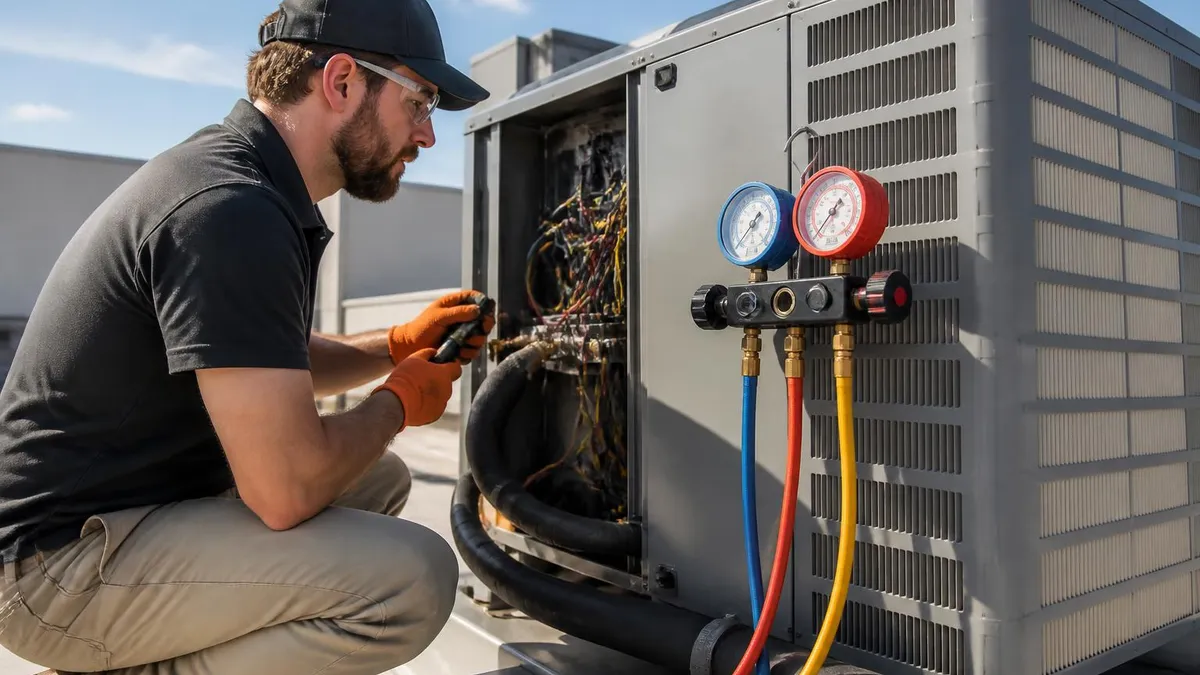
Many purpose-built grow room HVAC units use R-410A or newer A2L refrigerants like R-32 that have specific charge limits in occupied spaces. ASHRAE 15 and IMC code restrict refrigerant quantities based on room volume. Always verify code compliance during design — facilities with large charge quantities may require leak detection systems, mechanical ventilation, or refrigerant relocation to outdoor condensing units.
Installation and commissioning separate successful grow room HVAC projects from disasters waiting to happen. The first critical step is verifying that the building envelope can actually support a sealed cultivation environment. Cracks around doors, unsealed conduit penetrations, and missing vapor barriers all allow humid interior air to escape into wall cavities where it condenses, feeds mold growth, and damages structural elements. Every penetration must be sealed with appropriate gaskets, mastic, or spray foam.
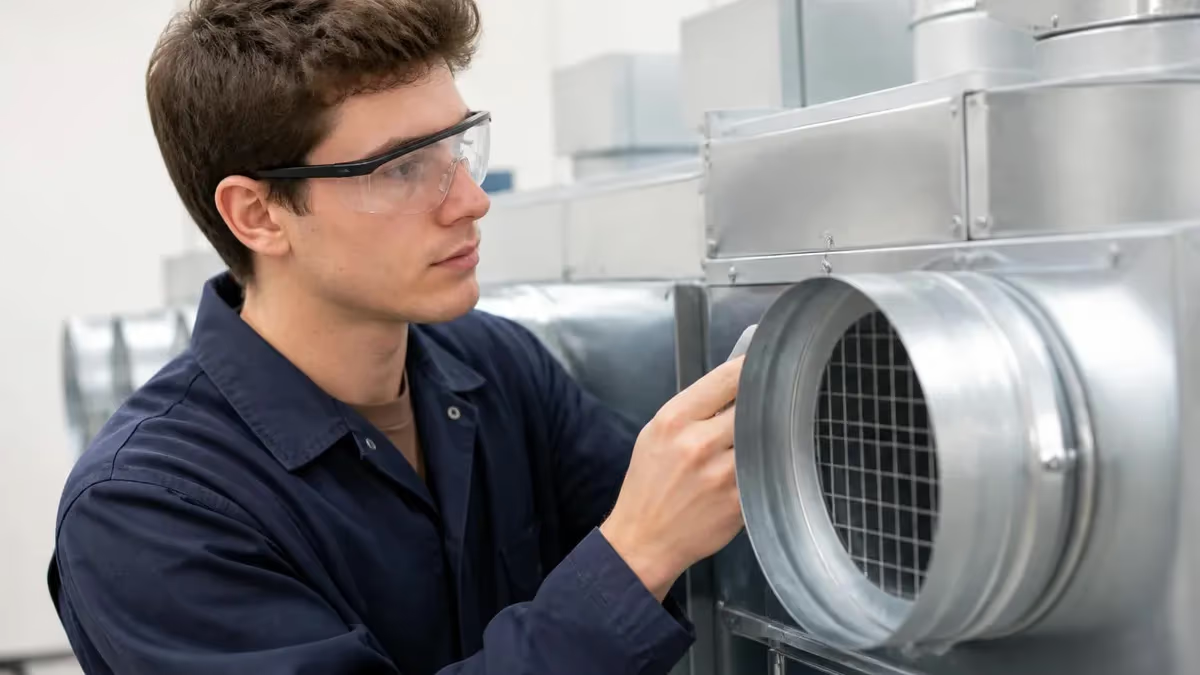
Ductwork design in grow rooms differs from commercial practice because air distribution must be uniform across the canopy without creating cold spots or dry zones. Fabric distribution duct works well in large rooms because it diffuses air across its entire length, eliminating concentrated airflow that desiccates leaves. Rigid metal duct with linear slot diffusers also performs well when properly sized. Round flex duct with random register placement creates uneven conditions and should be avoided.
Air balancing is mandatory but frequently skipped. A balanced system delivers the design CFM to each diffuser, verified with a flow hood and recorded for future reference. Unbalanced systems develop hot corners, humidity pockets, and CO2 stratification that reduce yields by 10-20% without obvious symptoms. Budget for professional balancing during commissioning and rebalance whenever room configuration changes.
Electrical service demands often exceed expectations. A 5,000 square foot flower room with 30 tons of cooling, 60 kilowatts of lighting, dehumidifiers, pumps, and CO2 generators easily draws 400+ amps at 480V three-phase. Many existing buildings need new transformers, switchgear, and service entrances to support a cultivation conversion. Engage an electrical engineer early to identify utility coordination requirements that can add 6-12 months to project timelines. For more on planning installations correctly, see our comprehensive hvac installation leeds guide.
Commissioning should include a full functional test of every operating mode: cooling, heating, dehumidification, defrost, alarm conditions, and integration with lighting and CO2 controls. Document setpoints, observed performance, and any deficiencies for resolution before the room enters production. Skip this step at your peril — discovering a control sequence problem during week 6 of flower with $300,000 of crop on the floor is a career-ending event.
Maintenance contracts deserve serious consideration even though they add 8-12% to annual operating cost. A qualified service technician should inspect coils, change filters, verify refrigerant charge, calibrate sensors, and test alarms quarterly. Grow rooms eat filters and foul coils far faster than hvac equipment parts due to airborne plant material, fertilizer residue, and high airflow rates. A neglected coil loses 25% of its capacity in six months, dragging down VPD control and inviting pathogen pressure.
Document everything: equipment serial numbers, refrigerant types and quantities, control programming, balancing reports, commissioning checklists, and maintenance history. This documentation supports warranty claims, regulatory inspections, facility refinancing, and eventual sale of the operation. Many cultivators who built informally during the gray-market era now struggle to refinance or sell because they cannot demonstrate compliance with mechanical codes or insurance requirements.
Practical operation of grow room HVAC reveals issues that no amount of engineering can anticipate. Start every production cycle with a clean room, clean coils, and clean filters. Pathogens accumulate in HVAC components between cycles and re-introduce themselves to new crops if equipment is not properly sanitized. A bleach-water wipe-down of accessible coils, plus filter replacement, takes two hours and prevents thousands of dollars in downstream losses.
Monitor leaf surface temperature, not just air temperature. Infrared thermometers cost $30 and reveal that leaves under intense lighting can run 5-10°F above ambient air temperature, which shifts true VPD significantly. If your sensors say VPD is 1.3 kPa at the wall but leaf temperature shows 84°F, actual VPD at the plant is closer to 1.8 kPa, which causes stomatal closure and stalls growth. Adjust setpoints based on leaf temperature for genuine optimization.
Track dehumidifier runtime as an early warning indicator. When a dehumidifier that normally runs 60% of the day suddenly runs 90%, something has changed: increased transpiration, equipment degradation, or envelope leaks. Investigate immediately rather than waiting for humidity excursions. Many control platforms log runtime automatically and graph trends over weeks, making anomalies obvious before they cause problems.
Plan for redundancy proportional to your risk tolerance. Commercial facilities should size for N+1 redundancy, meaning enough extra capacity that any single unit can fail without losing temperature control. A 30-ton load served by four 10-ton units provides this protection at modest premium. Single-point-of-failure designs save money initially but generate catastrophic losses when (not if) equipment fails during a critical growth stage.
Energy efficiency improvements compound dramatically across long operating cycles. Upgrading from SEER 14 to SEER 22 equipment reduces electricity consumption by 35-40%, which can save $30,000+ annually in a mid-size facility. LED lighting upgrades reduce sensible cooling load by 30%, often allowing smaller HVAC systems. Heat recovery from condenser water can offset gas consumption for hot water and drying rooms. These investments typically pay back in 2-4 years.
Stay current on local regulations, which are evolving rapidly in cannabis-legal states. Many jurisdictions now require energy benchmarking, refrigerant tracking, odor control through carbon filtration, and certified commissioning. Some utilities offer significant rebates for high-efficiency cultivation equipment that can offset 15-25% of capital costs. Engage local code officials and utility account managers early to capture all available incentives.
Finally, build relationships with manufacturers and service providers before you need them. Knowing the local Quest representative by name and having a service contract in place means a Sunday morning compressor failure gets a response in hours rather than days. Cultivation HVAC is too critical to rely on cold-calling unfamiliar contractors during emergencies. Invest in these relationships during normal operation, and they pay back during the inevitable crisis.
HVAC Questions and Answers
HVAC Solutions: The Complete Guide to Heating, Cooling, and Indoor Air Quality Systems for Homes and Buildings
Certified HVAC Contractors: How to Find, Vet, and Hire the Right Professional for Your Home or Business
Best HVAC Repair in Bandon, OR: Local Services Near Me Guide
HVAC Installations: The Complete Guide to Planning, Pricing, and Getting It Right the First Time