
HVAC Gauges: Manifold Sets, Pressure Reading, and Use 2026 September
HVAC gauges explained: manifold sets, pressure ranges, refrigerant types, digital vs analog, and how to read system pressures correctly. ✏️
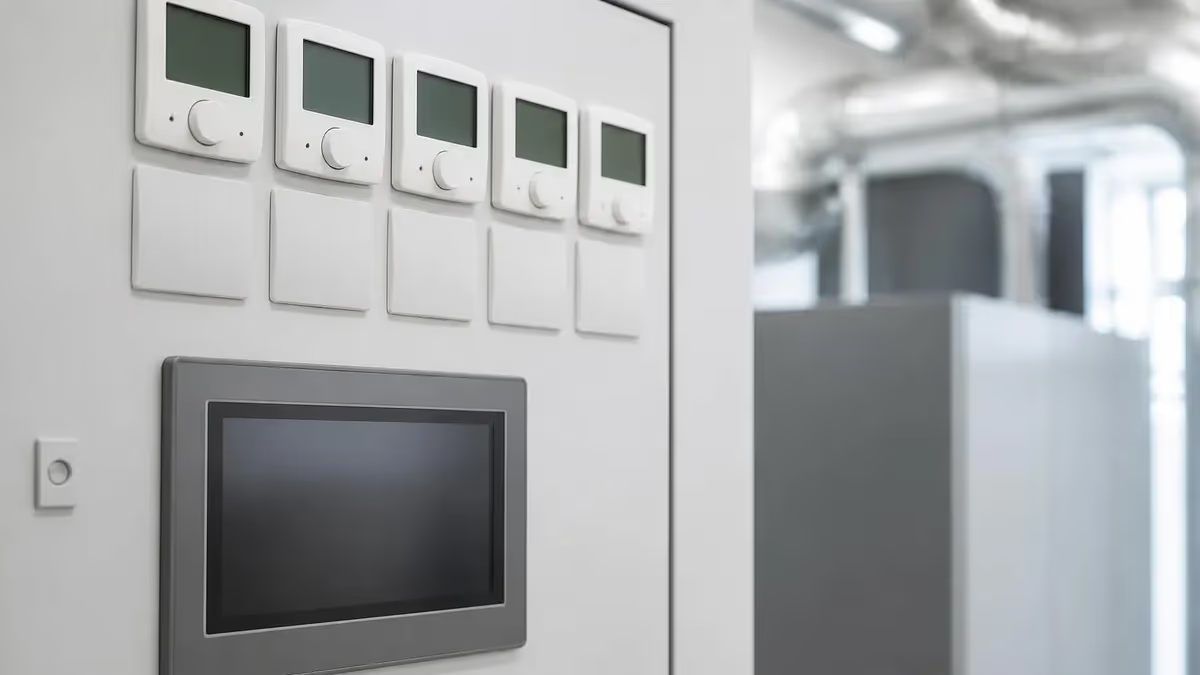
HVAC gauges are essential diagnostic tools for HVAC technicians, providing the pressure measurements needed to evaluate refrigerant systems, diagnose problems, and verify proper operation. The most common configuration is a manifold gauge set — typically two or four gauges mounted on a common manifold with valves and hoses connecting to the system being tested. Through these gauges, technicians read low-side and high-side pressures, calculate superheat and subcooling values, identify refrigerant problems, verify system charge levels, and troubleshoot operational issues. Without accurate gauge readings, HVAC diagnosis becomes guesswork.
The technology of HVAC gauges has evolved substantially over recent decades. Traditional analog manifold gauges with mechanical pressure indicators remain widely used due to durability and reliability, but digital gauges have become increasingly common for their accuracy, ability to display multiple values simultaneously, and integration with smartphone apps for system documentation. Modern technicians often own both types — digital for routine work where convenience matters and analog as backup for situations where digital fails. Understanding how to use both types proficiently distinguishes capable technicians from those limited to one technology.
HVAC Gauges Quick Facts
Manifold types: 2-valve (low and high side) most common, 4-valve (adds vacuum and refrigerant ports) for advanced work. Pressure ranges: Low-side typically 0-250 PSI; high-side 0-500 PSI with retard. Refrigerant scales: Modern gauges have multiple scales for R-22, R-410A, R-32, R-134a, and other common refrigerants. Cost: Basic analog $80-$200; quality digital $300-$800. Hoses: Standard 60 inches with 1/4" SAE fittings.
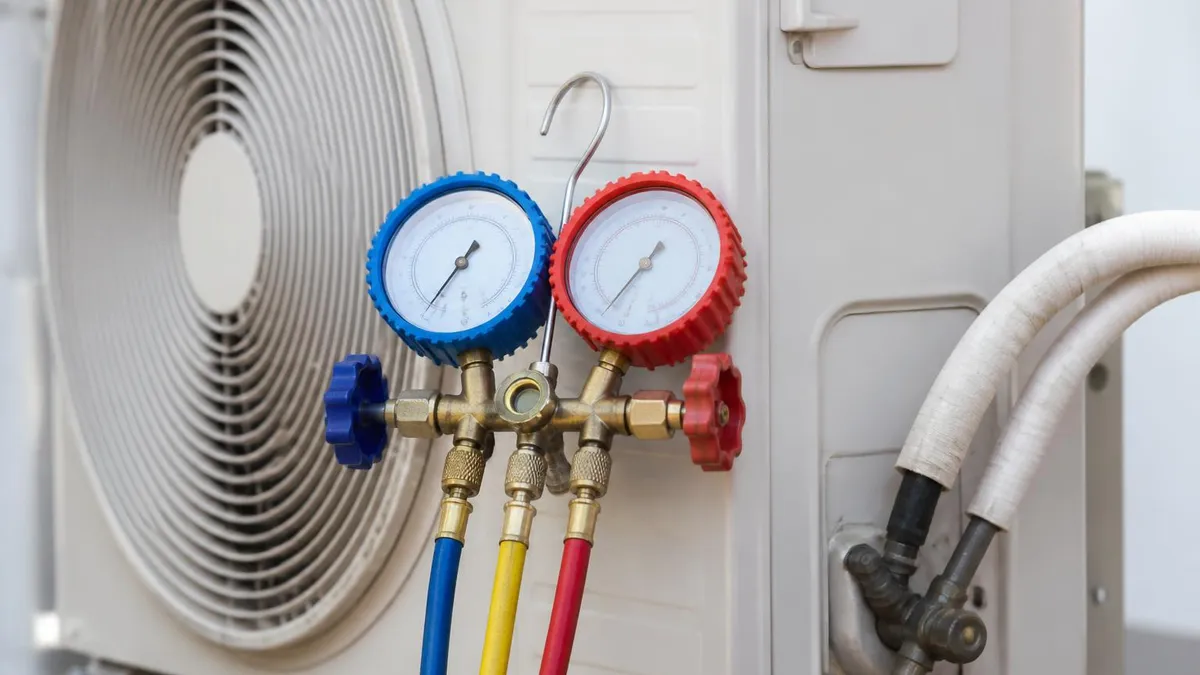
The standard manifold gauge set consists of two gauges mounted on a common metal manifold body. The blue gauge (left side) reads low-side pressure — typically the suction line pressure between the evaporator and compressor. The red gauge (right side) reads high-side pressure — typically the discharge line pressure between the compressor and condenser. The yellow center hose connects to refrigerant cylinders, vacuum pumps, or recovery equipment. Valves on the manifold control whether each gauge port is open or closed to the center connection, allowing controlled flow during charging, recovery, or evacuation operations.

HVAC Gauge Components
Reads suction pressure typically 0-250 PSI with vacuum scale below zero. Color-coded blue throughout HVAC industry.
Reads discharge pressure typically 0-500 PSI with retard mechanism preventing damage from overpressure. Color-coded red.
Houses gauges and valves, provides common point for connecting hoses and refrigerant equipment. Brass or aluminum construction.
Knobs controlling flow between manifold center and gauge ports. Open during charging/recovery; closed during pressure reading only.
Color-coded refrigerant hoses with check valves preventing refrigerant loss when disconnecting. Typically 60-inch length.
Modern gauges show pressure-temperature relationships for multiple common refrigerants on inner ring scales.
Multi-scale gauges show pressure-temperature relationships for common refrigerants directly on the gauge face. The inner colored rings correspond to specific refrigerants — typically R-22, R-410A, R-134a, and others depending on gauge manufacturer. To use these scales, read your pressure on the outer black scale (psi), then look at the corresponding refrigerant scale to see the saturation temperature. This conversion is essential for calculating superheat and subcooling. Modern systems use various refrigerants — your gauges must include the scale for whatever refrigerant you're working with. Older gauges showing only R-22 scales aren't useful for newer R-410A or R-32 systems.
Reading low-side pressure provides information about evaporator operation and overall system charge. Low pressure correlates with evaporator temperature through the saturation pressure-temperature relationship of the specific refrigerant. Properly operating systems show low-side pressures within expected ranges based on indoor and outdoor conditions. Pressures below expected range often indicate undercharge, restricted refrigerant flow (TXV problems, plugged filter-driers, kinked lines), low airflow across evaporator, or compressor issues. Pressures above expected range often indicate overcharge, high indoor heat load, or condenser problems affecting overall system operation.
High-side pressure reflects condenser operation and overall system performance. Saturation temperature corresponding to high-side pressure should be approximately 25-30°F above outdoor ambient temperature for properly operating air-cooled condensers. Higher than expected high-side pressure indicates overcharge, dirty condenser coil, condenser fan problems, restricted condenser airflow, or non-condensable gases (air) in the system. Lower than expected high-side pressure indicates undercharge, low refrigerant supply to condenser, or compressor problems. Combined low-side and high-side readings provide much more diagnostic information than either reading alone.
Proper connection procedure: Verify gauges are zeroed (atmospheric pressure shows 0 PSI). Confirm system valves are closed. Connect blue hose to system suction service port (low side). Connect red hose to discharge service port (high side). Connect yellow hose to refrigerant tank or other equipment as needed. Open valve on service ports. Manifold gauge valves remain closed for pure pressure reading; open only when transferring refrigerant. Disconnect in reverse order to minimize refrigerant loss.
Digital gauges offer several advantages over traditional analog gauges. Digital displays show pressures with greater precision than analog gauge needles. Multiple values can be displayed simultaneously — pressure, calculated saturation temperature, calculated superheat, calculated subcooling, ambient temperature. Built-in databases store properties for many refrigerant types. Some digital gauges include data logging that records pressures over time, useful for diagnosing intermittent problems. Smartphone connectivity allows transmission of data for documentation and analysis. The disadvantages include higher cost, dependence on batteries, more vulnerable to physical damage than analog gauges, and learning curve for technicians transitioning from analog.
Pressure-temperature charts are essential reference for HVAC technicians, particularly those still using basic analog gauges without multi-refrigerant scales. The chart shows saturation temperature for each pressure value across multiple refrigerants. Looking up your gauge reading on the chart gives the saturation temperature needed for superheat and subcooling calculations. Many technicians keep laminated PT chart cards in their service vehicles for quick reference. Smartphone apps now provide same information with calculated values, but PT charts remain useful particularly when working in areas without cellular signal or where dropping the phone could be costly.
Refrigerant identification is crucial because different refrigerants have completely different operating pressures. R-22 systems operate at fundamentally different pressures than R-410A systems at the same temperatures. R-32 differs from both. R-134a has its own pressure-temperature relationship. Connecting gauges and reading pressures without knowing which refrigerant is in the system leads to incorrect interpretation. The system data plate identifies original refrigerant; service work history may reveal whether retrofits to alternative refrigerants have occurred. When uncertain, refrigerant identifier instruments verify what's actually in the system before making service decisions.
Don't connect gauges without knowing the refrigerant — pressures vary dramatically between refrigerants. Don't leave gauges connected longer than necessary — each connection releases small amount of refrigerant. Don't rely on gauges alone for charge determination — superheat/subcooling calculations needed for accurate charge. Don't ignore zero calibration — gauges drift over time and need verification at atmospheric pressure. Don't use one set of gauges for multiple refrigerants without proper purging.
Cross-contamination between refrigerants is a real concern when using gauges across multiple system types. Residual refrigerant remaining in hoses after disconnecting can contaminate the next system. EPA regulations and best practices require purging hoses between different refrigerant types — connecting hoses to recovery equipment to remove residual refrigerant before connecting to a different refrigerant system. Some technicians dedicate separate gauge sets for each common refrigerant type to eliminate contamination risk. The cost of additional gauge sets is modest compared to potential damage from refrigerant cross-contamination affecting system operation.
Calibration verification ensures gauge accuracy over time. Both digital and analog gauges drift in calibration through use, exposure to extreme temperatures, and physical impacts. Periodic verification involves opening all hoses to atmosphere — gauges should read 0 PSI at sea level (slightly less at higher elevations). Gauges with significant deviation from zero require adjustment or replacement. Many quality gauges have calibration screws allowing adjustment; cheap gauges may not be adjustable, becoming throwaways when calibration drifts excessively. Document calibration check dates to establish maintenance pattern.
Hose maintenance affects gauge system performance. Standard refrigerant hoses use rubber compound that hardens and cracks over years of use. Cracked hoses leak refrigerant during connection and disconnection, costing both refrigerant and accuracy. Hoses with worn fittings produce unreliable seals. Quality hose check valves prevent refrigerant loss during disconnection — degraded check valves vent refrigerant uncontrollably. Replace hoses when they show signs of wear: cracks, swelling, hardness, leaking fittings, slow check valve operation. Annual inspection of all hoses identifies replacement needs.
Selecting HVAC Gauges
- ✓Choose multi-refrigerant scales matching refrigerants you'll work with
- ✓Verify pressure ranges adequate for high-pressure refrigerants (R-410A, R-32)
- ✓Consider analog vs digital based on work patterns and budget
- ✓Choose 4-port over 2-port if doing complex charging or evacuation
- ✓Verify hose condition and connection quality
- ✓Plan for accuracy verification at zero pressure
- ✓Consider weight and durability for field use
- ✓Check warranty coverage for digital gauges
Beyond manifold gauges, HVAC technicians use several other pressure-related instruments. Vacuum gauges (micron gauges) measure deep vacuum during evacuation, with much greater precision than manifold gauge vacuum scales. Quality micron gauges read down to 50 microns or below, essential for proper system evacuation before charging. Static pressure gauges measure airflow-related pressures in duct systems, typically 0-10 inches water column range. Combustion analyzers measure flue gas pressures and composition for furnace work. Electronic refrigerant leak detectors find leaks too small for soap-bubble testing. Each instrument addresses specific diagnostic needs that manifold gauges alone cannot.
Brand selection for HVAC gauges affects both initial cost and long-term reliability. Established manufacturers like Yellow Jacket, Robinair, JB Industries, Fieldpiece, and Testo produce quality instruments with good warranties and parts availability. Cheaper brands may save money initially but often fail faster, with limited parts availability for repairs. Professional technicians typically standardize on quality brands they can trust day after day in field use. The investment difference between premium gauges and economy gauges is modest compared to total tool investment for HVAC work.
Training and certification for refrigerant handling is required by EPA Section 608. All technicians who maintain, service, or dispose of equipment containing refrigerants must hold Section 608 certification. Type I covers small appliances, Type II covers high-pressure systems, Type III covers low-pressure systems, and Universal certifies for all three. The certification exam covers refrigerant properties, recovery procedures, safety, and regulatory requirements. Without Section 608 certification, technicians cannot legally purchase certain refrigerants or perform refrigerant work. Most HVAC programs include Section 608 preparation as standard curriculum.
For HVAC apprentices and students, mastering manifold gauge use is foundational skill development. Begin with study of pressure-temperature relationships for common refrigerants. Practice calculating superheat and subcooling using sample readings before working on actual equipment. Observe experienced technicians using gauges in field service before attempting independent work. Start with simpler diagnostic situations (verify charge on functioning system) before tackling complex troubleshooting. Build a personal collection of gauge experiences over time, documenting unusual readings and what they indicated. Years of field experience develop the diagnostic intuition that distinguishes excellent technicians from those who can only read the gauges without interpreting effectively.
For homeowners curious about HVAC gauges, understanding what they reveal can help interpret technician findings. hvac emergency repair mc lean service technician reports superheat is high, that typically suggests low refrigerant charge. Subcooling low suggests similar issue. High discharge pressure suggests condenser problems or overcharge. Low suction pressure suggests airflow issues across evaporator or undercharge. The gauge readings themselves are technical, but their implications can usually be explained by competent technicians who can communicate findings clearly. If your technician can't explain what the gauges reveal in understandable terms, consider seeking second opinion from someone who can.
The future direction of HVAC pressure measurement involves increasing integration with system controls and diagnostics. Smart HVAC equipment increasingly includes built-in pressure sensors that report through cloud connections, providing continuous monitoring rather than requiring service visits with manual gauges. Manifold gauge use will continue for retrofit work and repairs but new equipment will increasingly be self-monitoring. The technician's role shifts toward interpreting connected equipment data alongside traditional manual measurements. Career-long technicians will likely use both traditional manifold gauges and modern connected diagnostics throughout their working careers as the industry transitions.
HVAC Gauges Quick Numbers
Diagnostic Patterns from Gauge Readings
Suggests undercharge, restriction, low load on evaporator. Check refrigerant level, filter-drier, evaporator airflow.
Suggests overcharge, condenser problems, high indoor load. Check charge, condenser cleanliness, fan operation.
Suggests restriction between condenser and evaporator. Check TXV, capillary tube, filter-drier.
Suggests compressor issues — internal valve damage, piston problems, motor weakness. Compressor often needs replacement.
Low refrigerant feeding evaporator. Could be undercharge, restricted feed, low airflow across evaporator.
Insufficient liquid refrigerant in condenser. Could be undercharge, condenser problems, or refrigerant flow issues.
Career progression in HVAC service work depends substantially on diagnostic skill development with gauges and other instruments. Apprentice-level technicians focus on basic gauge use and routine maintenance under supervision. Journey-level technicians handle most diagnostic work independently, applying years of pattern recognition to identify problems efficiently. Senior service technicians solve unusual problems that stump less experienced techs, often combining gauge readings with other diagnostic information (electrical, controls, mechanical) to identify root causes. Master-level technicians teach others, write technical material, and serve as resources for complex diagnostic situations. Each level requires increasingly refined gauge interpretation skills.
Specialization within HVAC work develops different gauge-related expertise. Residential service technicians work mostly with R-410A systems on smaller equipment; commercial technicians handle larger systems with various refrigerants and more complex configurations. Industrial refrigeration technicians work with ammonia and other industrial refrigerants requiring specialized gauges and procedures. Supermarket refrigeration involves complex parallel-rack systems with unique diagnostic requirements. Cryogenic and ultra-low temperature systems need specialized equipment beyond typical HVAC gauges. Specialization develops focused expertise that commands premium wages and supports interesting career paths beyond general residential HVAC service.
Safety considerations during gauge use protect both technicians and equipment. Refrigerant under pressure is potentially dangerous if released suddenly — high-pressure liquid refrigerant can cause frostbite injuries and pressure injuries on contact with skin. Always wear safety glasses when connecting and disconnecting gauge fittings. Refrigerant vapor displaces oxygen in confined spaces, potentially causing asphyxiation in enclosed equipment rooms. Adequate ventilation is essential when working with substantial refrigerant quantities. R-22 and other older refrigerants pose chronic environmental concerns when released; even legal recovery requires careful handling to minimize losses. Newer hydrofluorocarbon refrigerants have similar handling requirements despite different environmental profiles.
Documentation practices for gauge readings build diagnostic value over time. Recording readings during each service visit creates baseline data for comparing future visits. Pattern recognition across multiple visits reveals gradual changes that single readings would miss. Software systems for HVAC service businesses increasingly include digital reading capture, attaching pressure data to specific equipment service records. Building owners benefit from this documentation when planning equipment replacement, because gradual degradation patterns help predict when equipment will need major work or replacement. Professional technicians and quality service businesses make documentation routine rather than optional.
Common gauge troubleshooting includes addressing equipment problems before assuming system problems. Stuck gauge needles indicate damaged gauges needing replacement. Erratic readings suggest defective gauges or contaminated refrigerant. Apparent zero-pressure readings on connected systems sometimes indicate clogged hoses or shut-off service ports rather than empty systems. Test gauge integrity periodically using known reference systems. Calibrate against known pressures when possible. Replace damaged components promptly. Bad gauge readings produce wrong diagnostic conclusions just as bad medical instruments produce wrong medical diagnoses. Investing in quality gauges and maintaining them properly is essential professional practice.
Beyond manifold gauges, modern HVAC diagnostics increasingly involves multi-meter electrical testing, infrared thermal imaging, smoke testing for duct leakage, and various other diagnostic tools. hvac company local seo services technicians develop competence across all these tools rather than relying on gauges alone. The best diagnoses come from combining multiple diagnostic perspectives — pressure readings plus electrical readings plus thermal observations plus airflow measurements. Technicians limited to gauge readings only often miss problems that other instruments would identify clearly. Career-long professional development in HVAC involves continuous learning about new diagnostic technologies as they emerge in the industry.
Choosing initial gauge investment when entering HVAC career requires balancing multiple factors. Starting with quality basic equipment generally serves better than buying cheap equipment that needs replacement later. Plan for refrigerant types you'll encounter most — R-410A dominates current new installations, R-22 still appears in older equipment, R-32 emerges in newer systems, R-134a in some applications, ammonia and other refrigerants in industrial work.
Hose quality matters as much as gauge quality — quality hoses with reliable check valves preserve refrigerant during disconnection. Get advice from experienced technicians at your training program or workplace before making major tool purchases. Investing in quality essentials and adding specialty tools as career develops works better than buying everything at once with budget constraints reducing quality.
Analog vs Digital HVAC Gauges
- +Analog: Durable, no batteries, lifetime use with care
- +Analog: Lower cost, easy entry into HVAC tools
- +Analog: Reliable in extreme conditions
- +Digital: Multiple displays simultaneously
- +Digital: Precise readings and calculated values
- +Digital: Smartphone connectivity and data logging
- −Analog: Calibration drift over time
- −Analog: Single value display per gauge
- −Analog: Manual calculations required for superheat/subcooling
- −Digital: Higher cost, especially quality units
- −Digital: Battery dependence
- −Digital: More vulnerable to physical damage
HVAC Questions and Answers
About the Author

NATE Certified HVAC Technician & Licensing Exam Trainer
Universal Technical InstituteMike Johnson is a NATE-certified HVAC technician and EPA 608 universal-certified refrigerant handler with a Bachelor of Science in HVAC/R Technology. He has 19 years of commercial and residential HVAC installation and service experience and specializes in preparing technicians for NATE certification, EPA 608, A2L refrigerant safety, and state HVAC contractor licensing examinations.