
Home Inspector Requirements: Complete 2026 October Guide to Licensing, Certification, Training Hours & State-by-State Rules
Home inspector requirements explained: training hours, certification, exam, insurance, and state-by-state licensing rules for 2026 October. 💯
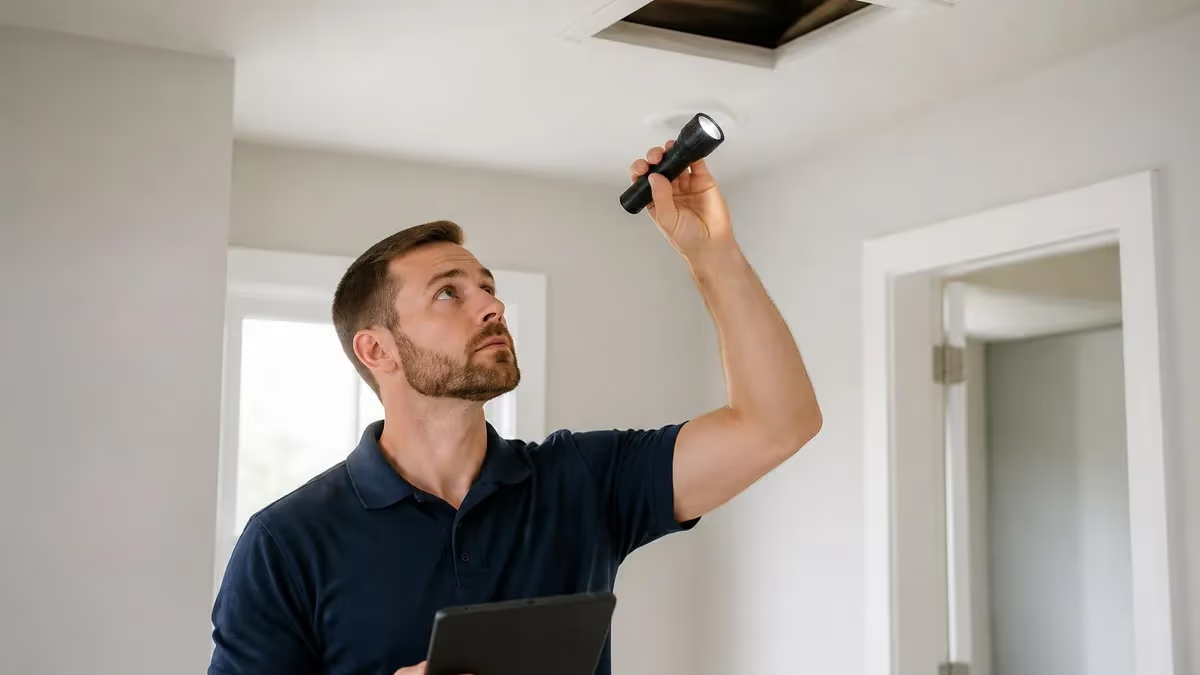
Understanding home inspector requirements is the first step toward building a successful, legally compliant inspection career in the United States. Whether you are searching online for home inspectors near me to study with, or you are seriously planning a career switch into property inspection, the rules vary widely from state to state. Some states demand 80 classroom hours plus 40 ride-along inspections, while others have no licensing requirement at all. Knowing what applies to your specific location saves time, money, and headaches.
In 2026, more than 32 states require some form of license or registration to legally perform paid home inspections. The remaining states either rely on voluntary certification through national bodies like InterNACHI or ASHI, or they enforce general business and consumer-protection statutes. Even in unregulated states, lenders, real estate brokers, and insurance carriers usually demand proof of training and liability coverage before recommending an inspector to their clients.
The typical baseline includes a high school diploma, 60 to 140 hours of approved coursework, passage of the National Home Inspector Examination, a background check, and proof of errors-and-omissions insurance. Costs to enter the field range from $1,800 to $5,500 depending on your state, school, and equipment choices. Most candidates complete the entire process in three to six months when studying part time around another job.
Beyond the legal minimums, market expectations have risen sharply. Buyers reading reviews compare credentials, photo-rich reports, drone capabilities, and turnaround time. A new inspector who only meets the bare regulatory floor will struggle against established firms that hold multiple specialty certifications in radon, mold, sewer scope, and thermal imaging. Building credibility from day one means stacking endorsements thoughtfully, not just checking the licensing box.
This guide breaks down every category of requirement: education, examination, fieldwork, insurance, continuing education, and ethics. We pull data from state regulatory boards, the Examination Board of Professional Home Inspectors, ASHI, InterNACHI, and salary surveys conducted in 2025. You will see exactly how long training takes, what the National Home Inspector Examination covers, how much licensing fees run, and how all of it connects to real earning potential in your region.
If you are already certified and looking to expand into a new state, pay close attention to reciprocity rules. Some states accept ASHI or InterNACHI membership in lieu of state coursework, while others require you to repeat training from scratch. Texas, Illinois, and North Carolina, for example, each have unique pre-license curricula that out-of-state inspectors must complete even if they have ten years of experience elsewhere.
By the end of this article you will know precisely which boxes to tick, in what order, and how to budget for them. You will also see how requirements connect to long-term earning power, business structure, and risk management decisions that affect your inspection company for years.
Home Inspector Requirements by the Numbers

Home Inspector Licensing Path & Timeline
Research State Rules
Complete Approved Coursework
Perform Ride-Along Inspections
Pass the NHIE
Submit License Application
Launch & Maintain License
Education sits at the heart of every state's home inspector requirements. The number of mandatory classroom hours ranges from 60 in Wisconsin to 134 in North Carolina and 140 in Washington, with most states landing between 80 and 120 hours. Coursework must come from a state-approved provider; self-study from a borrowed textbook does not count toward the hour requirement, even if the content is identical to an approved curriculum. Always verify your school appears on the official board roster before paying tuition.
Core subjects you will study include structural components, exterior systems, roofing, plumbing, electrical, heating, cooling, insulation, interiors, fireplaces, and built-in appliances. Programs also teach the Standards of Practice published by ASHI or InterNACHI, ethical conduct, report writing, client communication, and basic business operations. Curriculum quality varies enormously, so review the syllabus, instructor bios, and student outcomes before committing. The cheapest option rarely produces the highest first-time NHIE pass rate.
Hands-on training matters as much as theory. Many regulators now require a set number of mock inspections under supervision before you can sit for the licensing exam. North Carolina mandates 80 supervised inspections; Illinois requires a 60-hour pre-license course plus a parallel inspection module. New inspectors who skip ride-alongs almost always struggle with attic access, roof walking, electrical panel identification, and the time pressure of a real client walkthrough lasting two to three hours.
Several national associations offer training that meets or exceeds state minimums. InterNACHI provides free online coursework to dues-paying members and is recognized in most regulated states. ASHI partners with regional schools and emphasizes ethics and mentorship. The American Home Inspectors Training Institute and Kaplan also operate accredited programs nationwide. When comparing schools, weigh job-placement support, exam prep quality, software access, and the strength of the alumni network for finding mentors.
If you are curious about real income outcomes before investing in school, our breakdown of how much do home inspectors make covers regional pay differences, franchise versus independent earnings, and the impact of ancillary services. Pairing salary research with training research helps you choose a school whose tuition can be recouped within twelve months of full-time inspection work.
Online versus in-person training is the single biggest decision after picking a school. Online programs are typically 25 to 40 percent cheaper, self-paced, and accessible nights and weekends. In-person programs run two to four intensive weeks and include hands-on lab time with electrical panels, plumbing risers, and roofing mockups. A growing number of providers offer hybrid models that combine online lectures with one weekend of physical lab time, which produces strong NHIE pass rates without the full cost of a residential program.
Whichever format you pick, treat the 60 to 140 required hours as a floor, not a ceiling. The strongest new inspectors invest an additional 40 to 80 hours studying state-specific Standards of Practice, NHIE practice questions, sample reports from established firms, and YouTube channels run by experienced inspectors. This extra study converts a passable license into the foundation of a profitable business.
Home Inspector Practice Test Questions
Prepare for the Home Inspector Test exam with our free practice test modules. Each quiz covers key topics to help you pass on your first try.
Home Inspector MCQ
Home Inspector Exam Questions covering MCQ. Master Home Inspector Test concepts for certification prep.
Home Inspector Test
Free Home Inspector Practice Test featuring Test. Improve your Home Inspector Exam score with mock test prep.
Home Inspector Trivia
Home Inspector Mock Exam on Trivia. Home Inspector Study Guide questions to pass on your first try.
Home Inspector Home Online Inspector Test
Home Inspector Test Prep for Home Online Inspector Test. Practice Home Inspector Quiz questions and boost your score.
Home Inspector Top Rated Home Inspector
Home Inspector Questions and Answers on Top Rated Home Inspector. Free Home Inspector practice for exam readiness.
Home Inspector Ultimate Home Inspector
Home Inspector Mock Test covering Ultimate Home Inspector. Online Home Inspector Test practice with instant feedback.
Home Inspector Electrical System Safety Ha...
Free Home Inspector Quiz on Electrical System Safety Hazards. Home Inspector Exam prep questions with detailed explanations.
Home Inspector Forced-Air Furnace Inspection
Home Inspector Practice Questions for Forced-Air Furnace Inspection. Build confidence for your Home Inspector certification exam.
Home Inspector Plumbing DWV Systems
Home Inspector Test Online for Plumbing DWV Systems. Free practice with instant results and feedback.
Home Inspector Roofing Systems and Materials
Home Inspector Study Material on Roofing Systems and Materials. Prepare effectively with real exam-style questions.
Home Inspector Structural Framing Defects
Free Home Inspector Test covering Structural Framing Defects. Practice and track your Home Inspector exam readiness.
How to Become a Home Inspector: Exam, Insurance & Fieldwork
The National Home Inspector Examination is the single most common licensing test, accepted by more than 25 regulated states and many voluntary certifying bodies. It contains 200 multiple-choice questions, 175 scored and 25 pilot items, delivered through PSI testing centers across the country. Candidates have four hours to complete the exam and pay a registration fee of approximately $225. A scaled score of 500 out of 800 is required to pass.
Content is divided into property and building inspection, analysis of findings and reporting, and professional responsibilities. Most candidates study for eight to twelve weeks using practice questions, flashcards, and proctored mock exams. The first-time pass rate hovers around 54 percent, which is why dedicated prep is essential. Pairing structured study with the practical fieldwork detailed in your course produces the highest scores on test day.

Is Becoming a Home Inspector Worth the Requirements?
- +Median salary above $64,000 with top earners exceeding $130,000 in metro markets
- +Low startup cost compared to most licensed trades and professions
- +Schedule flexibility once you own your inspection business
- +Strong demand tied to real estate transactions in nearly every region
- +Clear path from licensing to ancillary revenue like radon, mold, and sewer scope
- +Recession-resilient because lenders require inspections on most purchases
- +Opportunity to specialize in commercial, new construction, or warranty inspections
- −Heavy physical demands including roof walking, attic crawling, and electrical access
- −Liability exposure even with strong E&O coverage and tight standards of practice
- −Income depends on real estate transaction volume which fluctuates with rates
- −Saturated markets in some metros create downward pressure on inspection fees
- −Weekend, evening, and rush turnaround requests are common from agents and buyers
- −Continuing education and license renewal fees recur every one to two years
Pros and Cons at a Glance
| Pros | Cons |
|---|---|
| Low startup cost compared to most licensed trades and professions | Heavy physical demands including roof walking, attic crawling, and electrical access |
| Schedule flexibility once you own your inspection business | Liability exposure even with strong E&O coverage and tight standards of practice |
| Strong demand tied to real estate transactions in nearly every region | Income depends on real estate transaction volume which fluctuates with rates |
| Clear path from licensing to ancillary revenue like radon, mold, and sewer scope | Saturated markets in some metros create downward pressure on inspection fees |
| Recession-resilient because lenders require inspections on most purchases | Weekend, evening, and rush turnaround requests are common from agents and buyers |
| Opportunity to specialize in commercial, new construction, or warranty inspections | Continuing education and license renewal fees recur every one to two years |
Pre-License Home Inspector Requirements Checklist
- ✓Confirm you are at least 18 and hold a high school diploma or GED.
- ✓Verify your state's exact licensing or registration requirements with the regulatory board.
- ✓Enroll in a state-approved pre-license course of at least 60 to 140 hours.
- ✓Complete required supervised ride-along or mock inspections with documentation.
- ✓Register and study 80 to 120 hours for the National Home Inspector Examination.
- ✓Pass the NHIE with a scaled score of 500 or higher and request transcripts.
- ✓Purchase E&O insurance with at least $300,000 in coverage from a reputable carrier.
- ✓Secure general liability insurance and confirm coverage of all ancillary services.
- ✓Submit fingerprints and background check through your state's approved vendor.
- ✓File your application, license fee, and supporting documents with the state board.
- ✓Form an LLC, obtain an EIN, and open a dedicated business bank account.
- ✓Join InterNACHI or ASHI to access free training, marketing tools, and mentorship.
Stack one ancillary service before launch day
Adding a single ancillary inspection — radon, sewer scope, or thermal imaging — raises your average ticket by 25 to 60 percent without adding much time on site. New inspectors who launch with radon certification and a continuous radon monitor report higher first-year revenue than peers who only offer the base inspection. Pick the ancillary that matches local buyer demand and bake it into every package.
Costs and earning potential are deeply tied to home inspector requirements. The total entry investment for a new inspector in 2026 typically falls between $3,500 and $7,500. That includes pre-license tuition of $700 to $1,800, NHIE registration of about $225, state license fees of $100 to $400, insurance premiums of $1,500 to $2,800 in the first year, tools and software of $1,200 to $2,500, and business setup costs of $300 to $800. Compared to other licensed careers, the ramp is fast and affordable.
Salary varies dramatically by region, business model, and service mix. The Bureau of Labor Statistics reports a median annual wage near $64,820 for construction and building inspectors, but home inspectors who own their firms and run two to three inspections per day can clear $120,000 to $180,000 in active markets. Salaried inspectors working for large multi-inspector franchises typically earn $52,000 to $78,000 plus performance bonuses tied to volume and customer satisfaction scores.
Geography reshapes both fees and competition. Inspectors in expensive metros like San Francisco, Seattle, and Boston charge $650 to $900 per standard inspection, while rural Midwestern and Southern markets settle around $325 to $475. If you are studying chicago area home inspectors as a benchmark, expect fees in the $425 to $575 range for a typical 2,000 square-foot home, with new construction phase inspections priced slightly higher because they require multiple visits during framing, pre-drywall, and final stages.
Ancillary services dramatically boost revenue per stop. Radon testing adds $150 to $250, sewer scope adds $200 to $325, mold sampling adds $200 to $450, and thermal imaging adds $100 to $250. Stacking two ancillaries onto every base inspection routinely lifts gross revenue by 35 to 60 percent. Successful new inspectors complete ancillary certifications during their first six months and market service bundles aggressively to buyer's agents who want one-stop convenience for clients.
Cash flow timing matters too. Most inspections are paid at the time of service through credit card or online portal, which means revenue arrives within one to three business days. Insurance, software subscriptions, vehicle fuel, continuing education, and marketing are the largest recurring expenses. Plan for roughly $1,200 to $2,200 in monthly fixed costs once your business is operational, then build toward four to six inspections per week as quickly as agent referrals allow.
Tax structure influences take-home pay. Forming an LLC and electing S-corporation status once net income exceeds about $60,000 can save thousands of dollars per year in self-employment taxes. Consult a CPA who has worked with inspection companies. Track every mile, every continuing education dollar, and every piece of equipment for legitimate deductions. A disciplined inspector with strong bookkeeping nets significantly more than a peer with identical gross revenue but messy records.
Finally, do not underestimate brand and review building. The fastest path to higher earnings is a Google Business Profile averaging 4.8 stars or higher with 50 or more reviews. Inspectors who actively ask every client for a review within 24 hours of report delivery accumulate social proof quickly, command premium pricing, and reduce dependence on agent referrals that come with implicit pressure to soften findings.

Several states have suspended licenses for inspectors whose E&O policies lapsed for as little as 48 hours. Set calendar reminders 30 days before renewal and confirm coverage extends to every ancillary service you offer. Mold, radon, and pool inspections are commonly excluded by default and require named endorsements that carriers will only add upon written request.
Meeting the minimum home inspector requirements gets you a license, but long-term success depends on what you build on top of that foundation. The most profitable inspectors in any market share a few common traits: relentless continuing education, deep specialty certifications, polished communication, and consistent referral systems. Treat the licensing process as basic training, then commit to the equivalent of a residency through your first 100 inspections under mentorship and review.
Specialty certifications widen your moat. Certified Master Inspector, ASHI Certified Inspector, and InterNACHI Certified Professional Inspector titles signal competence to buyers and agents. Specific add-ons in radon (NRPP), mold (IAC2), wood-destroying organisms (state pesticide license), thermal imaging (Level I thermography), and sewer scope add billable services and visual proof of expertise. Many inspectors collect three to six credentials in their first three years and feature each one prominently on their website and report cover page.
Report quality is the most underrated differentiator. Software like Spectora, HomeGauge, and Horizon let you build mobile-first, photo-rich reports that buyers and agents can navigate instantly. Compare leading platforms in our review of what do home inspectors look for when choosing reporting software, including pricing tiers, customization, and integration with scheduling tools. A modern report with clear summary, comments, and repair priorities consistently earns more referrals than a 60-page PDF with raw checklists.
Marketing investment pays exponential dividends. Allocate at least 6 to 10 percent of gross revenue toward Google Business Profile optimization, local SEO content, paid search, and agent appreciation events. Inspectors who publish weekly blog posts about common defects, seasonal maintenance, and buyer questions consistently rank higher in local search and pull in direct-to-consumer leads that bypass agent gatekeeping entirely. Direct leads also tend to convert at higher fees because they came in already trusting your expertise.
Customer experience extends beyond the inspection itself. Confirmation calls the day before, on-time arrival, a thorough but plain-language walkthrough at the end, and a same-day or next-day report delivery turn one-time clients into permanent advocates. Buyers who feel respected refer their family, agents, and lender, multiplying the lifetime value of every appointment. A repeat-and-referral business model insulates you from price competition and slow market cycles.
Risk management requires ongoing vigilance. Document every limitation, every inaccessible area, and every recommendation with photos and clear language. Use a pre-inspection agreement that complies with your state laws and reinforces scope. Many lawsuits arise not from missed defects but from miscommunication about what was and was not covered. Strong agreements, complete documentation, and quick follow-up communication prevent the vast majority of claims that would otherwise trigger E&O involvement.
Career longevity ultimately depends on energy management. Inspections are physically demanding: roofs in summer, attics with insulation, crawl spaces with limited clearance, and long days walking properties. Inspectors who exercise, lift carefully, hydrate, and rotate equipment loads sustain 25-plus year careers. Those who burn through five or six inspections a day without recovery often retire early due to injury. Treat your body like the asset it is, and the requirements you met to enter the field will keep paying you for decades.
With the requirements understood and your business plan sketched out, the final stretch is exam prep and launch logistics. Treat the 30 days before your NHIE attempt like a sprint. Block two to three hours per day for focused study, alternate practice questions with full-length mock exams, and review every missed answer with the underlying Standards of Practice section. Most candidates who pass on the first attempt complete at least 1,500 practice questions and three timed mock exams before sitting for the real test.
Build your exam-day toolkit in advance: photo ID, registration confirmation, scratch paper allowance per PSI rules, water bottle, and a snack for after the test. Arrive 45 minutes early to settle nerves, complete check-in, and review last-minute notes in the parking lot. Pace yourself to roughly one minute per question on the first pass, mark uncertain ones, then return for a focused review in the final 30 minutes. Most candidates finish in three hours of the allotted four.
While waiting for your score, complete every license application document you can in parallel. Order fingerprints, request transcripts, secure your insurance binder, finalize your business name, and reserve domain names. The fastest licensed inspectors finalize their application packet within seven days of passing the exam, which means state approval and active license status arrive two to four weeks later. Slow paperwork is the most common reason new inspectors miss their planned launch month.
Equipment purchases should be balanced and intentional. The essentials are a moisture meter, voltage tester, GFCI tester, gas leak detector, telescoping ladder, flashlight, dust mask, and inspection software subscription. Optional but high-ROI additions include a 4K drone for steep roofs, a thermal camera for moisture detection, and a continuous radon monitor for ancillary revenue. Avoid the temptation to buy every gadget in month one; add equipment as paying clients justify the purchase.
Marketing groundwork begins before your license arrives. Build a clean website with service pages, sample reports, transparent pricing, and a clear booking flow. Claim your Google Business Profile, populate it with photos and service categories, and invite friends and family for honest early reviews of your training and professionalism. Introduce yourself to ten buyer's agents and three lenders in your area; bring a one-page service menu and offer to shadow an inspection so they understand your process.
The first 90 days post-license are the most important sales runway you will ever have. Target one inspection per week in month one, two per week in month two, and four per week by month three. Track every lead source, every conversion, and every review request in a simple spreadsheet. Adjust marketing spend toward the channels that produce paying clients and away from those that only produce browsers. Discipline in this period sets the trajectory for years.
Finally, remember that home inspector requirements are not a one-time checkbox. Continuing education hours, license renewal fees, insurance updates, and software refreshes recur on annual cycles. Build a compliance calendar with quarterly reviews of every credential, policy, and contract. Inspectors who maintain careful compliance avoid surprise fines, license lapses, and insurance gaps, freeing them to focus on delivering excellent inspections and building the business they envisioned when they first started studying.
Sample Home Inspector Test Practice Questions
Try these questions from our free Home Inspector Test practice tests. The correct answer and an explanation follow each question.
During an inspection of a home built in 1968, a home inspector identifies solid strand aluminum branch circuit wiring. Which of the following represents the MOST significant hazard associated with this type of wiring?
- A. It is incompatible with modern high-amperage appliances.
- B. The wiring is prone to breaking during installation.
- C. Connections can loosen over time, leading to overheating and arcing.
- D. Aluminum wiring emits a gas that can degrade insulation.
Answer: C. Connections can loosen over time, leading to overheating and arcing.
Solid strand aluminum wiring has a higher coefficient of thermal expansion than copper. This property, known as "cold creep," causes the wire to expand and contract more with temperature changes. Over time, this can lead to loose connections at terminals (outlets, switches, breakers), which increases resistance, causes overheating, and creates a serious fire hazard from arcing.
When inspecting an older home, a home inspector observes that the floor joists rest directly on the foundation sill plate but no metal anchor bolts are visible at the sill. What hazard does this present?
- A. The floor and wall framing can slide or lift off the foundation during high winds or seismic events
- B. Lack of anchor bolts causes moisture to wick into the sill plate
- C. Without anchor bolts, floor joists will sag prematurely due to settlement
- D. Anchor bolts are only required in seismic zones and are cosmetic elsewhere
Answer: A. The floor and wall framing can slide or lift off the foundation during high winds or seismic events
Anchor bolts connect the sill plate to the foundation, preventing the entire structure from sliding or lifting off during lateral forces such as wind or earthquakes.
When inspecting a home built in the 1960s, a home inspector finds that the roof is framed with rafters but there are no collar ties or ridge beam — only a non-structural ridge board. What is the likely consequence over time?
- A. Without collar ties, outward thrust causes the walls to spread and the ridge to sag
- B. The absence of collar ties only affects the roof's ability to resist snow loads
- C. Ridge boards alone are sufficient to carry all rafter loads without collar ties
- D. Non-structural ridge boards are acceptable in warm climates with no snow
Answer: A. Without collar ties, outward thrust causes the walls to spread and the ridge to sag
Without collar ties to resist horizontal thrust, rafter loads push the top of the walls outward, allowing the ridge to drop over time.
When inspecting a gas furnace, which finding would be MOST concerning to a home inspector?
- A. Slightly dusty air filter
- B. Cracks in the heat exchanger
- C. Noisy blower motor
- D. Thermostat set to 68°F
Answer: B. Cracks in the heat exchanger
A cracked heat exchanger can allow combustion gases including carbon monoxide to enter the living space, posing a serious health risk.
Home Inspector Questions and Answers
Certified Home Inspector: Complete Guide to Training, Certification, Salary & Career Path in 2026
Local Home Inspectors: Complete Guide to Finding, Hiring, and Working With Trusted Inspection Pros Near You
National Home Inspector Exam: Complete 2026 Study Guide, Pass Rates, Cost & Certification Prep
Home Inspector Pro Review 2026: Pricing, Features & Top Alternatives
Free National Home Inspector Questions and Answers
About the Author

Licensed Real Estate Broker & Licensing Exam Specialist
University of Wisconsin School of BusinessSandra Taylor is a Graduate Realtor Institute (GRI) and Accredited Buyer's Representative (ABR) designee with an MBA in Real Estate from the University of Wisconsin School of Business. She has 18 years of residential and commercial real estate brokerage experience and coaches real estate license candidates through state salesperson and broker pre-license examinations across multiple states.