
Hard Geometry Questions: Complete Study Guide with Geometry Formulas, Lessons & Free Practice Tests
Master hard geometry questions with key geometry formulas, geometry lessons, and free practice tests. Study smarter today! 🏆

Hard geometry questions separate students who truly understand geometry formulas from those who have only memorized surface-level rules. Whether you are preparing for the SAT, ACT, state standardized tests, or a high-school final exam, tackling the most challenging geometry problems requires a layered strategy: you need solid foundational knowledge, the ability to visualize abstract shapes, and the discipline to work through multi-step proofs without losing your place. This guide is built specifically for students who want to move beyond basic practice and conquer the hardest problems the subject can throw at them.
Geometry as a discipline covers far more ground than many students expect. You will encounter everything from the properties of parallel lines cut by a transversal to calculating the surface area of composite three-dimensional solids. Molecular geometry, which describes the spatial arrangement of atoms in molecules, even shares conceptual DNA with the bond angles and coordinate geometry you study in math class. Understanding these connections helps you see geometry not as an isolated set of rules but as a framework for describing the physical world around you.
Many test-takers discover their weakest area only when they sit down for a timed exam. Hard geometry questions are specifically designed to combine multiple concepts in one problem — for example, a single question might require you to apply the Pythagorean theorem, recognize a 30-60-90 triangle, and then use a circle's arc-length formula all at once. Practicing these compound problems before test day is the single most effective way to boost your score quickly and reliably.
Geometry lessons have evolved significantly in recent years. Digital tools, interactive simulations, and even games that echo the precision of geometry — such as the rhythm-based platformer geometry dash unblocked, which demands spatial awareness and split-second timing — have made geometric thinking more accessible and engaging than ever. While game-based learning is not a substitute for rigorous study, it reinforces the spatial reasoning skills that underlie every hard geometry question you will face.
One of the most underrated study strategies for geometry is drawing every figure yourself rather than relying on diagrams printed in your textbook. When you sketch a diagram from scratch, you are forced to recall properties actively — where the right angle sits, how many degrees are in a polygon's interior angles, whether two triangles are congruent by SAS or ASA. This active recall process dramatically improves long-term retention and helps you catch errors that passive reading never would.
Throughout this guide you will find targeted geometry lessons, curated practice problems organized by difficulty, and step-by-step strategies for the problem types that appear most frequently on high-stakes exams. We cover triangles, circles, coordinate geometry, solid figures, and proofs — each with concrete examples and real numbers so you can see exactly how to approach each category. By the end, you will have a personalized study plan and the confidence to tackle even the most intimidating hard geometry questions on any test you face.
The geometry spot you want to reach is mastery — not just familiarity. Mastery means you can solve a problem you have never seen before by breaking it into parts you recognize. That level of skill does not come from reading alone; it comes from deliberate, structured practice with progressively harder problems. Let this guide be your roadmap to that destination, starting right now with the key numbers and benchmarks that define geometry achievement in the United States.
Hard Geometry Questions by the Numbers

Types of Hard Geometry Problems You Will Encounter
These questions combine the Pythagorean theorem, special right triangles (30-60-90 and 45-45-90), triangle similarity, and area formulas in a single problem. You must identify which relationship applies before you can begin calculating.
Inscribed angles, central angles, arc length, sector area, and chord relationships appear frequently on hard exams. Problems often embed circles inside polygons or vice versa, requiring you to switch between multiple formula sets.
Finding midpoints, slopes, distances, and equations of circles or lines on the coordinate plane — then using those results to prove geometric relationships — demands algebraic fluency alongside geometric intuition.
Surface area and volume of prisms, pyramids, cylinders, cones, and spheres become dramatically harder when shapes are combined or when a cross-section must be analyzed — a skill that bridges math and molecular geometry thinking.
Two-column and paragraph proofs test logical reasoning and your command of postulates, theorems, and definitions. Hard proof problems require you to plan several steps ahead before writing a single line of justification.
Mastering the essential geometry formulas is the foundation upon which every hard problem rests. Without instant recall of area, perimeter, volume, and angle-relationship formulas, you will spend precious exam minutes re-deriving things you should already know — leaving you no time to think through the conceptually difficult parts of the problem. The goal is not merely to have formulas on a reference sheet; it is to internalize them so deeply that they become second nature when you are working under pressure.
Triangle formulas are the workhorses of geometry. The area of any triangle is one-half base times height, but hard questions rarely give you the height directly. Instead, you must use trigonometry (area = ½ab·sin C), Heron's formula when all three sides are known, or the altitude-on-hypotenuse relationship in right triangles. The law of sines (a/sin A = b/sin B = c/sin C) and the law of cosines (c² = a² + b² − 2ab·cos C) extend your reach to non-right triangles, which appear regularly on college-entrance exams and Advanced Placement geometry assessments.
Circle formulas deserve their own dedicated review session. Circumference equals 2πr, area equals πr². Arc length equals (central angle / 360) × 2πr, and sector area equals (central angle / 360) × πr². When a chord is drawn, the perpendicular from the center bisects it — a fact that unlocks dozens of hard problems involving chords and radii. The power of a point theorem, which relates the products of chord segments or secant segments from an external point, is a formula that separates high scorers from average ones on the most difficult geometry sections.
Polygon formulas scale with the number of sides. The sum of interior angles of any n-sided polygon equals (n − 2) × 180 degrees. Each interior angle of a regular polygon equals that sum divided by n. The number of diagonals in an n-gon equals n(n−3)/2. These formulas appear deceptively simple but generate genuinely hard questions when combined with area partitioning or when the polygon is inscribed in a circle. Knowing them cold lets you pivot quickly rather than reconstructing the formula from scratch mid-problem.
Coordinate geometry formulas bridge algebra and geometry in ways that hard questions exploit relentlessly. The distance formula (d = √((x₂−x₁)² + (y₂−y₁)²)) derives directly from the Pythagorean theorem. The midpoint formula gives ((x₁+x₂)/2, (y₁+y₂)/2). The slope of a line is (y₂−y₁)/(x₂−x₁), and perpendicular lines have slopes that are negative reciprocals of each other. The standard equation of a circle centered at (h, k) with radius r is (x−h)² + (y−k)² = r² — a formula that appears in both SAT problems and AP Calculus BC free-response sections.
Three-dimensional formulas require careful attention to which dimension is which. Volume of a prism = base area × height. Volume of a pyramid = (1/3) × base area × height. Volume of a cylinder = πr²h. Volume of a cone = (1/3)πr²h. Volume of a sphere = (4/3)πr³. Surface area formulas add lateral faces to base areas, and the relationships between nets (unfolded 3-D shapes) and their solid counterparts appear on standardized tests specifically because students who practice geometry dash unblocked-style spatial visualization have a measurable edge over those who only study from flat diagrams.
Proof-based formulas are really theorems: the Triangle Angle Sum theorem, the Exterior Angle theorem, the Isosceles Triangle theorem, the Pythagorean theorem and its converse, the properties of parallelograms, and the theorems about similar triangles (AA, SSS, SAS similarity). Knowing these as provable statements — not just facts — lets you cite them as justifications in formal proofs and use them as logical anchors when working backward from what a problem asks you to find.
Organize your formula review by topic, test yourself with flashcards, and always write the formula before plugging in numbers to build the habit of checking your setup before committing to a calculation path.
Geometry Lessons by Difficulty Level
Foundational geometry lessons establish the vocabulary and axioms that underpin every harder concept. Students learn to classify angles (acute, right, obtuse, straight, reflex), identify parallel and perpendicular lines, calculate perimeter and area of basic polygons, and apply the Pythagorean theorem to right triangles. These lessons also introduce the coordinate plane, basic transformations (translations, rotations, reflections, dilations), and the difference between congruence and similarity — concepts that appear in virtually every subsequent geometry unit.
At this level, geometry lessons should emphasize precision in language and diagram drawing. A student who cannot accurately label a diagram or state what is given versus what must be proven will struggle badly when problems get harder. Spending extra time at the foundational stage — revisiting definitions, practicing construction with compass and straightedge, and verifying answers by substituting back into formulas — pays dividends that compound as problems become more complex. Many students rush through foundational lessons and pay for it later during hard geometry question sets on timed exams.
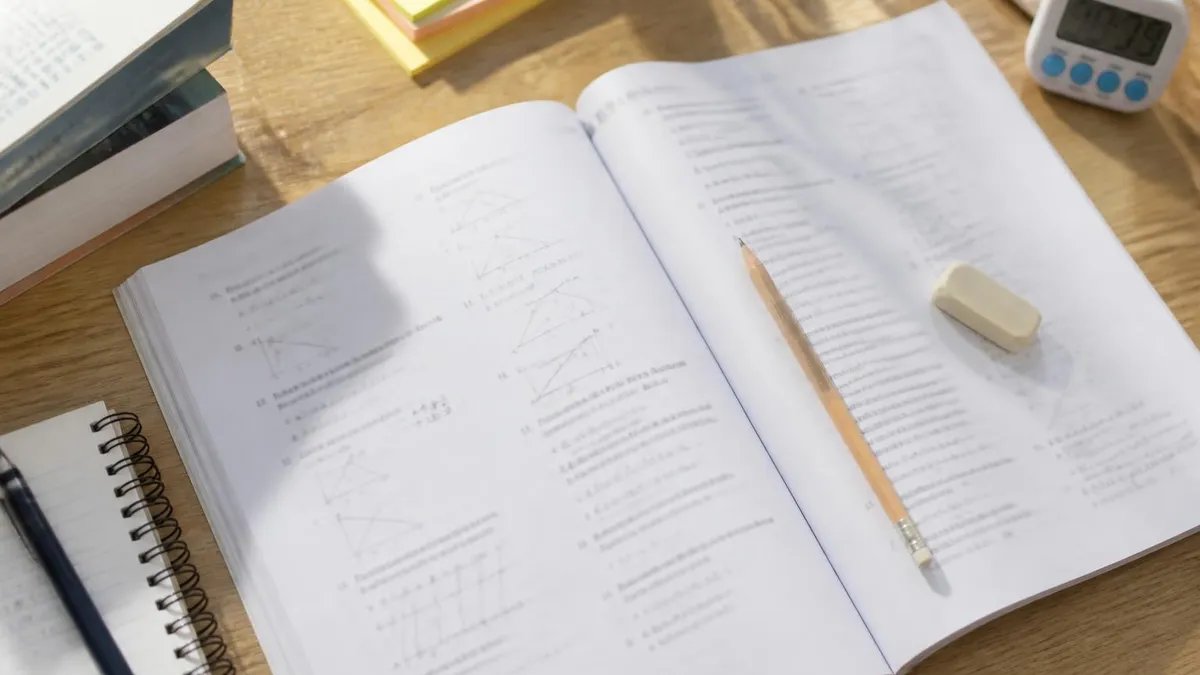
Timed Practice vs. Untimed Practice for Hard Geometry
- +Simulates real exam conditions so test anxiety decreases on the actual day
- +Forces you to develop efficient solution strategies rather than brute-force approaches
- +Reveals which problem types consume too much time before exam day
- +Builds mental stamina for long geometry sections with many hard questions
- +Creates urgency that improves focus and reduces distraction during study sessions
- +Gives you accurate data on your current scoring pace for realistic goal-setting
- −Time pressure can cause careless arithmetic errors that mask true conceptual understanding
- −Students may skip difficult problems rather than working through productive struggle
- −Rushing through hard geometry questions can reinforce bad solution habits
- −Beginners benefit more from untimed mastery practice before adding time constraints
- −Timed practice without review is nearly useless — analysis of errors is essential
- −Overemphasis on speed can discourage deep understanding of geometric proofs and reasoning
Pros and Cons at a Glance
| Pros | Cons |
|---|---|
| Simulates real exam conditions so test anxiety decreases on the actual day | Time pressure can cause careless arithmetic errors that mask true conceptual understanding |
| Forces you to develop efficient solution strategies rather than brute-force approaches | Students may skip difficult problems rather than working through productive struggle |
| Reveals which problem types consume too much time before exam day | Rushing through hard geometry questions can reinforce bad solution habits |
| Builds mental stamina for long geometry sections with many hard questions | Beginners benefit more from untimed mastery practice before adding time constraints |
| Creates urgency that improves focus and reduces distraction during study sessions | Timed practice without review is nearly useless — analysis of errors is essential |
| Gives you accurate data on your current scoring pace for realistic goal-setting | Overemphasis on speed can discourage deep understanding of geometric proofs and reasoning |
Hard Geometry Study Checklist: Are You Ready?
- ✓Memorize all triangle formulas including Heron's formula and the law of cosines.
- ✓Recite the sum of interior angles formula for any n-sided polygon without looking it up.
- ✓Solve at least three circle theorem problems involving inscribed angles and arcs per study session.
- ✓Practice drawing accurate diagrams for every geometry problem before writing any equations.
- ✓Complete one timed geometry proof per week and review every logical step afterward.
- ✓Study coordinate geometry by deriving the distance, midpoint, and slope formulas from scratch.
- ✓Work through at least five composite solid problems combining two or more 3-D shapes.
- ✓Review all triangle congruence and similarity theorems and know when each one applies.
- ✓Attempt five hard geometry questions from a released SAT, ACT, or AMC exam each week.
- ✓After every practice set, write a one-sentence explanation of each mistake you made.
Add an Auxiliary Line When You Feel Stuck
The single most powerful technique on hard geometry questions is drawing an auxiliary line — a line not given in the original figure that creates a new triangle, rectangle, or parallel line pair. Expert test-takers add auxiliary lines instinctively when a problem seems to have too little information. Practice this technique on five problems per week and your ability to solve previously impossible-looking questions will improve dramatically within one month.
Advanced problem-solving strategies for hard geometry questions go beyond formula recall and enter the territory of mathematical thinking. The most successful students approach every difficult problem with a structured mental checklist: What is given? What do I need to find? What geometric relationships connect the given information to the goal? Which formulas or theorems are relevant? Only after answering these questions systematically should you begin writing equations or performing calculations. This disciplined approach prevents the most common error on hard geometry tests — plugging numbers into the wrong formula because you started calculating before fully understanding the problem.
Working backward is a strategy that transforms many seemingly impossible geometry problems into manageable ones. Instead of asking yourself, what can I find from what I'm given, ask instead, what would I need to know to find the answer, and then ask that question again recursively until you reach something you already know.
For example, a problem asking for the area of a shaded region might require the area of a circle minus the area of an inscribed square. If you know the diagonal of the square equals the diameter of the circle, you can find the square's side length, its area, and then subtract. Working backward makes the solution path visible when forward reasoning stalls.
The strategy of assigning variables to unknown quantities and writing equations from geometric relationships is at the heart of coordinate geometry and algebraic geometry problems. When two angles are supplementary and one is described as three times the other, set the smaller angle equal to x, write 3x + x = 180, and solve.
This algebraic thinking is so natural to students who practice it regularly that it becomes invisible — they set up the equation almost automatically and focus their mental energy on the geometric insight that produced it. For students who practice scratch geometry dash, the pattern-recognition skill is transferable: identifying which rule governs the current situation is the same cognitive move in both contexts.
Symmetry is a vastly underutilized strategy on hard geometry questions. When a figure has a line of symmetry, distances, angles, and areas on one side mirror those on the other — cutting your calculation work in half. When a figure has rotational symmetry, you can analyze one section and multiply. Regular polygons, circles, and many composite figures built from identical parts have symmetry properties that hard problem designers embed specifically to reward students who recognize and exploit them. Train yourself to ask, does this figure have symmetry? before diving into any calculation.
Estimation and elimination work powerfully together on multiple-choice geometry questions, even the hardest ones. If a question asks for the area of a triangle and the answer choices are 12, 24, 48, and 96 square units, and your quick mental estimate based on the diagram suggests the answer is between 20 and 30, you can eliminate 12 and 48 and 96 immediately — leaving only one viable choice.
This strategy alone can save you from a calculation error that would otherwise cost you a point. Always sanity-check your numerical answer against the diagram and the scale of the given measurements before bubbling in an answer.
Pattern recognition is a meta-strategy that develops only through volume of practice. After solving several hundred geometry problems, you begin to notice that certain configurations always lead to the same type of calculation. A right triangle inscribed in a semicircle always has the diameter as its hypotenuse — every single time, without exception.
An angle formed by two chords inside a circle always equals half the sum of the intercepted arcs. Recognizing these patterns instantly — the way an experienced chess player recognizes a pin or fork — is what separates students who score in the top 5 percent on geometry sections from those who score in the top 25 percent.
Finally, error analysis is the most underused advanced strategy of all. After every practice set, sit with your incorrect answers and ask three questions: Did I misread the problem? Did I use the wrong formula? Did I make an arithmetic error? Categorizing your errors reveals whether your main problem is comprehension, conceptual knowledge, or careless calculation — and each has a different remedy.
Students who keep an error log and review it before every practice session see dramatically faster improvement than those who simply move on to the next problem set without reflection. Combine all these strategies with the geometry formulas and lessons covered in this guide, and hard geometry questions will become your strongest section rather than your biggest obstacle.

On hard geometry questions, the diagram is not decorative — it contains encoded information about angle relationships, proportionality, and figure type that the text alone does not fully convey. Students who skip redrawing or annotating the diagram consistently make more errors than those who spend 30 seconds marking known angles, labeling sides, and noting right-angle symbols before beginning any calculation. Never treat the figure as optional; treat it as your primary workspace.
Test day preparation for hard geometry questions is as much about mental readiness as it is about content knowledge. By the week before your exam, you should already have completed your geometry formulas review, worked through your weak topic areas, and taken at least two or three full-length timed practice tests under realistic conditions. The final week is not the time to learn new material — it is the time to consolidate, review your error log, and build confidence by doing problems you know you can solve correctly and efficiently.
Sleep and nutrition have a measurable impact on mathematical performance. Research consistently shows that students who sleep seven to nine hours the night before an exam score higher than sleep-deprived peers, even when the well-rested students studied less total time. On a geometry test, where visual-spatial reasoning is critical, the cognitive penalty for fatigue is especially steep. Hard geometry questions require you to hold multiple relationships in working memory simultaneously — a task that sleep deprivation impairs directly and severely. Prioritize sleep in the final days of your preparation as seriously as you prioritize practice problems.
During the exam itself, time management is your most important tactical skill. Budget roughly two minutes per standard question and three to four minutes for hard geometry questions on tests that allow this flexibility. If you are stuck after 90 seconds, mark the question and move on — returning with fresh eyes after completing easier questions is almost always more productive than grinding on a single hard problem. The geometry spot to aim for is completing all easy and medium questions correctly first, then using remaining time strategically on the hard ones.
The geometry dash spam strategy — rapidly clicking through problems without careful reading — is the fastest way to lose points on a geometry exam. Unlike vocabulary or history tests where you might guess successfully, geometry problems almost always require you to select from four very specific numbers. Guessing randomly on hard geometry questions, where wrong answers are specifically designed to match common errors, will hurt your score. Read every word of the problem, identify what is being asked, and invest the time needed to get it right the first time through.
Reviewing your geometry dash scratch work during any remaining exam time is a habit that consistently rescues points. Check that you answered the question that was actually asked — not a related but different question.
Verify that your units are correct (area is always in square units, volume in cubic units). Confirm that your answer is geometrically reasonable — a triangle's area cannot be larger than the rectangle that contains it, and a circle's area cannot exceed the square it is inscribed in. These common-sense checks take 15 seconds per problem and catch a surprising percentage of errors before they become lost points.
Practice tests from official sources are the gold standard for test-day preparation. The College Board releases actual SAT geometry questions, and the ACT publishes former test forms. State education departments publish released versions of their standardized assessments. Use these official materials in the final two weeks before your exam rather than third-party practice books, which sometimes have errors or represent difficulty levels that do not accurately match the real exam. Quality of practice is more important than quantity — 20 carefully analyzed official problems teach more than 100 rushed third-party questions.
In the moments immediately before beginning the geometry section, take three slow breaths and remind yourself of your preparation. You have studied geometry formulas, worked through geometry lessons from foundational to advanced, practiced hard geometry questions across every topic area, and analyzed your errors systematically. The work is done. The exam is simply the opportunity to demonstrate what you already know. Approach each problem with calm methodical confidence, trust your preparation, and remember that the test rewards students who think clearly and carefully — not those who rush or panic. You are ready.
Building a sustainable geometry study routine requires more than good intentions — it requires a realistic schedule, the right resources, and a feedback mechanism that tells you when you are improving and when you are stuck. Begin by assessing your current level honestly. Take a full-length geometry practice test without preparation and score it. Note which problem types you answered correctly, which you answered incorrectly but felt close on, and which you had no idea how to approach. This baseline assessment becomes the foundation of your entire study plan.
Divide your study time into three buckets: formula and theorem review (20 percent), targeted practice on weak topics (50 percent), and full mixed-difficulty practice (30 percent). The targeted practice bucket is where most improvement happens. If circle problems are your weakness, spend three to four sessions doing nothing but circle theorem problems — inscribed angles, power of a point, arc length, and chord relationships — until you can solve them confidently. Only then rotate to the next weak topic. This focused approach is far more efficient than practicing everything equally every session.
Geometry towels — a playful metaphor for the conceptual fabric that holds geometric knowledge together — are the connecting ideas between topics. For example, the Pythagorean theorem connects triangles to distance formulas, which connects to circles, which connects to trigonometry. When you study these connections explicitly rather than treating each topic as an isolated island, hard geometry questions that combine multiple concepts become far less intimidating because you can trace the thread from the given information to the answer through familiar pathways.
Study groups can be tremendously effective for geometry preparation, but only if members hold each other accountable to explaining their reasoning rather than just sharing answers. The most valuable study group activity is taking turns teaching a hard geometry problem to the rest of the group. When you explain your solution process out loud, you identify gaps in your own understanding that silent solo practice would never reveal. The group format also exposes you to solution methods you would not have discovered independently, broadening your strategic repertoire before the exam.
Digital resources have transformed geometry study in the past decade. Interactive graphing tools let you manipulate triangles and circles dynamically, seeing in real time how changing one measurement affects all the related ones. Video lessons from qualified geometry teachers walk through hard problems step by step with full audio explanation. Online quiz platforms offer immediate feedback on every answer, with worked solutions for questions you miss. Used strategically, these digital tools complement but do not replace the active problem-solving work of writing out solutions by hand, which builds the muscle memory and precision that exams demand.
Molecular geometry offers an unexpected study break that reinforces geometric thinking. When chemistry students analyze bond angles in water (104.5 degrees), ammonia (107 degrees), or methane (109.5 degrees), they are applying the same spatial reasoning they need for three-dimensional geometry problems in math. If you study both subjects, look for these cross-disciplinary connections — they reinforce each other and make both subjects more memorable. The geometry arrow between science and math points in both directions, and students who notice these connections tend to develop more strong spatial intuition than those who keep the subjects rigidly separate.
Finally, celebrate progress explicitly. Geometry is one of the subjects where improvement is measurable and relatively rapid when practice is systematic and consistent. If you could not solve inscribed angle problems three weeks ago and now you can solve them confidently in under two minutes, that is a genuine achievement worth acknowledging.
Positive reinforcement keeps motivation high through the harder stretches of your study plan, when the problems get more complex and improvement feels slower. Track your scores over time, review your error log to see categories disappearing, and remind yourself regularly that every hard geometry question you solve correctly today is one more data point proving that you are ready for the real exam.
Sample Geometry Practice Questions
Try these questions from our free Geometry practice tests. The correct answer and an explanation follow each question.
What is Euler's formula relating vertices (V), edges (E), and faces (F) of a polyhedron?
- A. V + E + F = 2
- B. V − E + F = 2
- C. V + E − F = 2
- D. V × E × F = 2
Answer: B. V − E + F = 2
Euler's formula states V − E + F = 2 for any convex polyhedron.
What is the formula for the area of a triangle?
- A. Base × height.
- B. ½ × base × height
- C. Base + height.
- D. 2 × (base + height).
Answer: B. ½ × base × height
The area of a triangle represents the amount of two-dimensional space it occupies. A triangle can be considered half of a parallelogram or rectangle with the same base and height. Thus, its area is calculated by multiplying the base by the height and then dividing the product by two.
The area of a trapezoid is found using which formula?
- A. base × height
- B. ½ × base × height
- C. ½(b₁+b₂) × height
- D. side²
Answer: C. ½(b₁+b₂) × height
A trapezoid's area is half the sum of the parallel bases times the height.
What is the formula for the volume of a rectangular prism?
- A. Length × width.
- B. Length + width + height.
- C. Length × width × height
- D. 2 × (length + width + height).
Answer: C. Length × width × height
The volume of a rectangular prism measures the three-dimensional space it fills. It is found by multiplying its three dimensions: length, width, and height. This formula essentially calculates the area of the base (length × width) and then extends it through the height of the prism.
Geometry Questions and Answers

Holt Geometry Practice Workbook Answer Key: Complete Study Guide with Geometry Formulas, Lessons & Free Practice Tests

Cross Section Geometry: Complete Guide with Geometry Formulas, Lessons & Free Practice Tests
Geometry Practice Test Video Answers

Geometry Proofs Practice: Complete Study Guide with Tips, Strategies & Free Tests
Geometry
About the Author

Educational Psychologist & Academic Test Preparation Expert
Columbia University Teachers CollegeDr. Lisa Patel holds a Doctorate in Education from Columbia University Teachers College and has spent 17 years researching standardized test design and academic assessment. She has developed preparation programs for SAT, ACT, GRE, LSAT, UCAT, and numerous professional licensing exams, helping students of all backgrounds achieve their target scores.