
Chapter 8 Geometry Test: Geometry Formulas, Lessons, Worked Examples and Free Practice
🎯 Prepare for your chapter 8 geometry test with key geometry formulas, geometry lessons, worked examples and free practice quizzes.
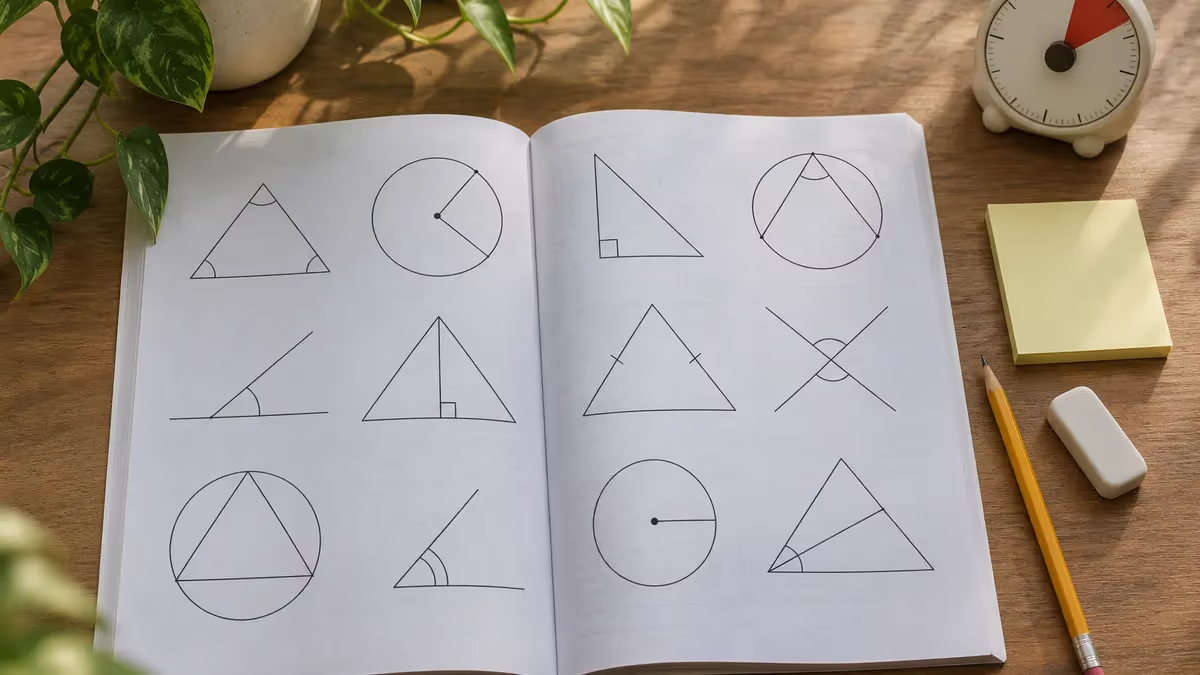
The chapter 8 geometry test is one of the most formula-heavy assessments in a high school geometry course, and in many textbooks it covers right triangles and trigonometry. Students who walk in with a clear list of geometry formulas, a few reliable diagrams, and a habit of checking units usually finish with time to spare. This guide explains what the test typically covers, how to study each skill, and where to find free practice so your preparation stays focused.
A quick caution before you start: chapter numbering differs by publisher. In many Glencoe, Holt, and Prentice Hall editions, chapter 8 is right triangles and trigonometry, while Big Ideas Geometry places similarity there. Check your syllabus or the chapter title page so you study the correct material. The skills below focus on the right triangle version, because it is the most common, but the study habits apply to any geometry chapter test you face this year.
Right triangle content builds directly on earlier geometry lessons. You need to remember that the angles of a triangle add up to 180 degrees, that similar triangles have proportional sides, and that radicals can be simplified. Many wrong answers on a chapter test come from weak algebra rather than weak geometry. If you can solve a proportion and rewrite the square root of 72 as 6 times the square root of 2, you already own half the skills.
The Pythagorean theorem, a squared plus b squared equals c squared, anchors the whole chapter. It works only for right triangles, and c must be the hypotenuse, the side opposite the right angle. For example, legs of 9 and 12 give 81 plus 144, which equals 225, so the hypotenuse is 15. Memorizing common triples such as 3-4-5, 5-12-13, 8-15-17, and 7-24-25 lets you spot answers quickly and verify your work.
Special right triangles are the next big topic. In a 45-45-90 triangle the legs are equal and the hypotenuse is the leg times the square root of 2. In a 30-60-90 triangle the short leg is half the hypotenuse, and the long leg is the short leg times the square root of 3. Teachers love these because they let you avoid a calculator, so expect exact radical answers rather than decimals.
Trigonometric ratios finish the chapter. Sine equals opposite over hypotenuse, cosine equals adjacent over hypotenuse, and tangent equals opposite over adjacent, the classic SOH-CAH-TOA memory aid. You will use them to find missing sides and, with inverse functions, missing angles. Always confirm your calculator is in degree mode, because radian mode is the most common reason students get a sensible-looking but wrong answer from an otherwise perfect setup.
Reasoning skills matter too, since some tests ask you to justify why two triangles are similar or why a segment is an altitude. If you want a refresher on statements and reasons, our geometry arrow proof practice guide pairs formulas with worked examples. Combine that reading with timed practice questions and you will see exactly which topics need more attention before test day arrives.
Chapter 8 Geometry Formulas by the Numbers

What the Chapter 8 Geometry Test Covers
Expect to find missing sides, use common triples, and decide whether three side lengths form a right, acute, or obtuse triangle. Word problems about ladders, ramps, and diagonals appear often, so practice drawing the triangle first.
You will apply the 45-45-90 and 30-60-90 ratios to find exact side lengths in radical form. Questions often hide the triangle inside a square, equilateral triangle, or rectangle, so look for diagonals and altitudes.
Sine, cosine, and tangent are used to solve for sides and angles. Inverse functions find angle measures, and angle of elevation or depression problems turn real situations into right triangles you can solve.
Some editions include the altitude to the hypotenuse. You will use the geometric mean to relate segments, legs, and the altitude, and you will identify the three similar triangles formed inside a right triangle.
Worked Geometry Formulas Examples You Can Copy
Start with a classic Pythagorean problem. A 13-foot ladder leans against a wall with its base 5 feet from the wall. How high does it reach? Set 5 squared plus h squared equal to 13 squared, so 25 plus h squared equals 169. Subtract to get h squared equals 144, and h equals 12 feet. Notice that 5-12-13 is a triple, which is a built-in check that your arithmetic is correct.
The converse tells you what kind of triangle sides make. Test 6, 7, and 9: the squares are 36, 49, and 81. Because 36 plus 49 equals 85, which is greater than 81, the triangle is acute. If the sum were less than the square of the longest side, it would be obtuse, and if equal, right. Always compare against the longest side, not whichever number appears last in the problem.
Now try the altitude to the hypotenuse. If the altitude splits the hypotenuse into segments of 4 and 9, the altitude equals the geometric mean, the square root of 4 times 9, which is 6. Each leg is the geometric mean of the hypotenuse and the segment next to it. So the leg beside the 4 equals the square root of 13 times 4, or 2 times the square root of 13.
For a 45-45-90 triangle with hypotenuse 10, divide by the square root of 2 to find each leg: 10 over the square root of 2. Rationalize by multiplying top and bottom by the square root of 2 to get 5 times the square root of 2, about 7.07. Check it with the theorem: two legs of 7.07 give 50 plus 50, which equals 100, and the square root is 10.
In a 30-60-90 triangle with hypotenuse 14, the short leg is half of that, so 7. The long leg is 7 times the square root of 3, about 12.12. Verify with the theorem: 49 plus 147 equals 196, and the square root of 196 is 14. For longer lists of textbook-style solutions, the geometry spot answers page walks through similar problems step by step.
Trigonometry works the same way. Suppose a right triangle has a 35 degree angle and a hypotenuse of 20. The opposite side is 20 times sine of 35 degrees, which is about 20 times 0.5736, or 11.47. The adjacent side is 20 times cosine of 35 degrees, about 16.38. Confirm by squaring: 131.6 plus 268.3 is roughly 400, which equals 20 squared.
Finally, try an angle of elevation. You stand 50 feet from the base of a tower and measure a 40 degree angle to the top. Tangent of 40 degrees equals height over 50, so the height is 50 times 0.8391, about 42 feet. Add your eye height if the problem gives it. Sketching the triangle and labeling opposite and adjacent before you touch the calculator prevents most setup errors.
Geometry Lessons to Review Before the Chapter 8 Geometry Test
Begin with vocabulary: legs, hypotenuse, altitude, and the right angle symbol. Label every diagram before solving, because the hypotenuse is always opposite the right angle and is always the longest side. Many students lose points by placing the unknown in the wrong spot of the equation, and a labeled sketch prevents that. Practice with three or four problems where you only set up the equation without solving it.
Next, review how to simplify radicals and solve equations such as x squared equals 144 or x squared plus 49 equals 625. These algebra steps appear in nearly every problem. Keep a short list of perfect squares through 25 squared, which is 625, on your formula sheet. Quick recall of squares speeds up the theorem, the converse, and the distance formula you will meet later in coordinate geometry.

Is Practice Testing Better Than Rereading Your Notes?
- +Retrieving formulas from memory strengthens recall far more than rereading them.
- +Practice questions reveal weak topics, such as radicals or inverse trig, early.
- +Instant answer explanations teach you the exact steps your teacher expects.
- +Timed sets build the pacing you need for a 45-minute class period.
- +Mixed problems train you to choose the right formula without a hint.
- +Seeing familiar question styles lowers test anxiety on the actual day.
- −Practice sets that are too easy can create false confidence.
- −Skipping the explanations means you repeat the same mistakes.
- −Question wording may differ from your teacher's style and notation.
- −Without a formula sheet, early practice can feel frustrating.
- −Taking quizzes alone will not replace understanding the underlying lessons.
- −Tests that cover another publisher's chapter 8 can waste study time.
Chapter 8 Geometry Test Checklist: Geometry Formulas to Know
- ✓Write the Pythagorean theorem and label the hypotenuse every time.
- ✓Memorize the triples 3-4-5, 5-12-13, 8-15-17, and 7-24-25.
- ✓Rebuild the 45-45-90 ratio from a square with a diagonal.
- ✓Rebuild the 30-60-90 ratio from half of an equilateral triangle.
- ✓Recite SOH-CAH-TOA and label opposite and adjacent from the reference angle.
- ✓Set your calculator to degree mode before the test begins.
- ✓Practice simplifying radicals and rationalizing denominators.
- ✓Solve at least five angle of elevation or depression word problems.
- ✓Review the geometric mean formulas for altitude and legs.
- ✓Complete one timed practice quiz and correct every missed question.
Check Every Answer With the Pythagorean Theorem
After solving any right triangle problem with sines, cosines, or special ratios, plug your three sides into a squared plus b squared equals c squared. If the numbers match within rounding, your answer is almost certainly right. This ten-second check catches swapped ratios and calculator mode errors.
Common Mistakes and Test-Day Strategy
The most frequent error is mislabeling the hypotenuse. Students see a 7, 24, and unknown and add the squares even when the unknown is a leg. Circle the side opposite the right angle first. If the hypotenuse is unknown, add the squares of the legs. If a leg is unknown, subtract. A one-line reminder at the top of your paper, hypotenuse is biggest, saves several points on most chapter tests.
The second mistake is using the wrong ratio in special triangles. In a 30-60-90 triangle, the long leg is the short leg times the square root of 3, not the hypotenuse divided by anything simple. Remember that the shortest side sits opposite the smallest angle, so 30 degrees faces the short leg, and 60 degrees faces the long leg. Matching sides to angles prevents mixing up the radical.
Calculator errors cost more points than any concept. Check degree mode, enter sine of 35 as sin(35), and close parentheses when dividing. When finding an angle, use the inverse key, not the regular sine key. If a sine or cosine answer exceeds 1, you have set up the ratio upside down. A quick estimate, such as knowing sine of 30 is 0.5, helps you catch silly mistakes.
Rounding rules also trip students. Most teachers want sides to the nearest tenth and angles to the nearest degree unless told otherwise, and some require exact radical form. Do not round until the final step, because rounding early can shift your answer by a full unit. Keep extra decimal places in your scratch work, then round once. Reading the directions at the top of each section prevents losing credit for a correct value in the wrong form.
Geometry rewards visual thinkers, and the subject reaches well beyond a single chapter. Patterns in sacred geometry, for instance, rely on the same ratios and proportional reasoning you use for similar triangles. Even molecular geometry in chemistry uses bond angles and trigonometry to predict shapes. Seeing these connections can make formulas feel less like trivia and more like tools that you will use in later science and art classes.
Diagram problems need special attention. When a figure contains a square, rectangle, or equilateral triangle, draw an altitude or diagonal to create right triangles you can solve. For instance, the diagonal of a 6 by 8 rectangle is 10, because it is a 3-4-5 triangle scaled by 2. Marking every right angle and equal side on the figure before you start often reveals which formula to use.
Chapter 8 is not the same in every textbook. Some courses cover similarity or quadrilaterals instead of right triangles, so confirm the chapter title and review sheet with your teacher before you study. Studying the wrong topics is the most expensive mistake on this list.
Time Management, Calculators, and Test Format
Most chapter tests run 40 to 50 minutes and include 15 to 25 questions, often a mix of multiple choice, short answer, and one or two word problems. Divide your time by points. If a question is worth 1 point, spend about a minute. If it is worth 5 points with a diagram, spend six or seven. Skip any problem that stalls you for more than two minutes and return after you finish the easy ones.
Read each question twice before doing any math. Underline what is asked, such as the hypotenuse, the angle, or the height above the ground. Many word problems include extra numbers designed to distract you. Draw a labeled triangle even when a diagram is provided, adding the given numbers in your own handwriting. This slows you down for fifteen seconds and speeds you up for the next two minutes.
Know your calculator before test day. Scientific and graphing calculators place the inverse trig functions behind a second key. Practice entering sin(35), cos inverse of 0.8, and the square root of 98 until your fingers know the sequence. If your teacher allows only basic calculators, practice using exact forms and the 3-4-5 style triples instead. Never borrow an unfamiliar calculator on test day without trying its degree mode first.
If you have ever typed something like geometry dash spam into a search bar looking for a game, you know how crowded the word geometry is online. For schoolwork, stick to sources that match your course. Our right triangles test answer key page offers worked solutions and free practice built around the same theorem, special triangles, and trigonometry topics you will see on this exam.
Use partial credit to your advantage. On free-response problems, write the formula, substitute the numbers, and show each step even if you are unsure of the final answer. Teachers often award most of the points for a correct setup. If you run short on time, write the equation you would solve and move on. A clearly set up wrong answer earns more than a blank space.
Finally, protect the last five minutes for review. Check units, confirm you answered every part of multi-part questions, and re-verify two or three calculations with the Pythagorean theorem. Look at your answers for reasonableness: a leg can never exceed the hypotenuse, a sine can never exceed 1, and a side length can never be negative. These sanity checks catch errors that careful students otherwise miss.
Final Prep Advice for the Week Before Your Test
Plan your last seven days instead of cramming the night before. On day one, rewrite the formula list from memory, then compare it with your notes and fix gaps. On day two, redo the homework problems you got wrong. Days three and four should be mixed practice sets. Day five is a timed practice test, day six is correction, and day seven is a light review followed by a full night of sleep.
Make flashcards for the items that you must know cold: the theorem, both special triangle ratios, the three trig ratios, and the geometric mean relationships. Put a picture on each card instead of only words. When you can answer a card in under five seconds, move it to the done pile. Reviewing the stack for ten minutes each morning is more effective than one long evening session.
Study with a partner for one session. Explain a problem aloud, such as why the long leg of a 30-60-90 triangle contains the square root of 3. If you can teach it, you understand it, and if you stumble, you have found a gap. Partners also catch careless errors, like dropping a negative sign or forgetting to rationalize a denominator, that you would not notice in your own work.
Do a mistake audit after every practice set. For each wrong answer, label the cause: concept, setup, algebra, calculator, or reading. After three sets, a pattern will appear, and that is where to focus. If most errors are algebraic, spend an evening on radicals and proportions. If they are calculator errors, practice key sequences. This targeted approach beats redoing random problems and often raises scores by a full letter grade.
Gather the right materials the night before: two sharpened pencils, an approved calculator with fresh batteries, a ruler or protractor if your teacher allows them, and your formula flashcards for a final glance. Eat breakfast, arrive early, and avoid last-minute cramming that raises anxiety. A calm start helps you read directions carefully, and careful reading is the cheapest way to earn extra points.
On the test, begin by writing the key formulas in the margin while they are fresh. Then work through the problems in order, skipping any that look long. For each answer, ask whether it makes sense: a hypotenuse longer than the legs, an angle between 0 and 90 degrees, an exact value that matches the decimal. Finish with the review habits above, and you will have done everything within your control.
After you get the test back, treat it as data. Rework every missed problem on a separate sheet, write the correct method, and keep it for the cumulative midterm or final. Right triangle skills return in coordinate geometry, circles, and later trigonometry courses, so the effort pays off again. Keep using free quizzes weekly, even briefly, to keep your geometry formulas fresh through the entire year.
Geometry Questions and Answers

Geometry Proof Practice: Formulas, Reasons, Worked Examples and Free Tests

4.1 Practice A Geometry Answers Page 111: Complete Study Guide with Geometry Formulas, Lessons & Free Practice Tests

Geometry Right Triangles Test Answer Key: Worked Solutions, Geometry Formulas & Free Practice

Unit 7 Geometry Test: Geometry Formulas, Lessons, Worked Examples & Free Practice

Cross Section Geometry: Complete Guide with Geometry Formulas, Lessons & Free Practice Tests
How this page was made: written with AI tools and published by Nathan Beja, founder of Practice Test Geeks, who is responsible for its content. We have not yet matched this exam's facts to an official source, so confirm fees, dates and rules with the exam body. Not reviewed by a subject-matter expert. Editorial policy