
Geometry Quiz 50: Master Geometry Formulas, Lessons & Practice Tests
Master geometry formulas with our free 50-question geometry quiz. Practice angles, circles, proofs & more. Start your geometry lessons today! 🎯
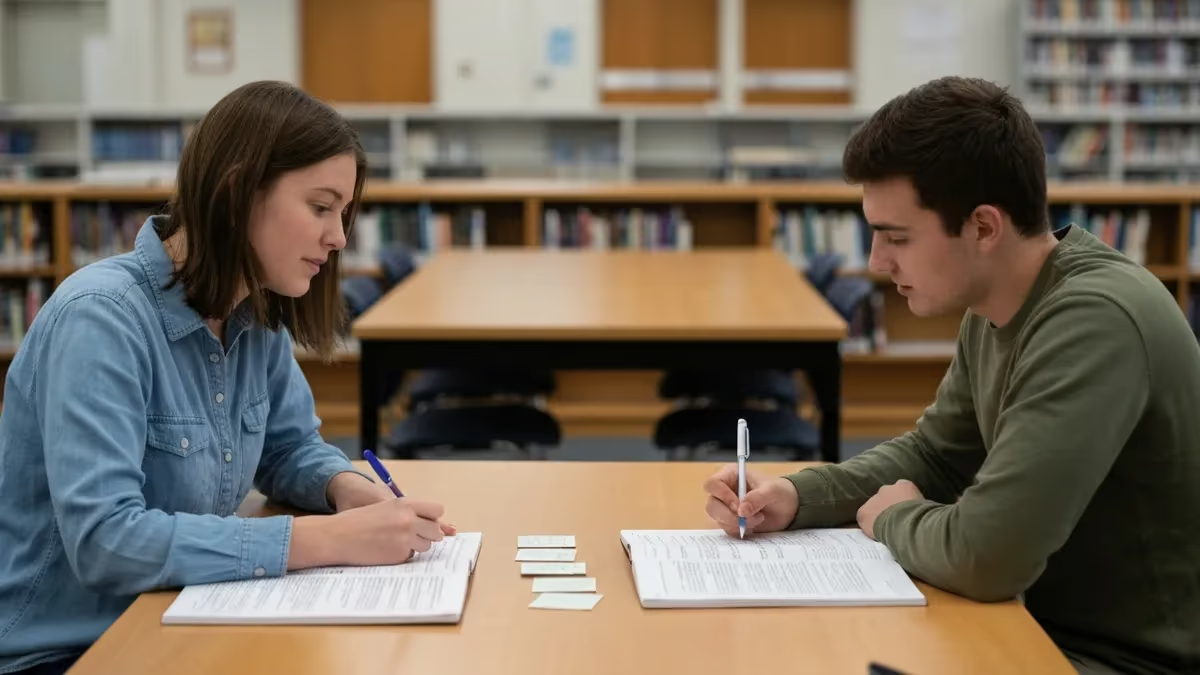
Mastering geometry formulas is the foundation of success in any math course, standardized test, or real-world application that involves shapes, space, and measurement. Our free geometry quiz 50 gives students, test-takers, and lifelong learners a structured way to assess their understanding of angles, triangles, circles, polygons, and coordinate geometry all in one comprehensive session. Whether you are preparing for the SAT, ACT, a state exam, or simply brushing up on geometry lessons from school, this quiz covers exactly the content you need to build confidence and sharpen your skills.
Geometry is far more than memorizing the area of a triangle or the circumference of a circle. It is a discipline that trains logical reasoning, spatial visualization, and systematic problem-solving. When you work through geometry problems, you are practicing the same analytical thinking used by architects, engineers, game designers, and data scientists every day. Understanding the relationships between shapes — how angles sum inside polygons, how similar triangles preserve ratios, how the Pythagorean theorem links the sides of a right triangle — gives you a powerful toolkit that extends well beyond the classroom.
This article serves as your complete geometry study companion. You will find an overview of the most important geometry formulas, organized by topic, alongside detailed explanations of why each formula works. We cover two-dimensional figures like triangles, quadrilaterals, and circles, as well as three-dimensional solids including prisms, pyramids, cylinders, cones, and spheres. Each section pairs conceptual understanding with practical examples so you can see exactly how to apply a formula in a test question or real-world scenario.
Beyond pure formula review, this guide explores geometry lessons that address common misconceptions. Many students confuse perimeter with area, or forget that volume and surface area require entirely different formulas for the same solid. We tackle those confusion points directly, giving you clear mental models and memory tricks. You will also learn about molecular geometry — the three-dimensional arrangement of atoms in chemistry — because geometry principles appear across scientific disciplines and knowing this connection deepens your understanding of why spatial reasoning matters.
We also acknowledge that geometry learning looks different for every person. Some students thrive with visual diagrams and color-coded notes. Others prefer working through practice problems sequentially until patterns click. A growing number of learners use digital tools — including geometry spot resources, browser-based sketch tools, and even geometry dash scratch projects that teach coordinate concepts through game mechanics. This guide accommodates all learning styles by offering structured content, interactive quiz links, and a flexible study schedule you can adapt to your own timeline.
Sacred geometry — the study of mathematical ratios and patterns found throughout nature, architecture, and art — reminds us that geometry has captivated human minds for thousands of years. From the golden ratio in Renaissance paintings to the hexagonal cells of a honeycomb, geometry describes the deep structure of the world around us. Understanding these principles in a formal academic setting gives you the vocabulary to appreciate and analyze beauty and structure wherever it appears.
Ready to begin? Work through the sections below, use the quiz tiles to test yourself after each topic, and track your progress with the checklist provided. By the end of this guide, you will have a complete picture of the geometry content most commonly tested on US high school and college-entrance exams, along with the practice reps needed to perform confidently on test day.
Geometry by the Numbers

Core Geometry Formulas by Topic
Area of a triangle = ½ × base × height. For quadrilaterals: rectangle area = length × width, parallelogram area = base × height, and trapezoid area = ½ × (b₁ + b₂) × height. The Pythagorean theorem (a² + b² = c²) applies exclusively to right triangles and is the most frequently tested geometry formula on US standardized exams.
Circle area = πr², circumference = 2πr. Arc length = (θ/360) × 2πr and sector area = (θ/360) × πr², where θ is the central angle in degrees. These formulas appear heavily in SAT and ACT geometry sections, and understanding the relationship between central angles and intercepted arcs is essential for multi-step circle problems.
Volume of a prism = base area × height. Cylinder volume = πr²h. Cone volume = ⅓πr²h. Sphere volume = (4/3)πr³. Surface area formulas differ: cylinder SA = 2πr² + 2πrh. Many students mix up volume and surface area, so always confirm which measurement the problem requests before selecting a formula.
Distance between two points = √[(x₂−x₁)² + (y₂−y₁)²]. Midpoint = ((x₁+x₂)/2, (y₁+y₂)/2). Slope = (y₂−y₁)/(x₂−x₁). These coordinate geometry formulas connect algebra and geometry, and they appear in virtually every standardized test that includes a geometry section, including state end-of-course assessments.
The sum of interior angles of any polygon = (n − 2) × 180°, where n is the number of sides. For a triangle that is 180°, quadrilateral 360°, pentagon 540°. Exterior angles of any convex polygon always sum to 360°. Knowing these rules lets you solve for missing angles quickly without drawing the polygon.
Effective geometry lessons begin with building a solid mental model rather than jumping straight into formula memorization. Before a student can reliably apply the distance formula or calculate the volume of a cone, they need to understand what those measurements represent in physical space. Visualizing a cone as a pyramid with an infinitely sided base, or thinking of the circumference formula as the limit of perimeter formulas for regular polygons with more and more sides, creates durable understanding that survives the pressure of timed test conditions.
One of the most powerful geometry learning strategies is working backwards from the answer. When you encounter a multi-step geometry problem, try to identify what type of answer is expected — a length, an area, a ratio, or a degree measure — and then work backwards to figure out which formula chain connects the given information to that answer type. This reverse-engineering approach is especially useful for complex coordinate geometry problems where multiple formulas must be applied in sequence, and it mirrors the logical structure of formal geometric proofs.
Spaced repetition is the scientific backbone of long-term formula retention. Rather than studying all geometry formulas in a single marathon session, plan shorter practice blocks spread over several days. During each session, review formulas from previous sessions before introducing new ones. Research consistently shows that retrieving information from memory — even when that retrieval feels difficult — strengthens the neural pathways associated with that knowledge far more effectively than simply re-reading notes. Our geometry quiz 50 is designed to support spaced repetition by covering a broad range of topics in a single timed session.
Drawing accurate diagrams is a non-negotiable skill for geometry success. Even professional mathematicians sketch figures when solving geometry problems because diagrams reveal relationships that are invisible in symbolic form. When you draw a diagram, label every piece of given information — side lengths, angle measures, parallel marks — so you can see at a glance what tools are available. Many test errors occur not from formula mistakes but from misreading the problem because the student never drew a figure.
A geometry spot — whether a dedicated section of your notebook, a digital whiteboard, or a laminated scratch sheet — gives you a consistent workspace for diagrams and calculations. Keeping your geometry work organized in one location makes it easier to review mistakes and notice error patterns. If you consistently make arithmetic errors when computing square roots, for example, you can target that specific skill with focused drill practice rather than re-studying the entire topic.
Group study sessions bring a unique benefit to geometry learning because explaining a concept to another person is one of the best ways to identify gaps in your own understanding. When you teach the difference between congruent and similar triangles, or walk a classmate through the steps of a two-column proof, you are forced to articulate ideas that might otherwise remain fuzzy intuitions. If you get stuck trying to explain something, that sticking point reveals exactly where you need more practice.
Digital geometry lessons — including interactive graphing tools, animated proof demonstrations, and browser-based quiz platforms — have transformed how students engage with spatial concepts. These tools allow learners to drag vertices, observe how angle measures change dynamically, and instantly check whether a constructed figure meets given constraints. Combining digital exploration with traditional pencil-and-paper problem solving gives you the broadest possible foundation for geometry mastery and ensures you are prepared for both calculator-active and calculator-inactive test sections.
Geometry Dash, Scratch & Digital Learning Tools
Geometry dash unblocked has become a surprisingly popular entry point into spatial reasoning for millions of students worldwide. While the game is primarily a rhythm-based platformer, its level design depends entirely on geometric shapes — cubes, spikes, slopes, and portals that occupy precise positions in a two-dimensional coordinate space. Players who spend time in the level editor begin to internalize concepts like symmetry, translation, and reflection without realizing they are practicing foundational geometry skills.
Educators have begun incorporating geometry dash into classroom discussions as a bridge between gaming engagement and formal mathematical content. When students analyze why a particular level layout feels balanced or challenging, they are applying informal geometric intuition. That intuition can then be formalized through targeted geometry lessons that give students the vocabulary — congruence, perpendicularity, slope — to describe what they already understand intuitively from gameplay. The game's enduring popularity means its coordinate-based logic resonates across age groups.
Timed Quiz vs. Open-Book Formula Review: Which Study Method Wins?
- +Timed quizzes simulate real test pressure and build mental endurance for exam day performance
- +Active retrieval during quizzes strengthens long-term memory retention more than passive re-reading
- +Identifying wrong answers on a quiz pinpoints exact knowledge gaps for targeted follow-up study
- +Consistent quiz practice reduces test anxiety by making the timed format feel familiar and manageable
- +Quiz feedback is immediate, allowing faster iteration between practice and correction than textbook review
- +Tracking quiz scores over multiple sessions provides objective evidence of improvement and boosts motivation
- −Timed quizzes can increase anxiety in students who already struggle with test performance pressure
- −Without reviewing wrong answers in depth, quiz practice becomes mere repetition rather than genuine learning
- −Open-book review is better for initial exposure to new formulas that you have never encountered before
- −Quizzes cannot replace conceptual instruction — knowing the formula without understanding the concept leads to fragile knowledge
- −Students may memorize question patterns from repeated quizzes rather than developing transferable geometry skills
- −Poorly designed quizzes that lack answer explanations leave students guessing why they got a question wrong
Geometry Quiz 50 Preparation Checklist
- ✓Review all triangle formulas: area, perimeter, Pythagorean theorem, and special right triangles (30-60-90 and 45-45-90).
- ✓Memorize the circle formulas: area (πr²), circumference (2πr), arc length, and sector area using central angle ratios.
- ✓Practice coordinate geometry: calculate distance, midpoint, and slope between two coordinate pairs without a calculator.
- ✓Study polygon interior angle sums using the formula (n − 2) × 180° and apply it to pentagons, hexagons, and octagons.
- ✓Review 3D solid formulas for volume and surface area: prisms, cylinders, cones, pyramids, and spheres.
- ✓Work through at least five geometric proof problems to practice deductive reasoning and two-column proof structure.
- ✓Identify and practice transformations: reflection, rotation, translation, and dilation on the coordinate plane.
- ✓Test yourself on angle pair relationships: vertical angles, supplementary, complementary, alternate interior, and corresponding.
- ✓Complete a timed 50-question geometry quiz and score your answers before reviewing explanations for wrong responses.
- ✓Review molecular geometry basics to understand how geometry principles apply in chemistry and real-world science contexts.
The 5 Most Tested Geometry Formulas on US Standardized Exams
According to analysis of released SAT, ACT, and state end-of-course exams, five geometry formulas appear more frequently than any others: the Pythagorean theorem (a² + b² = c²), circle area (πr²), triangle area (½bh), distance formula (√[(x₂−x₁)² + (y₂−y₁)²]), and interior angle sum ((n−2)×180°). Committing these five to memory and knowing when to apply each one will resolve the majority of geometry questions you encounter on test day without requiring any additional formula recall.
Molecular geometry is the three-dimensional arrangement of atoms within a molecule, and it is determined by applying the same angular and spatial reasoning used in high-school geometry. The VSEPR model — Valence Shell Electron Pair Repulsion — predicts molecular shapes by treating electron pairs as geometric objects that repel each other and arrange themselves to minimize that repulsion.
The result is a set of standard molecular geometries — linear, trigonal planar, tetrahedral, trigonal bipyramidal, and octahedral — each of which corresponds to a specific bond angle that any geometry student will immediately recognize as related to regular polygon and polyhedron angle measures.
A water molecule (H₂O) has a bent geometry because its two bonding pairs and two lone pairs arrange into a tetrahedral electron geometry, but the lone pairs compress the bond angle from the ideal 109.5° to approximately 104.5°. Carbon dioxide (CO₂) is linear with bond angles of exactly 180°. Methane (CH₄) is tetrahedral with bond angles of 109.5°. Understanding these geometries requires no chemistry background beyond what geometry students already know about angles and three-dimensional space, which is why molecular geometry units in chemistry classes proceed much faster for students with strong geometry foundations.
Sacred geometry extends the application of mathematical ratios and spatial patterns into art, architecture, and philosophy. The golden ratio (approximately 1.618) appears in the proportions of the Parthenon, the spiral arrangement of sunflower seeds, and the growth patterns of nautilus shells. The Fibonacci sequence — 1, 1, 2, 3, 5, 8, 13, 21 — generates the golden ratio as consecutive terms are divided, and the geometric spiral created by connecting quarter-circle arcs across Fibonacci-squared rectangles appears throughout the natural world. Studying sacred geometry gives students a profound appreciation for why human beings have been captivated by mathematical relationships for millennia.
Fractal geometry, developed formally by Benoit Mandelbrot in the 1970s, describes self-similar patterns that repeat at every scale of magnification. Coastlines, mountain ranges, snowflakes, and tree branching patterns all exhibit fractal properties. The Koch snowflake, constructed by iteratively adding equilateral triangles to each side of a triangle, has a perimeter that increases without bound while its area converges to a finite value — a result that challenges students who assume larger perimeter always means larger area and forces a deeper understanding of geometric measurement.
Geometry also underpins computer graphics, game design, and animation. Every 3D model in a video game or animated film is a mesh of polygons — typically triangles, because any polygon can be decomposed into triangles and triangle rendering is computationally efficient. Game engines calculate whether objects collide by checking whether geometric bounding shapes (spheres, boxes, capsules) overlap in three-dimensional space. The geometry arrow notation used in physics and game development represents direction vectors that control how characters move and how light rays bounce off surfaces in ray-traced rendering.
Architecture and civil engineering rely on geometry at every stage of design and construction. Floor plans are two-dimensional coordinate geometry problems where distances must be accurate and angles must be precise for walls to meet correctly. Structural engineers calculate load distributions using principles of similar triangles and vector decomposition. Bridge designers use parabolic curves — a conic section related to circles and ellipses — to distribute tension optimally across suspension cables. Each of these real-world applications reinforces the message that geometry formulas are not arbitrary facts to memorize but descriptions of relationships that govern the physical world.
For students pursuing STEM careers, mastery of geometry formulas is a prerequisite for calculus, where area formulas become integrals and volume formulas emerge from solids of revolution. The transition from geometry to calculus is smoother for students who have internalized why area formulas work — not just that the area of a circle is πr², but why integrating a circumference function from radius zero to radius r yields exactly that result. Building this deeper understanding during your geometry study sessions now creates a foundation that pays dividends in every quantitative course you take afterward.

Three errors account for the majority of lost geometry points on US standardized exams. First, students confuse the radius and diameter in circle formulas — always confirm whether a problem gives radius or diameter before applying circumference or area formulas. Second, students apply the Pythagorean theorem to triangles that are not right triangles — check for the right angle symbol before using a² + b² = c². Third, students use degree-mode angle formulas when the problem requires radians, or vice versa — read the problem carefully to identify which unit is expected.
Test-day geometry strategy begins weeks before the exam with deliberate practice that mimics real testing conditions. This means timing yourself, working without reference materials, and resisting the urge to check answers mid-problem. The mental discipline developed during timed practice translates directly into composure on exam day, when pressure can cause even well-prepared students to second-guess correct answers or rush through multi-step calculations. Scheduling at least three full timed geometry quiz sessions in the two weeks before your exam is a minimum standard for serious preparation.
When you sit down for a geometry exam, scan the entire question set before answering anything. This two-minute investment reveals the distribution of difficulty across the test and allows you to allocate time intelligently. If you notice that the last five questions are straightforward formula-application problems and the middle section contains several complex proof questions, you might choose to answer the easier items first to secure those points before investing time in the harder problems. This strategic approach prevents the common disaster of running out of time on questions you could easily answer.
For multiple-choice geometry questions, the process of elimination is a powerful tool even when you are uncertain of the correct answer. Geometry answer choices are rarely random — wrong answers are typically generated by common errors like forgetting to square the radius, using diameter instead of radius, or computing area instead of perimeter.
Recognizing the error types embedded in wrong answer choices helps you verify your own work by checking whether your answer matches the expected magnitude and units. If your calculated area is the same as one of the answer choices for circumference, you know to double-check your formula selection.
Geometry dash spam — the practice of repeatedly attempting a level's most difficult segment until the movement pattern becomes automatic — is actually a reasonable analogy for the repetitive practice that builds procedural geometry fluency. Just as a player develops muscle memory for a tricky jump sequence through repeated attempts, a geometry student develops automatic formula recall through repeated problem-solving. The key in both cases is deliberate repetition with attention to what went wrong on failed attempts, rather than mindless repetition of the same approach that keeps failing.
Sacred geometry traditions emphasize the meditative and contemplative aspect of working with mathematical patterns — a reminder that deep learning requires focused, calm attention rather than anxious rushing. When you approach a geometry problem set with the same deliberate focus a craftsperson brings to precision work, you notice relationships and patterns that escape hurried attention. The student who carefully labels every diagram, writes out each step of a calculation, and checks units consistently will outscore an equally talented student who skips steps and relies on mental shortcuts.
The night before a geometry exam, your most productive activity is a light review of the five most important formulas, followed by eight hours of sleep. Sleep is when the brain consolidates the day's learning into long-term memory, and students who sacrifice sleep for last-minute cramming consistently perform below their potential. A well-rested mind recalls formulas more quickly, makes fewer arithmetic errors, and maintains focus through longer problem sets. Geometry rewards systematic preparation over intense last-minute effort, so plan your study schedule with rest as a non-negotiable component.
After your exam, regardless of how you performed, conduct a thorough post-exam review by going through every question you answered incorrectly or guessed on. Understanding the source of each error — formula confusion, diagram misread, arithmetic slip, or time pressure — gives you actionable information for future improvement. Students who treat each exam as a diagnostic tool rather than a final judgment improve fastest over time. Whether your next geometry challenge is a standardized test, a college course, or a professional certification, the habits and strategies you develop through deliberate practice will serve you at every level.
Practical geometry tips start with knowing your formula sheet policy before exam day arrives. Many standardized tests — including state geometry end-of-course assessments — provide a reference sheet with key formulas. If your exam allows a reference sheet, study it carefully in advance so you know exactly where to find each formula under time pressure. Students who are familiar with the reference sheet's layout retrieve formulas significantly faster than students who see it for the first time on test day. If your exam does not allow references, prioritize memorizing the twelve formulas that appear most frequently across geometry exams.
Building a personal geometry formula card is one of the most effective low-tech study tools available. Write each formula on a separate index card with the formula on the front, a labeled diagram on the back, and one worked example below the diagram. Review your cards daily using a shuffled order so you practice retrieving any formula at any moment, not just in a predictable sequence.
After each card, recite the formula aloud without looking, then verify. Cards you answer correctly three times consecutively can be retired from active review — this graduated approach keeps your practice sessions focused on genuine weak spots rather than formulas you already know cold.
Understanding special right triangles eliminates calculation steps on timed exams and is worth a dedicated study session. In a 30-60-90 triangle, the sides are in ratio 1 : √3 : 2. In a 45-45-90 triangle, the sides are in ratio 1 : 1 : √2. These ratios appear so frequently — in proofs, coordinate geometry, trigonometry, and physics problems — that instant recall of these patterns effectively transforms a multi-step Pythagorean theorem calculation into a single mental lookup.
Practice identifying these triangles from incomplete information: if you are given only the hypotenuse of a 45-45-90 triangle, you should immediately know each leg equals hypotenuse divided by √2.
Geometry proofs require a different mental mode than formula application — they demand structured logical argument rather than calculation. The key to writing a clean proof is to work backwards from what you need to prove, identifying which known theorems or definitions could establish that conclusion, and then determining what information you need to apply those theorems. This backward-planning approach is analogous to GPS navigation: you set your destination first and then the route reveals itself. Students who attempt proofs by moving forward from given information often get lost because there are too many possible first steps.
Coordinate geometry problems — finding equations of lines, circles, or parabolas from given conditions — are among the most calculation-intensive items on geometry exams and reward careful, organized algebra as much as geometric insight. A reliable approach is to set up a coordinate system with one important point at the origin, exploit any symmetry to reduce variables, and then apply the relevant distance or midpoint formula. Always verify your answer by substituting key points back into your equation — if a circle equation is supposed to pass through three given points, check all three before moving on.
Volume and surface area problems routinely trip up students who confuse which formula to use for which solid. A reliable check: volume formulas always produce cubic units (cm³, ft³), while surface area formulas always produce square units (cm², ft²). If your answer to a surface area question comes out in cubic units, you used a volume formula by mistake. Maintaining this units-based self-check as a habit prevents an entire category of avoidable errors and takes less than five seconds per problem.
Finally, connect your geometry study to the broader mathematical world by exploring how geometry formulas are derived rather than just accepting them as given. The area formula for a circle can be understood by dividing the circle into thin concentric rings and summing their approximate rectangular areas — a process that foreshadows integral calculus.
The volume formula for a sphere can be derived by rotating a semicircle around its diameter — another calculus concept made visible through geometry. Students who understand these derivations remember the formulas more reliably and adapt more successfully when exam questions present formulas in unfamiliar forms, because they understand what the formula is measuring at a fundamental level.
Geometry Questions and Answers
About the Author

Educational Psychologist & Academic Test Preparation Expert
Columbia University Teachers CollegeDr. Lisa Patel holds a Doctorate in Education from Columbia University Teachers College and has spent 17 years researching standardized test design and academic assessment. She has developed preparation programs for SAT, ACT, GRE, LSAT, UCAT, and numerous professional licensing exams, helping students of all backgrounds achieve their target scores.