
Evaluate Homework and Practice Answers Geometry: Complete Study Guide with Geometry Formulas, Lessons & Free Practice Tests
Master geometry formulas & evaluate homework and practice answers geometry with step-by-step lessons, worked examples, and free practice tests. 📚

When students need to evaluate homework and practice answers geometry style, the single most powerful tool in their arsenal is a firm command of geometry formulas. From the Pythagorean theorem to the area of a circle, every formula is a shortcut that transforms a confusing diagram into a solvable equation. This guide is designed to help you not only memorize those formulas but also understand when and why each one applies, so checking your own work becomes second nature rather than a guessing game.
Geometry is far more than a collection of shapes on a page. It is the mathematical language of space, measurement, and structure. Whether you are a high school student struggling with triangle congruence or a college student revisiting molecular geometry before a chemistry exam, the underlying principles of spatial reasoning appear everywhere. Mastering them at the homework level creates a feedback loop: the more carefully you evaluate your practice answers, the faster your intuition grows and the stronger your test performance becomes.
One common stumbling block is failing to check intermediate steps. Many students verify only the final answer, missing algebra errors or unit mistakes hidden inside the solution. A disciplined approach to evaluating geometry homework means re-reading every step, confirming that each formula was applied to the correct measurement, and verifying that units are consistent throughout. For example, mixing centimeters and meters in a surface-area problem will produce a wildly incorrect result even when the formula is right.
Another strategy that high-performing students use is working problems backwards. After reaching an answer, substitute it back into the original conditions to confirm it satisfies every constraint. If you calculated the side length of a square and then multiply that value by itself, the result should match the given area exactly. This reverse-check technique catches sign errors, rounding mistakes, and formula mix-ups before they cost points on a quiz or exam. Combining forward solution with backward verification is the gold standard for geometry accuracy.
Visual learners benefit enormously from sketching diagrams even when the problem provides one. Redrawing a figure with your own labels forces active engagement with the geometry, making errors in angle assignment or segment identification obvious. Students who use geometry lessons that emphasize diagram construction consistently outperform peers who rely solely on symbolic manipulation. A clean, labeled drawing is both a problem-solving tool and a self-checking device.
Practice tests play an equally important role. Timed, exam-condition practice exposes weaknesses that casual homework review never reveals. When you attempt problems under a clock and then carefully evaluate your answers afterward, you discover not just what you got wrong but why you got it wrong — insufficient time, misread instructions, or a conceptual gap. Each identified weakness becomes a targeted study goal, making subsequent practice sessions dramatically more efficient and focused.
This guide covers geometry formulas for every major topic, structured geometry lessons that build concept by concept, and worked examples you can use to benchmark your own solutions. By the end, you will have a complete framework for evaluating any geometry homework or practice set, catching your own mistakes, and arriving at test day fully confident in your spatial reasoning skills.
Geometry Homework & Practice by the Numbers

Core Geometry Formulas Every Student Must Know
Rectangle area = length × width; triangle area = ½ × base × height; circle area = πr². Perimeter formulas add all side lengths. These six foundational formulas account for the majority of geometry homework problems at the middle and high school level.
Cube volume = s³; cylinder volume = πr²h; sphere volume = (4/3)πr³. Surface area formulas involve summing the areas of all faces. Confusing volume with surface area is one of the most frequent errors students make during homework review.
The Pythagorean theorem (a² + b² = c²) applies only to right triangles. The Law of Sines and Law of Cosines extend trigonometric relationships to all triangles. Knowing which theorem applies to a given triangle is critical for correctly evaluating practice answers.
Circumference = 2πr; arc length = (θ/360) × 2πr; sector area = (θ/360) × πr². These formulas require careful attention to whether angles are given in degrees or radians, a distinction that causes widespread errors on geometry homework sets.
Distance formula: d = √[(x₂−x₁)² + (y₂−y₁)²]; midpoint formula: M = ((x₁+x₂)/2, (y₁+y₂)/2); slope = (y₂−y₁)/(x₂−x₁). Mastering coordinate geometry connects algebra to spatial reasoning and appears frequently on standardized tests.
Learning how to evaluate homework and practice answers geometry problems demand a systematic process, not a casual glance at the final number. Start by re-reading the problem statement after you have finished your solution. Students frequently misread a question, solve for the wrong quantity, and produce a mathematically correct answer to the wrong problem. This simple re-read eliminates a surprising percentage of avoidable errors before you even check the formula.
Next, audit your formula selection. Each geometry topic has a specific set of applicable formulas, and selecting the wrong one — for example, using the formula for a rectangle's area when the shape is actually a parallelogram — will produce a plausible-looking but incorrect result. Build a personal formula sheet organized by shape and property. Cross-reference your solution against this sheet every time you complete a multi-step problem. Over time, this habit becomes automatic and dramatically accelerates accurate self-assessment.
Unit analysis is another essential verification layer. Geometry problems routinely mix linear units (meters, centimeters, inches) with square units (cm²) and cubic units (m³). A correct formula applied to mismatched units produces a nonsensical answer. Explicitly write the unit next to every numerical value as you work, and carry those units through each algebraic step. If the units in your final answer do not match the quantity requested — say, the problem asks for area but your answer comes out in meters rather than square meters — you know immediately that a conversion error occurred.
Diagram verification is equally powerful. After solving, return to the figure and ask whether your answer is geometrically reasonable. If you calculated that a triangle's hypotenuse is shorter than its longest leg, something went wrong. If you found that a cylinder's volume is less than the volume of a sphere that fits inside it, the result is impossible. These sanity checks take only seconds but reliably catch errors that algebraic checking misses, because they engage spatial intuition rather than symbolic manipulation.
For students who use geometry dash scratch resources to supplement their study, video-based explanations are particularly helpful because they externalize the thought process of an expert solver. Watching a worked solution after you have already attempted a problem lets you pinpoint exactly where your approach diverged from the correct one. This targeted feedback is far more efficient than re-reading a textbook chapter, because it connects directly to the specific error pattern you exhibited on that particular problem type.
Peer review is a technique borrowed from professional mathematics and adapted powerfully for classroom use. After completing a homework assignment, swap papers with a classmate and apply the same evaluation checklist you would use on your own work. Explaining why a particular step is wrong to someone else cements your own understanding more deeply than simply noting your own mistakes. It also exposes you to alternative solution methods you may not have considered, broadening your strategic toolkit for future problems.
Finally, keep an error log. Each time you identify a mistake — wrong formula, arithmetic slip, unit error, misread problem — record it in a dedicated notebook or digital document. After two weeks of consistent logging, patterns emerge: you will see that you consistently forget to divide by two in triangle area problems, or that you routinely confuse radius and diameter. These patterns are your personalized study agenda. Address each pattern deliberately, and your accuracy rate on geometry homework and practice sets will rise measurably within days.
Geometry Lessons: Building Skills Topic by Topic
Angle relationships form the backbone of nearly every geometry lesson. Complementary angles sum to 90°, supplementary angles sum to 180°, and vertical angles are always equal. When two parallel lines are cut by a transversal, corresponding angles are congruent, alternate interior angles are congruent, and co-interior angles are supplementary. These relationships appear constantly in proofs and multi-step problems, making them among the highest-value concepts to master early in any geometry course.
Applying angle rules correctly requires identifying the geometric configuration first. Students who skip the identification step and jump directly to calculation frequently apply the wrong relationship. For example, treating co-interior angles as congruent instead of supplementary is a classic error that produces a plausible-looking answer exactly 180° off from correct. When evaluating your homework answers on angle problems, always name the configuration — parallel lines with transversal, triangle interior, polygon exterior — before checking whether the correct rule was applied.
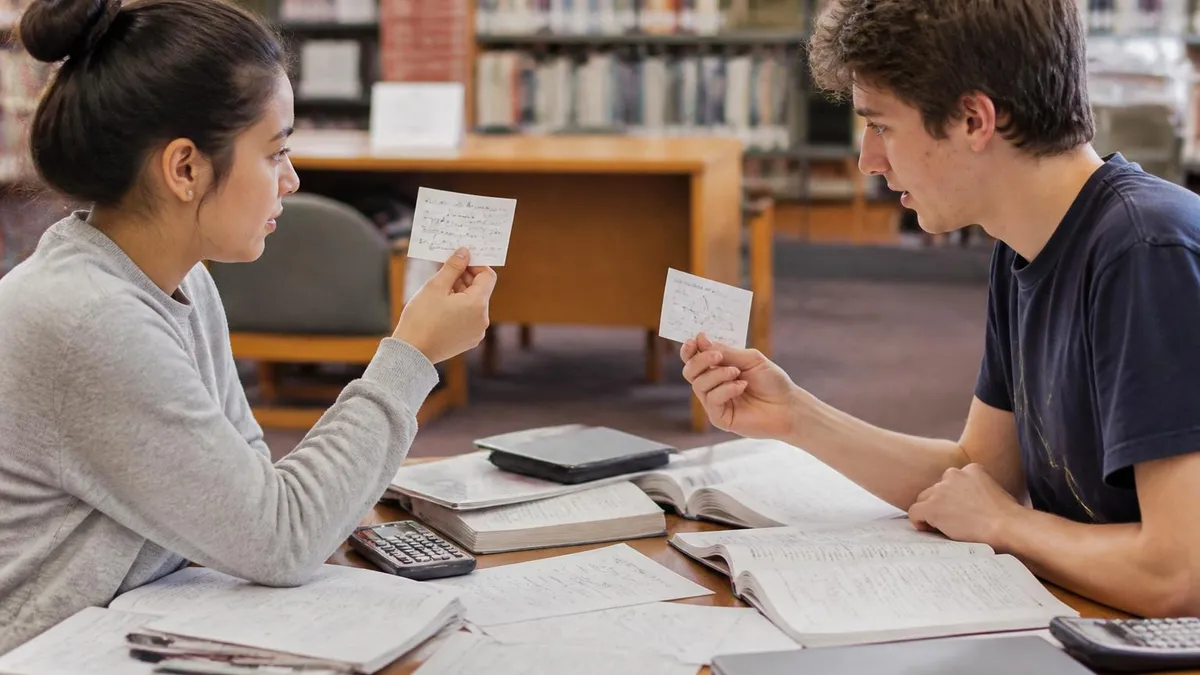
Self-Evaluation vs. Answer-Key Checking: Which Approach Wins?
- +Self-evaluation builds deeper conceptual understanding than passively reading an answer key
- +Identifying your own errors creates stronger memory traces, reducing repeat mistakes
- +Working through logic independently prepares you better for timed exam conditions
- +Self-checking exposes the specific step where reasoning broke down, not just the wrong final number
- +Regular self-evaluation builds mathematical confidence and reduces test anxiety over time
- +The habit transfers to all STEM subjects, making it a high-return investment of study time
- −Self-evaluation is slower than glancing at an answer key, especially early in learning a topic
- −Without guidance, students sometimes confirm incorrect methods if their intuition is flawed
- −Persistent misconceptions can be reinforced if no external correction mechanism exists
- −Some students find self-evaluation discouraging when error rates are initially high
- −Complex proofs are extremely difficult to self-evaluate without a strong foundation in logic
- −Time pressure during homework completion makes thorough self-evaluation feel impractical
Geometry Homework Evaluation Checklist
- ✓Re-read the problem statement after completing your solution to confirm you answered the right question.
- ✓Verify that the formula you used matches the exact shape and property described in the problem.
- ✓Check that all measurements are in the same units before plugging numbers into any formula.
- ✓Confirm that area answers are expressed in square units and volume answers in cubic units.
- ✓Substitute your final answer back into the original conditions to verify it satisfies every constraint.
- ✓Redraw or annotate the diagram with your calculated values to detect geometric impossibilities.
- ✓Check every algebraic step for arithmetic errors, especially when distributing negatives or squaring binomials.
- ✓For proofs, confirm that every statement has a named reason (theorem, postulate, or definition).
- ✓Compare your approach to a worked example or similar problem to spot methodological differences.
- ✓Log any identified mistakes in an error journal with a note on the root cause and correct strategy.
The 5-Minute Post-Homework Review Rule
Research on mathematics learning consistently shows that students who spend just five minutes reviewing completed homework — checking units, re-reading the question, and scanning intermediate steps — score an average of 12 to 15 percentage points higher on subsequent tests covering the same material. This micro-review costs almost no additional time but converts passive completion into active evaluation, the skill that separates proficient geometry students from exceptional ones.
Advanced geometry topics extend the foundational formulas into richer mathematical territory. Molecular geometry, for instance, applies geometric principles to predict the three-dimensional shape of molecules based on electron pair arrangements. While this sits at the intersection of chemistry and mathematics, the underlying spatial reasoning is identical to what students practice in polygon and solid geometry units. Recognizing these cross-disciplinary connections deepens appreciation for why geometry formulas are worth mastering thoroughly.
Coordinate geometry opens another advanced frontier. When points, lines, and circles are placed on a coordinate plane, algebraic equations and geometric properties become two descriptions of the same reality. The equation of a circle (x − h)² + (y − k)² = r² encodes center and radius in a form that allows algebraic manipulation. Finding the intersection of a line and a circle, for example, combines the substitution method from algebra with circle geometry in a problem type that appears frequently on the SAT, ACT, and state geometry assessments.
Transformational geometry — reflections, rotations, translations, and dilations — provides yet another lens through which to evaluate geometric relationships. When a figure is reflected across the y-axis, each point (x, y) maps to (−x, y). When a figure is rotated 90° counterclockwise about the origin, each point (x, y) maps to (−y, x). These transformation rules are formula-like in their precision, and evaluating homework answers in this topic requires verifying that the correct rule was applied to every vertex, not just one representative point.
Three-dimensional geometry introduces new formula families for prisms, pyramids, cylinders, cones, and spheres. The lateral surface area of a cone equals πrl, where r is the radius and l is the slant height — a value that must be calculated using the Pythagorean theorem if not directly given. Students who confuse slant height with vertical height, or who use the wrong surface area formula for a given solid, produce errors that look numerically reasonable but are geometrically wrong. Careful diagram analysis before formula application prevents this category of mistake.
Geometry proofs at the advanced level incorporate properties of quadrilaterals, circle theorems, and segment relationships in multi-stage logical arguments. A proof might require establishing that two triangles are similar (using AA), then using that similarity to set up a proportion, then solving the proportion to find a missing length, and finally applying that length in a circle chord relationship. Each stage depends on the previous one, so an error anywhere propagates through the entire chain. When evaluating such multi-stage proofs, work backward from the conclusion to verify that each dependency holds.
Vectors represent a bridge between geometry and physics that appears in advanced high school and college coursework. A vector's magnitude is calculated using the distance formula, and vector addition follows the parallelogram rule — a deeply geometric operation. Dot products and cross products extend vector geometry into three dimensions, connecting back to the solid geometry formulas encountered earlier. Students who build a cohesive mental map connecting these topics across their geometry course find that evaluating practice answers across topic boundaries becomes dramatically easier.
Non-Euclidean geometry, while rarely tested at the secondary level, illustrates that familiar formulas depend on the assumption of flat space. On a sphere, the interior angles of a triangle sum to more than 180°, and the shortest path between two points is not a straight line but a great-circle arc. Understanding this boundary condition reveals why Euclidean geometry formulas work: they are accurate approximations for the flat or nearly flat spaces we encounter in everyday engineering, architecture, and design. This perspective enriches appreciation for why the formulas are structured the way they are.

The three most penalized errors on geometry homework and tests are: (1) using diameter instead of radius in circle formulas — always halve the diameter before applying πr²; (2) forgetting to square the radius or height when computing volume — the exponent is part of the formula, not optional; and (3) applying the Pythagorean theorem to non-right triangles without verifying the right angle first. Each of these mistakes appears simple in retrospect but is devastatingly common under time pressure.
Effective test preparation for geometry goes well beyond re-reading notes and doing a few practice problems the night before. A research-backed study approach begins at least three weeks before the assessment, allocates specific sessions to specific topic areas, and includes active retrieval practice — attempting problems from memory rather than copying worked examples. Students who structure their geometry prep this way consistently outperform those who rely on passive review, regardless of initial ability level.
Topic prioritization matters enormously when time is limited. Analyze your recent homework and quiz performance to identify the three or four topic areas where your error rate is highest. Devote the majority of your preparation time to those areas rather than reviewing topics you have already mastered. This targeted approach is more efficient than comprehensive review because it concentrates effort where marginal returns are greatest. A student who improves from 60% to 80% on circle problems gains far more than one who improves from 90% to 95% on a topic already well understood.
Spaced repetition is the scientifically validated technique for building long-term retention of geometry formulas. Rather than studying formulas in a single intensive session, review them in multiple shorter sessions spread over several days or weeks. Each review session should include active recall — covering the formula sheet and trying to write each formula from memory — followed by checking and correcting errors. This spaced practice schedule produces retention rates two to three times higher than massed practice, making it the highest-return strategy for formula memorization.
Mixed practice, also called interleaved practice, involves solving problems from different geometry topics within a single study session rather than completing all problems of one type before moving to the next. Interleaving is less comfortable than blocked practice but produces stronger learning because it forces your brain to identify which formula or strategy applies to each new problem — exactly the skill tested on exams. Students who use geometry dash unblocked resources that mix problem types in randomized order train this identification skill more effectively than those who work topic-by-topic blocks.
Practice exams under realistic conditions are non-negotiable for exam readiness. Complete at least two full-length practice tests in a setting that mimics the actual exam: same time limit, no interruptions, and no reference materials beyond what will be allowed on test day. After each practice exam, conduct a thorough post-mortem: categorize every missed question by topic and error type, then add each error category to your targeted review list. This iterative feedback loop transforms practice tests from assessment tools into powerful diagnostic instruments.
Collaboration amplifies individual study. Forming a small study group of three to five students allows you to teach concepts to peers, hear alternative explanations, and work through challenging problems collectively. Teaching is the highest form of learning: when you explain why a formula works, you consolidate your own understanding far more deeply than any passive review achieves. Assign each group member a topic to teach the others, then rotate problem-solving leadership so everyone practices the full range of geometry skills.
Finally, manage the logistical details of test preparation to eliminate avoidable stress. Confirm the exam format — multiple choice, free response, or a mix — and calibrate your time allocation strategy accordingly. Know which formulas will be provided and which must be memorized. Prepare your permitted calculator, compass, and ruler the evening before. Sleep adequately the night before the exam; research consistently shows that sleep deprivation impairs spatial reasoning more severely than it impairs verbal processing, making it a particularly costly mistake for geometry students.
Practical tips for daily geometry homework success begin with workspace organization. Keep your formula reference sheet, compass, ruler, protractor, and calculator within reach before starting any assignment. Hunting for tools mid-problem breaks concentration and increases the likelihood of careless errors. A dedicated geometry workspace — even just one corner of a desk — conditions your brain to enter focused problem-solving mode when you sit down, accelerating the transition from distraction to productive work.
Time-boxing individual problems prevents the common trap of spending twenty minutes on one difficult question and rushing through ten easier ones. Set a soft limit of three to five minutes per problem during homework, marking difficult questions with a flag symbol rather than getting stuck. Complete all the flagged problems after finishing the rest of the assignment. This approach ensures you collect all the easy points first and arrive at challenging problems with a warm, engaged mathematical mind rather than one that has been stuck and frustrated for fifteen minutes.
Using scratch geometry dash workbooks and practice sets that include fully worked solutions allows you to compare not just your final answer but your entire solution method. When your method differs from the worked solution, evaluate whether both methods are valid — sometimes multiple correct approaches exist — or whether the worked solution reveals a more elegant or efficient strategy. This comparative analysis accelerates skill development far more than simply checking a numerical answer.
Visualization technology has transformed geometry study. Dynamic geometry software allows you to drag vertices and watch how angles, areas, and perimeters change in real time, building intuition for geometric relationships that static textbook diagrams cannot convey. Free browser-based tools make this technology accessible to any student with internet access. Spending ten to fifteen minutes per week exploring geometric relationships visually in these tools produces measurable improvements in problem-solving speed and accuracy on both homework and tests.
Note-taking strategy significantly affects geometry learning. Rather than copying theorems word-for-word from a textbook, write each theorem in your own words alongside a hand-drawn diagram that illustrates it. This dual-coding approach — combining verbal and visual representations — creates multiple retrieval pathways in memory, making the theorem easier to recall under exam pressure. Annotate your notes with worked examples immediately below each theorem so the abstract statement and its concrete application are always paired.
Consistency beats intensity in geometry preparation. Thirty minutes of focused daily practice produces better results than a single four-hour cram session once per week, because the daily practice creates multiple memory consolidation cycles while the brain sleeps between sessions. If you are working toward a standardized test or final exam, begin daily practice at least four weeks in advance, starting with foundational topics and progressing to advanced applications as fluency grows. Consistency also builds the habit of mathematical thinking that makes complex geometry problems feel routine rather than overwhelming.
Celebrate incremental progress. When you correctly apply a formula that tripped you up last week, recognize that improvement explicitly. When your error rate on triangle proofs drops from 40% to 20%, acknowledge the gain rather than focusing only on the remaining errors. Positive reinforcement sustains motivation across the weeks of preparation needed for genuine geometry mastery, and motivation is ultimately the variable that determines how many hours of quality practice you accumulate before exam day.
Geometry Questions and Answers

Chapter 9 Test Geometry Answers Big Ideas Math: Complete Study Guide with Geometry Formulas, Lessons & Free Practice Tests

Holt Geometry Practice Workbook Answer Key: Complete Study Guide with Geometry Formulas, Lessons & Free Practice Tests

Cross Section Geometry: Complete Guide with Geometry Formulas, Lessons & Free Practice Tests
Geometry Practice Test Video Answers

Molecular Geometry Practice: Master Geometry Formulas, Lessons & Free Practice Tests
About the Author

Educational Psychologist & Academic Test Preparation Expert
Columbia University Teachers CollegeDr. Lisa Patel holds a Doctorate in Education from Columbia University Teachers College and has spent 17 years researching standardized test design and academic assessment. She has developed preparation programs for SAT, ACT, GRE, LSAT, UCAT, and numerous professional licensing exams, helping students of all backgrounds achieve their target scores.