
GCSE French: Exam Format, Past Papers, Mocks and Revision Guide 2026
🎓 Gcse French is four 25% papers graded 9-1. Learn the exam format, free past papers, mocks, vocab and listening tips to pass in 2026.
Gcse French is the General Certificate of Secondary Education in French, a two-year UK course that ends with four exam papers: listening, speaking, reading and writing, each worth 25% of the final grade. Students are graded 9 to 1, and a grade 4 is the standard pass.
Gcse French: Key Facts (Updated October 2026)
| Fact | Details | Source |
|---|---|---|
| Course length and delivery | A two-year course. Students sit all their written exams in one series at the end of the course, at their school or college exam centre. | GOV.UK |
| Papers | Listening, speaking, reading and writing, each worth 25%, entered at Foundation or Higher tier. | AQA, Pearson Edexcel, WJEC Eduqas and CCEA specifications |
| Grading | Graded 9 to 1 in England. Grade 4 is the standard pass. Students aged 16 to 19 must keep studying English or maths without a grade 4, but French is not a resit subject. | GOV.UK |
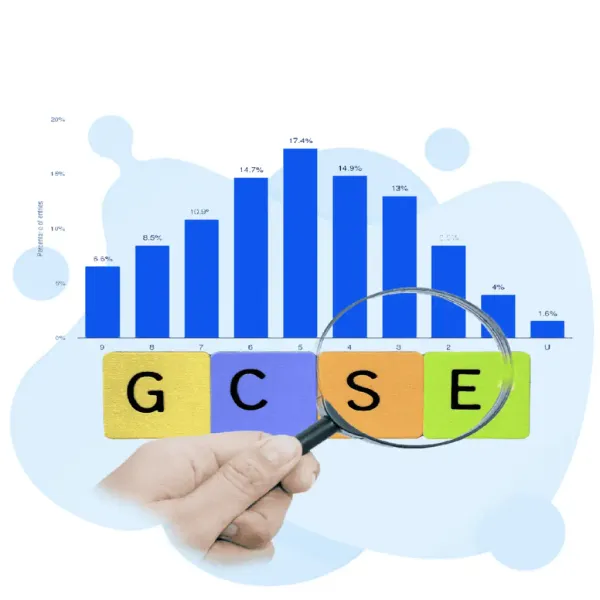
| Results in summer 2026 | 67.3% of UK GCSE results (all subjects) were graded 4/C or above, compared with 67.4% in 2025. | JCQ |
| Entry fee (for reference) | AQA charges UK centres £52.85 per entry for English Language or Mathematics in June 2027. Fees differ by subject and board, and schools normally pay for their own students. | AQA |
| Late entry | For AQA's summer 2027 series, a late fee applies from 22 February 2027 and a very late fee after 21 April 2027, at 100% and 150% of the entry fee on top of the normal fee. | AQA |
| Retakes | In England the only resits outside the summer series are English Language and Maths in November. A French resit means waiting for the next summer series. | GOV.UK |
Before the details, it helps to define GCSE properly. The meaning GCSE carries is General Certificate of Secondary Education, and the definition of GCSE is a subject-based qualification taken by students aged 14 to 16 across the UK. Each subject is a separate certificate, so a student might sit ten or more. This guide treats gcse French as a stand-alone course with its own exams, tiers, vocabulary lists and revision demands.
American readers often ask how this compares with a US high school course. The nearest comparison is a French class that ends with an externally set, externally marked exam, rather than a teacher's own final. There is no GPA and no continuous grading toward the result. Everything rests on four papers taken at the end of the two-year course, which makes steady revision across both years far more valuable than last-minute cramming before the summer.
Each skill gets equal weight. Listening tests whether you can follow recorded French at natural speed and answer the questions set. Speaking is a recorded conversation with your teacher covering a role play, a photo card and a general conversation. Reading mixes comprehension with a translation into English. Writing asks for short and extended answers, plus a translation into French. Because every paper is worth 25%, a weak skill cannot hide behind a strong one.
Searches for leaked papers appear every June, but they lead nowhere useful. Genuine exam papers stay secure until the exam has finished, and anything claiming to be an advance copy is a scam, an old paper relabelled, or a malpractice trap. Boards can disqualify candidates who use stolen material. Our explainer on leaked gcse papers and how the qualification works gives the wider background.
The legitimate alternative is better anyway. Exam boards publish past papers, mark schemes and examiner reports for free, and these show exactly how marks are awarded. Working through ten genuine past papers teaches the question styles, the typical traps and the vocabulary themes far more reliably than any rumour. Start with the most recent papers your board has released, then move backward, marking each one against the official scheme and noting every slip.
Tiers matter too. French is entered at Foundation tier, which covers grades 1 to 5, or Higher tier, which covers grades 4 to 9. Your teacher normally advises on the entry, and in many schools all four papers must be taken at the same tier. Foundation papers use shorter texts and more scaffolding, while Higher papers demand longer reading passages, more complex grammar and extended writing. Choosing the right tier protects a student from an unexpectedly low grade.
The rest of this guide covers the exam structure, mocks, vocabulary, translation, listening and reading practice, and a final preparation plan. Every section answers a question students actually type into search engines, from where to find Edexcel French past papers to how to practise listening in the weeks before the exam. Use the contents menu to jump around, and treat the free quizzes linked throughout as warm-ups for your wider GCSE revision.
How Big Is GCSE French? Key Numbers
What Is in the GCSE French Exam?
You hear recorded French speakers and answer comprehension questions, some in English and some in French. Foundation recordings are shorter and slower, while Higher recordings are longer and include more complex language. Numbers, times and negatives are favourite traps.
A recorded conversation with your teacher, made up of a role play, a photo card and a general conversation. You are judged on communication, range of language, pronunciation and accuracy, so rehearsed answers must still sound natural.
You read short texts on topics from family and school to travel and work, answer comprehension questions, and translate a passage from French into English. Higher tier adds longer literary or factual extracts with unfamiliar vocabulary.
Tasks range from short descriptions to an extended piece of around 150 words at Higher tier, plus a translation from English into French. Marks reward content, range of structures and accuracy of verbs, agreement and spelling.
Where Can I Find Edexcel GCSE French Past Papers Free Download?
Edexcel GCSE French past papers are free to download from the Pearson Edexcel website, and the same is true of AQA, WJEC Eduqas and CCEA. Look under the qualification page for your exact specification, then open the past papers section. Recent papers are normally released with their mark schemes once the exam series has finished, though some boards hold back the very latest paper so teachers can use it as mock material in school.
Students often ask about leaked papers from earlier years. Searches such as leaked gcse papers 2020 spiked because that summer's exams were cancelled and grades were awarded differently, which created confusion and rumours. No French papers were sat that year. If a website offers 2020 papers as a secret leak, treat it as fake. Genuine archived papers from other years sit openly on the boards' own sites.
Past papers gcse French students use should match the specification they are studying. The AQA course code is 8658 and Pearson Edexcel uses 1FR0. A paper from an older specification will have different question styles, so check the code on the front cover before you start. If you study with AQA, our aqa gcse skills checklist, written for biology, is still a handy model for tracking topics in any subject.
Each paper should be done under timed conditions at least once. Print the paper, set a timer, put your phone out of reach and sit it in silence. For listening, use the official audio files and play them only as many times as the real exam allows. After finishing, mark the work using the official scheme, then convert your raw total into an approximate grade using the boundaries published after that exam series.
Mark schemes are the most undervalued resource. They show which answers earn credit, how marks are split between communication and accuracy in writing, and which common errors cost points. In the writing paper, a student can produce a fluent paragraph and still lose marks for missing verb endings. Read three full mark schemes before you attempt your fourth past paper, and highlight the patterns in what examiners consistently reward.
Examiner reports are the other hidden gem. They explain where thousands of real candidates went wrong, such as confusing the near future with the perfect tense, mispronouncing words in the speaking test, or translating word for word. Reading a single report can fix mistakes you did not know you were making. Keep a notebook of the five most repeated errors and revisit it weekly so the corrections become automatic.
Finally, build a tracker. List every past paper for your board, tick each one when completed, and record the percentage plus the main weakness. After six papers, patterns appear. If listening scores sit at 55% while reading reaches 80%, shift your revision time accordingly. A simple spreadsheet is enough, and it gives teachers and tutors something concrete to work with when you ask where to focus the remaining weeks.
What Are GCSE Mocks in French and When Do They Happen?
A mock gcse in French normally takes place in December or January of Year 11, with some schools running an earlier set at the end of Year 10. Mocks mirror the real format: listening, reading and writing papers sat in the hall, and a speaking test usually held in class. Because gcse mocks fall roughly five months before the real exams, they leave enough time to repair weaknesses.
Some schools run two rounds, a shorter set in Year 10 and a full set in Year 11. The second round often uses a past paper from the exam board's archive, so avoid practising that exact paper beforehand if your teacher names it. Ask your department early for the dates so you can plan revision weeks around them instead of being surprised by a timetable change.
Are Mock GCSE French Papers Worth Doing?
- +They reveal your real weak skill while there is still time to fix it.
- +They rehearse exam stamina, since listening, reading and writing papers each need sustained focus.
- +They give a realistic grade estimate that helps confirm Foundation or Higher entry.
- +They train timing, so you stop running out of minutes on the writing translation.
- +They lower exam-day anxiety because the format already feels familiar.
- +They give teachers evidence to target support and write accurate predicted grades.
- −A poor mock result can hurt confidence if you treat it as a final verdict.
- −Mock grade boundaries are estimates and may not match the real series.
- −Preparing for mocks can crowd out revision for other subjects.
- −Speaking mocks may be short or informal and give less accurate feedback.
- −Practising the same paper twice inflates your score and hides weaknesses.
- −Mocks in December cover content you may not have finished teaching.
How Do I Prepare for the GCSE French Exam? A Checklist
- ✓Confirm your exam board and specification code with your teacher.
- ✓Download the official vocabulary list for your board and tier.
- ✓Learn 20 new words a day using flashcards in both directions.
- ✓Sit one full past paper under timed conditions each week.
- ✓Mark every paper with the official mark scheme.
- ✓Record yourself answering photo card questions out loud.
- ✓Practise ten translations in each direction every week.
- ✓Revise the present, perfect, imperfect and future tenses.
- ✓Read at least one examiner report for your board.
- ✓Plan the final month of revision around your lowest-scoring skill.
Vocabulary first, then verbs
Almost every paper draws on the board's published vocabulary list, so learning it systematically lifts all four skills at once. Pair that with secure present, perfect and future tenses, and many students gain a full grade without learning anything exotic.
What Do French Translations GCSE Students Need to Know?
French translations GCSE papers include two tasks: translating a short passage from French into English in the reading paper, and translating sentences from English into French in the writing paper. Both are worth meaningful marks, and both punish word-for-word thinking. Examiners award marks for conveying each unit of meaning accurately, so the goal is to read or write in meaningful chunks rather than translating single words in isolation and hoping the result makes sense.
For English-to-French translation, accuracy decides the score. Check every verb for tense and person, every adjective for gender and number agreement, and every noun for its article. A sentence such as 'My sister has gone to the new school' needs the correct auxiliary, a past participle that agrees where required, and the right preposition. Read each finished sentence back slowly, hunting for endings that look wrong or accents that have gone missing.
The vocabulary list matters because translation questions draw from it. The AQA GCSE French vocabulary list contains roughly 1,200 words for Foundation and about 1,700 for Higher, grouped across the three themes: identity and culture, local, national, international and global areas of interest, and current and future study and employment. Pearson Edexcel publishes its own list. Download the version for your board, because the overlap is large but not total.
To learn the list, use spaced repetition. Twenty words a day, tested in both directions, takes about 15 minutes and gets you through the full list in two to three months. Test yourself with a mock gcse paper every few weeks to check that the words survive under exam pressure. Cover the French side to test recall into French, then the English side to test recognition, and always add a short example sentence to each hard word.
Watch for false friends, which are the classic translation trap. Actuellement means currently, not actually. Assister means to attend, not to assist. Rester means to stay, not to rest. Une journée is a whole day, not a journey. Keep a running list of these, because examiners deliberately choose sentences where a tempting English lookalike gives the wrong meaning. Missing one such word costs a mark, and a list of fifteen is easy to memorise.
Rumours about so-called leaked gcse papers 2019 still circulate online, and they distract students from the work that actually moves a grade. No leaked paper can teach you the translation habit of chunking, checking agreement and reading back. The official archive contains many genuine translation tasks, each with a mark scheme showing which units of meaning were credited, which is a far better training ground than any rumour.
One of the GCSE's most useful features is that translation marking is transparent and predictable. Marks are given for specific units of meaning, so a partly correct sentence still earns credit. If you are unsure of a single word, never leave a gap: write a sensible attempt and move on. Practise ten short translations in each direction every week, correct them against the scheme, and track which grammar points keep cropping up.
Exam boards treat use of leaked material as malpractice, which can lead to disqualification from the qualification. Genuine papers are never released before the exam. Stick to official past papers and mark schemes, and check entry deadlines with your exams officer, since late fees apply after published cut-off dates.
What Is the Best GCSE Listening Practice French Routine?
The best GCSE listening practice French routine is short, daily and active: 15 to 20 minutes of French audio every day, plus one full timed listening paper each week. Little and often beats a long weekend session because your ear adapts gradually to speed, accent and rhythm. Pick audio at the right level so you understand around 70% on first hearing, then replay it with the transcript to close the gap.
Use a mix of sources. Official board audio gives the exact style of the exam, including the speed and the question formats. Beyond that, short news bulletins, learner podcasts and slower French radio expose you to different voices, which matters because the exam uses several speakers of different ages. Subtitled French videos are useful too, as long as you cover the English subtitles and check your understanding afterwards rather than relying on them.
Technique is as important as exposure. Read the questions before the recording starts and underline the key words, such as who, when, how much or why. Predict the type of answer you need: a time, a place, an opinion. During the first hearing, jot down numbers, names and negatives in short notes. On the second hearing, confirm or correct. Never leave an answer blank, since a sensible guess costs nothing.
Know the usual traps. French speakers often give a wrong option first and correct it, such as saying Tuesday and then no, Thursday. Numbers like soixante-dix and quatre-vingt-dix trip up many students, as do times written differently in speech. Opinions may be hidden in phrases like ce n'est pas mal, which means it is not bad, a positive comment. Collect these patterns in a notebook and rehearse them before every listening test.
Some students look for shortcuts, and searches like gcse 2020 papers leaked prove it. But listening is the one skill where a leaked paper helps least, because the recordings are never leaked and the skill comes from hours of exposure. Better to use the legitimate archive of past papers and spend those hours on real recordings. For a fuller picture of how exams are structured, read our complete guide to the GCSE exams.
Foundation and Higher listening differ in length and difficulty. Higher recordings are longer, include less common vocabulary and ask for more detailed answers, while Foundation recordings use clearer, shorter exchanges. Whichever tier you sit, practise the other one occasionally: Higher students gain accuracy from easier papers, and Foundation students stretch their ear with harder ones. In a typical british gcse course, listening is also the skill most schools test least outside exams.
Link listening to speaking. After each recording, summarise it aloud in French in three sentences, then record yourself and play it back. This builds pronunciation, which examiners reward in the speaking test, and it shows how listening and speaking reinforce each other. Shadowing, where you repeat a sentence a half-second after the speaker, is especially effective for rhythm and liaison. Ten minutes of shadowing a day produces noticeable improvement within a month.
How Do I Use AQA French GCSE Reading Past Papers and Finish Revising?
AQA French GCSE reading past papers are best used in three passes: a timed attempt, a marked review, and a vocabulary clean-up. First sit the paper without a dictionary and within the time limit. Then mark it with the official scheme and work out which questions failed because of vocabulary, grammar or technique. Finally, add every unknown word to your flashcards and redo the failed questions a week later to confirm the gap has closed.
In the final eight weeks, divide time by weakness rather than interest. In weeks eight to six, repair the lowest-scoring skill with two focused sessions a week. In weeks five to three, do a full timed paper in each skill. In the final two weeks, shift to light daily recall: vocabulary, verb tables, photo card answers and translation sentences. Cramming new material in the last days adds anxiety without adding marks.
For reading, use a consistent method. Skim the title and questions first, then read the text once for gist, then return to each question with the text in view. Underline the words that match the question rather than hunting for exact wording. Use cognates to guess meaning, but check context before trusting them. If a word blocks you, skip it and read around it, because the sense of the sentence often reveals the meaning.
For writing, prepare a bank of flexible sentences you can adapt to any topic. Include opinions with reasons, past, present and future time frames, a conditional sentence, and a few connectives such as cependant, parce que and de plus. Practise two extended answers a week and have a teacher or tutor mark them. Mark yourself first, checking verb endings, agreement and accents, because most lost marks come from careless slips, not lack of ideas.
For speaking, rehearse aloud, not silently. Record answers to the photo card and general conversation questions, then listen for hesitation, flat intonation and repeated phrases. Prepare for unexpected questions by practising how to buy time in French, using phrases like bonne question or laissez-moi réfléchir. Examiners value natural interaction over a memorised speech, so learn flexible chunks you can adapt rather than scripts that collapse when the conversation moves.
On exam day, arrive early, bring spare black pens, and read every instruction carefully. In listening, use the reading time. In reading, watch the clock and never spend more than a few minutes on one question. In writing, leave five minutes to check endings, accents and spelling. Sleep matters more than a final late revision session, so go to bed at a normal time the night before.
If you need more support, look into GCSE French courses. Options include school revision classes, online courses, private tutors and evening classes for adults, and private candidates can enter through an exam centre that accepts external entries. Check cost, qualifications and the exam board of any provider. Combine outside help with your own routine, because the strongest results come from daily practice, official past papers and honest review of mistakes.
GCSE Questions and Answers
GCSE 2026

AQA GCSE Biology Checklist: The Complete Skills & Revision List for 2026
Periodic Table GCSE: Groups, Trends, Electrons and Revision Guide

GCSE Subjects 2026: Compulsory, Optional & How to Choose

What Is GCSE? The General Certificate of Secondary Education Explained

GCSE 2026: Complete Guide to GCSE Exams in England

GCSE Tutors & Tuition: Find the Right Programme
How this page was made: written with AI tools. Exam facts are checked against the official sources listed below. Not reviewed by a subject-matter expert. Editorial policy
Sources & references
Exam facts on this page (fees, format, dates, passing scores) are checked against these official sources; the date is our last check. Editorial policy
- gov.uk — Test delivery, retake policy, passing score · verified Oct 2026
- aqa.org.uk — Exam format, fees, late registration, retake fee · verified Oct 2026
- jcq.org.uk — Exam information · verified Oct 2026