
Forklift Jobs Near Me: Pay, Top Employers, Shifts & How to Apply 2026 October
Find forklift jobs near me with pay ranges, top employers, ✏️ OSHA certification, shift options, and the full application process explained.
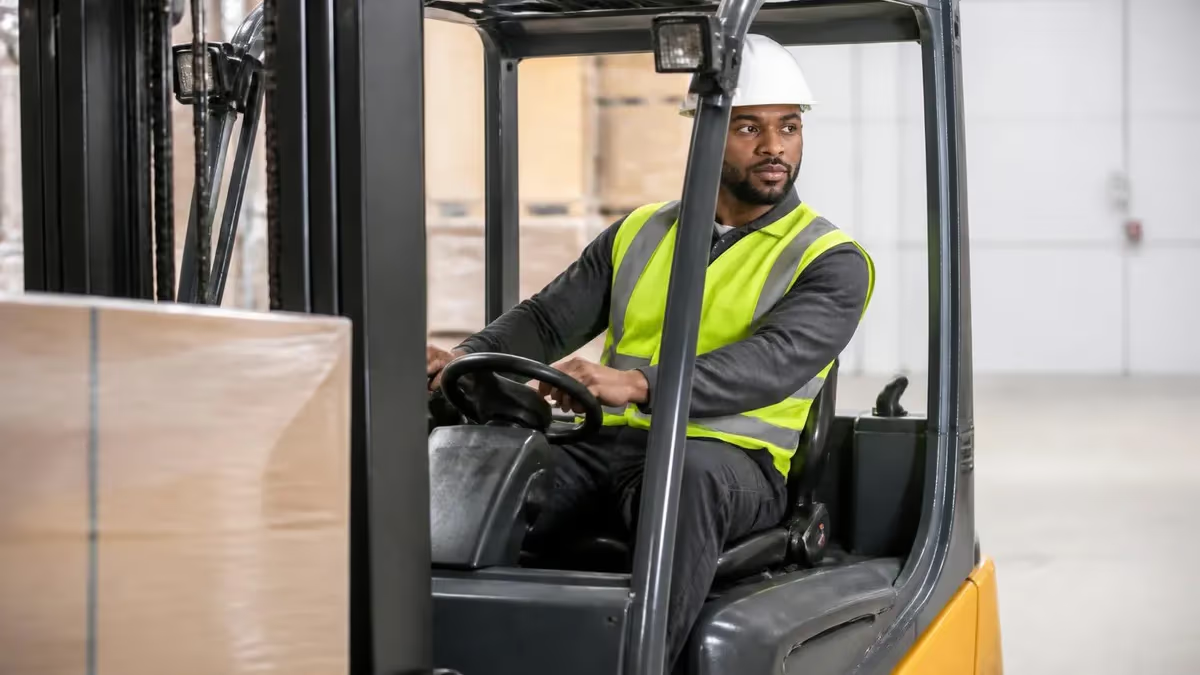
You want a forklift job close to home — and that instinct is right. Warehouse work, manufacturing, distribution, lumberyards — almost all of it is local. A 60-minute commute eats your day, your gas budget, and your knees before you even clock in. Most local Google searches pull jobs inside a 25-50 mile radius, which is exactly the sweet spot for blue-collar hiring.
Local employers actually prefer local hires. Less commute means fewer call-outs, faster start dates, and easier coverage when someone calls out sick at 4 AM. If you live ten minutes from a distribution center, you're already ahead of half the applicants on paper. Recruiters know that drivers who live close stick around longer — turnover is the silent killer in warehouse staffing.
So when you search 'forklift jobs near me,' you're not just being lazy about commute. You're aligning your search with what employers actually want. Start with a forklift jobs overview to see the full landscape before you narrow it down by zip code.
Local intent also unlocks better pay tools. You can compare two warehouses across town, drive by both, even chat with current drivers in the parking lot at shift change. None of that is possible if your search radius stretches across three counties. Keep it tight, keep it close, and you'll get hired faster with less stress on your tank and your back.
Think about the long game too. Local jobs make it easier to switch employers if a better offer comes along — you keep the same commute, same neighborhood, same routine. Drivers who stay local often build reputations across nearby warehouses and get poached for better roles within a year or two. That kind of word-of-mouth movement is hard to pull off when you're driving an hour each way to a single faraway employer in another part of the metro.
For a deeper look at this topic, see our guide to forklift jobs near me.

Pay: $15-$28/hour depending on industry, shift, and certification. Demand: very high — warehouses are short-staffed in most major US metros. Entry barrier: low — high school diploma, OSHA cert, drug screen. Time to hire: often under two weeks from application to start date. Best places to look: Indeed, ZipRecruiter, LinkedIn Jobs, and walking into warehouses that have a help-wanted sign on the door.
Forget shotgun-blasting your resume across the internet. The fastest hires come from a small handful of reliable channels. Indeed dominates raw volume — filter by zip code, shift, and pay range. ZipRecruiter is the king of quick-apply for hourly warehouse roles, and it'll send you new listings by text. LinkedIn Jobs handles the slightly higher-skill stuff, especially reach truck operator roles and supervisor postings.
SnagAJob still works for hourly positions if you want one-tap apply. Glassdoor pulls double duty with salary data — check the company before you interview. Don't sleep on Craigslist either. Small family-owned distributors and warehouses still post there because it's cheap. The listings are less polished but the jobs are real.
Staffing agencies are the secret weapon. Aerotek, Adecco, Kelly Services, and Randstad run temp-to-perm pipelines all day long. Many drivers landed their best long-term gig through a six-week temp assignment that converted to a direct hire. Don't overlook the local newspaper classifieds online either — older employers still post there.
One more channel most people miss: hospital, university, and military base logistics teams. They hire forklift operators steadily, pay well, and offer pension-style benefits that private warehouses can't match. Check the careers page on every large institution within driving distance. Government jobs through usajobs.gov also list material handler roles with hourly pay in the GS-5 to GS-7 range, which beats most private DCs.
Typical Forklift Pay at a Glance
Where You'll Actually Work
About 70% of all forklift jobs sit inside warehouse and distribution centers. Think Amazon fulfillment, FedEx Ground hubs, Walmart DCs, and 3PL operators. The work is fast, repetitive, and structured around pick rates. Most use counterbalance trucks, reach trucks, and pallet jacks. Climate-controlled or ambient — depends on what's stored. Expect steady hours, performance bonuses, and clear advancement paths into shift lead or trainer roles.
Pay isn't just about your experience — it's mostly about which industry you land in. Logistics and 3PL operators run $18-$23/hr because the work is high-volume and competitive. Auto manufacturing pays $20-$28/hr thanks to union contracts and parent-company budgets. Aerospace tops the list — Boeing, Lockheed, Raytheon vendors pay $24-$32/hr and demand security clearances for some roles. That clearance alone bumps you up the food chain.
Cold storage runs $19-$24/hr (premium for the cold). Construction hits $22-$28/hr but the season can be short in northern states. Retail and big-box distribution sits at the bottom — $15-$20/hr — but the volume is huge and the hiring is fast. If you need a paycheck this week, retail DCs hire fastest.
Government and federal contractor jobs through usajobs.gov run $20-$28/hr with the best benefits package you'll see anywhere — pension, full medical, generous PTO. Hazmat operations (chemical plants, fuel depots) pay $22-$30/hr and require extra certifications beyond standard OSHA. The certification effort pays back fast.
What about union vs non-union? It matters more than people think. Teamsters-represented drivers at UPS, big retail DCs, and grocery warehouses earn $5-$10/hr more than non-union peers doing identical work. Trade-off: union dues run roughly $50-$80/month, and you'll have less flexibility on shift swaps. For most drivers the math still pays off long-term, especially when you factor in pension contributions and grievance protection.
Hourly Pay by Industry
Top Employers Hiring Forklift Drivers Right Now
- ✓Amazon — by far the largest warehouse employer in the country, hiring continuously
- ✓FedEx Ground — high volume, structured shifts, decent pay with overtime available
- ✓UPS — Teamsters union wages, strong benefits, very stable long-term employer
- ✓Walmart Distribution — steady hours, internal advancement, reliable hiring funnel
- ✓Costco — pays well but limited openings (low turnover, people stay for decades)
- ✓Home Depot and Lowe's distribution centers — regional hubs in most major metros
- ✓Pepsi and Coca-Cola regional distribution — beverage handling and route support
- ✓Sysco and US Foods (food service distribution) — cold storage and route prep
- ✓Local beverage wholesalers — often overlooked but pay competitive wages
- ✓Government contractors — aerospace, defense, federal logistics through usajobs.gov

The Forklift Job Application Process Step by Step
Step 1 — Update resume
Step 2 — Get OSHA certified
Step 3 — Search daily
Step 4 — Apply within 24 hours
Step 5 — Background check
Step 6 — Drug screen
Step 7 — Physical exam
Step 8 — In-person interview
Step 9 — Skills test
Step 10 — Offer letter
Most postings list a wall of requirements, but only a few are real deal-breakers. You need to be 18 or older — federal minimum for operating powered industrial equipment. You need a high school diploma or GED — about 70% of employers will reject without it, even if you have years of experience. You need a valid forklift license in the form of OSHA certification, current within the last three years.
You need to pass a background check and, usually, a pre-employment drug screen. Recent felonies (especially theft, violence, or drug-related charges) are dealbreakers because you'll be trusted with inventory worth millions. Some warehouses are stricter than others — Amazon and Walmart run tighter screens than smaller distributors.
Physical requirements are real and they're not just box-ticking. Lift 50 lbs repeatedly through an 8-hour shift. Stand 8+ hours. Climb on and off machines maybe 30 times a day. Vision matters — corrected is fine, but uncorrected issues are a safety risk. Read English well enough to follow safety procedures and warning signage. Communicate clearly with team leads over the radio. Speak Spanish? Huge advantage in most metros.
One more under-the-radar requirement: a clean driving record outside of work. Some employers pull your DMV history because they want to know how you behave behind any wheel. Multiple speeding tickets, recent at-fault accidents, or DUI convictions raise red flags. Warehouse insurance carriers care. If your driving record is messy, focus on smaller employers who don't run a full DMV pull during background screening.
Minimum Qualifications and How to Stand Out
- ✓High school diploma or GED — about 70% of employers require this
- ✓18 years or older — federal minimum for powered industrial equipment
- ✓Valid OSHA forklift certification (3-year cycle, renewable)
- ✓Pass a 7-year criminal background check with no recent felonies
- ✓Pass a pre-employment drug screen (state-dependent for marijuana)
- ✓Lift 50 lbs and stand 8+ hours per shift without restriction
- ✓List every specific forklift type you've operated with dates
- ✓Quantify achievements — pallet counts, safety record, zero-accident years
- ✓Mention specialty experience — cold storage, hazmat, rough terrain
- ✓Spanish (or any second language) — huge plus in most US warehouses
Specialty Forklift Pay — Where the Real Money Lives
- Pay range: $20-$28/hr
- Skill level: Intermediate
- Best for: High-bay warehouses
- Pay range: $16-$23/hr
- Skill level: Entry
- Best for: General warehouse
- Pay range: $15-$20/hr
- Skill level: Entry
- Best for: Floor moves, dock work
- Pay range: $18-$25/hr
- Skill level: Intermediate
- Best for: E-commerce fulfillment
- Pay range: $22-$30/hr
- Skill level: Advanced
- Best for: Construction sites
- Pay range: $25-$35/hr
- Skill level: Advanced
- Best for: Port and rail yards
- Pay range: $25-$32/hr
- Skill level: Advanced
- Best for: Very tall storage racks
OSHA forklift certification isn't optional. It's federal law under 29 CFR 1910.178, and every employer has to verify it before letting you operate. The good news? Getting certified is fast and cheap. A typical course runs 1-2 days, costs $50-$200, and covers both classroom theory and a practical hands-on evaluation behind the controls.
The cert is valid for three years. After that, you renew — and most employers pay for the renewal as part of their safety program. There's no federal license per se; certification is issued by your employer or a third-party training provider that meets OSHA's standards. New to forklifts entirely? Get certified before you apply. It immediately moves you up the candidate stack and signals you're serious.
For deeper training paths, check the forklift training guide. The full OSHA framework — including written test, practical evaluation, and the difference between operator types — is covered in our OSHA forklift certification breakdown. Class I through Class VII trucks each require their own evaluation.
Watch out for online-only certifications that promise 'OSHA compliant' for $30. Pure classroom theory without a hands-on practical evaluation does not meet 29 CFR 1910.178. Your employer is required to evaluate you on the actual equipment you'll operate, in the actual workplace. So even a perfect online course won't get you in the truck — you still need the practical sign-off from a qualified evaluator at the worksite.
Watch out: Many employers — especially Amazon, Walmart DC, FedEx Ground, and most major warehouses — provide OSHA forklift training and certification for free during onboarding. If you can't afford the $200 upfront, apply first. Mention in the interview that you're willing to certify on day one. Plenty of warehouses hire uncertified candidates and train them in week one of employment.
Shift Options and What They Pay
The classic 6 AM - 3 PM shift. Most common, most competitive. Standard pay with no shift differential. Best for people with kids in school or who want evenings free. Tends to fill quickly when posted — apply within hours of the listing going live. Heavy supervisor presence which can be a plus or minus depending on your management.

Cost of living drives forklift pay more than skill level does. Coastal cities pay more because rent is brutal and labor pools are thinner. Mid-size Sun Belt metros pay less because the labor pool is deeper and the cost of living is lower. Knowing your local range gives you negotiating ammunition. Don't accept the first offer if the city average is higher.
Seattle, New York, and Boston lead the pack — all over $19/hr average. Chicago and Houston cluster around $17-$24/hr. Los Angeles runs $18-$25/hr depending on which warehouse district. Atlanta and Phoenix sit at the lower end at $16-$22/hr but the cost of living offsets some of that gap. National average is roughly $18.50/hr in 2026.
Don't forget to factor in commute cost — gas, tolls, parking, vehicle wear — and shift differential when comparing offers. A $20/hr job 5 miles away beats a $22/hr job 30 miles away once you do the math. Use the IRS standard mileage rate of $0.67 per mile as a rough proxy for commute cost.
Cost of living calculators help too. A $22/hr job in Phoenix often goes further than $26/hr in Boston once rent, taxes, and groceries are factored. Don't move metros chasing a higher headline number unless the lifestyle math actually works out. Local stays local for a reason — your dollar stretches further when you already have housing and a support network where you live.
Average Hourly Pay by US City
Forklift interviews are short and practical — most run 15-30 minutes. Don't expect a corporate-style behavioral grilling. Expect basic questions plus a few safety scenarios. The classics show up every time: 'Why do you want this job?' 'Describe a time you avoided an accident.' 'What forklifts have you operated and which do you prefer?' 'How do you handle stress in a fast-paced warehouse during peak season?'
Logistics questions matter just as much: 'Can you work overtime?' 'Are you available nights and weekends if needed?' 'Any felony convictions in the last seven years?' 'Do you have a valid driver's license?' Be honest about everything. Lying on your application or in interview is the fastest way to get fired in week one — background checks catch it.
Have your own questions ready too. Ask about pick rate expectations, accident history, turnover rate, and shift differential. Smart questions signal you've done your homework. The forklift operator role guide has more interview prep examples worth reading before you sit down across from a hiring manager.
Dress matters more than you'd think — clean jeans, work boots, and a button-down or polo. Don't show up in a suit; don't show up in shorts. The interviewer will probably be in steel-toes and a hi-vis vest, so match the energy. Bring two copies of your resume, your OSHA cert card, and a written list of references. Old-school, but it still impresses managers who've seen too many casual applicants.
Benefits to Negotiate (Don't Just Accept Base Pay)
- ✓Health insurance — usually kicks in after 60-90 days at major employers
- ✓Dental and vision coverage — separate enrollment, often low employee cost
- ✓401(k) retirement plan with employer match of 3-6% typical
- ✓Paid time off — 10-20 days per year depending on tenure and employer size
- ✓Sick leave kept separate from PTO at larger employers like Amazon and UPS
- ✓Tuition or education reimbursement (Amazon, Walmart, UPS lead the industry here)
- ✓Performance bonuses tied to pick rate, accuracy, or productivity metrics
- ✓Safety bonuses paid quarterly for zero-accident performance
- ✓Steel-toed boots provided free or reimbursed up to $100-$150 annually
- ✓Company-paid OSHA renewal every 3 years plus first-aid and CPR training
Most rejections come down to a handful of repeating issues. Background check failures top the list — recent felonies, especially theft or violence-related, are dealbreakers for warehouse jobs because you're trusted with valuable inventory and heavy equipment. Drug screen positives are a close second. Marijuana is state-dependent now, but most large warehouses still test and reject regardless of state legality, particularly federal contractors.
Missing HS diploma or GED disqualifies you at maybe 70% of employers. Uncorrected vision problems are a safety issue and most postings list 20/40 corrected as the minimum. DUI on record is a real concern when you'll be operating heavy equipment around people. Felony theft history triggers automatic rejection at almost every distribution center because you're trusted with millions in inventory.
Bad references from previous warehouse jobs hurt more than people think — the warehouse industry is small and managers often know each other. Burned bridges follow you. So does no-call-no-show history. Keep your record clean and don't ghost employers; word travels.
If you've got something on your record, address it head-on. Many employers run 'fair chance' or second-chance hiring programs — Amazon, Walmart, and several major DCs publicly support them. Be upfront in the application and the interview. Lying about a felony is worse than the felony itself because it shows up on the background check anyway. Owning your story builds trust with managers who've seen everything.
Forklift Career Path — Where You Can Actually Go
Step 1 — Entry forklift driver
Step 2 — Senior driver
Step 3 — Shift lead
Step 4 — Trainer / safety officer
Step 5 — Warehouse supervisor
Step 6 — Operations manager
Step 7 — Distribution center director
Honest Pros and Cons of a Forklift Career
- +Strong starting pay — $30-$50K with no college degree required
- +Only 3-year OSHA cert needed — no expensive licensing exam process
- +Massive demand in nearly every US metro, especially e-commerce hubs
- +Active physical work, not chained to a desk for eight hours
- +Wide variety of employers — warehouse, manufacturing, construction, retail
- +Overtime is common and pays time-and-a-half above 40 hours
- +Clear advancement path to supervisor and operations management
- +Many employers pay for certifications, renewals, and safety training
- +Schedule flexibility — days, evenings, nights, weekends all available
- +Specialty roles pay $25-$35/hr after a few years of experience
- −Physically demanding — back, knees, and shoulders take a beating over time
- −Repetitive motion injuries are common over a 10-20 year career
- −Lower wages than skilled trades like welding, HVAC, or electrical
- −Real safety risks — 5,000+ forklift injuries reported each year in the US
- −Background and drug screens disqualify many applicants up front
- −Pay tied to warehouse logistics — recessions cut hours and overtime
- −Mandatory overtime in peak seasons (Q4 e-commerce, harvest, holiday)
- −Night and weekend shifts disrupt family and social life
- −Limited remote or flexible-location options — you go where the forklift is
- −Some employers run punishing pick-rate metrics that lead to burnout
Pros and Cons at a Glance
| Pros | Cons |
|---|---|
| Massive demand in nearly every US metro, especially e-commerce hubs | Physically demanding — back, knees, and shoulders take a beating over time |
| Active physical work, not chained to a desk for eight hours | Lower wages than skilled trades like welding, HVAC, or electrical |
| Wide variety of employers — warehouse, manufacturing, construction, retail | Background and drug screens disqualify many applicants up front |
| Clear advancement path to supervisor and operations management | Pay tied to warehouse logistics — recessions cut hours and overtime |
| Many employers pay for certifications, renewals, and safety training | Night and weekend shifts disrupt family and social life |
| Schedule flexibility — days, evenings, nights, weekends all available | Limited remote or flexible-location options — you go where the forklift is |
Open Indeed and search 'forklift jobs near me [your city].' Set the radius to 25 miles. Filter by full-time, hourly pay, and shift preference. That alone gives you 50+ listings in most major metros. Then hit ZipRecruiter for quick-apply — you can knock out 10 applications in an hour and they'll text you new matches. LinkedIn is worth a pass for more professional roles, especially if you want supervisor or trainer positions down the road.
Don't ignore local Facebook groups. Community job boards turn up listings that never hit the big sites — especially small family-owned warehouses and beverage distributors. Walk in to warehouses with help-wanted signs on the door — old-school approach but it still works, particularly with smaller operators who post on the door before they post online.
Staffing agencies like Aerotek, Kelly Services, and Adecco run temp-to-perm pipelines that convert at 60-70% within six months. For federal jobs (highest pay, best benefits), check usajobs.gov and look for GS-5 through GS-7 material handler roles. Some military bases hire civilian forklift operators with strong pay and pension benefits.
Bottom line: local forklift jobs are abundant in nearly every US metro. Pay ranges $15-$28/hour depending on industry, experience, and shift. Get OSHA certification ($50-$200, three-year validity) before applying — it moves you up the candidate stack. Apply via Indeed, LinkedIn, ZipRecruiter, and check warehouse storefronts directly. Specialty forklifts (reach truck, container handler) pay $5-$10 more per hour. The career path leads to warehouse supervisor and operations management with no college required.
Mistakes That Kill Forklift Applications
- ✓Applying without OSHA certification when the listing says required up front
- ✓Lying about experience or which forklift types you've actually operated
- ✓Skipping the cover letter when one is requested in the posting
- ✓Ignoring the physical requirements until you fail the physical exam
- ✓Accepting the first offer without checking local pay ranges on Glassdoor
- ✓Applying to high-turnover companies without reading employee reviews
- ✓Forgetting to ask about benefits, PTO, shift differential, and bonuses
- ✓Accepting an offer without seeing the exact schedule in writing first
- ✓Not confirming whether the role is full-time, part-time, or seasonal-only
- ✓Missing the drug screen window after offer — usually 48-72 hours
Sample Forklift certification Practice Questions
Try these questions from our free Forklift certification practice tests. The correct answer and an explanation follow each question.
Under OSHA 1910.178, how often must an employer evaluate each forklift operator's performance?
- A. At least once every three years
- B. At least once every year
- C. Only once at hiring
- D. Every five years
Answer: A. At least once every three years
OSHA requires employers to evaluate each powered industrial truck operator's performance at least once every three years.
Which of these is an employer responsibility regarding forklift maintenance?
- A. Remove damaged trucks from service until repaired
- B. Allow use until the truck fully fails
- C. Let operators repair trucks themselves without training
- D. Delay repairs to the annual inspection
Answer: A. Remove damaged trucks from service until repaired
Employers must remove any forklift in unsafe condition from service until it is repaired.
An employer is cited for the same forklift violation found at a previous inspection. What is this classified as?
- A. A serious violation
- B. A repeat violation
- C. A de minimis violation
- D. An other-than-serious violation
Answer: B. A repeat violation
A repeat violation occurs when a substantially similar violation is found on re-inspection within the look-back period.
Which document must an employer keep to prove operator certification?
- A. A verbal acknowledgment
- B. A written record of training and evaluation
- C. The operator's resume
- D. A photo of the operator
Answer: B. A written record of training and evaluation
Employers must maintain a written record certifying each operator's training and evaluation.
Forklift Jobs Near Me Questions and Answers
About the Author

Certified Crane Operator & Skilled Trades Exam Specialist
Ferris State UniversityRobert Martinez is a Journeyman Ironworker, NCCCO-certified crane operator, and forklift trainer with a Bachelor of Science in Construction Technology from Ferris State University. He has 21 years of ironworking, rigging, and heavy equipment operation experience across high-rise and industrial construction sites. Robert prepares candidates for crane operator, rigger, forklift, and skilled trades certification examinations.