
Caterpillar Forklift Models: Cat VC60C Forklift Guide, Rental Options, and Operator Training
🎯 Cat VC60C forklift basics, Caterpillar forklift models, rental vs. buying, and US operator training rules, with free practice questions to test yourself.

The Cat VC60C forklift is the kind of machine that turns up in used-equipment listings, rental fleets, and warehouse floors across the United States. Buyers and operators often struggle to find clear information about it. Cat lift trucks have a long reputation for rugged, dependable design. Understanding how a model like the VC60C fits into the wider lineup helps you choose, inspect, and operate it correctly. This guide covers the lineup, the practical questions, and the training rules.
Cat lift trucks are not built in Caterpillar's heavy-equipment plants. They are produced under a trademark license by Mitsubishi Logisnext, which grew out of the former Mitsubishi Caterpillar Forklift America joint venture. That explains why dealer networks and parts catalogs look different from Caterpillar's dirt-moving machines. When you compare caterpillar forklift models, expect to work with a lift-truck dealer for service, parts, and rental, not a construction dealer.
Cat model names reward a little decoding. Prefixes and numbers usually signal the power type, tire style, and rated capacity in hundreds of pounds, so a 60 in the name points toward the 6,000-pound class. Letters at the end often mark a design generation. Because naming has shifted across decades, never rely on the badge alone. Read the data plate for the actual capacity, load center, and attachment limits before you lift anything.
Most searches for the VC60C come from three groups. Fleet managers want to know whether an older unit is still worth keeping. Buyers scanning forklift for sale listings want to confirm exactly what they are looking at. New operators want to know what training the machine requires. All three groups benefit from the same basics: identify the class, confirm capacity, inspect the truck, and make sure every operator holds valid employer certification.
Many businesses never buy at all. A forklift rental can cover a seasonal peak, a short project, or a trial period before purchase, and a search for forklift rental near me usually surfaces dealers offering same-day delivery. Rental rates vary by region, capacity, and term, so we will walk through how to compare quotes later. The key point now is that renting does not shift your safety obligations. The employer still has to train and evaluate every operator.
This article is awareness content, not a manufacturer spec sheet. Always defer to the operator's manual and the nameplate on your specific truck. Where numbers appear, they are typical industry figures meant to orient you. Use them to ask better questions of dealers, inspectors, and trainers. They also help you prepare for the kinds of questions that appear on forklift practice tests about truck types, capacity, and stability.
Below you will find a snapshot of key statistics, a breakdown of lift-truck types, an in-depth look at specs and inspection, rental versus ownership considerations, training and certification requirements, and a final prep section. Free practice questions are linked throughout so you can test what you learn. Take them in order, review the explanations for any you miss, and you will walk onto the floor better prepared than most new hires.
Cat Forklifts and Operator Rules by the Numbers
Caterpillar Forklift Models by Truck Type
The classic Cat workhorse runs on LP gas, gasoline, or diesel. Cushion-tire units suit smooth indoor floors and docks, while pneumatic tires handle yards and uneven pavement. Trucks in the 6,000-pound class sit in this group and handle everyday pallet work reliably.
Battery-powered counterbalanced trucks produce no exhaust at the truck, making them ideal for food, retail, and enclosed warehouses. Three-wheel versions turn tightly, while four-wheel versions carry heavier loads. Lithium-ion options now allow fast charging during breaks.
Reach trucks, stand-up riders, and order pickers fit tight racking and maximize storage density. The operator stands on a platform, which changes controls, tip-over response, and training needs. Each design requires its own evaluation before independent operation.
Outdoor lumber yards and construction sites use rough-terrain trucks and large-capacity units with big pneumatic tires and powerful engines. Capacity ratings drop with tall masts and attachments, so operators must read the load chart for each configuration.
Cat VC60C Forklift: Capacity, Specs, and What to Inspect
Start with what the VC60C represents: a mid-capacity internal combustion lift truck in the roughly 6,000-pound class, the kind of workhorse used on loading docks, in lumber yards, and in manufacturing plants. Capacity figures on any forklift apply only at a stated load center, usually 24 inches, and only with the original mast and attachments. Add a side shifter or longer forks and the real capacity drops. The nameplate is the only authority.
Consider a practical example. A truck rated at 6,000 pounds at a 24-inch load center is handling a pallet whose center of gravity sits 36 inches from the fork face. As a rough rule, the effective capacity falls toward 4,000 pounds. Operators who do not understand this relationship overload trucks without realizing it. That is why load center and the stability triangle appear on nearly every operator exam and every serious training course.
Before any shift, OSHA requires that powered industrial trucks be examined at least daily, or after each shift when used around the clock. Walk around the truck first. Check tires for chunking or flat spots, forks for cracks and heel wear, mast chains for rust or stretch, and hydraulic hoses for leaks. Then check fluids, horn, lights, brakes, and steering. Tag out any truck with a defect and report it immediately.
Internal combustion trucks in this class run on LP gas, gasoline, or diesel depending on configuration. LP-gas units are popular indoors with good ventilation because their exhaust is cleaner than diesel, though carbon monoxide remains a hazard. Operators should know how to change a propane cylinder safely, wearing gloves and eye protection and keeping cylinders away from ignition sources. Diesel units suit outdoor yards where torque matters more than emissions.
If you are shopping for a forklift for sale, hours on the meter matter, but maintenance history matters more. A truck with 9,000 hours and complete service records can outperform a neglected 5,000-hour unit. Ask for the serial number, then request records of mast rebuilds, transmission service, and brake work. Test drive under load, listen for whining hydraulics, and watch for drift when the forks are raised. Have an independent technician inspect before you sign.
Parts availability is a quiet advantage of established brands. Cat-licensed dealers stock wear items such as filters, belts, brake components, and tires for popular models, and older generations can often be supported through aftermarket suppliers. Still, ask the dealer whether specific parts for your serial range are in stock before you buy. A truck waiting two weeks for a hydraulic valve erases whatever you saved compared with a newer machine.
Never modify a truck or add an attachment without written manufacturer approval. OSHA requires that modifications affecting capacity, operation, or safety be approved in writing by the manufacturer, and that capacity plates, tags, and markings be updated to match. A fork positioner, rotator, or clamp changes both weight and load center. If a used truck arrives with an attachment but no updated nameplate, treat the listed capacity as unreliable until documentation arrives.
Forklift Rental vs. Buying: Which Fits Your Operation?
A forklift rental makes sense when demand is temporary or uncertain. Short-term rentals cover seasonal peaks, plant shutdown projects, and trial periods before a purchase. Dealers typically deliver the truck, include scheduled maintenance, and swap the unit if it breaks down. You also avoid capital outlay, storage, and resale risk. For a warehouse adding a second shift for ten weeks, renting a Cat-class truck often costs far less than owning one.
Searching forklift rental near me will surface local dealers, national chains, and equipment brokers. Compare delivery radius, response time for service calls, and whether operator training is included or available. Renting does not transfer safety responsibility. You must still train and evaluate each operator, provide the operator's manual, and perform daily inspections. Ask the dealer for a controls walkthrough at delivery, and document who attended.
Is a Cat Internal Combustion Forklift Right for You?
- +Strong torque for ramps, docks, and heavy pallet work
- +Fast refueling with LP gas or diesel, no charging downtime
- +Established dealer and parts network for Cat-licensed trucks
- +Cushion and pneumatic tire options fit indoor and outdoor jobs
- +Lower purchase price than comparable lithium-ion electric trucks
- +Large used market makes finding a forklift for sale easy
- −Exhaust emissions limit use in enclosed or poorly ventilated areas
- −Fuel, engine oil, and exhaust system maintenance add ongoing costs
- −Noisier than an electric forklift, which affects operator comfort
- −Propane cylinder handling adds a safety procedure to learn
- −Not suited to very narrow aisles where stand-up trucks excel
- −Older units may lack modern operator-assist and stability features
Forklift Operator Pre-Shift Checklist
- ✓Confirm the data plate matches the truck and attachments.
- ✓Check tires for cuts, chunking, and proper pressure.
- ✓Inspect forks for cracks, bends, and heel wear.
- ✓Examine mast, chains, and hoses for leaks or damage.
- ✓Test the horn, lights, and backup alarm.
- ✓Verify brakes and parking brake hold the truck firmly.
- ✓Check engine oil, coolant, hydraulic fluid, or battery charge.
- ✓Inspect the propane cylinder mount and hose connections.
- ✓Buckle the seat belt and adjust mirrors and seat position.
- ✓Tag out any defective truck and report the problem.
Read the data plate before you trust the model name
Badges like VC60C hint at capacity, but the data plate is the legal record. It lists rated capacity at a stated load center, plus attachment limits. If the plate is missing, unreadable, or does not match the truck's attachments, do not lift until the dealer provides updated documentation.
Forklift Training and Certification of Forklift Operators
Whatever badge is on the hood, the legal requirements for a forklift operator come from OSHA standard 29 CFR 1910.178. It requires employers to train and evaluate every operator before they use a powered industrial truck without direct supervision. Many people search for certification of forklift operation expecting a government-issued card, but OSHA does not issue one. The employer certifies that training and evaluation were completed, and that certification is tied to that employer and the trucks used.
Forklift training has three required parts. First comes formal instruction, such as a classroom lecture, video, or online course, covering truck controls, stability, load handling, and workplace hazards. Second is practical training, where the trainee drives under the supervision of a qualified trainer. Third is an evaluation of performance in the actual workplace. Online courses satisfy only the first part, so a provider promising full certification without a hands-on evaluation is selling something incomplete.
Operators must generally be at least 18 to operate a forklift in non-agricultural workplaces under federal hazardous-occupations rules. Beyond age, trainees should be physically able to see, hear, and control the truck. Trainers must have the knowledge, training, and experience to teach and evaluate operators. A trainer who has never driven the specific truck type in your facility is a weak link, so ask who will conduct the practical evaluation before paying for any program.
Refresher training is required in several situations: after an accident or near miss, when an operator is observed driving unsafely, when an evaluation shows a deficiency, when workplace conditions change, or when the operator is assigned a different type of truck. Separately, performance must be re-evaluated at least once every three years. A worker certified on a Cat cushion-tire truck needs additional training before moving to a stand-up rider or an order picker.
The standard lists truck-related topics such as operating instructions, differences from automobiles, controls, fork and attachment use, capacity and stability, fueling or charging, and steering and braking. Workplace topics include surface conditions, load composition, pedestrian traffic, ramps, narrow aisles, hazardous locations, and ventilation. Because both lists matter, a generic course never completes the job alone. The site-specific evaluation fills the gap by covering your dock, racks, and traffic patterns.
Documentation matters during inspections and after incidents. Records should include the operator's name, training dates, evaluation date, and the trainer's identity. Keep the file accessible and calendar the three-year evaluation so it never lapses. Many employers also keep the evaluation checklist showing which truck types were covered. If OSHA investigates an accident, missing training records can lead to citations, and the penalties far exceed the cost of a one-day refresher.
Practice questions help you master the written side. Expect items on the stability triangle, load center, traveling with forks low, driving ramps with the load facing uphill, and what to do if the truck starts to tip. The tip-over answer surprises many people: on a sit-down truck with a seat belt, stay in the seat, brace your feet, grip the wheel, and lean away from the fall. Jumping out is a leading way operators are crushed.
An operator card from a previous employer does not satisfy OSHA at a new job. The new employer must verify training and evaluate the operator on the trucks and hazards at that site. Never assume a rented truck or a new class of lift truck is covered by your existing certification.
Electric Forklift, Stand Up Forklift, and Cherry Picker Forklift Types
Caterpillar-branded lineups are not limited to internal combustion trucks. The broader lift-truck market, including Cat-licensed models, covers each major power and design category, and the right choice depends on aisle width, floor surface, and shift length. An electric forklift runs on a lead-acid or lithium-ion battery and produces no exhaust at the truck. That makes it the standard choice indoors, in food handling, and anywhere air quality is regulated.
Electric trucks come as three-wheel or four-wheel sit-down units, which fall into OSHA's Class 1, along with narrow-aisle trucks and pallet jacks in Classes 2 and 3. Battery charging requires its own procedures: ventilated areas, no smoking, eye protection, and careful handling of acid. Lithium-ion batteries allow opportunity charging during breaks and eliminate watering, which is why more fleets are converting despite a higher purchase price than traditional lead-acid.
A stand up forklift places the operator on a platform with a compact chassis that turns in tight spaces. Stand-up riders suit narrow aisles, dock work, and operations where operators step on and off hundreds of times per shift. Reach trucks, a related design, extend the forks forward into the rack. Because the operator is not seated in the usual way, restraint and tip-over responses differ, and training must cover the specific model.
Few terms cause as much confusion as cherry picker forklift. In the warehouse, people use it for an order picker, a truck on which the operator rides up with the forks to pick individual cases from racks. Elsewhere, a cherry picker is an aerial lift or bucket truck regulated under different OSHA rules. Always clarify which machine is meant, because training, fall protection, and inspection requirements differ between an order picker and a boom lift.
Order pickers add a serious fall hazard. The operator is elevated, sometimes thirty feet or more, often with little enclosure around them. Industry standards and most employers require a body harness or restraint system tied to an approved anchor point, and operators must never step off the platform while it is raised. Training should include rescue planning, because a stuck platform with an incapacitated operator needs a response that does not involve improvising with another forklift.
How does this connect back to a model like the VC60C? Comparing categories shows why a cushion-tire internal combustion truck remains useful: it handles dock work, outdoor-to-indoor transitions, and heavy loads at a moderate cost. Yet it is not ideal for eight-foot aisles or food-grade rooms. Matching the truck to the task, instead of forcing one machine to do everything, cuts product damage, speeds up picking, and reduces accidents.
When managing a mixed fleet, assign operators only to the truck classes on their certification record. A worker trained on a sit-down counterbalanced truck should not be handed a stand-up rider on a busy afternoon because it happens to be available. Cross-training takes a few hours, and a documented evaluation protects both the operator and the employer. Treat each class as its own skill set, with its own controls, hazards, and emergency responses.
Practical Tips for Choosing, Renting, and Operating Cat Forklifts
Start with the task, not the truck. Write down the heaviest load, the maximum lift height, the aisle widths, the floor surface, and the hours of use per week. Those five facts narrow your choices fast. When you request a quote for a forklift rental, give the dealer the same list so they propose the right capacity, mast, and tires. Quotes that arrive without these questions often lead to undersized or mismatched equipment.
Compare rental quotes on total cost, not the daily rate. Ask about delivery and pickup fees, fuel or propane charges, damage waivers, maintenance coverage, and hour limits. A cheap daily rate with a 40-hour weekly cap can cost more than a higher rate with unlimited hours. Typical weekly rates for mid-size trucks often run from a few hundred dollars to over a thousand for larger or specialty machines, depending on the market.
If you decide to buy, schedule an independent inspection and ask for a load test. Check the data plate against the listing and confirm lift height and capacity at full extension. Look for fresh paint hiding weld repairs, mismatched tires, and fluid stains under the truck. Negotiate based on findings, and budget for immediate maintenance such as fluids, filters, and tires. A fair price is the listed price minus the cost of what the truck needs.
Good habits keep both people and equipment safe. Travel with forks four to six inches off the floor and the mast tilted back slightly. Slow down at corners and sound the horn at blind intersections. Never carry passengers, never raise anyone on the forks without an approved platform, and never leave a running truck unattended. Face the direction of travel and look where you are going, including when reversing.
For test prep, study in short sessions rather than one long cram. Spend your first session on truck classes and terminology, the second on the stability triangle and load center, the third on inspection and refueling or charging, and the fourth on pedestrian safety and emergency procedures. After each session, answer ten to twenty practice questions and write down why each wrong answer was wrong. That habit builds understanding rather than memorization.
Remember the human side of the warehouse. Hi-vis vests, hard hats where overhead hazards exist, and safety shoes protect people on the floor, while seat belts protect operators in the seat. Establish pedestrian walkways, mirrors at blind corners, and clear right-of-way rules. Most forklift deaths involve tip-overs and pedestrians struck by trucks, so both topics deserve extra attention in daily toolbox talks, not only during annual refreshers.
Finally, treat your certification as a living credential. Calendar your three-year evaluation, note when you change truck types, and speak up when a truck feels wrong. A confident forklift operator is not one who never hesitates; it is one who stops, checks, and asks. Take the practice quizzes below, review the explanations, and walk into your evaluation ready to show real skill, not just recite answers.
Forklift Questions and Answers
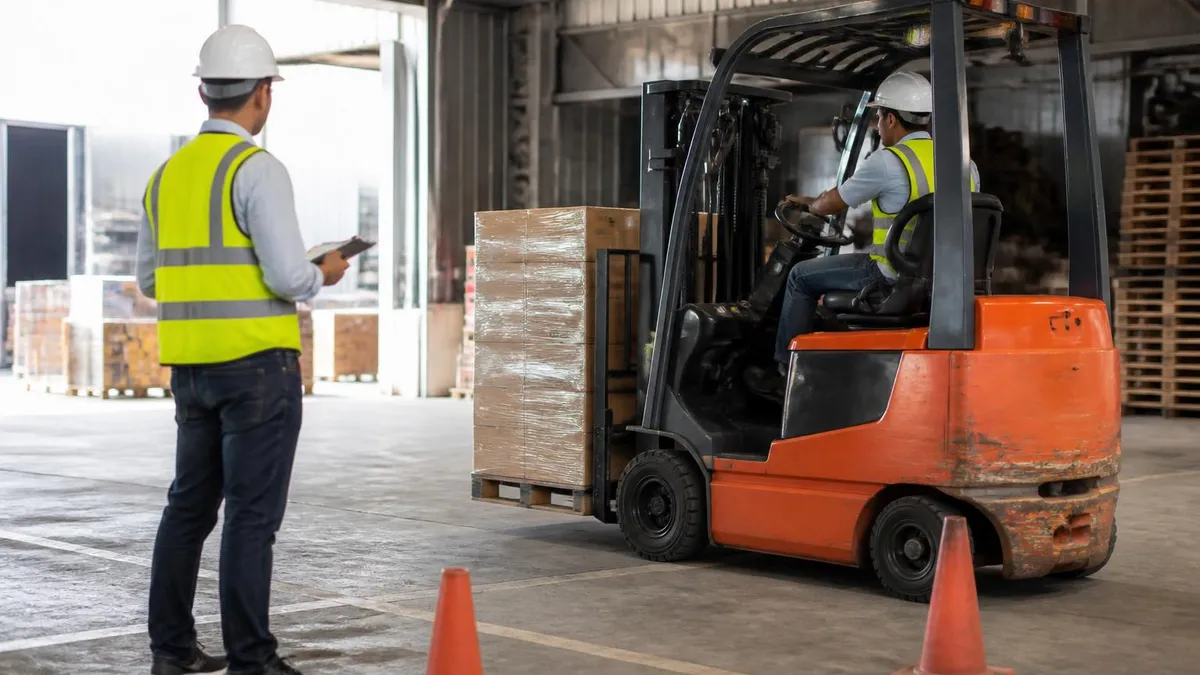
Forklift Stability Triangle: Complete Guide to Safe Operation, Physics, and Certification
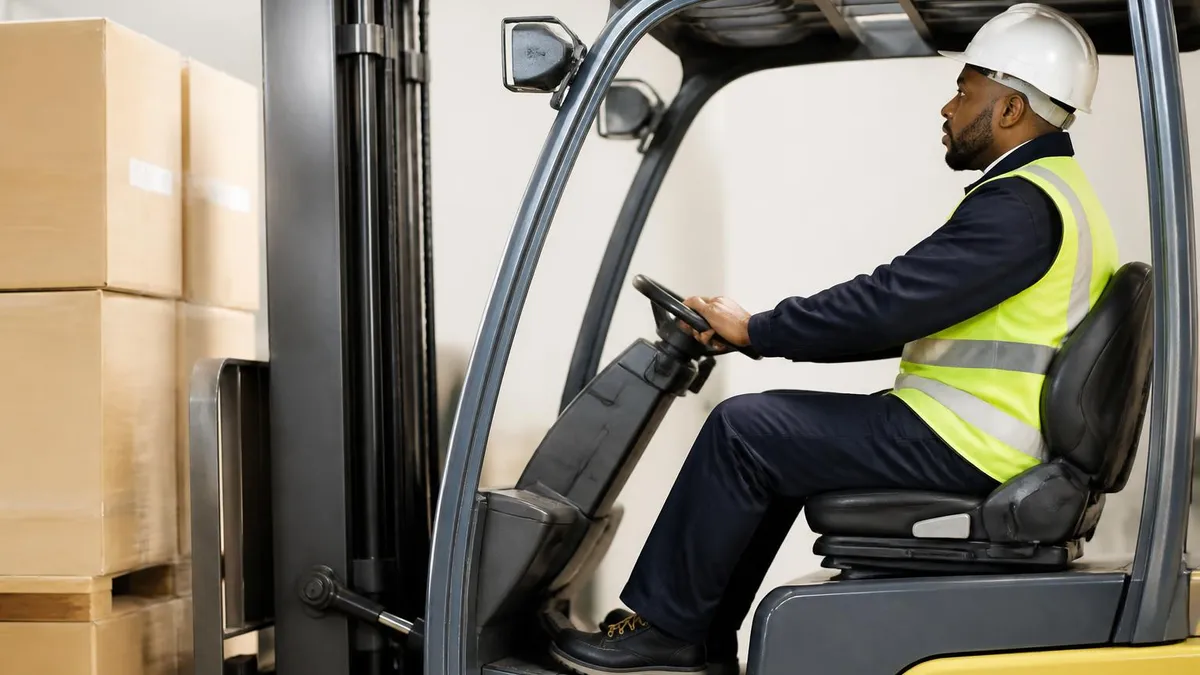
How to Get a Forklift License: Complete Training Guide and Certification Requirements
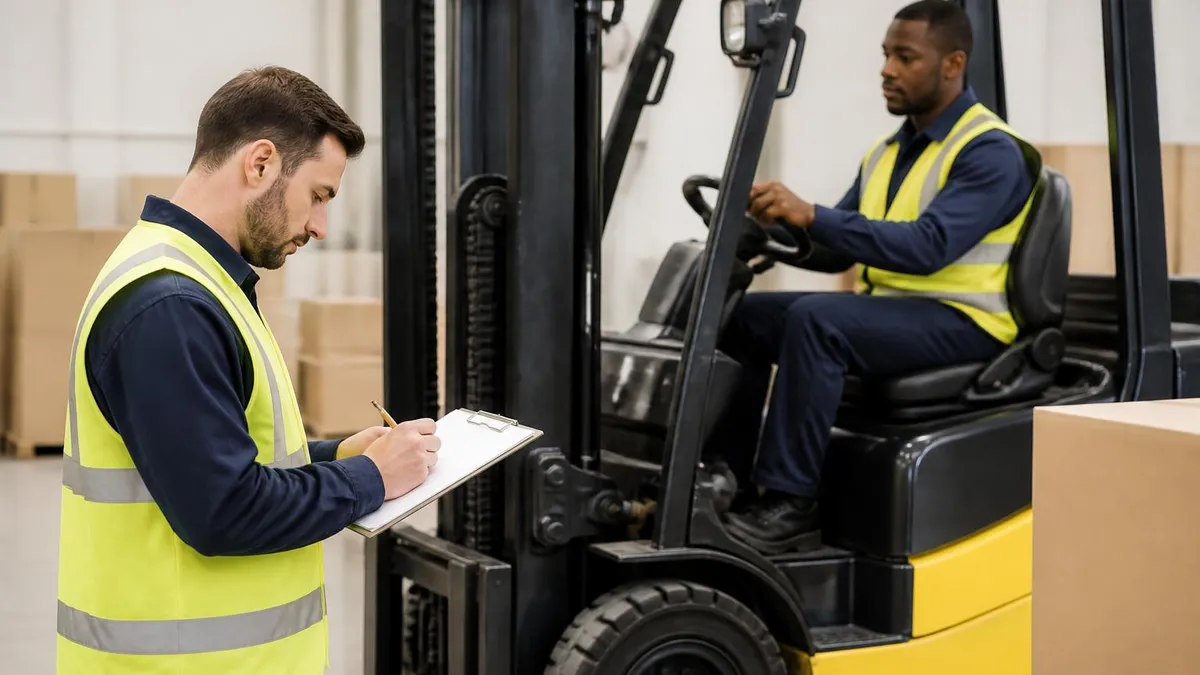
Forklift Driver Salary: Complete Pay Guide for 2026
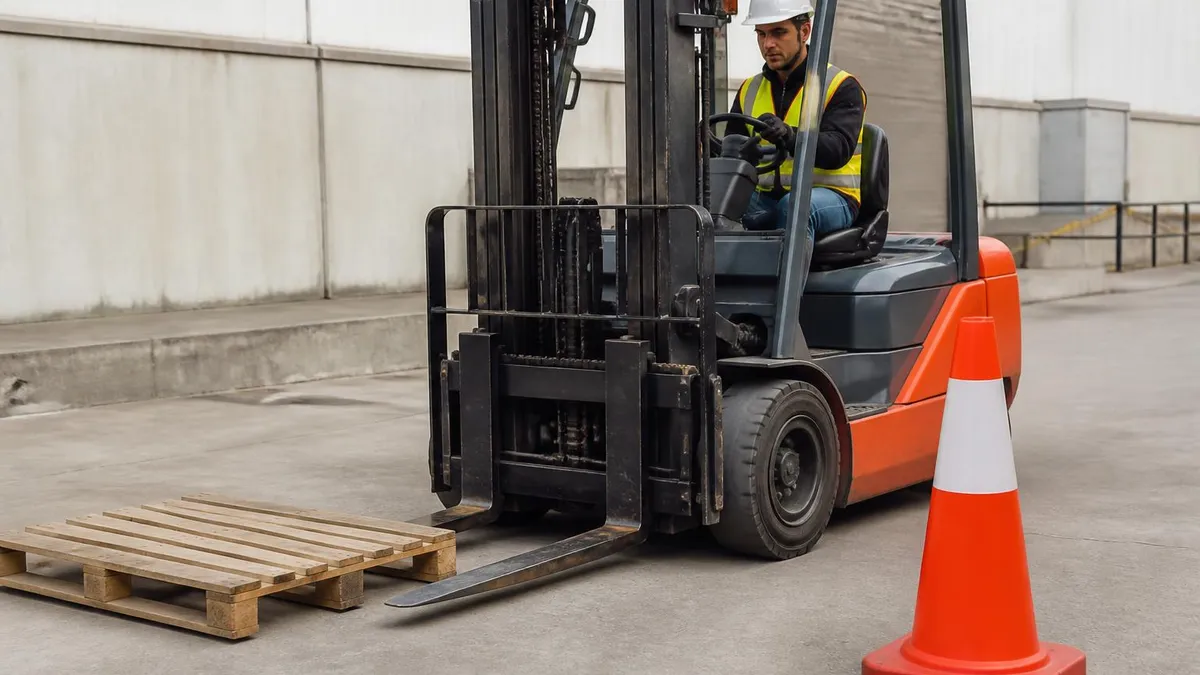
Forklift Types: Complete Guide to Classes, Uses, and Certification
Forklift Price Guide 2026: New, Used, Rental, and Total Cost of Ownership Breakdown
How this page was made: written with AI tools and published by Nathan Beja, founder of Practice Test Geeks, who is responsible for its content. Exam facts are checked against the official sources listed below. Not reviewed by a subject-matter expert. Editorial policy
Sources & references
Exam facts on this page (fees, format, dates, passing scores) are checked against these official sources; the date is our last check. Editorial policy
- osha.gov — Test delivery, eligibility, renewal · verified Oct 2026