
FDNY Baseball and Sports Teams: New York's Bravest Beyond the Firehouse
FDNY baseball, hockey, and more — discover how New York's Bravest compete on and off the field. ✅ Full guide to FDNY sports teams.
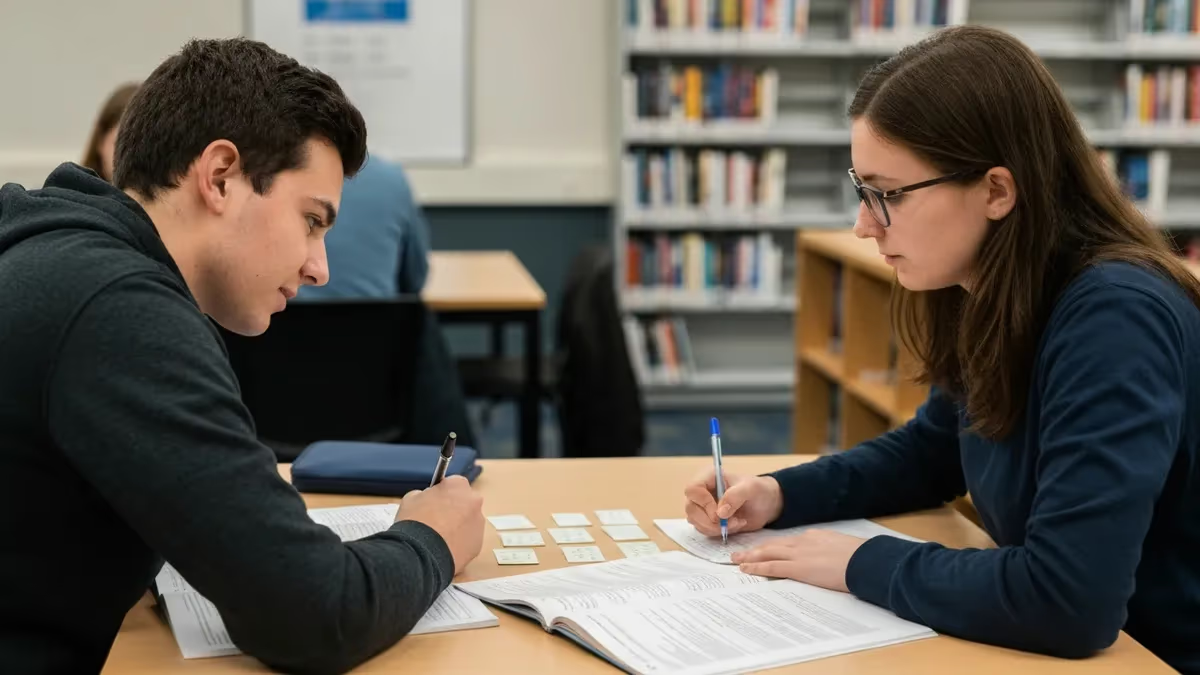
FDNY baseball has a long and storied tradition inside one of the world's most demanding fire departments. New York City firefighters are famous for their courage in burning buildings, but many of those same men and women bring equally fierce competitive spirits to athletic fields, rinks, and courts across the five boroughs. From organized baseball leagues to charity softball tournaments, FDNY athletes have been competing for bragging rights and worthy causes for well over a century, making sports a central part of departmental culture and community identity.
The Fire Department of New York is the largest fire department in the United States, with approximately 11,000 uniformed firefighters operating out of more than 200 firehouses citywide. Inside that enormous workforce, athletic competition has always served as a pressure valve, a bonding mechanism, and a way for firefighters to stay in peak physical condition between grueling tours of duty. Sports teams form at the company level, the borough level, and through citywide FDNY leagues that bring members together from Brooklyn to the Bronx.
Baseball and softball are among the most popular sports within the FDNY because they require teamwork, communication, and situational awareness — skills that transfer directly to the fireground. A catcher calling pitches is not so different from an incident commander coordinating units on a working fire. The rhythm of the game mirrors the controlled urgency that defines firefighting: long stretches of readiness punctuated by moments that demand immediate, decisive action from every person on the field.
Beyond the diamond, FDNY athletes compete in hockey, basketball, football, boxing, golf, and running events that attract participants from across the department. Many of these programs operate under the umbrella of the Uniformed Firefighters Association or dedicated nonprofit organizations that use athletic events to raise money for fallen firefighter families and burn survivors. The competitive and charitable dimensions of FDNY sports are inseparable — where there is a game, there is almost always a cause being served alongside it.
Public-facing events like the annual FDNY vs. NYPD hockey game at Madison Square Garden draw tens of thousands of fans and raise hundreds of thousands of dollars for charity each year. Smaller baseball and softball games played at city parks draw local neighborhoods into direct contact with the firefighters who protect them, building the kind of community trust that no public relations campaign could manufacture. These moments on the field humanize the department in ways that go far beyond any formal outreach program.
For prospective firefighters preparing for the FDNY entrance exam, understanding the department's culture — including its deep commitment to athletics and brotherhood — is just as important as mastering the technical knowledge required on test day.
The FDNY is not simply a job; it is a way of life built on shared sacrifice, mutual support, and a relentless drive to be the best. That same ethos shows up every time an FDNY athlete steps onto a baseball diamond or laces up a pair of skates. Exploring fdny sports teams across disciplines reveals how deeply athletics are woven into the fabric of the Bravest.
This article takes a comprehensive look at FDNY baseball and the broader athletic ecosystem inside the Fire Department of New York, covering history, notable events, the charity dimension, and what participation in departmental sports means for morale, fitness, and community connection. Whether you are a lifelong FDNY fan, a prospective firefighter, or simply curious about how New York's Bravest spend their off-duty hours, you will find everything you need right here.
FDNY Sports by the Numbers
Core FDNY Sports Programs
Organized leagues and charity tournaments connect firefighters across companies and boroughs. Games are played at city parks and often raise funds for fallen firefighter families, burn survivor programs, and other department charities.
The most publicly visible FDNY sport, culminating in the legendary FDNY vs. NYPD charity game at Madison Square Garden. Teams train year-round and compete in regional first-responder leagues with serious competitive intensity.
Firefighters compete in intradepartmental basketball leagues organized at the borough level. Games are held in city recreation centers and serve as important team-building events that strengthen relationships between companies.
The FDNY boxing team has produced Golden Gloves competitors and represents the department at first-responder combat sports events. Training is rigorous and mirrors the fitness demands required for active firefighting duty.
Dozens of FDNY members participate in the New York City Marathon and other road races each year, often in full gear to honor fallen colleagues. These events draw enormous public attention and raise significant charitable funds.
Understanding how FDNY sports are organized requires a brief look at the department's administrative structure. The FDNY is divided into nine divisions across the five boroughs, each containing multiple battalions and individual companies. Athletic programs can operate at any of these levels, meaning a firefighter might play on a firehouse softball team, a battalion basketball squad, and a citywide hockey roster simultaneously. This layered structure creates a rich ecosystem of competition that keeps athletes engaged throughout the year.
At the top level, the Uniformed Firefighters Association (UFA) and the Uniformed Fire Officers Association (UFOA) both support athletic programs as part of their broader mission to promote the welfare and morale of FDNY members. Nonprofit organizations like the FDNY Foundation and the Stephen Siller Tunnel to Towers Foundation also organize or sponsor major athletic events that bring departmental sports into the public eye and generate substantial charitable revenue for firefighter-related causes.
Company-level sports are the grassroots of FDNY athletics. A typical firehouse might field a softball team that competes in a local park district league against other FDNY companies or even civilian teams from the surrounding neighborhood. These neighborhood-level games are enormously effective community-building tools because they put firefighters in an informal, friendly context with the residents they serve. Children who meet FDNY athletes on the softball diamond are far more likely to trust and respect firefighters during emergencies later in life.
Borough-level competition steps up the intensity considerably. Brooklyn, Queens, the Bronx, Manhattan, and Staten Island each have enough FDNY members to support serious, well-organized leagues in multiple sports. Borough championships in baseball and softball draw significant attendance from firefighters who are off duty and from family members who come out to cheer. These events often double as informal reunions where veterans who came up together in the same firehouse reconnect over a shared love of competition.
The citywide tier is where FDNY sports achieve their highest visibility. The annual FDNY baseball and softball tournaments that bring together winners from each borough are competitive enough to attract former college and semi-professional players who joined the department. Winning a citywide FDNY championship carries genuine prestige within the department and is a source of lasting pride for the company or battalion that claims the title. Trophies from these tournaments often occupy prominent display cases inside firehouses for decades.
Administrative support for FDNY sports programs has grown significantly in recent years as department leadership has recognized the connection between athletic participation and firefighter wellness. Departments across the country have invested in fitness infrastructure after research confirmed that active firefighters have meaningfully lower rates of cardiovascular disease, the leading cause of line-of-duty death in the American fire service.
The FDNY, which leads the nation in many areas of firefighting innovation, has been at the forefront of integrating structured athletic programming into its overall wellness strategy. Exploring the full breadth of FDNY sports teams reveals just how seriously the department takes this commitment to physical and mental fitness alongside the professional excellence for which the Bravest are globally known.
For those preparing for a career in the FDNY, engaging with the department's athletic culture — even as an outside observer — provides valuable insight into what life inside the firehouse actually looks like day to day. The competitive camaraderie, the shared goals, and the commitment to performing at a high level under pressure are values that show up equally in the firehouse and on the baseball diamond. Candidates who internalize these values before their first day in the academy will be far better prepared for the challenges ahead.
FDNY Baseball, Hockey, and Charity Events Explained
FDNY baseball leagues operate throughout the spring and summer months across all five boroughs. Teams from individual firehouses compete in round-robin formats before advancing to borough playoffs and ultimately a citywide tournament. Games are typically played on weekends at city parks, with families and off-duty firefighters filling the bleachers. The competitive level varies widely — some teams are casual and social, while others recruit members with serious collegiate or semi-professional backgrounds who bring a high level of play to every at-bat.
Charity softball tournaments organized by FDNY-affiliated nonprofits are a distinct but related tradition. These events often feature celebrity participants, corporate sponsors, and large crowds, transforming a neighborhood park into a festival-like atmosphere that raises tens of thousands of dollars in a single afternoon. Proceeds typically go to the FDNY Foundation, the Burn Center at New York-Presbyterian, or memorial funds for firefighters killed in the line of duty. These events make FDNY baseball visible to tens of thousands of New Yorkers who might never otherwise interact with the department in a relaxed, community setting.
Benefits and Challenges of FDNY Athletic Programs
- +Builds deep camaraderie and trust between firefighters from different companies and boroughs
- +Promotes cardiovascular fitness that directly reduces line-of-duty health risks
- +Raises millions of dollars annually for fallen firefighter families and community causes
- +Creates positive, humanizing public interactions between FDNY members and New York City residents
- +Provides mental health benefits by offering structured social activity and stress relief
- +Develops teamwork and communication skills that transfer directly to fireground operations
- −Injury risk during athletic competition can sideline firefighters from duty
- −Scheduling around 24-hour shift rotations makes consistent team practice challenging
- −Not all firehouses have equal access to athletic facilities or league opportunities
- −Competitive programs at the citywide level can be time-intensive for participants with family obligations
- −Funding for athletic programs can be inconsistent and dependent on charity revenue
- −Physical demands of both the job and sports can contribute to cumulative fatigue over a career
Pros and Cons at a Glance
| Pros | Cons |
|---|---|
| Builds deep camaraderie and trust between firefighters from different companies and boroughs | Injury risk during athletic competition can sideline firefighters from duty |
| Promotes cardiovascular fitness that directly reduces line-of-duty health risks | Not all firehouses have equal access to athletic facilities or league opportunities |
| Raises millions of dollars annually for fallen firefighter families and community causes | Competitive programs at the citywide level can be time-intensive for participants with family obligations |
| Creates positive, humanizing public interactions between FDNY members and New York City residents | Funding for athletic programs can be inconsistent and dependent on charity revenue |
| Provides mental health benefits by offering structured social activity and stress relief | Physical demands of both the job and sports can contribute to cumulative fatigue over a career |
How to Get Involved in FDNY Sports as a New Firefighter
- ✓Introduce yourself to your firehouse's informal athletic coordinator or most active sports participants during your first weeks on the job
- ✓Ask your company officer about any existing team rosters for baseball, softball, basketball, or other sports at the company level
- ✓Register with the UFA sports committee to receive notifications about citywide FDNY athletic events and league sign-ups
- ✓Attend at least one charity athletic event as a spectator before your first year is complete to understand the culture and expectations
- ✓Connect with members from other companies who share your sport through department social media groups and informal networks
- ✓Volunteer to help organize or run a charity sporting event to build relationships across companies and demonstrate your commitment to department values
- ✓Maintain a consistent personal fitness regimen that complements your sport of choice and supports your readiness for active duty
- ✓Respect the balance between athletic commitment and shift responsibilities — never let sports participation compromise your performance on the job
- ✓Look into borough-level or citywide league opportunities once you have settled into your assigned company and established your working relationships
- ✓Encourage fellow probationary firefighters to participate in sports programs as a key tool for building the brotherhood that defines FDNY culture
Sports Participation Strengthens Fireground Performance
Research across American fire departments consistently shows that firefighters who participate in regular team sports have lower rates of cardiovascular disease, report higher job satisfaction, and demonstrate stronger team coordination during emergency operations. The FDNY's investment in athletic programs is not just about recreation — it is a measurable strategy for producing better, healthier, more cohesive firefighters who perform at a higher level when lives are on the line.
The connection between FDNY sports participation and departmental morale runs far deeper than most outside observers realize. Inside the firehouse, the bonds formed between firefighters who share a dugout or a locker room often prove just as durable and just as important as those forged during emergency operations. There is something about shared competition — the wins, the losses, the arguments about lineup decisions, the post-game meals together — that creates the kind of mutual understanding that makes a crew function as a seamless unit when seconds count on the fireground.
Veteran firefighters who have spent decades in the department consistently identify athletic programs as one of the most effective tools for integrating new probationary firefighters into the culture of a firehouse. When a probie joins a company's softball team and hustles on every play, earns the respect of veterans through effort and coachability, and shows up early to help set up equipment, that individual communicates volumes about their character and their commitment to the team. These qualities are exactly what senior firefighters want to see in a partner they may one day depend on in a life-threatening situation.
The mental health dimension of FDNY athletic programs has received increasing attention in recent years as the department has confronted an ongoing crisis of firefighter suicides, which has claimed more FDNY lives in some years than line-of-duty deaths from fires and other emergencies combined. Athletic participation provides structure, social connection, physical outlets for stress, and a sense of purposeful achievement — all factors that mental health researchers identify as protective against depression, anxiety, and post-traumatic stress disorder. The department has increasingly integrated sports programs into its broader mental health and wellness strategy as evidence mounts that they work.
For families of FDNY members, athletic programs also provide an important community. Spouses, partners, and children who come to games and tournaments meet the people their loved ones spend 24-hour shifts with, building relationships that reduce isolation and create extended support networks. An FDNY spouse who knows her husband's crewmates well enough to call them in a crisis has a meaningful advantage over someone who meets the company only at a promotion ceremony. These family connections, built partly through shared athletic experiences, strengthen the entire FDNY community ecosystem in ways that are difficult to quantify but impossible to ignore.
The morale benefits of FDNY sports extend even to firefighters who do not participate directly. Knowing that the department values its members as whole people — not just as functional units who show up to perform emergency services — creates a sense of institutional belonging that elevates job satisfaction and reduces turnover.
When a firefighter can see their company's trophy case, hear their captain talk with genuine pride about last weekend's championship game, and know that the department supports their participation, they feel seen and valued in ways that improve their daily experience of what is already an enormously demanding career.
The historical roots of FDNY sports culture also deserve acknowledgment. New York City's fire companies have competed in athletic events since the nineteenth century, when volunteer fire companies held public competitions to demonstrate strength, speed, and coordination. These contests were partly about civic pride and partly about recruitment — companies wanted the strongest, fastest, most capable members and used athletic events to identify and attract them.
That competitive tradition evolved directly into the organized sports programs that exist today, giving FDNY athletics a lineage that connects the contemporary department to its earliest origins as a community institution in the neighborhoods of New York.
Looking across the full spectrum of FDNY athletic programs — from the friendly neighborhood baseball game to the sell-out hockey match at Madison Square Garden — what emerges is a coherent picture of a department that understands the whole firefighter. Physical strength, mental resilience, teamwork, charitable purpose, and community engagement: all of these values find expression in FDNY sports. They are not ancillary to the department's mission. They are, in many ways, its mission made visible in a different form.

Many FDNY charity baseball, softball, and hockey events welcome public spectators and volunteers. Attending these events is an excellent way for prospective firefighters to connect with the department culture before entering the recruitment process. Check the FDNY Foundation website and the UFA's official communications for upcoming public athletic events throughout the year.
For anyone seriously considering a career with the Fire Department of New York, understanding the role that sports and physical culture play inside the department is genuinely useful preparation.
The FDNY entrance exam tests cognitive ability, reading comprehension, spatial reasoning, and situational judgment, but what the exam cannot fully capture is the cultural dimension of firefighting — the commitment to being physically ready, mentally sharp, and deeply connected to your crew at all times. Athletic programs are one of the most visible expressions of that culture, and candidates who already embody those values arrive at the academy with a meaningful head start.
Physical fitness preparation for the FDNY exam and the Candidate Physical Ability Test (CPAT) overlaps significantly with the kind of training that FDNY athletes do year-round. Cardiovascular endurance, functional strength, agility, and team coordination are all attributes that show up both on the baseball diamond and inside a burning building. Candidates who train as athletes — pushing themselves competitively, recovering intelligently, and working with partners toward shared goals — tend to perform better on the physical components of the FDNY hiring process than those who train in isolation without the motivation that competition provides.
The psychological benefits of team sport preparation extend to the FDNY exam as well. Competitive athletes are accustomed to performing under pressure, managing nerves before high-stakes moments, and bouncing back quickly from errors or setbacks. These mental skills transfer directly to the test-taking environment, where a candidate who panics in the face of a difficult question or loses confidence after an early struggle is far less likely to achieve their best score than someone who has learned through athletic experience that composure and persistence are the keys to performing when it matters most.
Many FDNY members who are now veterans of the department will tell you that the sports culture inside the firehouse was one of the aspects of the career they had least expected and most valued. The image of the firefighter as a lone hero is deeply embedded in popular culture, but the reality of fire service is profoundly team-oriented.
No firefighter enters a burning building alone, advances a hoseline alone, or rescues a victim alone. Everything is done in pairs or crews, with absolute trust in the people beside you. Athletic programs build exactly the kind of trust and cohesion that makes those partnerships function, which is why the most experienced firefighters are almost universally among the most enthusiastic supporters of departmental sports.
The charity dimension of FDNY sports programs deserves one final emphasis here. The dollars raised through baseball tournaments, hockey games, golf outings, and road races fund scholarships for the children of firefighters killed in the line of duty, support rehabilitation for burn survivors who might otherwise face those challenges without resources, and provide mental health services for FDNY members struggling with the psychological weight of what they experience on the job.
When a fan buys a ticket to an FDNY hockey game or a corporation sponsors a charity softball tournament, that money does concrete, measurable good in the lives of real people who have been touched by the fire service's unique sacrifices. That connection between athletic entertainment and genuine human impact is one of the most remarkable aspects of the FDNY sports ecosystem.
Preparing for the FDNY exam is itself an athletic endeavor in some respects — it requires consistent training over time, strategic preparation, resilience when practice tests reveal gaps in knowledge, and a competitive drive to perform at your highest level on the day that counts. The same discipline that makes an FDNY athlete exceptional on the field makes an FDNY candidate exceptional on exam day. Whether your sport is baseball, hockey, basketball, or simply the game of mastering a challenging test, the mental framework is the same: prepare relentlessly, compete with integrity, and trust the work you have put in.
As you prepare for your FDNY exam journey, consider exploring the full range of resources available to you — from practice tests that mirror the real exam format to articles that deepen your understanding of department culture, history, and values. The more complete your picture of what the FDNY is and what it stands for, the more prepared you will be to join it — and to contribute to the athletic and professional traditions that have made New York's Bravest the finest fire department in the world.
Practical tips for connecting with FDNY sports culture begin long before you earn your shield and take your place in a firehouse. As a candidate in the hiring pipeline, you can start building the athletic mindset and physical foundation that will serve you both in the academy and throughout a long career with the department. Start by establishing a consistent cardiovascular training program that mirrors the demands of the CPAT: stair climbing, hose dragging, equipment carrying, and ladder raising all have athletic analogs that you can practice at any well-equipped gym or even in your neighborhood.
Research the FDNY Foundation and the UFA's public-facing athletic events and consider attending as a spectator or volunteer. These events are open to the public and provide unmatched access to the culture of the department in a relaxed, informal setting.
Talking to FDNY members at a charity softball game or a road race will teach you more about what life in the firehouse is actually like than any book or website can convey. The personal connections you make at these events can also become part of the informal network that supports you through the lengthy FDNY hiring process, which can take two years or more from application to appointment.
Physical preparation for the FDNY should be team-oriented whenever possible. Training alone is fine, but training with others who share your goal — whether that means joining a CrossFit gym, a running club, or a recreational baseball league — builds exactly the interpersonal skills and competitive mindset that the FDNY values.
Departments select candidates not just for individual ability but for team fit, and a candidate who has demonstrated over years of athletic participation that they are a reliable, coachable, committed team member arrives at the academy with a cultural fluency that cannot be faked or crammed for in the final weeks before the exam.
Study the history of the FDNY athletic programs as part of your broader research into the department. Know that the FDNY vs. NYPD hockey game at Madison Square Garden is one of the most beloved charity traditions in New York City. Know that firefighters have been competing in baseball and softball leagues since the department's earliest organized years.
Know that the Stephen Siller Tunnel to Towers run — which retraces the path that firefighter Stephen Siller ran through the Brooklyn-Battery Tunnel in full gear on September 11, 2001 — is now one of the most moving and well-attended charity running events in the country. This historical knowledge signals genuine respect for the department and its traditions.
When you do enter the academy and eventually land in a firehouse, approach the athletic culture with the same openness and humility you bring to every other aspect of probationary firefighter life. Do not assume your athletic background makes you better than veterans with more years in the department. Instead, let your athleticism be a tool for building relationships and demonstrating your commitment to the crew.
Hustle on every play, support your teammates when they struggle, and bring the same intensity to the softball diamond that you bring to your duties inside the firehouse. The veteran firefighters watching will notice, and their respect — earned through demonstrated character rather than résumé claims — is the foundation of everything that follows.
Finally, remember that FDNY sports are ultimately about more than competition. They are about community — the community of firefighters who depend on each other with their lives, and the broader community of New York City that those firefighters serve.
Every home run hit in an FDNY charity tournament, every goal scored in an FDNY hockey game, and every mile run in gear through the streets of Brooklyn in memory of fallen heroes is a statement about what the department stands for. When you step onto that field or that rink as an FDNY member, you carry the weight of that history with you. Carry it well, and play with everything you have.
Use the practice quizzes and study resources available on PracticeTestGeeks.com to build the exam knowledge that will get you to the field alongside the Bravest. The athletic journey and the academic journey toward joining the FDNY are different in form but identical in spirit: both require discipline, persistence, and an uncompromising commitment to doing the work that excellence demands. Get started today, train hard, and trust the process — the badge, the firehouse, and the softball lineup are waiting for those who earn them.
Sample Fire Department New York Practice Questions
Try these questions from our free Fire Department New York practice tests. The correct answer and an explanation follow each question.
In FDNY HazMat operations, what is the role of the 'Technical Decon' team member?
- A. To monitor air quality in the hot zone
- B. To perform gross decontamination on large groups of civilians
- C. To provide thorough decontamination of entry team members and equipment
- D. To establish the incident command post
Answer: C. To provide thorough decontamination of entry team members and equipment
Technical Decon team members perform thorough, systematic decontamination of HazMat entry team personnel and their equipment as they exit the warm zone.
How are FDNY firehouses typically identified in official communications?
- A. By the borough and street address only
- B. By company type and number (e.g., Engine 10, Ladder 30)
- C. By division and battalion number only
- D. By a unique GPS coordinate designation
Answer: B. By company type and number (e.g., Engine 10, Ladder 30)
FDNY units are designated by company type (Engine, Ladder, Rescue, etc.) and a unique number, such as Engine 10 or Ladder 30.
What is the name of the FDNY's water rescue team stationed on the waterways surrounding New York City?
- A. Marine Division
- B. Harbor Unit
- C. Water Rescue Squad
- D. Coastal Response Team
Answer: B. Harbor Unit
The FDNY Marine Division, informally known as the Harbor Unit, operates fireboats and rescue vessels on the Hudson River, East River, and other surrounding waterways.
What role do FDNY firefighters play during community events?
- A. They oversee event security and manage crowd control
- B. They participate in event planning and logistics
- C. They provide fire safety demonstrations and interact with the community
- D. They handle financial transactions and fundraising activities
Answer: C. They provide fire safety demonstrations and interact with the community
During community events, FDNY firefighters play a vital role by providing fire safety demonstrations and interacting directly with the community. They showcase their equipment, explain fire prevention tips, and answer questions, fostering a positive relationship between the department and the public. This presence helps educate residents and builds trust within the community.
FDNY Questions and Answers

FDNY Hockey: The Rich Tradition of New York's Bravest on the Ice

FDNY Super Pumper: The Massive Fire-Fighting System That Transformed New York City's Firefighting
FDNY (Fire Department New York) Test: Your Guide
FDNY vs NYPD Hockey Game: Inside New York's Bravest vs Finest Heroes on Ice Rivalry
FDNY Runs and Workers: What the Numbers Really Mean
About the Author
Law Enforcement Trainer & Civil Service Exam Specialist
John Jay College of Criminal JusticeMarcus B. Thompson earned his Master of Arts in Criminal Justice from John Jay College of Criminal Justice and served 12 years as a law enforcement officer before transitioning to full-time academy instruction. He is a POST-certified instructor who has prepared candidates for police entrance exams, firefighter assessments, and civil service examinations across dozens of agencies.
Join the Discussion
Connect with other students preparing for this exam. Share tips, ask questions, and get advice from people who have been there.
View discussion (9 replies)