
FDNY Codes: A Complete Guide to Fire Department of New York Radio Signals, Box Numbers, and Response Codes
FDNY codes explained: 🗨️ 10-codes, signals, box numbers, and response classifications used by the Fire Department of New York every day.
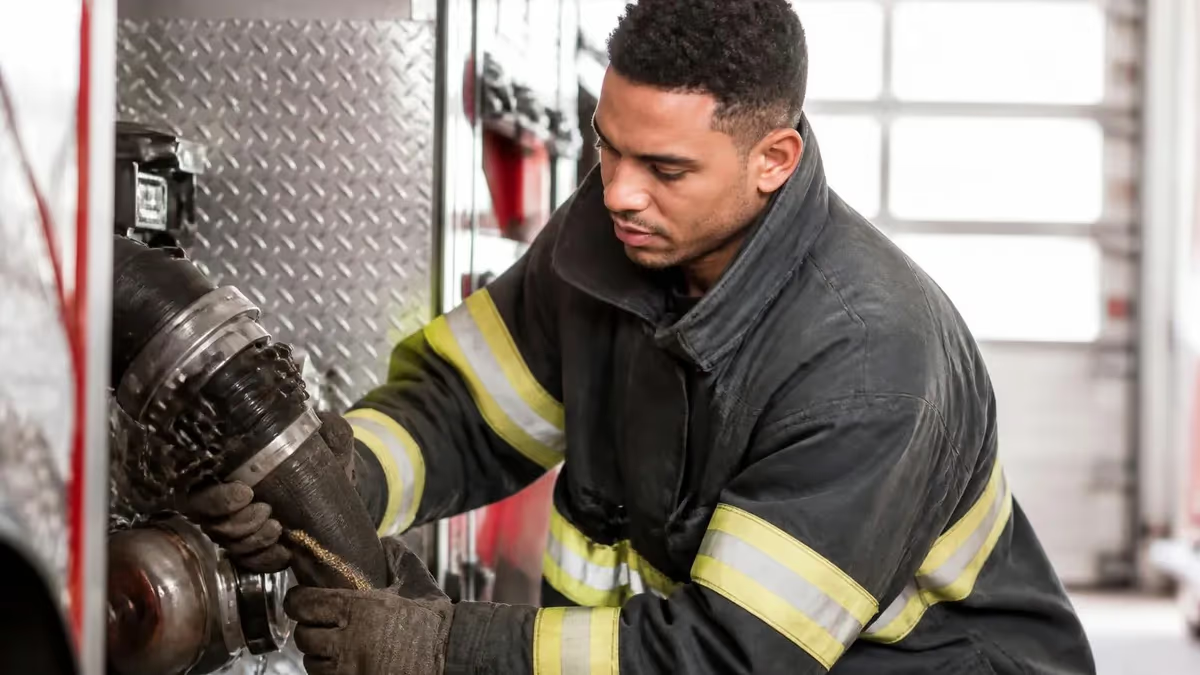
FDNY codes are the shorthand language that the Fire Department of New York uses to dispatch units, communicate over the radio, and classify incidents from the smallest rubbish fire to a five-alarm warehouse blaze. If you have ever stood on a Manhattan sidewalk and heard a chief shout numbers into a handie-talkie, you were listening to a vocabulary that took the department more than a century to refine. Learning these codes is essential for candidates, buffs, journalists, and anyone studying for the exam.
The system did not appear all at once. It grew out of telegraph alarm boxes installed in the 1870s, evolved through the radio era of the 1930s and 1940s, and was repeatedly updated as the FDNY merged with the EMS in 1996. Today the codes blend three traditions: numeric 10-codes for radio brevity, signal numbers for alarm escalation, and box numbers for geographic location. Knowing how they interact is the difference between a confused listener and an informed one.
For the modern firefighter, codes are not optional knowledge. They appear on the written exam, on every run ticket, on the mobile data terminal mounted in the apparatus cab, and in the after-action reports that follow major incidents. Probationary firefighters at the Fire Academy on Randall's Island spend weeks memorizing the most common signals before they are ever allowed to respond to a working fire. The codes are part of the cultural DNA of the department.
Civilians encounter these codes too, often without realizing it. The little metal boxes mounted on lampposts around the five boroughs each carry a unique four or five-digit number. When somebody pulls the handle, dispatchers in the Brooklyn or Bronx central offices instantly know which intersection to send engines and ladders to. The box number, transmitted in a distinctive series of bells, is the original FDNY code and the foundation everything else was built on top of.
This guide walks through every major category of code you will encounter. We will cover the 10-codes used on the radio, the signal numbers that escalate alarms, the box number geography that organizes the city, the EMS call type codes adopted after the 1996 merger, and the special codes reserved for hazardous materials, technical rescue, and mayday situations. Each section includes the actual numbers in use, the history behind them, and tips for committing them to memory.
If you are preparing for the written exam, bookmark this page and use the practice quizzes embedded throughout. The exam tests recognition rather than rote recall, but you cannot recognize a code you have never seen. By the end of this article you should be able to listen to a department radio scanner and follow along with what the units are saying, which is exactly the level of fluency the academy expects from day one.
One last note before we dive in: codes evolve. The department has retired some signals, added new ones for emerging threats like active shooter incidents and lithium battery fires, and renumbered others to avoid confusion with EMS terminology. We have flagged the most recent changes throughout, but always cross-check against the current department-issued radio code card before relying on any number for operational purposes.
FDNY Codes by the Numbers
10-Code Quick Reference
The universal acknowledgment that a message has been received and understood. Used after dispatch transmits an assignment or a chief gives an order. It does not imply agreement, only receipt.
Signals that crews have a confirmed working fire requiring the full first-alarm assignment of engines, ladders, a battalion chief, a rescue, and a squad. Triggers automatic special calls in many situations.
Reserved for confirmed fires in buildings of significant height, this code automatically upgrades the assignment to include additional engines, a tower ladder, and a high-rise unit response.
Distinct from 10-76, this signal applies to residential high-rises and dispatches a tailored response profile that accounts for sleeping occupants, sprinkler-protected stairs, and standpipe operations.
Used when an alarm is determined to be intentionally pulled with no actual emergency. Important for crime reporting and for tracking chronic false-alarm locations that may require enforcement action.
Signal numbers are the older cousin of the 10-code, and they remain the primary mechanism by which the FDNY escalates an incident from a routine response into a multi-alarm operation. While 10-codes describe a type of condition, signal numbers describe the scale of the resources being committed. A signal 7-5, for example, is the radio shorthand for an all-hands working fire, while a signal 2-2 calls a second alarm, 3-3 a third, and so on through five alarms and beyond. Each escalation brings a predetermined assignment of engines, ladders, and chiefs.
The numbering system has roots in the telegraph era. Before voice radios were reliable, alarms were transmitted as a series of bell strikes over the joker tape inside the firehouse. A signal 2-2-2 meant the bell rang two strikes, paused, two more, paused, two more. Old-timers can still recall the exact cadence, and ceremonial bells at department funerals replicate the pattern as a tribute to firefighters who have died in the line of duty. The signal 5-5-5-5, struck four times, marks a line-of-duty death.
Beyond alarm escalation, signal numbers cover a wide range of operational events. Signal 10-45 is used to report a casualty discovered at a scene, with a numeric suffix indicating severity. A 10-45 Code 1 indicates a deceased victim, Code 2 a life-threatening injury, Code 3 a serious injury, and Code 4 a minor injury. Dispatchers use these codes to prioritize ambulance assignments and to alert chiefs and the press office in the case of a serious incident. The code shows up in news reports as the official department classification.
Other signals describe apparatus and personnel status. Signal 10-8 means a unit is in service and available for assignment, 10-7 means out of service. Signal 10-20 reports a location, often used when a chief is asked to confirm an address. Signal 10-22 cancels a previous assignment. Signal 10-66 reports a member down. The variety of available signals reflects decades of accumulated operational experience, with each code added to fill a specific communication need that arose during real incidents.
If you are studying for the exam, focus first on the alarm escalation series (7-5, 2-2, 3-3, 4-4, 5-5) and the casualty codes (10-45 with all four severity levels). These appear most often on the written test and on the practical scenarios you will encounter in the academy. The casualty codes in particular are tested heavily because they intersect with the EMS protocols and the department's responsibility to report accurate information to hospitals and the medical examiner's office.
Remember that signal numbers are transmitted in a specific tone of voice and cadence over the radio. Dispatchers will repeat the signal twice to ensure accuracy, and chiefs will acknowledge each one. Listening to live audio of department operations, available through department-approved recordings and museum archives, is one of the best ways to internalize the rhythm. The numbers stop feeling like flashcards and start feeling like a language you actually speak.
Finally, do not confuse signal numbers with alarm numbers. A second-alarm fire is escalated by transmitting a signal 2-2 over the radio, but the incident itself is described in casual conversation as a two-alarm fire. The signal is the action; the alarm level is the descriptor. Getting this distinction right separates serious candidates from those who have only watched a few department videos online.
FDNY Practice Test Questions
Prepare for the FDNY - Fire Department New York exam with our free practice test modules. Each quiz covers key topics to help you pass on your first try.
FDNY Building Construction
FDNY Exam Questions covering Building Construction. Master FDNY Test concepts for certification prep.
FDNY Community Engagement and Public Educa...
Free FDNY Practice Test featuring Community Engagement and Public Education. Improve your FDNY Exam score with mock test prep.
FDNY Emergency Medical Response
FDNY Mock Exam on Emergency Medical Response. FDNY Study Guide questions to pass on your first try.
FDNY Emergency Medical Services
FDNY Test Prep for Emergency Medical Services. Practice FDNY Quiz questions and boost your score.
FDNY Hazardous Materials Response
FDNY Questions and Answers on FDNY Hazardous Materials Response. Free FDNY practice for exam readiness.
FDNY Technical Rescue Operations
FDNY Mock Test covering FDNY Technical Rescue Operations. Online FDNY Test practice with instant feedback.
FDNY Fire Behavior
Free FDNY Quiz on Fire Behavior. FDNY Exam prep questions with detailed explanations.
FDNY Firefighting Operations and Equipment
FDNY Practice Questions for Firefighting Operations and Equipment. Build confidence for your FDNY certification exam.
Box Numbers Explained
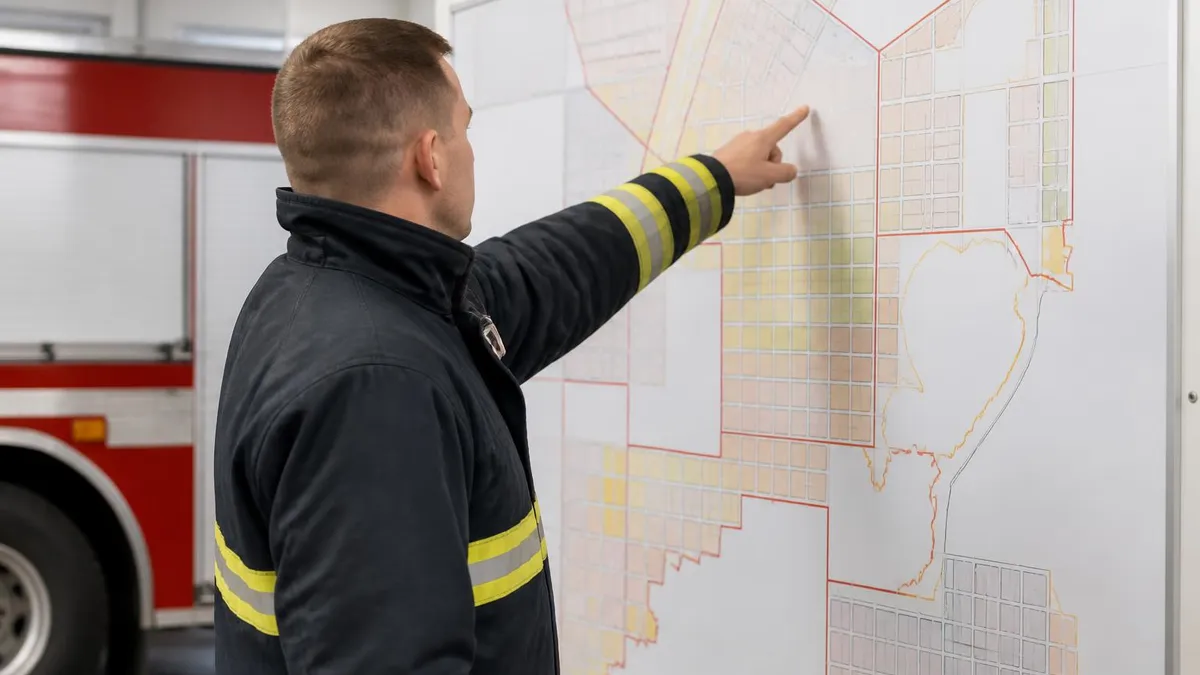
Manhattan box numbers generally run in the hundreds and low thousands, with lower numbers concentrated in the financial district and higher numbers as you move north. Each box covers a defined geographic area, usually a single intersection or a discrete building. When the box is transmitted, dispatch knows exactly which engines and ladders are first-due for that location without any need to look up an address in real time.
The box number system predates GPS and remains in use because it works flawlessly even when computer systems fail. During the 2003 blackout and the September 11 attacks, when computer dispatch was overwhelmed, the box number tradition allowed chiefs and dispatchers to coordinate hundreds of units using only paper running cards and radio transmissions. That redundancy is why the department still trains every member to recognize box numbers.
Codes vs. Plain Language: Should the FDNY Modernize?
- +Codes transmit faster than plain English over a busy radio channel
- +Codes mask sensitive details from civilian scanners and bystanders
- +Codes are precise and avoid ambiguity that plain language can introduce
- +Codes are well understood by every member after academy training
- +Codes have legal and reporting value when entered into official records
- +Codes preserve the cultural traditions of the department
- −Codes have a steep learning curve for new probationary firefighters
- −Codes can confuse mutual aid partners from other departments
- −Codes occasionally collide with EMS terminology causing dual-use confusion
- −Codes require ongoing memorization as the system evolves
- −Codes can be misheard in noisy environments without confirmation
- −Codes are sometimes opaque to civilians who need to understand alerts
Pros and Cons at a Glance
| Pros | Cons |
|---|---|
| Codes transmit faster than plain English over a busy radio channel | Codes have a steep learning curve for new probationary firefighters |
| Codes mask sensitive details from civilian scanners and bystanders | Codes can confuse mutual aid partners from other departments |
| Codes are precise and avoid ambiguity that plain language can introduce | Codes occasionally collide with EMS terminology causing dual-use confusion |
| Codes are well understood by every member after academy training | Codes require ongoing memorization as the system evolves |
| Codes have legal and reporting value when entered into official records | Codes can be misheard in noisy environments without confirmation |
| Codes preserve the cultural traditions of the department | Codes are sometimes opaque to civilians who need to understand alerts |
Memorize These FDNY Codes Before Your Exam
- ✓Learn 10-4, 10-7, 10-8, 10-20, 10-22 for routine acknowledgments and status
- ✓Master the alarm escalation series 7-5, 2-2, 3-3, 4-4, 5-5
- ✓Memorize 10-45 codes 1 through 4 for casualty severity
- ✓Know 10-75, 10-76, 10-77 and the differences between them
- ✓Understand 10-92 for malicious false alarms
- ✓Recognize signal 5-5-5-5 as a line-of-duty death notification
- ✓Learn box number ranges for each of the five boroughs
- ✓Study 10-66 member down and the immediate response it triggers
- ✓Review the mayday procedures and Urgent transmissions
- ✓Practice with live audio recordings to internalize cadence and tone
Listen Before You Speak
Experienced firefighters say the single best way to learn FDNY codes is to listen quietly to the radio for a full tour before you ever key the microphone. The cadence, the pauses, and the exact phrasing matter as much as the numbers themselves. Repeat what you hear out loud in the cab. Within two weeks the code book becomes second nature.
EMS call type codes were folded into the FDNY's vocabulary after the 1996 merger that brought New York City's Emergency Medical Service under the fire department's umbrella. Before that consolidation, EMS used its own three-character call type system inherited from the Health and Hospitals Corporation, while the fire side used its 10-codes and signal numbers. The merger forced the two systems to coexist on the same dispatch infrastructure, and the result is a hybrid language that every member of the modern department must understand.
EMS call types are typically three-letter codes that describe the nature of the medical complaint. CARD means cardiac arrest. STAB indicates a stabbing. SHOT denotes a gunshot wound. DIFFBR is difficulty breathing. INJURY covers general traumatic injuries. UNCON is an unconscious patient. PEDDP is a pediatric dispatch. There are roughly 80 call types in active use, each tied to a specific assignment of basic life support and advanced life support resources. The codes are updated periodically based on call volume analysis and changes in medical protocols.
Each EMS call type has an associated priority level, numbered 1 through 8. Priority 1 is the most urgent, typically cardiac arrest or active hemorrhage, and triggers the closest available ambulance with lights and sirens plus a paramedic unit if one is on duty in the area. Priority 8 is the lowest, covering non-emergent transports and minor complaints, and may queue for several minutes during busy periods. The priority system is what allows EMS dispatchers to triage hundreds of calls per hour during peak times.
Fire units cross-respond to many EMS call types. The most common cross-response is to cardiac arrests and serious traumas, where the additional manpower of an engine company speeds up CPR, hemorrhage control, and patient extrication. Engine companies in particular are trained as Certified First Responders with Defibrillator (CFRD) and arrive on scene with an automated external defibrillator. The fire ticket for these runs uses both an EMS call type and a fire-side 10-code, creating a hybrid radio language unique to the FDNY.
Hazardous materials and technical rescue incidents have their own coding overlay. A signal 10-80 indicates a hazardous materials condition and dispatches the Hazmat 1 unit along with a battalion chief and the appropriate special operations command. A 10-60 indicates a major emergency such as a building collapse or transportation accident with mass casualties, automatically dispatching rescue companies, squads, and the citywide tour commander. These codes trigger pre-planned responses developed through years of incident command experience.
The complexity of the system is part of what makes the FDNY exam challenging. Candidates must demonstrate fluency in fire codes, awareness of EMS call types, and understanding of how the two languages interact during cross-response incidents. The exam typically includes scenario-based questions that present a dispatch transmission and ask the candidate to interpret what is happening, what resources are responding, and what the next likely escalation would be. Study materials should cover both sides of the merged department.
One important development in recent years has been the addition of codes for emerging incident types. Lithium battery fires, particularly involving e-bikes and electric vehicles, now have specific operational codes that trigger the deployment of dedicated suppression resources. Active shooter incidents have a coordinated response code shared with NYPD. Drone incidents in the wake of mass-casualty potential have a developing code framework. The system continues to evolve, and aspiring firefighters should expect new codes to appear during their careers.
Codes are revised regularly by the FDNY Bureau of Communications. Studying from an outdated source can cost you points on the exam and create operational confusion in the field. Always cross-reference your study materials with the most recent official department code card.
Mayday and Urgent transmissions are the most important codes a firefighter will ever transmit, and ideally also the codes they will never need to use. A Mayday is declared when a firefighter is in immediate danger of death or serious injury, typically due to entrapment, disorientation in heavy smoke, a structural collapse, or a sudden loss of air supply. The transmission of a Mayday triggers the entire incident command structure to pivot toward rescuing the trapped member, sometimes pulling resources away from active firefighting operations to do so.
The FDNY mayday procedure follows the LUNAR format: Location, Unit, Name, Assignment, Resources needed. A typical transmission might sound like: Mayday Mayday Mayday, Engine 24, Firefighter Smith, third floor rear bedroom, trapped under collapsed ceiling, need RIT immediately. The dispatcher acknowledges, marks the location on the running map, and immediately dispatches the Rapid Intervention Team that has been pre-staged at every working fire for exactly this purpose. Every member of the academy practices Mayday transmissions dozens of times before graduation.
The Urgent transmission is a step below Mayday in severity but still indicates a significant problem. Urgent is used when there is a developing situation that requires immediate command attention but does not yet rise to life-threatening levels. Examples include a partial structural collapse with no members trapped, a sudden change in fire behavior, the loss of a primary water supply, or a hazardous condition newly discovered during operations. The chief receiving an Urgent transmission will typically clear the radio channel to focus on the developing situation.
Beyond Mayday and Urgent, there are several special codes worth memorizing for operational and exam purposes. Signal 10-99 indicates a member needs assistance but is not in immediate life-threatening danger. Signal 10-84 means a unit is on scene and beginning operations. Signal 10-21 is a fire investigation request from the Fire Marshal's office. Signal 10-30 indicates an outside leak of gas, while 10-31 is an inside gas leak with specific evacuation and venting protocols. Each of these has been refined over decades to convey precise information in seconds.
The department also maintains a roster of special operations codes for the elite rescue and squad companies. These codes coordinate the specialized resources that arrive at major incidents involving collapse, confined space, water rescue, rope rescue, and other technical disciplines. Candidates interested in the path toward these elite assignments should familiarize themselves with the related codes during their initial exam preparation, as questions about rescue and squad operations frequently appear on promotional examinations later in a career.
The integration of new technology has added another layer to the code system. Mobile data terminals in apparatus cabs display incident information in real time, often before the radio transmission is complete. Personal accountability tags scanned at the scene allow chiefs to track every member's status with electronic precision. None of this has replaced the spoken code system, however, because radio remains the only universally redundant communication channel that functions during blackouts, network outages, and electromagnetic disturbances common at major fires.
For candidates and current members alike, the lesson is that codes are not arbitrary jargon but a carefully engineered communication system that has saved countless lives. The fluency you build during exam preparation will serve you for an entire career, and the discipline of speaking clearly and precisely on the radio will mark you as a professional from your very first run. Take the time to master the language, because in this job, the language is the work.
Putting it all together for the exam requires a study plan that builds layer by layer rather than trying to memorize everything at once. Start with the most common 10-codes used in routine radio traffic, the kind you would hear dozens of times during a typical tour. These include the acknowledgments, the status reports, and the location confirmations. Once these feel automatic, layer on the alarm escalation series and the casualty codes. By the time you reach the box numbers and EMS call types, your brain will have a framework to attach the new information to.
Flashcards remain the gold standard for code memorization, despite all the digital tools available today. Make physical cards with the code on one side and the meaning on the other. Shuffle them every day and run through the deck for ten minutes in the morning and ten minutes at night. The repeated spaced retrieval forces your brain to consolidate the codes into long-term memory rather than letting them slip away after a single review session. Many academy graduates still keep their original card decks years into their careers.
Audio practice is equally important. Recordings of historical fires, training exercises, and museum archives provide hours of authentic radio traffic that you can listen to during your commute or workout. Try to predict what the next transmission will be based on context. Pause the recording and translate aloud what you just heard. This active listening transforms passive exposure into deliberate practice and accelerates fluency in ways that flashcards alone cannot match. The goal is not just recognition but anticipation.
Group study with other candidates multiplies the benefit. Quiz each other on codes during study sessions, take turns playing dispatcher and unit responder, and run scenario drills where one person describes a fictional incident and the other must respond with the correct codes. The social pressure of being asked unexpectedly forces faster recall, and the variety of scenarios your study partners invent will expose gaps in your knowledge that solo study would miss. Form a study group early in your preparation and meet regularly.
Do not neglect the written context around the codes. The exam will test your ability to interpret a transmitted code within a scenario, not just to translate it in isolation. Practice writing short responses to dispatch scenarios. Read incident reports from the department's archives, paying attention to how codes appear in the narrative. Watch documentaries about famous FDNY incidents and listen for the codes embedded in the historical audio. Context turns a list of numbers into a working vocabulary.
If you have access to a department member, ask if you can spend time at a firehouse during their tour. Many members are happy to mentor serious candidates, and a few hours sitting in the kitchen listening to the joker tape will teach you more about codes than any book. You will also pick up on the cultural nuances, the inside jokes, and the unwritten norms that govern radio communication. These soft skills are not tested directly on the exam but contribute to your ability to interpret what you hear quickly and accurately.
Finally, keep your perspective. The codes are a tool, not the job itself. Mastery of the radio language enables you to do the actual work of fighting fires, rescuing people, and providing medical care. As you prepare for the exam, remember that every code you memorize is part of a system designed to save lives. That sense of purpose will carry you through the long hours of study and make the eventual moment of putting your knowledge into practice all the more meaningful when it arrives.
Sample Fire Department New York Practice Questions
Try these questions from our free Fire Department New York practice tests. The correct answer and an explanation follow each question.
When educating the public about cooking fires, which action should FDNY educators identify as the MOST dangerous response to a grease fire?
- A. Sliding a lid over the pan
- B. Turning off the heat source
- C. Pouring water on the burning grease
- D. Using a Class K fire extinguisher
Answer: C. Pouring water on the burning grease
Pouring water on a grease fire causes a violent steam explosion that dramatically spreads the fire, making it extremely dangerous.
When operating at a cellar fire, the FDNY typically deploys which specialized tool to apply water without exposing firefighters to the fire area?
- A. Bresnan distributor
- B. Piercing nozzle
- C. Distributor pipe
- D. Weed burner nozzle
Answer: A. Bresnan distributor
The Bresnan distributor is a rotating nozzle lowered through cellar openings to distribute water in a 360-degree pattern below without direct firefighter entry.
What is the most important foundational concept in Fire Behavior?
- A. Understanding core principles and their practical application in Fire Behavior
- B. Memorizing all rules without understanding
- C. Only following instructions from supervisors
- D. Ignoring established guidelines
Answer: A. Understanding core principles and their practical application in Fire Behavior
Core principles provide the foundation for all decision-making and practice in Fire Behavior.
What quality metrics are most important in Fire Behavior?
- A. Measurable outcomes, process compliance, and stakeholder satisfaction
- B. Only financial metrics
- C. Only speed of completion
- D. No metrics are needed
Answer: A. Measurable outcomes, process compliance, and stakeholder satisfaction
Quality in Fire Behavior is measured through multiple dimensions including outcomes, processes, and satisfaction.
FDNY Questions and Answers
About the Author
Law Enforcement Trainer & Civil Service Exam Specialist
John Jay College of Criminal JusticeMarcus B. Thompson earned his Master of Arts in Criminal Justice from John Jay College of Criminal Justice and served 12 years as a law enforcement officer before transitioning to full-time academy instruction. He is a POST-certified instructor who has prepared candidates for police entrance exams, firefighter assessments, and civil service examinations across dozens of agencies.
Join the Discussion
Connect with other students preparing for this exam. Share tips, ask questions, and get advice from people who have been there.
View discussion (9 replies)