
FAA A&P License: Complete Guide to Earning Your Airframe & Powerplant Certificate
🏆 Get your FAA A&P license fast. Eligibility, two qualification paths, three exams, costs, salary, and career options for certified aircraft mechanics.
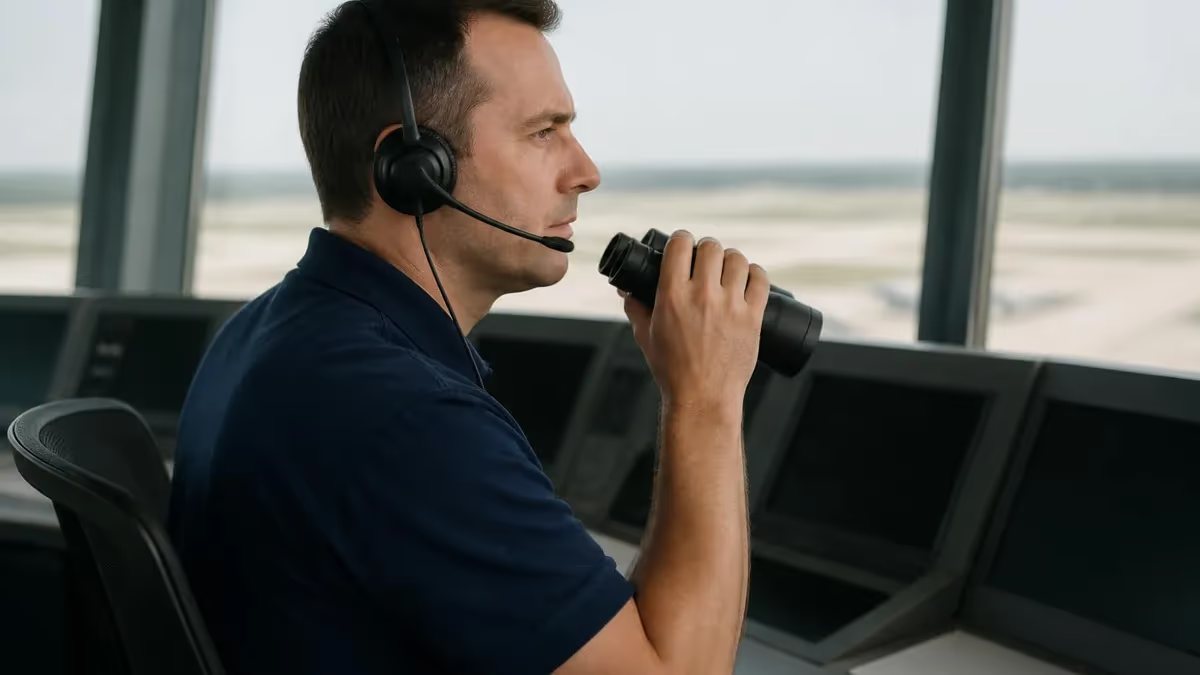
The FAA A&P license — short for Airframe and Powerplant mechanic certificate — is the credential that lets you legally inspect, repair, and sign off on civil aircraft in the United States. It's not a degree. It's not a college diploma.
It's a federal certificate issued under 14 CFR Part 65, and it can take you from a curious teenager in a hangar to a six-figure technician on a wide-body fleet line. The same piece of paper hangs in the shop of a single-engine Cessna mechanic in Iowa and in the office of a director of maintenance at a major air carrier. That's how broad the authority is.
Here's the truth most prep sites won't tell you up front: getting your A&P isn't about being a genius. It's about meeting a clear set of FAA rules, putting in the hours, and passing three tests. Lots of people do it. Roughly 8,000 new mechanics earn their tickets each year. You can be one of them — and you probably don't need to spend $40,000 at a fancy school to do it. Some of the best mechanics in the industry started by sweeping hangar floors and asking questions. The certificate rewards persistence over pedigree.
This guide walks you through every piece of the puzzle. Eligibility. The two main paths to qualify. The written, oral, and practical exams. How to study without burning cash. What examiners look for. What you'll actually earn once you're certified. And what keeps your ticket valid for life. By the end, you'll know exactly what to do next — whether that's signing up for a school, walking into a local FBO with your resume, or downloading the free FAA handbooks and starting to study tonight.

FAA A&P License By The Numbers
So what exactly does the A&P certificate authorize? Two ratings live on one piece of paper. The Airframe rating covers the structure — wings, fuselage, landing gear, flight controls, hydraulics, fuel systems, environmental systems. The Powerplant rating covers what makes the airplane move — reciprocating engines, turbine engines, propellers, ignition, induction, exhaust, lubrication.
You can technically earn just one, but almost nobody does. The combined A&P is the industry standard, and most employers won't hire you with only half the credential. Carriers, MROs, and FBOs want one person who can sign off both halves of the airplane. Going halfway cuts your job market in half too.
The legal framework lives in 14 CFR Part 65, Subpart D. That regulation spells out who can apply, what experience counts, what tests you have to pass, and what privileges and limitations come with the rating. It's worth bookmarking on the FAA's website. You'll reference it more than once on your journey. Section 65.71 covers eligibility. Section 65.75 lays out knowledge requirements. Section 65.77 details experience. Section 65.79 covers the skill test. Section 65.81 lays out general privileges. And 65.83 sets the recency-of-experience rule. Together they're maybe twenty pages — short, dense, and surprisingly readable.
One more thing worth saying up front. The A&P isn't a pilot's license. You don't get to fly anything. But the certificate is, in many ways, more durable than a pilot certificate. There's no medical to renew. No biennial flight review. No fuel costs. And the demand for certified mechanics has outstripped supply for more than a decade running, with Boeing forecasting the global aviation industry will need over 700,000 new technicians by 2042.
What the A&P Certificate Lets You Do
Once certified, you can perform and approve for return to service any maintenance, preventive maintenance, alteration, or 100-hour inspection on aircraft for which you're rated — subject to the limitations in Part 65.81. You can't sign off annual inspections (that requires an Inspection Authorization, or IA, with three additional years of experience), but you can do nearly everything else. That's a huge scope of authority for a federal certificate that never expires.
Before you even think about exams, you've got to meet the basic eligibility rules under 14 CFR 65.71. There are only four — and they're not negotiable. You must be at least 18 years old. You must be able to read, write, speak, and understand English. You must pass each of the prescribed tests within a 24-month window. And you must demonstrate the required experience, either through schooling or hands-on work.
That English requirement trips up some applicants. It's not casual. The FAA wants you to read maintenance manuals, write logbook entries, and communicate clearly with pilots and inspectors. If English isn't your first language, the practical and oral exams will test that fluency hard. There's no waiver.
There's an exception for applicants whose medical reasons prevent reading or speaking — but those cases are rare and require special evaluation. Most applicants who fail on the language portion fail it at the oral, when the examiner asks them to interpret a Maintenance Manual passage cold. Practice reading aviation English out loud during prep.
The age rule is firm too. You can start training at 16 at most Part 147 schools, but you can't sit for the FAA exams until you turn 18. Plan accordingly if you're in high school and thinking ahead. Some high school career and technical education (CTE) programs partner with Part 147 schools to let students earn dual credit, shaving a year or more off the standard timeline. If your district offers one, jump on it — it can put you in the workforce making $50,000+ before your friends finish their freshman year of college.
The experience side has its own quirks. "Practical experience" under 65.77 means concurrent, supervised work — not just hanging around a hangar. Your hours have to be signed off by a certificated mechanic or repair station, and the work has to span the breadth of the rating. Forty-hour weeks of changing the same oil filter won't satisfy the breadth requirement, no matter how many months you log.
Paths to Qualify for the FAA A&P License
Enroll in an FAA-approved Aviation Maintenance Technician School. Programs run 18-24 months and cover 1,900 hours of curriculum across general, airframe, and powerplant subjects. Tuition ranges from $15,000 to $45,000 depending on the institution. You graduate eligible to sit all three written exams plus the oral and practical.
Work under the supervision of certified mechanics for at least 18 months per rating — 30 months total for both Airframe and Powerplant. Your time must be documented and signed off by your supervisor. Then you apply for FAA approval to test by visiting your local FSDO with proof of experience.
If you served as an aircraft maintainer in any branch of the U.S. military, your service records may satisfy the experience requirement. The Joint Service Aviation Maintenance Technician Certification Council (JSAMTCC) program streamlines this — many veterans test out within months of separation.
Some applicants mix a shorter A&P school program with documented shop time, or combine military experience with civilian apprenticeship. The FSDO inspector reviews the full record and signs FAA Form 8610-2 if the combined experience meets Part 65 requirements.

Let's talk testing. The path from "qualified applicant" to "certificated mechanic" runs through three distinct exam categories, and you need to clear all of them to get your ticket. Each one is a different beast, and you'll prepare for them differently.
First, the written tests — three of them. General, Airframe, and Powerplant. Each is a computer-based, multiple-choice exam administered by an authorized testing center like PSI. The General test runs 60 questions in 2 hours. Airframe and Powerplant each have 100 questions and a 2.5-hour time limit. Passing score is 70% on each. The questions come from a published FAA bank, which means you can — and absolutely should — study the actual questions before you sit down.
Next comes the oral exam. After you pass all three writtens, you schedule with a Designated Mechanic Examiner (DME). The oral is essentially an interview about systems, regulations, and procedures. It can last anywhere from 4 to 12 hours depending on the examiner. They'll ask you to identify components, explain inspection procedures, troubleshoot scenarios, and reference the FARs from memory.
Finally, the practical exam — same day, same examiner. You'll be given a series of hands-on projects from the FAA's Practical Test Standards. Safety wire a fitting. Inspect a magneto. Measure cylinder compression. Repair a sheet metal patch. Each task gets graded pass/fail. Miss too many and you go home and reschedule.
The Three FAA A&P Written Tests
The General test covers basic electricity, aircraft drawings, weight and balance, fluid lines and fittings, materials and processes, ground operations, cleaning and corrosion control, mathematics, maintenance forms and records, basic physics, and FARs applicable to all mechanics. 60 questions. 2 hours. 70% to pass. You take this one first — it's the foundation for both rating exams.
Now — how do you actually study without going broke? Here's the unspoken secret of the A&P world. The FAA publishes its own free handbooks. The Aviation Maintenance Technician Handbook — General (FAA-H-8083-30), Airframe (FAA-H-8083-31), and Powerplant (FAA-H-8083-32) — are all available as free PDF downloads. Together they cover roughly 90% of what shows up on the writtens. Print the chapters you struggle with, mark them up, sleep with them under your pillow if you have to. The repetition matters more than the format.
Beyond the free handbooks, the two big test-prep brands you'll see everywhere are ASA (Aviation Supplies & Academics) and Dauntless Aviation. ASA's Test Prep books include the official FAA question bank with explanations. Dauntless sells a digital app, GroundSchool, that drills you on the same questions adaptively.
Either one will get you ready — and you can grab used copies on eBay for under $20. Use the app for daily 20-minute drilling on your phone. Use the book for deep-dive sessions on weekends. Together they'll get you scoring 85-90% on practice tests, which is where you want to be before booking the real thing.
For the oral and practical, the PMI (Aviation Maintenance Press) guides are the gold standard. Frank Delp's Aircraft Maintenance Technician Oral & Practical Exam Guides are battered, dog-eared, and on every examiner's shelf for a reason. They cover the exact format DMEs use and include sample questions pulled from actual tests. Read the guide cover to cover. Then go back and quiz yourself out loud. The oral exam is a verbal art — if you can't explain how a magneto works while looking at one, no amount of reading will save you.
Part 147 schools are not the only legitimate path. Many applicants overpay $30,000+ for AMTS programs when they could have apprenticed at a local FBO or repair station for free — and earned wages while doing it. If you live near a general aviation airport or a regional MRO, walk in and ask. Mechanics are in such short supply that shops will often hire and train inexperienced applicants. Document your hours from day one using FAA Form 8610-2 and you'll be eligible to test in 30 months. School makes sense if you want a structured, fast track or live far from aviation jobs. Otherwise, weigh the cost.
Once you're ready to test, you'll need a few documents and a clear plan of attack. The order matters more than people realize. Get the writtens out of the way first — they expire 24 months from the date of your first pass, so don't drag your feet. Then schedule the oral and practical together with your DME within that window.
Pro tip from working mechanics: book the General test as soon as you feel ready, even if Airframe and Powerplant aren't quite there yet. Passing one written tends to break the psychological barrier, and you'll find the next two come faster. Many applicants knock out all three writtens in a single month after months of dragging their feet.
Picking your DME matters more than you might think. Examiners have reputations. Some are known for grueling 12-hour orals. Others run a tight, fair, six-hour exam and send people home certified by dinner. Ask around at your shop. Talk to recent graduates from your school. Read the FAA's public DME directory and call two or three. The fee variation alone — $600 on the low end versus $1,200 on the high end — justifies the research.
Here's the checklist you'll want to print and tape to your fridge:

FAA A&P License Application Checklist
- ✓Confirm you meet age (18+) and English language requirements under 14 CFR 65.71
- ✓Document your eligibility via FAA Form 8610-2 (experience) or graduation certificate (Part 147 school)
- ✓Get FSDO authorization to test if applying via the experience route — schedule the visit early, they book out weeks ahead
- ✓Register on faa.psiexams.com and pay for the General, Airframe, and Powerplant written tests ($175 each as of 2026)
- ✓Pass all three writtens with a score of 70 or higher within a 24-month window
- ✓Find a Designated Mechanic Examiner (DME) in your area — the FAA maintains a public directory
- ✓Bring valid photo ID, your written test reports, your 8610-2 or school certificate, and a calculator to the oral and practical
What's the certificate actually worth once you have it? That depends on the segment of aviation you choose. The starting wage for a fresh A&P at a general aviation FBO might be $22-28 an hour. The same mechanic two years later at a regional airline hits $35-40.
A senior heavy maintenance tech at a major like Delta or American can clear $90,000 a year before overtime — and the overtime is real, often pushing total compensation past six figures. Add in per-diem when traveling for AOG (Aircraft on Ground) calls, completion bonuses, and shift differentials for nights, and the headline number underplays the real earnings of a seasoned mechanic.
Geography matters. Mechanics in Alaska, Hawaii, and remote Pacific routes routinely earn 30-50% above mainland rates because the talent pool is thin. Texas, Florida, and Arizona host massive MRO clusters — Dallas, Miami, Tucson — where wages are competitive and the cost of living is lower than the coasts. New York, Los Angeles, and Chicago pay more but cost more to live in. Pick your hangar carefully.
Let's weigh the trade-offs honestly. Aircraft mechanics earn well, work indoors most of the time, and the certificate gives you portable, federally recognized expertise that travels anywhere there's a runway. But it's not a desk job, and the hours can be brutal. Anyone telling you the A&P is a relaxed nine-to-five hasn't worked a midnight maintenance check on a 737 with departure pressure breathing down their neck.
FAA A&P Career Pros and Cons
- +Median wages of $70,000+ with strong overtime opportunities — top 10% of A&Ps earn over $97,000
- +Certificate never expires — pass your tests once and you're licensed for life as long as you maintain currency
- +Severe industry shortage means jobs are everywhere, with sign-on bonuses up to $20,000 from major airlines
- +Skills transfer globally — your A&P is recognized by most ICAO member states with limited conversion
- +Multiple career paths: airlines, MROs, manufacturers, corporate, government, military contractors, and aerospace R&D
- −Physical demands are real — you're climbing, lifting, working in awkward positions, often outdoors in extreme weather
- −Shift work and on-call rotations are standard in airline maintenance, including overnight "red-eye" lines
- −Initial certification can take 2-3 years even on the fastest path, with significant time and money invested
- −Legal liability is substantial — your signature on a logbook entry follows you for the life of the aircraft
- −Continuing education is essentially mandatory to stay current on new fleet types and avionics changes
Pros and Cons at a Glance
| Pros | Cons |
|---|---|
| Certificate never expires — pass your tests once and you're licensed for life as long as you maintain currency | Physical demands are real — you're climbing, lifting, working in awkward positions, often outdoors in extreme weather |
| Skills transfer globally — your A&P is recognized by most ICAO member states with limited conversion | Shift work and on-call rotations are standard in airline maintenance, including overnight "red-eye" lines |
| Multiple career paths: airlines, MROs, manufacturers, corporate, government, military contractors, and aerospace R&D | Legal liability is substantial — your signature on a logbook entry follows you for the life of the aircraft |
Speaking of staying current — your A&P doesn't actually expire, but the privilege to exercise it does. This is where 14 CFR 65.83 comes in. To act on your certificate, you must have worked actively as a mechanic for at least 6 months out of the previous 24 months, or completed an FAA-approved refresher course, or retaken the practical exam. Most working mechanics meet the active-work threshold without thinking about it. The rule mainly catches folks who walk away from the trade for a few years and try to come back.
Career-wise, you've got real choices. Airline maintenance offers the highest wages and the best benefits but also the most rigid schedules. General aviation pays less but gives you more variety — you might be working on a Cessna 172 in the morning and a King Air turboprop in the afternoon.
MROs (Maintenance, Repair, and Overhaul shops) run somewhere in between, often specializing in heavy checks for multiple airlines. Manufacturers like Boeing and Gulfstream hire A&Ps for assembly, flight test, and field service positions. And there's a growing market for A&Ps in space — SpaceX, Blue Origin, and Rocket Lab all need certified hands working on launch vehicles.
One last bit of strategy. If you eventually want to sign off annual inspections or operate as a freelance shop foreman, you'll need the Inspection Authorization (IA). Three years after earning your A&P, having actively maintained aircraft for the past two, you can apply for the IA. It's an additional written test and a more rigorous knowledge of regulations. IAs typically earn 15-25% more than non-IA A&Ps.
Ready to start testing your knowledge? Take a free FAA A&P practice quiz now and see where your gaps are before you spend a dime on study materials.
Whether you're 18 and just graduated high school, a veteran transitioning out of the military, or a mid-career professional looking for a hands-on trade with real upward mobility — the FAA A&P certificate opens a door that doesn't close. Aircraft will need mechanics for as long as people fly, and the demand right now outpaces supply by a wide margin.
The aging workforce makes things even tighter: nearly 40% of active A&Ps are over 55, and the wave of retirements has only begun. Carriers are responding with sign-on bonuses, tuition reimbursement, and accelerated promotion tracks that didn't exist five years ago. The window is wide open.
Get your study materials. Book your tests. Find a DME. And start signing logbooks. The runway is right there — and the aircraft on it need somebody to keep them flying safe. That somebody could be you, sooner than you might think.
FAA Questions and Answers
About the Author

Commercial Pilot & FAA Certification Specialist
Embry-Riddle Aeronautical UniversityCaptain Jennifer Walsh graduated with honors in Aerospace Engineering from Embry-Riddle Aeronautical University and holds FAA Airframe & Powerplant and Airline Transport Pilot certificates. With 11 years of commercial aviation experience and 6 years as a ground school instructor, she guides aviation mechanics and student pilots through FAA written exams and practical tests.
Join the Discussion
Connect with other students preparing for this exam. Share tips, ask questions, and get advice from people who have been there.
View discussion (9 replies)