
FAA Written Test PSI: Complete Guide to Scheduling, Testing & Passing
FAA Written Test PSI guide — how to schedule via PSI Online, IACRA setup, fees, check-in, scoring, retest rules, and pass strategies. 💯
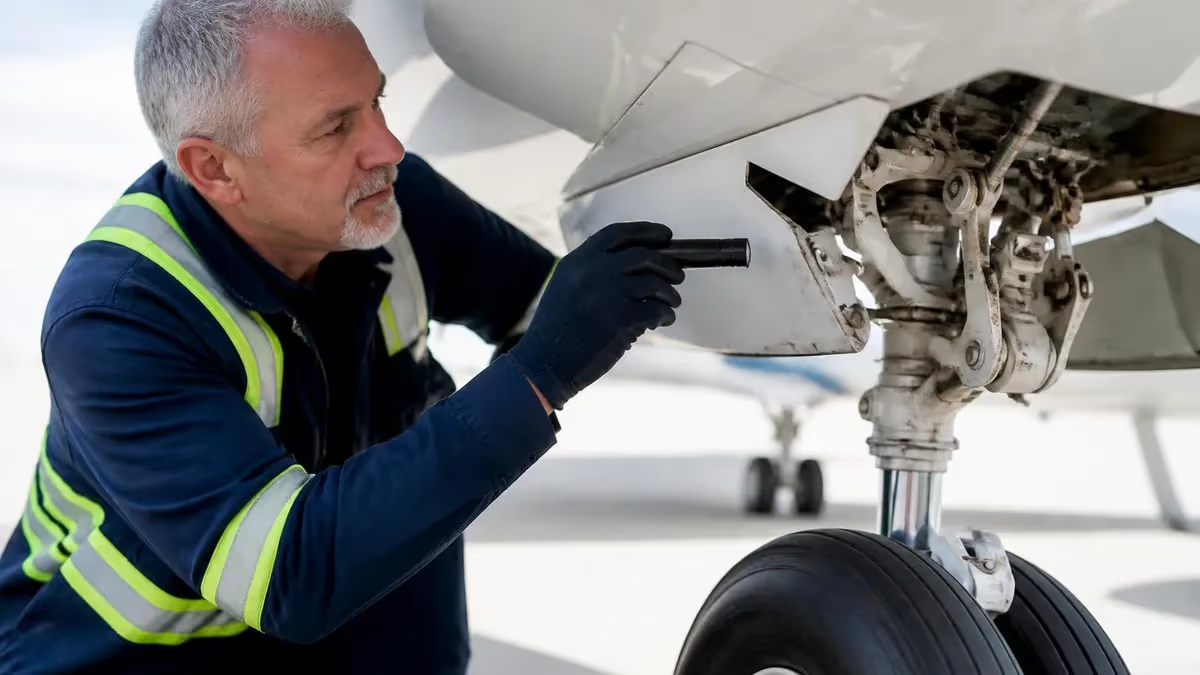
If you're chasing a pilot certificate or an aviation mechanic ticket, you'll meet PSI Services before you ever meet a DPE. Since 2018, PSI has been the FAA's exclusive vendor for airman knowledge tests — the company replaced LaserGrade and CATS, and it now runs every single computer-based FAA knowledge exam across the United States. That covers the Private Pilot test, the Commercial, the Instrument rating, the ATP, A&P General/Airframe/Powerplant, Flight Engineer, the Remote Pilot 107, and the FOI. Pretty much anything you'd sit for inside the federal aviation system flows through PSI.
And yet, most candidates show up with no idea what PSI actually does. They think it's a website. It's not. PSI is a testing-services giant — they handle thousands of licensing exams beyond aviation — and the FAA contract makes them the gatekeeper between you and your knowledge-test report (the IACRA-ready document a DPE will demand at your checkride). This guide walks you through the whole thing: scheduling, IACRA, what to bring on test day, the on-screen calculator, breaks, scoring, retests, fees, and the endorsement headaches that trip up first-timers.
Let's get into it.
FAA Written Test PSI by the Numbers
Before PSI, the FAA juggled two vendors — CATS and LaserGrade. Candidates often had to pick between them, and pricing wasn't uniform. The 2018 consolidation simplified things on paper but introduced one universal scheduling platform: PSI Online (faa.psiexams.com). That's where you book, pay, reschedule, and download your Airman Knowledge Test Report (AKTR) after passing. The site isn't gorgeous, but it works — and you only need it for about ten minutes total across your entire testing journey.
One thing that catches new candidates off guard? PSI doesn't grade you. The questions are FAA-written, drawn from the FAA's official question bank, and the answer keys are FAA-owned. PSI just hosts the delivery infrastructure: the scheduling, the secured test rooms, the proctors, the workstations, and the on-screen testing engine. They also handle ID verification and scoring transmission back to Oklahoma City. Think of PSI as the airport — they don't own the planes, but nothing takes off without them.
The handoff in 2018 wasn't perfectly smooth. Older flight schools still keep printed CATS contact sheets in their reception drawers, and a few CFIs reflexively tell students to "go to LaserGrade." Both names are dead. If anyone tells you to book through CATS or LaserGrade, gently correct them — those vendors no longer have FAA authorization, and any link you find online pointing to them is broken or redirects to PSI anyway. Stick with the official portal and you'll save yourself a lot of confusion.
Who Needs the PSI FAA Knowledge Test?
Anyone seeking an FAA airman certificate — Private Pilot, Commercial, Instrument, ATP, CFI, Remote Pilot (Part 107), Flight Engineer, or any A&P mechanic rating — must pass a knowledge test administered by PSI. Flight Instructor candidates also sit for the FOI (Fundamentals of Instructing). There is no paper alternative anymore, and home-study candidates are held to the same standard as full-time flight school students.
Step one is creating an IACRA account. IACRA (Integrated Airman Certification and Rating Application) is the FAA's online system for processing airman applications, and it's where your knowledge test result ultimately lives. You'll need an FAA Tracking Number (FTN) — that 10-character ID becomes your permanent identifier across the federal aviation universe. Get it before you schedule with PSI. Why? Because PSI Online asks for your FTN during registration, and walking into a test center without one creates paperwork friction you don't need on test day.
Setting up IACRA takes maybe fifteen minutes. Go to iacra.faa.gov, click "Register," choose "Applicant," fill in the basics (name, address, date of birth, US citizenship status, language preference), set a password, and verify your email. You'll get your FTN immediately. Save it somewhere — your phone, your wallet, a sticky note on your fridge. You'll use it forever.
Now scheduling. Head over to faa.psiexams.com, create a PSI Online account (separate from IACRA — they don't talk to each other directly), and link your FTN. Pick the exam code that matches your goal: PAR for Private, CAX for Commercial Airplane, IRA for Instrument Airplane, ATA for ATP Airplane, UAG for Remote Pilot 107, FOI for Fundamentals of Instructing, and so on. The system shows you available test centers within a radius you choose. Pick a date, pay the fee, and you're locked in.
What You Need Before You Schedule
Create at faa.psiexams.com. Separate from IACRA, with its own login and password. Handles scheduling, payment, rescheduling, and your Airman Knowledge Test Report download after passing the exam.
Get your FAA Tracking Number at iacra.faa.gov before you schedule with PSI. Required for PSI registration and every future airman application, including all future ratings and certificates you ever pursue.
A signed CFI or home-study endorsement is required for most knowledge tests. Bring the original or a clear printed copy with date, CFI number, and signature — no endorsement on hand means no test, even if you paid.
A valid driver's license or passport works. The name must match your PSI registration and IACRA records exactly — no nicknames, no middle-name abbreviations, no expired documents accepted at any PSI test center.

Endorsements deserve their own conversation because they're where 90% of test-day disasters start. For most knowledge tests — Private, Commercial, Instrument, ATP — you need a written endorsement from an authorized instructor stating you've received the required ground training and are prepared for the exam. The endorsement language comes from FAA Advisory Circular 61-65, and your CFI knows the exact wording.
Don't show up with a handwritten note on a napkin. PSI proctors have rejected endorsements for missing dates, missing CFI certificate numbers, missing expiration dates on the CFI ticket, and missing signatures. Each rejection costs you the test fee — PSI keeps your money even if you don't get to sit.
Home-study candidates (folks using King Schools, Sporty's, Gleim, or Sheppard Air) usually get an endorsement from their course provider after completing the curriculum. That endorsement is just as valid as a CFI's — but it must be printed and signed, not just shown on your phone. A few test centers will accept a digital copy on an iPad; many won't. Print it. Bring it. Bring two copies if you're paranoid.
A note on which exams require endorsements and which don't. The Remote Pilot (Part 107) initial test does not require an instructor endorsement — it's open to anyone 16 or older with a valid ID. Same with most A&P mechanic tests, where the endorsement requirement is replaced by documented work experience or aviation maintenance school graduation. But the Private, Recreational, Sport, Commercial, Instrument, ATP, CFI, and Ground Instructor exams all demand an endorsement. Check the specific FAR for your exam (61.35, 61.103, 61.123, 61.157, etc.) if you're not sure — or just ask your CFI.
Tests Administered by PSI
Private Pilot (PAR), Recreational (RPA), Sport (SPA), Commercial Airplane (CAX), Instrument Airplane (IRA), ATP Airplane (ATA), Military Competence (MCA), and Foreign Pilot (FPP). Each is 60-90 questions delivered across 2 to 2.5 hours, with a 70% minimum to pass. Most candidates finish the Private Pilot in 90 minutes and the ATP in just under two hours, though you're free to use every available minute. Pacing varies by exam length and personal style.
Test day. Show up thirty minutes early. Not fifteen — thirty. PSI proctors run a check-in process that includes ID verification, fingerprint or signature capture (depending on the center), a biometric photo, and a personal-belongings sweep. You'll empty your pockets, surrender your phone, smartwatch, hat, jacket, and any food or drink. Lockers are usually provided. Everything you brought except your ID, your endorsement, an FAA-approved calculator, and any FAA-permitted reference materials (more on that in a moment) goes into the locker.
What you can bring into the testing room: a non-programmable calculator (E6-B or CX-2 Pathfinder are common), a plotter, a magnifying glass if needed for sectional charts, plain blank scratch paper (provided by PSI), and the FAA-supplied Computer Testing Supplement booklet — that's the spiral-bound figure book containing all the charts, graphs, and weight-and-balance tables referenced in your questions. The proctor hands it to you. Don't bring your own.
Some centers also offer an on-screen calculator built into the testing software. It's basic — four functions, square root, percentage — and it pops up via a button in the test interface. Most candidates ignore it and use a physical E6-B. The on-screen tool is fine for arithmetic but useless for time-speed-distance or wind-correction problems. Bring a real flight computer.
Cell phones, smartwatches, fitness trackers, Bluetooth earbuds, programmable calculators, books, notes, weather products, and personal pens are all banned from the testing room. Bringing any prohibited device — even powered off — can result in test invalidation and forfeiture of fees. When in doubt, lock it up.
Once you're seated, the proctor walks you to a workstation, logs you in, and starts the exam clock. The interface is plain — black text on white, navigation buttons at the bottom, a question counter at the top, and that on-screen calculator button I mentioned. You can flag questions for review, skip and return, and change answers freely until you click "End Exam." There's no penalty for guessing, so always answer every question even if you have to triage your way to the finish line. A blank answer is a guaranteed wrong; a guess is a 25% shot.
Breaks: PSI allows unscheduled bathroom breaks, but the clock keeps running. For a 2.5-hour Private Pilot exam, that's a real cost. Plan your hydration. Some candidates skip coffee the morning of — too much risk of a 10-minute restroom detour eating into review time. The proctor will escort you to and from the testing room, and you can't access your phone or locker during the break. Just bathroom, drinking fountain, and back.
Scoring is immediate. The moment you click "End Exam," the system tallies your score, displays it on-screen, and prints an Airman Knowledge Test Report (AKTR) at the proctor's desk. You'll get the AKTR before you leave the building. It shows your percentage, the FAA learning-statement codes for any questions you missed (so you and your CFI know which areas to review), the exam title, your FTN, and the date. Don't lose it. Your DPE will want the original at your checkride, and the FAA requires you to have it for two years.

Test Day Checklist
- ✓Government-issued photo ID with name matching IACRA exactly
- ✓Original endorsement document (CFI or home-study)
- ✓FAA Tracking Number (FTN) memorized or written down
- ✓Non-programmable calculator or E6-B flight computer
- ✓Plotter and any approved chart tools
- ✓PSI confirmation email or printed receipt
- ✓Arrive 30 minutes before scheduled start time
What if you fail? It happens — about 10-12% of Private Pilot candidates don't make 70% on the first sit. The retest rules are straightforward: you must wait until your CFI re-endorses you (a separate retest endorsement, also from AC 61-65), and you can typically reschedule with PSI immediately after you have that signature.
There's no mandatory cooling-off period imposed by the FAA — the wait is purely based on how fast your instructor will sign you off. Most CFIs want to review your missed learning-statement codes before re-endorsing, which usually means at least one ground session. Plan on a 2-3 day minimum turnaround in practical terms, though some folks bang out a retest within 24 hours if their CFI is available.
You'll pay the full test fee again — PSI doesn't discount retests. That stings, but it's the cost of doing business. Some flight schools have negotiated bulk pricing with PSI, dropping per-exam fees to around $150, but the standard rate posted on PSI Online is $175 for most knowledge tests as of 2026. ATP and certain specialty exams may run higher. Always confirm the price on your specific exam code before scheduling.
There's one quirk worth knowing about. The FAA doesn't post a hard limit on how many times you can retake a knowledge test — there's no "three strikes and you're out" rule baked into the regs. But your CFI is on the hook professionally for re-endorsing you, and a pattern of repeat failures will spook most instructors into requiring a much heavier remedial ground curriculum before they'll sign again.
If you fail twice, expect a serious conversation about study habits before attempt number three. The 14-day language some candidates hear about isn't an FAA rule — it's just a common minimum CFIs set internally to make sure you actually study between attempts.
FAA Written Test PSI Pros and Cons
- +One unified scheduling platform across the entire US
- +Immediate scoring with on-screen results
- +Hundreds of test center locations nationwide
- +AKTR printed at the test center — no waiting for mail
- +Flexible rescheduling up to 48 hours before your appointment
- −Test fees are not refundable if you fail to bring proper endorsement
- −Clock keeps running during bathroom breaks
- −Some test centers have inconsistent proctor training
- −No partial credit — 70% is hard floor across all exams
- −Limited test center coverage in rural areas can mean long drives
Pros and Cons at a Glance
| Pros | Cons |
|---|---|
| One unified scheduling platform across the entire US | Test fees are not refundable if you fail to bring proper endorsement |
| Immediate scoring with on-screen results | Clock keeps running during bathroom breaks |
| Hundreds of test center locations nationwide | Some test centers have inconsistent proctor training |
| AKTR printed at the test center — no waiting for mail | Limited test center coverage in rural areas can mean long drives |
A few pro tips from candidates who've been through it. First — schedule early, but not too early. PSI lets you book up to 90 days out, and morning slots (7-9am) tend to be quieter and less rushed than afternoon ones. Friday slots fill up first; Tuesday and Wednesday mornings are the sweet spot. Second, do a dry run the week before.
Drive to the test center, find the parking, see the front desk, get a feel for the building. Test-day stress doubles when you're also lost in an industrial park looking for suite 204. Third, sleep. Not the night before — the night before the night before. Pre-test insomnia is real, so bank your rest two nights out.
One more thing about location. PSI test centers are run as franchises and partners — community colleges, flight schools, dedicated testing facilities. Quality varies. Some centers feel professional; others feel like someone's spare room. Read Google reviews of your specific center before booking. The exam content is identical everywhere, but the environment — chair comfort, monitor quality, room temperature, proctor friendliness — can affect a 2.5-hour ordeal more than you'd think. If a center has consistent 1-star reviews mentioning broken AC or rude staff, drive an extra 30 minutes to a better one. You're paying $175 either way.
And finally — practice. Real practice. The FAA question bank is finite, and the best candidates have seen every question multiple times before sitting. Sheppard Air, King Schools, Gleim, and Sporty's all maintain solid prep databases. Free practice tests are useful for diagnostics but tend to drift from the actual FAA wording. When you can hit 90%+ on full-length timed practice exams three sessions in a row, you're ready to schedule. Not before.
About the actual sitting. The PSI workstations are standard office PCs — Windows machines with a 22-inch monitor, a mouse, and a keyboard. Nothing fancy. The exam software is built specifically for FAA delivery, so you won't see ads or browser tabs. Your only inputs are click-to-select for multiple-choice answers, a flag button for review-later questions, and the navigation arrows. There's also a small running clock in the upper right showing time remaining — you can't hide it, so if clock-watching stresses you out, train yourself to glance only after every 10 questions. Pacing is everything on the 2.5-hour exams.
The PSI experience isn't designed to be friendly — it's designed to be standardized. That's actually good news. Once you understand the workflow (IACRA → FTN → PSI Online → endorsement → test center → AKTR), every FAA knowledge exam follows the same pattern. The Private Pilot test runs identically to the ATP, the same as the Remote Pilot 107, the same as the A&P powerplant. Master the process once, and every future certificate gets cheaper, faster, and less stressful.
One last thought. The AKTR is valid for 24 calendar months from the date of the test. That means if you pass your Private Pilot knowledge test on March 1, 2026, you must complete your practical exam (checkride) by March 31, 2028, or the knowledge test expires and you'll have to retake it. Most pilots finish well within the window, but if life intervenes — job change, family stuff, financial squeeze — watch that calendar. The expiration is firm. There is no extension, no appeal, no "I was almost ready." Two years means two years.
If you do need to replace a lost AKTR before the checkride, the FAA Airman Certification Branch in Oklahoma City keeps a digital copy on file. You can request a replacement by writing to the branch with your name, FTN, and date of birth — they'll mail one back within a couple of weeks. Don't lose the original, but know there's a safety net if you do. Plenty of pilots have had to go that route after a basement flood or a moving-day disaster.
Good luck. Knock out the PSI exam, then go fly.
FAA Questions and Answers
About the Author

Commercial Pilot & FAA Certification Specialist
Embry-Riddle Aeronautical UniversityCaptain Jennifer Walsh graduated with honors in Aerospace Engineering from Embry-Riddle Aeronautical University and holds FAA Airframe & Powerplant and Airline Transport Pilot certificates. With 11 years of commercial aviation experience and 6 years as a ground school instructor, she guides aviation mechanics and student pilots through FAA written exams and practical tests.
Join the Discussion
Connect with other students preparing for this exam. Share tips, ask questions, and get advice from people who have been there.
View discussion (9 replies)