
FAA DMS: Document Management System & Drug & Alcohol Management Guide
Complete FAA DMS guide covering the Document Management System at dms.dot.gov and the Part 120 Drug & Alcohol Management Program. 📝
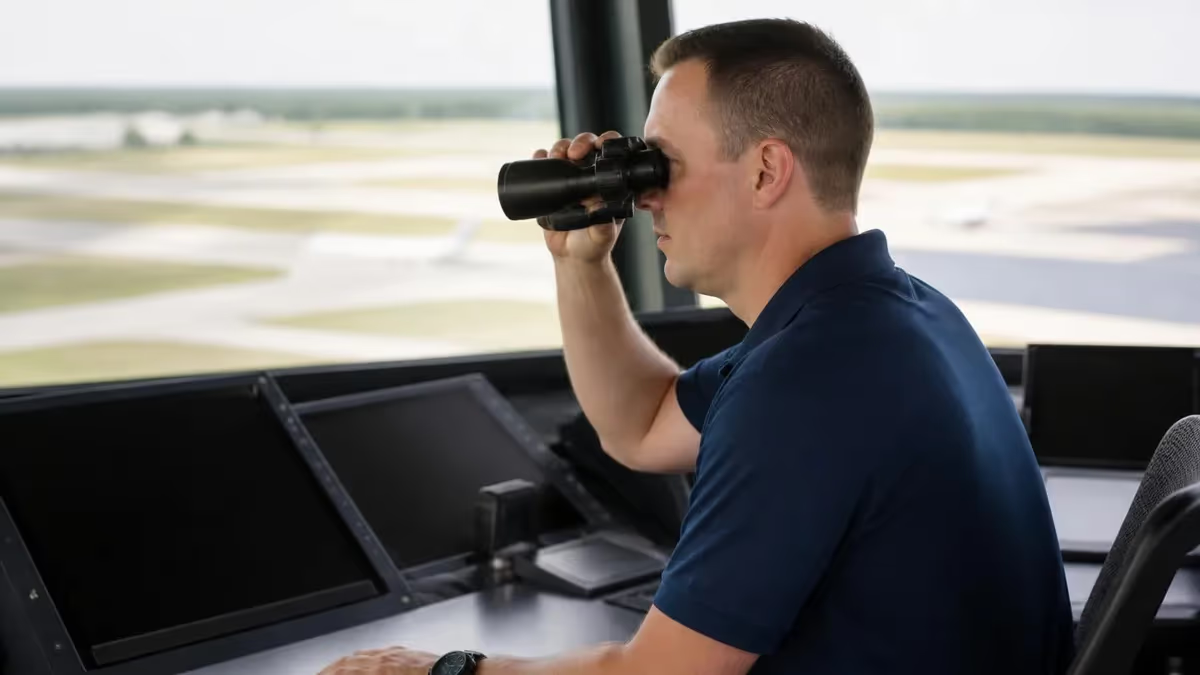
FAA DMS is one of those acronyms that means two completely different things depending on who is asking. For aviation lawyers, rulemaking analysts, and accident investigators, DMS means the Document Management System operated by the US Department of Transportation at dms.dot.gov. For drug program managers, pilots, mechanics, dispatchers, and air traffic controllers, DMS means the Drug and Alcohol Management Program required by 14 CFR Part 120.
Both systems sit at the heart of how the Federal Aviation Administration runs its regulatory work, and confusing them creates real problems. A company expecting to find a rulemaking docket on dms.dot.gov but searching for drug testing records will waste hours. A safety-sensitive employee skimming an FAA notice about DMS reporting changes who assumes it relates to electronic filing instead of drug testing data could miss a compliance deadline.
This guide unpacks both meanings of FAA DMS in plain language. You will see how the Document Management System works, what kinds of records live inside it, and how to search for NTSB accident files, FAA Notices of Proposed Rulemaking, public comment letters, and final rule packages. You will also see how the Part 120 drug and alcohol program operates day to day, who counts as a safety-sensitive employee, how random selection works, what happens when somebody fails or refuses a test, and how Medical Review Officers fit into the chain.
By the time you finish reading you should know exactly which DMS somebody means when they mention it, how to use the right one to get your work done, and where the most common compliance landmines sit. Whether you are studying for an FAA exam, running a Part 121 air carrier compliance program, filing a comment on a proposed rule, or just curious about how aviation paperwork really moves through Washington, the pieces below will save you considerable time.

FAA DMS Numbers You Should Know
The Document Management System hosted at dms.dot.gov is the official public docket of the entire Department of Transportation, and the FAA is its largest single user. Every Notice of Proposed Rulemaking, every direct final rule, every Special Federal Aviation Regulation, every petition for exemption, and every set of public comments related to FAA rulemaking lives inside DMS. The system also holds NTSB accident investigation public dockets, advisory circular drafts opened for comment, and many other categories of regulatory documents that the FAA wants on the public record.
You access DMS by going to dms.dot.gov in any modern browser. The front page presents a basic search box plus links into advanced search features that let you filter by docket number, agency, date range, document type, and submitter. Anyone can read documents without registering. You only need an account if you plan to submit comments yourself on a rulemaking, which most aviation professionals end up doing at some point in their careers.
Each docket is essentially a folder. The folder collects the original notice, supporting analyses such as regulatory evaluations and environmental assessments, public comments submitted by individuals and organizations, and eventually the final rule preamble. Some dockets stay open for years as the FAA collects comments, drafts responses, and works toward a final rule. Others close quickly when the agency issues a direct final rule because no significant comments arrive.
One quirk that catches first-time users is that DMS is increasingly being replaced for routine rulemaking work by the federal-wide system at regulations.gov, which is much faster and easier to search. The two systems share data through the Federal Document Management System backbone, so you can usually find the same FAA docket at either address. However, certain older accident investigation dockets and historical records still live only at dms.dot.gov, so aviation researchers learn to check both. NTSB accident reports moved to their own system at data.ntsb.gov, but related public dockets often still appear in DMS.
Document Management System (DMS) at dms.dot.gov is the DOT public docket holding FAA rulemakings, exemptions, and related records. Drug and Alcohol Management Program (also called DMS in some FAA operator manuals) is the regulated testing program under 14 CFR Part 120 covering pilots, mechanics, flight attendants, dispatchers, ground security coordinators, screening personnel, and air traffic controllers. Context tells you which one is meant. If somebody is talking about random tests, MROs, or refusals, they mean the Part 120 program. If they are talking about NPRMs, dockets, or comments, they mean the public document system.
The FAA drug and alcohol management program sits inside 14 CFR Part 120 and pulls in detailed procedures from 49 CFR Part 40, which applies across all DOT-regulated transportation modes. Together these two rule sets define who must be tested, when testing happens, what substances are tested, who reviews results, what happens after a positive or refusal, and how an employee can return to safety-sensitive duty after a violation.
Coverage applies to anybody performing what Part 120 calls a safety-sensitive function for an FAA-regulated employer. That includes flight crewmembers, flight attendants, flight instructors, aircraft dispatchers, aircraft maintenance and preventive maintenance personnel, ground security coordinators, aviation screeners, and air traffic control specialists who are not employed directly by the FAA. Each operator must maintain a written drug and alcohol misuse prevention program approved by the FAA before any covered employee performs safety-sensitive work.
The five required test types under Part 120 are pre-employment, random, reasonable suspicion, post-accident, and return-to-duty plus follow-up. Pre-employment tests must occur before the employee first performs a safety-sensitive function. Random tests pull names from a scientifically valid random selection process throughout the year at the rates set by the FAA Administrator.
Reasonable suspicion testing happens when trained supervisors observe behaviors, speech, or appearance suggesting prohibited drug or alcohol use. Post-accident testing covers fatal accidents and certain serious incidents. Return-to-duty and follow-up testing are part of the path back to work for somebody who has tested positive or refused a test.
Covered Safety-Sensitive Functions
Pilots, copilots, and other required flight crew at Part 121, 125, 135, and other regulated operators must be tested under the employer drug and alcohol program.
Cabin crew assigned to operations under Part 121 and Part 135 plus flight instructors employed by regulated operators fall under the covered employee definition.
Part 121 dispatchers exercising operational control alongside the pilot in command are safety-sensitive and subject to the full test panel.
Mechanics, repairmen, and preventive maintenance staff performing work on regulated aircraft must be in a Part 120 program through their employer.
Ground security coordinators and aviation screening personnel performing security-sensitive duties are covered employees under the FAA program structure.
Contract tower controllers and other non-federal ATC specialists working at FAA-overseen facilities fall under Part 120 random selection pools.

Specimen collection and laboratory analysis follow strict 49 CFR Part 40 procedures designed to protect both employee privacy and chain-of-custody integrity. Urine collection for drug testing takes place at a collection site staffed by a qualified collector who follows a detailed step-by-step protocol. The collector verifies identity, asks the employee to empty pockets, and observes from outside the bathroom area. The employee provides a specimen of at least 45 milliliters split into two bottles labeled primary and split. Both bottles are sealed in the employee's presence and shipped under chain of custody to a certified HHS laboratory.
The HHS-certified lab tests the primary bottle using an initial immunoassay screen followed by a confirmation test using gas chromatography or mass spectrometry. A non-negative result triggers Medical Review Officer review before any positive is reported to the employer. The MRO is a licensed physician with specific training in substance abuse and federal testing rules.
The MRO contacts the employee to ask about legitimate medical explanations such as prescription opioids, ADHD medications, or other valid uses that could explain the laboratory finding. Only after the MRO concludes there is no acceptable medical explanation does the result get reported to the employer as a verified positive.
Alcohol testing is different. Saliva or breath testing occurs at the collection site, not in a lab. A confirmation test must follow any non-negative screen, typically using an evidential breath testing device. The DOT alcohol threshold under Part 40 is 0.04 grams per 210 liters of breath. A result between 0.02 and 0.039 is not a violation per se but does trigger removal from safety-sensitive duty for at least eight hours. A result at or above 0.04 is a verified violation triggering the full return-to-duty process.
Refusal to test is treated exactly the same as a positive result. Refusal includes failing to appear, leaving the collection site before completing the test, refusing to provide a specimen, providing an insufficient specimen without adequate medical explanation, adulterating or substituting a specimen, or any behavior the collector documents as obstructing the testing process. Employees sometimes mistakenly believe that not showing up is somehow safer than testing. It is not. Refusal goes on the record the same way.
Part 120 Test Types Explained
Every new safety-sensitive employee must pass a pre-employment drug test before performing any covered function. Alcohol pre-employment testing is permitted but not required. The pre-employment test is also required when transferring an employee into a safety-sensitive job from a non-safety-sensitive role within the same company. Failure or refusal blocks the employee from starting the safety-sensitive position until they complete return-to-duty steps including SAP evaluation.
Practical use of the dms.dot.gov document system starts with knowing how to find what you need. Every FAA docket has a unique identifier in the format FAA-YYYY-NNNN where YYYY is the year the docket was opened and NNNN is the sequence number. If you have the docket number, the fastest path is to enter it directly into the search box. Without a docket number you can search by keyword, agency, or document type, though keyword searches return many results and require patience to filter.
Once inside a docket you see a list of all documents associated with the rulemaking or investigation. The original notice typically appears first, dated when the FAA published the proposal in the Federal Register. Below that you see supporting documents the agency relied on, then a chronological list of public comments. Each comment has a tracking number and is fully searchable. Many commenters attach supporting documents such as engineering analyses, legal opinions, or economic studies. All attachments become part of the public record and remain searchable indefinitely.
Submitting your own comment requires creating a free account with regulations.gov, which is the front-end most rulemaking participants use today. The comment submission form asks for your name and contact information, the docket you are commenting on, and your comment text or attached document. Anonymous comments are technically possible but tend to receive less weight in agency analysis. Trade associations and large operators typically submit detailed multipage comments addressing specific provisions point by point, while individuals often submit shorter statements expressing support or opposition.
Aviation lawyers and compliance professionals develop favorite advanced search tricks. Filtering by date range cuts results to recent activity. Filtering by document type narrows results to just notices, just final rules, or just public comments. Combining a date range with a specific FAA office name in the keyword field often surfaces exactly the rulemakings you need without scrolling through thousands of unrelated hits.
Refusal to test under 14 CFR Part 120 is treated as a verified positive. That means you lose safety-sensitive privileges immediately, must complete the full Substance Abuse Professional evaluation and treatment process, and must pass a return-to-duty test before resuming any covered work. Common unintentional refusals include arriving late to the collection site, leaving before signing the chain-of-custody form, refusing to provide a second specimen when the first is insufficient, and adulterating the sample. If something happens during your collection that feels wrong, finish the test and document concerns afterward rather than walking out.
The Medical Review Officer is the firewall between the laboratory and the employer. Every verified positive must pass through MRO review before any action can be taken against an employee. The MRO interview is a confidential conversation where the employee can offer legitimate medical explanations for the laboratory finding. Valid explanations might include a prescription opioid taken under proper medical supervision, ADHD medication legitimately prescribed and used as directed, or a recent dental procedure involving anesthetic. The MRO weighs these explanations against the specific laboratory results, current medical literature, and DOT testing rules.
When the MRO determines no legitimate medical explanation exists, the result becomes a verified positive and is reported to the employer's designated representative. The employer then has 24 hours to remove the employee from all safety-sensitive duties. The employer cannot return the employee to safety-sensitive work until the entire return-to-duty process is complete. This includes evaluation by a Substance Abuse Professional, successful completion of any prescribed education or treatment, a negative return-to-duty test conducted under direct observation, and entry into a follow-up testing program lasting one to five years.
The SAP role is distinct from the MRO role. The MRO is a licensed physician focused on verifying laboratory results. The SAP is a licensed counselor, social worker, psychologist, or addiction medicine specialist focused on assessing the employee's substance use situation and recommending appropriate education or treatment. The SAP also determines the follow-up testing schedule and confirms when the employee has successfully completed the recommended plan. The employer pays for SAP services in most cases but is not required to do so under federal rules. Some union contracts require employer-paid SAP services.
Consequences of a verified positive or refusal extend beyond the immediate employer. The FAA maintains an Aviation Industry Drug and Alcohol Testing Records Database (Pilot Records Improvement Act records and the Pilot Records Database) that tracks violations across operators. A pilot who tests positive at one Part 121 carrier cannot simply move to another carrier without disclosure. The Pilot Records Database, which went live in 2021, gives hiring operators access to drug and alcohol testing history along with training records and disciplinary actions across the industry.

Operator Compliance Checklist for Part 120
- ✓Maintain a written drug and alcohol misuse prevention program approved by the FAA before any covered employee performs safety-sensitive work
- ✓Identify and document every safety-sensitive position in your operation including pilots, dispatchers, mechanics, flight attendants, and ground security coordinators
- ✓Use a qualified third-party administrator or in-house specialist to manage random selection pools at the FAA-required 25 percent annual drug and 10 percent alcohol rates
- ✓Train supervisors at least 60 minutes on drug indicators and 60 minutes on alcohol indicators before they make any reasonable suspicion determinations
- ✓Use only HHS-certified laboratories for drug testing and only DOT-approved devices for alcohol testing under 49 CFR Part 40 procedures
- ✓Engage a qualified Medical Review Officer to review every non-negative laboratory result before reporting to the employer as a verified positive
- ✓Maintain records of every test, supervisor training session, and program audit for the periods required by Part 120 retention rules
- ✓Report annual MIS (Management Information System) data to the FAA showing test counts, positive counts, and refusals by safety-sensitive category
- ✓Establish written procedures for return-to-duty including SAP referral, follow-up testing schedule, and reinstatement decision authority
How does all this look in practice for a working pilot or mechanic? Day one of employment starts with a pre-employment drug test before any work touches a regulated aircraft. The operator schedules the test at a contracted collection site, the employee provides a urine specimen, and the lab processes the sample over the next few business days. A negative result reported to the operator clears the employee to begin training and revenue work. A non-negative result triggers MRO review and potential delays or complete blocking of employment depending on outcomes.
Over the course of a year working in safety-sensitive duty, the employee can expect at least one notice from their employer or third-party administrator that they have been randomly selected for testing. Random notices are immediate. You report to the collection site as soon as practical after notification, generally within two hours.
You cannot stop home first, you cannot delay until tomorrow, and you cannot use the time between notice and collection to consume anything that might affect the result. Random selections happen throughout the year on a schedule unknown even to the operator until the third-party administrator generates each draw.
If a reportable accident occurs and the employee's role might have contributed, post-accident testing kicks in. Pilots involved in fatal accidents are tested as quickly as practical after the event. Mechanics whose work might be implicated in an accident are tested when their connection to the event suggests possible contribution. Even when the employee is not at fault, testing creates the documentary record showing the operator complied with Part 120 obligations.
For somebody who has gone through a violation and completed the return-to-duty process, follow-up testing continues for one to five years. The SAP determines the specific schedule including the number of tests per year, which substances are tested, and when the program ends. The first 12 months always include at least six unannounced tests. These follow-up tests are in addition to any random selections from the regular employee pool, meaning a returning employee is tested substantially more often than a never-violated peer for the duration of their follow-up period.
FAA DMS Programs: Strengths and Pain Points
- + —
- + —
- + —
- + —
- + —
- + —
- − —
- − —
- − —
- − —
- − —
- − —
State medical and recreational marijuana laws create one of the trickiest compliance areas for aviation employers. Federal law continues to list marijuana as a Schedule I controlled substance with no accepted medical use under DOT testing rules. The MRO cannot accept a state medical marijuana card as an explanation for a positive THC result. The same applies to recreational use in states where it has been legalized for adults. The DOT issued specific guidance reaffirming this position multiple times, most recently as states have continued expanding marijuana programs.
Cannabidiol products marketed as legal hemp create another trap. CBD products are legal at the federal level when derived from hemp containing less than 0.3 percent THC by dry weight. However, many CBD products contain more THC than the label states, and some users consume enough product to reach detectable urine THC levels. The DOT has stated clearly that CBD use is not an acceptable medical explanation for a positive marijuana test. Safety-sensitive employees should avoid CBD products entirely or accept the risk that a positive test will not be excused.
Prescription opioid use is more nuanced. Employees prescribed opioids for legitimate pain management can sometimes continue safety-sensitive work depending on the medication, dosage, and employer-specific policies. The FAA has separate medical certification rules for pilots that go beyond Part 120 drug testing and may disqualify even prescription opioid users from medical certificates. Mechanics and other ground personnel face less restrictive medical rules but employer policies still apply. Employees on new prescriptions should consult their MRO or aviation medical examiner before returning to safety-sensitive work, ideally before they need to.
Foreign-conducted random selections sometimes create logistical challenges for international operators. Part 120 random selections must include employees regardless of geographic location, but collection logistics in remote destinations require advance planning. Most operators maintain contracts with international collection networks or designate alternate collection procedures for crew based abroad temporarily. Missing a random because the employee was in a destination without collection capability is generally not an acceptable excuse and operators must demonstrate they took reasonable steps to ensure compliance.
Researchers digging into FAA DMS materials should bookmark a few specific resources beyond just dms.dot.gov. The Federal Register at federalregister.gov publishes daily notices including every FAA NPRM and final rule with direct links into the relevant DMS docket. The FAA Office of Aviation Policy maintains topic pages summarizing major rulemakings in plain language with timelines and key documents linked. The Aircraft Owners and Pilots Association, Air Line Pilots Association, Regional Airline Association, and other trade groups publish their submitted comments on their own websites where you can read industry positions alongside the agency record.
For drug and alcohol program research, the FAA Office of Aerospace Medicine publishes specific drug testing guidance, statistical reports on random testing rates and positive results, and answers to frequently asked compliance questions. The DOT Office of Drug and Alcohol Policy and Compliance publishes broader cross-modal guidance applying across aviation, trucking, rail, transit, and pipeline modes. Substance Abuse and Mental Health Services Administration certification lists name every HHS-certified laboratory authorized to perform DOT testing.
One practical tip for aviation compliance professionals is to monitor docket activity using free email alerts available through regulations.gov. You can set alerts for specific dockets, specific keywords, or specific agencies. Whenever new documents post to a tracked docket you receive an email letting you respond promptly to industry-impacting developments. Operators who miss comment periods often regret missed input opportunities later when the final rule includes provisions they could have addressed earlier with timely engagement.
Putting it all together, FAA DMS sits at the intersection of how aviation rules are made and how aviation safety-sensitive personnel are kept fit for duty. The Document Management System provides the transparency backbone for federal aviation rulemaking. The Drug and Alcohol Management Program provides the substance-abuse safety net for the people physically operating aircraft and supporting their operation. Both serve legitimate safety purposes and both reward operators and employees who understand how they actually work rather than treating them as bureaucratic check-the-box exercises.
If you take only one thing from this guide it is this: when somebody mentions FAA DMS, pause for a moment to confirm which one they mean. The answer determines whether you need to log into a public records system or pull out your compliance manual. With the right starting point you can find documents, file comments, manage testing programs, and stay on the right side of federal rules without wasting hours on the wrong path.
FAA Questions and Answers
About the Author
Commercial Pilot & FAA Certification Specialist
Embry-Riddle Aeronautical UniversityCaptain Jennifer Walsh graduated with honors in Aerospace Engineering from Embry-Riddle Aeronautical University and holds FAA Airframe & Powerplant and Airline Transport Pilot certificates. With 11 years of commercial aviation experience and 6 years as a ground school instructor, she guides aviation mechanics and student pilots through FAA written exams and practical tests.
Join the Discussion
Connect with other students preparing for this exam. Share tips, ask questions, and get advice from people who have been there.
View discussion (9 replies)