
EPA 608 Test Locations Near Me: Your Complete Guide to Finding, Booking & Passing Your Certification Exam
Find EPA 608 test locations near me, book your exam, and prep with free practice questions. Complete guide to Section 608 testing sites. ✅
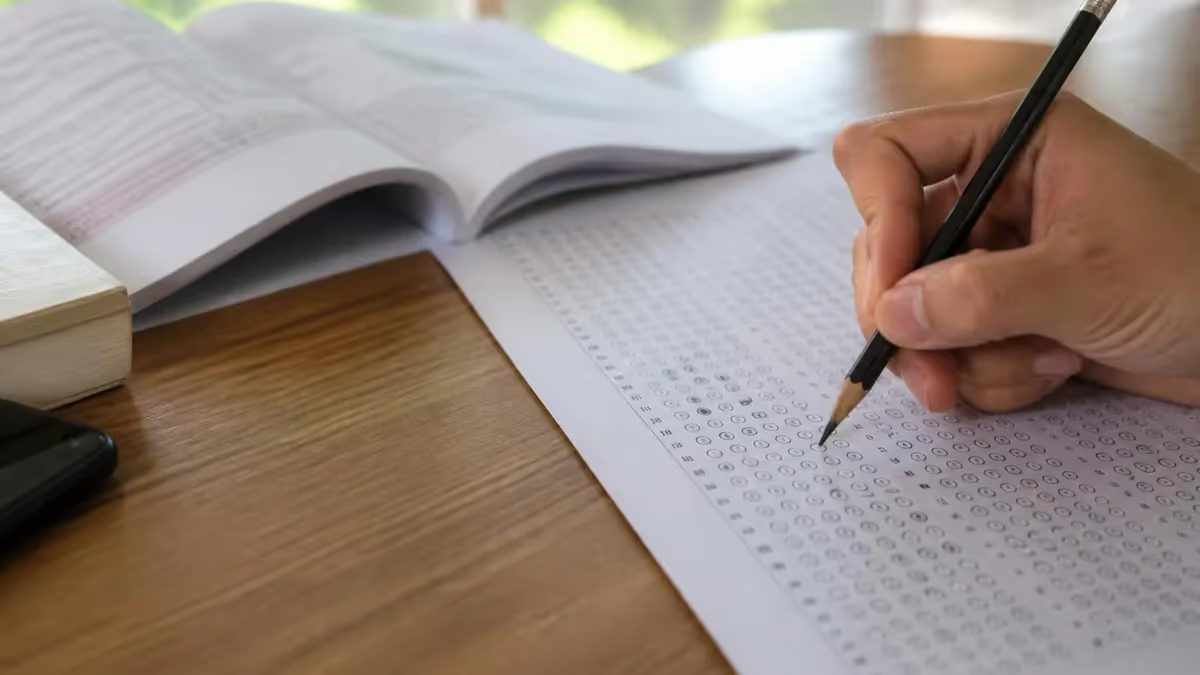
Finding EPA 608 test locations near me is the first practical step every HVACR technician must take after committing to Section 608 certification. The EPA requires anyone who purchases, handles, or recovers regulated refrigerants to hold this credential, and the exam is administered through an EPA-approved certifying organization — not a federal testing center. That means your local options may include community colleges, HVACR trade schools, union halls, supplier showrooms, and third-party proctoring services, each with its own schedule, format, and pricing.
Understanding how the testing network is structured saves you time, money, and frustration. Unlike centralized credential programs such as CompTIA or Prometric, EPA 608 certification is deliberately decentralized. The EPA approves organizations to develop and administer their own exams, which is why you will encounter names like ESCO Group, NATE, Mainstream Engineering, and ICE when searching for test sites. Each approved organization maintains its own locator tool and proctor network, so searching just one organization may cause you to miss a more convenient option across town.
The exam itself tests your knowledge across four certification types: Type I for small appliances, Type II for high-pressure systems, Type III for low-pressure systems, and the Universal certification that encompasses all three. Your testing location choice can influence which types are offered on a given day, the format (paper vs. computer-based), and the turnaround time for receiving your results and wallet card. Planning ahead — ideally four to six weeks before you need the credential — gives you enough flexibility to pick the format and location that fits your schedule.
Before you even look at epa 608 testing locations, it is worth auditing your own readiness. Many technicians underestimate the depth of thermodynamics, refrigerant safety, and regulatory knowledge the exam demands. The Universal exam, in particular, covers recovery techniques, leak detection procedures, reclamation standards, recordkeeping rules, and the global-warming-potential implications of modern refrigerants like R-410A and the newer HFO blends. Walking into a test site unprepared is the fastest way to waste a registration fee and delay your career.
This guide covers every dimension of the testing location process: how to use official locator tools from major certifying organizations, what to expect at different venue types, how to compare online proctored exams against in-person options, what documents and fees you need on test day, and how to build a study plan that maximizes your first-attempt pass rate. Whether you are a first-year apprentice or a seasoned technician updating your credentials, the information here will help you move from registration to certification with confidence and clarity.
One factor that many candidates overlook is the difference between exam administration quality across venue types. A proctored session at a dedicated HVACR training center will typically offer better test-day conditions — quiet rooms, trained staff, immediate technical support — compared to a pop-up session hosted at a supplier's warehouse. Reading reviews of your shortlisted locations and calling ahead to confirm proctor qualifications can make a measurable difference in your test-day experience and your ability to concentrate on the questions themselves.
Finally, keep in mind that passing the EPA 608 exam is not the endpoint — it is the gateway to higher-paying work orders, apprenticeship advancement, and compliance with federal refrigerant regulations that carry civil penalties of up to $44,539 per day per violation. Treating your exam location search and your study preparation as a unified project, rather than two separate tasks, is the mindset that consistently separates first-time passers from repeat test-takers.
EPA 608 Certification by the Numbers
How to Find Approved EPA 608 Test Locations Near You
Identify EPA-Approved Certifying Organizations
Use Organization-Specific Locator Tools
Contact Your Local HVACR Trade School or Union Hall
Confirm Exam Types Offered and Format
Register and Pay Your Exam Fee
Schedule Your Study Timeline Backward From Test Day
Arriving at your EPA 608 exam venue prepared for the specific environment you will encounter can significantly reduce test-day anxiety and improve performance. The physical conditions, proctor protocols, and available resources vary more widely across EPA 608 testing sites than they do in a standardized national exam network, so a brief reconnaissance of your chosen location — even just a phone call — is time well spent in the days before your scheduled exam.
At a dedicated HVACR trade school or training center, you can typically expect individual testing carrels or a dedicated computer lab, a trained proctor who understands the Section 608 material and can clarify administrative instructions (though not answer content questions), and a structured check-in process that includes identity verification with a government-issued photo ID. These venues usually prohibit phones, notes, and outside study materials during the exam, and many enforce a mandatory lock-box policy for personal items. Arrive at least fifteen minutes early to complete paperwork and settle in before the clock starts.
At supplier showrooms or warehouse-based test sessions — common with organizations like Johnstone Supply or Ferguson HVAC, which partner with certifying bodies for periodic exam days — the environment is typically less formal. You may be seated at a folding table in a break room or conference space, and the proctor might be a sales associate who has completed proctor training rather than a dedicated testing professional. This is not inherently problematic, but it does mean you should be self-disciplined about managing distractions and bringing your own approved materials such as a basic calculator if permitted.
Online proctored exams, which surged in availability after 2020, present yet another set of environmental considerations. You will need a computer with a working webcam, microphone, and reliable internet connection — typically at least 5 Mbps upload and download. Your testing environment must be a private room with no other people, a clear desk, and no dual monitors.
The remote proctor will conduct a 360-degree room scan via your webcam before the session begins. Technical failures during a remote session can be stressful, so test your equipment using the organization's system-check tool at least 24 hours before your scheduled exam time.
Regardless of venue type, you will almost certainly need to provide a valid government-issued photo ID. Some organizations also require a second form of identification such as a credit card or employee badge. If you are testing through an employer-sponsored session, your employer may have pre-registered you and paid the fee, but you are still responsible for bringing your own identification. Confirming these requirements with a quick phone call or email to the testing site eliminates the risk of being turned away on exam day due to a missing document.
Payment structures also vary by venue. While most organizations now accept online payment at registration, some older proctor networks — especially small vocational programs — still collect cash or check on test day. If your chosen venue falls into this category, confirm the exact amount due and the accepted payment methods before you arrive. Showing up with the wrong payment type can result in your seat being forfeited, especially at high-demand sessions where a waitlist exists.
After the exam, the process for receiving your results and official certification card depends entirely on the certifying organization and the exam format. Computer-based exams administered by ESCO or Mainstream Engineering typically display a pass/fail result on-screen immediately after submission, with an official score report and wallet card following by mail or email within two to four weeks.
Paper-based exams require manual grading, which can extend the waiting period to four to eight weeks. If you need your certification quickly — for a new job start date or a compliance inspection — prioritize venues offering computer-based testing and ask specifically about their card issuance timeline.
EPA 608 Exam Formats: Comparing Your Testing Options
The traditional paper-based EPA 608 exam remains widely available through trade schools, union halls, and supplier-hosted test events. Administered by a local proctor, the exam typically consists of printed multiple-choice questions answered with a pencil on a bubble sheet. Fees are generally lower — often $20 to $50 for a Universal exam — making this format the most budget-friendly option, especially for apprentices covering their own costs.
The primary drawback is the extended wait for results. Paper exams must be manually graded and mailed to the certifying organization, meaning you may wait four to eight weeks before receiving your official score and wallet card. If you need your certification urgently for a job or compliance deadline, this format's turnaround time may be a disqualifying factor. Always ask your proctor about the grading timeline before registering for a paper-based session.

In-Person vs. Online Proctored EPA 608 Testing: Pros & Cons
- +In-person venues provide a distraction-free, structured environment optimized for exam performance
- +Computer-based in-person exams deliver immediate on-screen results after submission
- +Local training centers often offer pre-exam workshops bundled with the registration fee
- +Online proctored exams eliminate the need to travel, saving time and transportation costs
- +Remote testing allows flexible scheduling including evenings and weekends at many organizations
- +Online exams are ideal for technicians in rural areas far from physical testing centers
- −Paper-based in-person exams can take four to eight weeks to return official results
- −In-person venue availability may be limited, requiring advance planning of four or more weeks
- −Travel to a physical site takes additional time and may incur fuel or transit costs
- −Online proctored exams require reliable high-speed internet, which is not always available
- −Technical failures during a remote session can cause exam termination and fee forfeiture
- −Online testing environments require a private room and cleared desk, which not all candidates can arrange
EPA 608 Test Day Preparation Checklist
- ✓Bring a valid government-issued photo ID such as a driver's license or passport to your exam appointment.
- ✓Confirm your exam appointment at least 48 hours in advance by calling or emailing the testing site.
- ✓Arrive at the testing site at least 15 minutes before your scheduled start time to complete check-in.
- ✓Bring a second form of identification such as a credit card, employee badge, or social security card if required.
- ✓Confirm the payment method accepted if your registration fee is collected on test day rather than online.
- ✓For online proctored exams, run the organization's system-check utility at least 24 hours before your session.
- ✓Clear your desk and ensure your testing room is private with no other people present for remote exams.
- ✓Review recovery equipment operation, refrigerant cylinder markings, and leak rate thresholds the night before.
- ✓Get a full night of sleep and eat a meal before your exam to maintain focus and cognitive performance.
- ✓Bring an approved basic calculator if permitted — confirm with your testing site whether calculators are allowed.
One Exam, All Refrigerant Types — Maximum Career Flexibility
Technicians who earn the Universal EPA 608 certification — covering Type I, II, and III in a single sitting — report access to a wider range of service calls, higher billing rates, and fewer job site restrictions. The marginal cost of adding Type III to a Type I + II exam session is minimal, and most employers prioritize Universal-certified candidates for lead technician and supervisory roles. If you are going to invest the study time and exam fee, always test for Universal.
The landscape of EPA-approved certifying organizations is larger than most candidates realize, and navigating it strategically can help you find a testing location that is closer, cheaper, or better scheduled than the first result that appears in a Google search. As of the most recent EPA review cycle, more than fifty organizations hold approval to administer Section 608 exams, ranging from large national entities with hundreds of authorized proctors to small regional training centers that host exams a few times per year.
ESCO Group is one of the most widely recognized certifying organizations for EPA 608 and offers both paper-based and computer-based testing through its extensive authorized training center network. ESCO's online locator tool allows candidates to search by state, city, or zip code and filter results by exam type. The organization also offers a proctor-request option for employers who want to host a group testing session on-site, which can be particularly cost-effective when five or more employees need certification simultaneously.
Mainstream Engineering Corporation, another major EPA-approved body, is known for its straightforward online registration system and its network of authorized proctors located in HVACR distributors, vocational programs, and employer facilities across all fifty states. Mainstream's exam fee structure is transparent and published on its website, which simplifies cost comparison. The organization's certification cards are recognized universally by employers, regulatory agencies, and refrigerant suppliers as valid proof of Section 608 compliance.
The National Refrigerants Certification Program (NRCP) and ICE (International Certification Exams) also maintain proctor networks and are particularly well-represented in the mid-Atlantic and southeastern United States. If ESCO and Mainstream do not have a convenient location in your area, cross-referencing the EPA's master list of approved organizations with your zip code can surface regional options you would not find through a standard internet search. The EPA's list is available on its official website and is updated periodically as organizations earn or lose approval status.
Many HVACR distributors and wholesale suppliers — including Johnstone Supply, Waxman Industries affiliates, and Carrier Enterprise locations — partner with certifying organizations to host periodic exam days at their branches. These events are sometimes advertised only through local email lists, trade association newsletters, or in-store signage, which means they will not appear in a standard online search. Calling your nearest HVACR supplier and asking whether they host or sponsor EPA 608 exam sessions can uncover options that are more conveniently located and more affordably priced than what you find online.
Union training facilities deserve special mention for apprentices and journeymen in organized trades. Local chapters of the United Association (UA), the Sheet Metal Workers International Association (SMWIA), and IBEW locals with refrigeration jurisdiction regularly administer EPA 608 exams as part of apprenticeship progression requirements. If you are in an organized trade program, your training coordinator can often arrange a group testing session that eliminates the need to search for an external site. These sessions frequently include study resources and are scheduled at times that do not conflict with work shifts.
For employers managing multiple technicians who need certification, on-site group testing is the most efficient option. Most major certifying organizations offer on-site proctor services for groups of five or more candidates, with the employer covering the proctor travel costs in exchange for a discounted per-candidate fee. Coordinating a group session at your shop or service facility reduces lost work time, eliminates individual travel costs, and allows your training coordinator to brief all candidates together on exam logistics and study priorities in the days immediately before the session.
Searching only one certifying organization's website for EPA 608 test locations near me will cause you to miss dozens of valid options in your area. The EPA does not maintain a single centralized testing locator — each of the 50+ approved organizations runs its own proctor network independently. Always check at least three organizations' locator tools, contact your local HVACR distributor, and call your trade association before concluding that no convenient test site exists in your area.
Building an effective study strategy for the EPA 608 exam requires understanding not just what topics are tested, but how the questions are structured and what level of detail is expected. The Section 608 exam is not a simple memorization test — it requires candidates to apply knowledge of thermodynamic principles, federal regulatory requirements, and practical refrigerant handling procedures to realistic service scenarios. Technicians who study only from summary sheets or flashcards frequently find themselves unprepared for the multi-step reasoning questions that appear on the Universal exam.
The four core knowledge domains tested on the Universal exam are: refrigerant properties and the refrigeration cycle (covering pressure-temperature relationships, subcooling, superheat, and refrigerant identification by cylinder color code); environmental regulations under the Clean Air Act Section 608 (covering venting prohibitions, de minimis exemptions, record-keeping requirements, and the phasedown of high-GWP refrigerants); recovery, recycling, and reclamation requirements (covering equipment certification standards, recovery techniques for different system types, and refrigerant purity standards set by ARI 700); and leak detection and repair requirements (covering mandatory leak inspection intervals, repair deadlines for systems with charges above threshold amounts, and documentation obligations).
One of the most reliable study frameworks is to work through practice exams by domain rather than in simulated full-test mode until you have achieved at least 80 percent accuracy in each area. This targeted approach lets you identify weak spots early and allocate additional review time where your foundational knowledge is thinnest. For most technicians, the regulatory sections covering refrigerant purchase restrictions, technician certification purchase requirements, and the Clean Air Act violation penalty structure are the most unfamiliar and therefore the areas most likely to cost points on exam day.
The ESCO Group study manual and the Mainstream Engineering practice test bank are the two most widely recommended study resources by HVACR educators. The ESCO manual provides thorough coverage of all four exam domains with chapter-ending review questions, while Mainstream's practice questions closely mirror the difficulty level and phrasing style of their actual exam. Using both resources together creates a more complete preparation than relying on either alone. Supplement these with digital flashcards for refrigerant pressure-temperature data and regulatory thresholds, which benefit from spaced repetition review.
Time management during the actual exam is a skill that practice tests help you develop. The Universal exam typically allocates two to three hours for all three type sections combined, which sounds generous until you encounter calculation-based questions on refrigerant charge weights, recovery cylinder capacities, or pressure-temperature conversions. Practicing under timed conditions — setting a timer for 90 minutes and working through a full-length practice Universal exam without pausing — trains your pacing instincts and prevents the time-related anxiety that causes careless errors on well-understood questions.
Peer study groups, whether organized through your employer, trade school, or local union, add accountability and expose you to questions and scenarios you might not generate on your own. A colleague who has already passed the exam is an invaluable resource — not because they remember specific exam questions, which would be a violation of testing agreements, but because they can describe the difficulty distribution, the time pressure they experienced, and the study resources they found most effective. This practical perspective complements textbook preparation in ways that solo studying cannot replicate.
Finally, pay attention to the evolution of the refrigerant landscape as part of your preparation. The transition from R-22 to R-410A is now well-established, but the industry is actively moving toward lower-GWP alternatives including R-32, R-454B, and various HFO blends. The EPA 608 exam has historically updated its question pools to reflect current regulatory realities, including the AIM Act provisions that established phasedowns for HFCs. Understanding the regulatory rationale behind these transitions — not just the names of the newer refrigerants — positions you to answer the policy-oriented questions that the exam increasingly includes alongside the technical content.
The final weeks before your EPA 608 exam should be focused on consolidation rather than new content acquisition. If you have followed a structured four-to-eight-week study plan, the last ten days are best spent reinforcing what you already know rather than cramming unfamiliar material. Review your weakest topic areas using targeted practice questions, but resist the temptation to spend long sessions on content that already feels comfortable — that time is better spent on the regulatory and environmental sections that most technicians find counterintuitive.
One of the most effective final-week strategies is to simulate the exact conditions of your exam appointment. Sit down at the same time of day your exam is scheduled, use only the materials you will have in the testing room, and work through a complete timed practice set without breaks or distractions.
This dress rehearsal reduces the novelty effect on actual test day, where unfamiliar surroundings and mild anxiety can disrupt the recall of information you know perfectly well in a comfortable study environment. The psychological benefit of having already experienced the time pressure and question format is measurable and real.
Pay particular attention to refrigerant identification questions in your final review. The EPA 608 exam consistently includes questions on cylinder color codes, pressure-temperature behavior, and the distinctions between CFCs, HCFCs, HFCs, and HFOs in terms of their ozone depletion potential and global warming potential.
These questions are memory-dependent rather than conceptual, which means they reward brief daily review sessions over a single long cramming session the night before the exam. Create a simple table of the most common refrigerants — R-22, R-410A, R-134a, R-404A, R-32, R-454B — and review their properties, cylinder colors, and regulatory status each morning during your final week of preparation.
On the day before your exam, keep your preparation light and restorative. A brief one-hour review of key regulatory thresholds — the 100-pound-charge leak inspection threshold, the 30-day repair deadline for comfort cooling systems, the 50-percent rule for retrofit decisions — is useful. Beyond that, prioritize sleep, hydration, and a calm evening. Exhaustion impairs working memory and processing speed, which are both essential for navigating the multi-step scenarios on the Universal exam. The most thorough study plan in the world is undermined by arriving at the testing center running on four hours of sleep.
Logistics matter more on exam day than candidates typically expect. Know the exact address of your testing site, confirm parking or transit options in advance, and plan to arrive fifteen minutes early. Bring your ID, any required secondary identification, and your exam confirmation number or registration receipt. If your exam permits a basic calculator, bring one even if you think you will not need it — pressure-temperature conversions and refrigerant charge calculations are faster and more accurate with a calculator, reducing the risk of arithmetic errors on questions you understand conceptually.
After completing each section of the Universal exam, use any remaining time to review flagged questions before moving on. Most computer-based exams allow you to mark questions for review and return to them before submitting the section. Use this feature strategically — flag questions where you are uncertain between two answers and return to them with fresh eyes after completing the questions you are confident about. First instincts are often correct, but a second look at a carefully worded regulatory question sometimes reveals a qualifier you missed on the first pass.
When you finish the exam and receive your results, make sure to follow up promptly on any required next steps. If you passed, confirm the timeline for receiving your official certification card and wallet card, and notify your employer and any relevant licensing authorities.
If you did not pass, most certifying organizations allow you to retest after a waiting period — often thirty days — and will provide a score breakdown by section that shows exactly which domains need additional work. Use that feedback to build a targeted remediation plan rather than simply repeating the same general study approach that did not produce a passing score the first time.
EPA 608 Questions and Answers

EPA 608 Certification Test Results: What to Expect, Passing Scores & Next Steps

EPA 608 Test Flashcards: The Complete Study System for Section 608 Certification
EPA 608 Practice Test 2026 — Free Questions

ESCO EPA 608 Study Guide: Master the Manual and Pass Section 608 Certification

EPA 608 Universal Practice Test: Master All Refrigerant Sections Before Exam Day
About the Author

NATE Certified HVAC Technician & Licensing Exam Trainer
Universal Technical InstituteMike Johnson is a NATE-certified HVAC technician and EPA 608 universal-certified refrigerant handler with a Bachelor of Science in HVAC/R Technology. He has 19 years of commercial and residential HVAC installation and service experience and specializes in preparing technicians for NATE certification, EPA 608, A2L refrigerant safety, and state HVAC contractor licensing examinations.
Join the Discussion
Connect with other students preparing for this exam. Share tips, ask questions, and get advice from people who have been there.
View discussion (8 replies)