
How to Pass Your Theory Test: The Complete UK Study Guide for 2026 September
Learn how to pass theory test first time with our complete UK guide — revision tips, mock tests, hazard perception advice, and test day strategies. ✏️

Learning how to pass theory test requirements is the essential first step on your journey to becoming a fully licensed driver in the United Kingdom. Every year, around 1.7 million people sit the DVSA theory test, yet nearly half walk away without a pass certificate. The good news is that failure is almost always preventable — with the right study plan, quality practice materials, and a clear understanding of the test format, you can confidently walk into the test centre and walk out with your certificate in hand. This guide covers everything you need to know.
The theory test is split into two distinct parts: a multiple-choice section consisting of 50 questions, and a hazard perception section made up of 14 video clips. You must pass both parts on the same sitting to receive a pass certificate. For the multiple-choice section, you need to answer at least 43 out of 50 questions correctly. For hazard perception, you need a minimum score of 44 out of 75. Understanding these thresholds from the outset allows you to structure your revision so that every hour you spend studying is targeted and productive rather than vague and unfocused.
Many candidates underestimate the breadth of topics the multiple-choice section covers. Questions draw from 14 subject areas including alertness, attitude, safety and your vehicle, safety margins, hazard awareness, vulnerable road users, other types of vehicle, vehicle handling, motorway rules, rules of the road, road and traffic signs, documents, accidents, and vehicle loading. Each of these areas carries real-world relevance — the examiners are not testing memory for its own sake, but testing whether you have the knowledge to make safe decisions when you are behind the wheel in real traffic conditions.
The hazard perception section trips up a surprising number of candidates who assume it is simply a matter of clicking the mouse whenever something looks slightly unusual on screen. In reality, the DVSA scoring algorithm rewards early identification of developing hazards — situations that are unfolding in a way that might require a driver to slow down, change direction, or stop.
Each clip contains at least one scoreable hazard, and one clip contains two. Scores per hazard run from zero to five, with five points awarded for the earliest correct click. Practising with official-style clips before test day is essential preparation.
One of the most common mistakes candidates make is relying solely on the official DVSA revision app and ignoring mock tests. While the official materials are authoritative and should form the backbone of your revision, working through full-length timed mock tests replicates the pressure of test day and reveals gaps in your knowledge that casual browsing through questions never will. Aim to sit at least five complete mock tests in the fortnight before your appointment, targeting a consistent score of 47 or above before you consider yourself ready.
Time management on test day matters more than many candidates realise. The multiple-choice section gives you 57 minutes for 50 questions, which works out to roughly 68 seconds per question. Most questions can be answered in under 30 seconds, so you will usually have time to review flagged questions at the end.
The hazard perception section runs in real time alongside the video clips with no ability to pause, so familiarity with the click timing from practice sessions is your best asset. Arriving at the test centre at least 10 minutes early, bringing valid photo ID, and knowing which documents are accepted will help you stay calm and focused when it counts most.
This guide is structured to walk you through every aspect of the theory test in detail — from how the test is formatted and what it costs, to week-by-week study plans, proven revision strategies, and a comprehensive FAQ answering the questions candidates ask most often. Whether you are booking your first attempt or preparing to resit after a previous disappointment, the sections below will give you everything you need to approach this milestone with confidence and clarity.
UK Theory Test by the Numbers

Theory Test Study Schedule
- ▸Read the Highway Code from cover to cover, taking brief notes on rules you find unfamiliar
- ▸Complete a diagnostic mock test to identify your weakest subject areas
- ▸Study all road sign categories using official DVSA revision materials
- ▸Review speed limits, stopping distances, and motorway rules in detail
- ▸Work through at least 200 practice questions across all official topic categories
- ▸Flag every question you answer incorrectly and revisit it the following day
- ▸Focus additional time on your three weakest topic areas from week 1 diagnostic
- ▸Study vehicle safety checks, tyre law, and document requirements thoroughly
- ▸Watch at least 30 practice hazard perception clips using official-style materials
- ▸Learn the difference between a developing hazard and a potential hazard
- ▸Sit two full-length timed mock tests and review every incorrect answer
- ▸Revise eco-friendly driving, vehicle loading, and accident procedures
- ▸Sit three more full mock tests targeting a consistent score of 47+ out of 50
- ▸Complete five hazard perception practice sessions back-to-back
- ▸Review the DVSA's official list of accepted photo ID documents
- ▸Plan your journey to the test centre and do a dry run if possible
Building an effective revision strategy is what separates candidates who pass on their first attempt from those who book multiple resits. The single most important principle is consistency over intensity — studying for 45 minutes every day for four weeks will produce better results than cramming for eight hours the night before your test. The human brain consolidates knowledge during sleep, so spreading your revision across multiple sessions gives the material time to move from short-term recall into long-term memory, which is exactly what you need when you are sitting under pressure in the test centre.
Start your preparation by taking a diagnostic mock test before you have done any revision at all. This sounds counterintuitive, but it gives you a baseline score and, more valuably, an accurate map of your weakest subject areas. Most revision platforms will break down your results by topic category, so you can immediately see whether you are weakest on motorway rules, vehicle loading, or road signs. Prioritising those weak areas in the first week of study is far more efficient than working through topics you already understand well.
The official DVSA revision materials — available through their app and website — are the gold standard for multiple-choice preparation because they draw directly from the same question bank used in the actual test. There are approximately 700 questions in the official bank, and while the exact 50 that appear in your test are selected at random, systematic exposure to the entire bank means there will be very few surprises on test day. Work through the full bank at least twice: once for initial learning, and once as a revision pass in the week before your test.
For the hazard perception section, watching the practice clips is not enough on its own — you also need to understand the scoring system. The DVSA awards between zero and five points for each scoreable hazard based on how quickly you identify it after it begins to develop.
The clip plays in real time, and there is a window of a few seconds during which a click earns maximum points. Click too early (before the hazard begins to develop), and you score zero. Click too late, and you score low or nothing. Practise until you develop an instinct for the rhythm of identifying developing hazards.
One revision technique that experienced instructors recommend is the explain-it-back method. After answering a batch of practice questions, take any that you got wrong and try to explain in plain language why the correct answer is right. If you cannot articulate the reason clearly, you do not yet fully understand the rule — and the DVSA may test the same concept from a different angle in your actual test. This technique forces deep processing rather than surface-level pattern matching, which makes your knowledge far more robust under exam conditions.
Eco-friendly driving and vehicle loading questions are among the most commonly missed by candidates who focus all their preparation on road signs and the Highway Code. Topics like correct tyre pressure, how a loaded roof rack affects fuel consumption, and the safest way to load a van all appear regularly in the question bank. Our practice resources cover these topics thoroughly, and working through dedicated question sets on these subjects in weeks two and three of your study plan will reliably add two or three marks to your final score.
Finally, pay attention to the wording of questions during practice. The DVSA often uses phrasing like "when should you" or "what is the main reason" that points to a specific type of answer. Questions asking about the primary reason for a rule tend to have answers rooted in safety, while questions asking about the correct procedure usually have answers drawn directly from the Highway Code. Training yourself to read the question carefully before looking at the answer options will prevent you from losing marks to misreading during the actual test.
Multiple Choice, Hazard Perception & Test Costs Explained
The multiple-choice section of the theory test presents 50 questions drawn randomly from the official DVSA question bank. You have 57 minutes to answer them, and you need at least 43 correct to pass. Questions are displayed one at a time on a touchscreen, and you can flag any question to revisit later. The test covers 14 topic areas including road signs, hazard awareness, motorway rules, vehicle safety, and accident procedures. Some questions include photographs or diagrams, and a small number ask you to identify the correct answer from a still image of a road scene.
Preparation for this section is straightforward if methodical: work through the full official question bank at least twice, sit multiple timed mock tests, and review every incorrect answer in detail. The questions are not designed to trick you — they test genuine knowledge of safe driving rules. Candidates who study consistently for three to four weeks typically find the multiple-choice section manageable, with the hazard perception section often proving the bigger challenge on test day.
Online Revision vs Official DVSA App: Which Is Better?
- +Online platforms offer detailed performance analytics broken down by topic category
- +Third-party mock tests often replicate the test interface more closely than the official app
- +Many free practice sites provide unlimited questions without a subscription paywall
- +Video explanations on some platforms make complex rules easier to understand and retain
- +Browser-based tools work on any device without needing to download and update an app
- +Some platforms include community forums where candidates share recent test experiences
- −Only the official DVSA question bank contains the exact questions used in the real test
- −Third-party platforms may include outdated or inaccurate questions if not regularly updated
- −Free sites often serve adverts that disrupt concentration during timed practice sessions
- −Unofficial hazard perception clips may not accurately replicate DVSA scoring thresholds
- −Over-reliance on a single platform may leave gaps if that platform's bank is incomplete
- −Some apps require an internet connection and cannot be used for offline revision on the go
Theory Test Day Readiness Checklist
- ✓Bring your valid UK photocard driving licence — this is the only accepted form of ID at most centres
- ✓Arrive at the test centre at least 10 minutes before your appointment time
- ✓Leave your mobile phone and smart watch in your car or locker — they are not permitted in the test room
- ✓Read the on-screen instructions carefully before starting the multiple-choice section
- ✓Use the flag feature to mark any question you are unsure about and return to it at the end
- ✓Do not click randomly during hazard perception clips — erratic clicking is detected and scores zero
- ✓Complete the short hazard perception tutorial video before the real clips begin
- ✓Stay hydrated and get a full night's sleep the evening before your test date
- ✓Know your test centre address and parking options in advance to avoid last-minute stress
- ✓Confirm your booking reference number the day before and have it ready on your phone or printed
Consistent daily practice beats last-minute cramming every time
Candidates who study for 30-45 minutes every day for four weeks consistently outperform those who spend equivalent hours crammed into the final few days. The DVSA's own data shows that candidates who use official revision materials and sit at least five mock tests before their appointment have significantly higher pass rates than those who do not. Set a daily revision reminder and treat it like a driving lesson appointment — non-negotiable.
Improving your theory test score from borderline to comfortably above the pass mark requires targeted work on the specific areas where marks are being lost. After each practice session or mock test, spend at least as much time reviewing your incorrect answers as you spent answering the questions themselves. The review phase is where real learning happens — understanding why an answer is correct cements the rule in memory far more effectively than simply noting the right answer and moving on to the next question.
One area where candidates consistently leave marks on the table is stopping distances. The DVSA tests stopping distances frequently and from multiple angles — sometimes asking for the overall stopping distance at a given speed, sometimes asking how much the stopping distance increases in wet conditions, and sometimes asking what proportion of the overall distance is thinking distance versus braking distance.
The standard mnemonic device many instructors teach is to divide the speed in mph by ten, square the result, and add the thinking distance separately. Memorising the key figures for 30, 50, 60, and 70 mph covers the vast majority of questions you are likely to encounter.
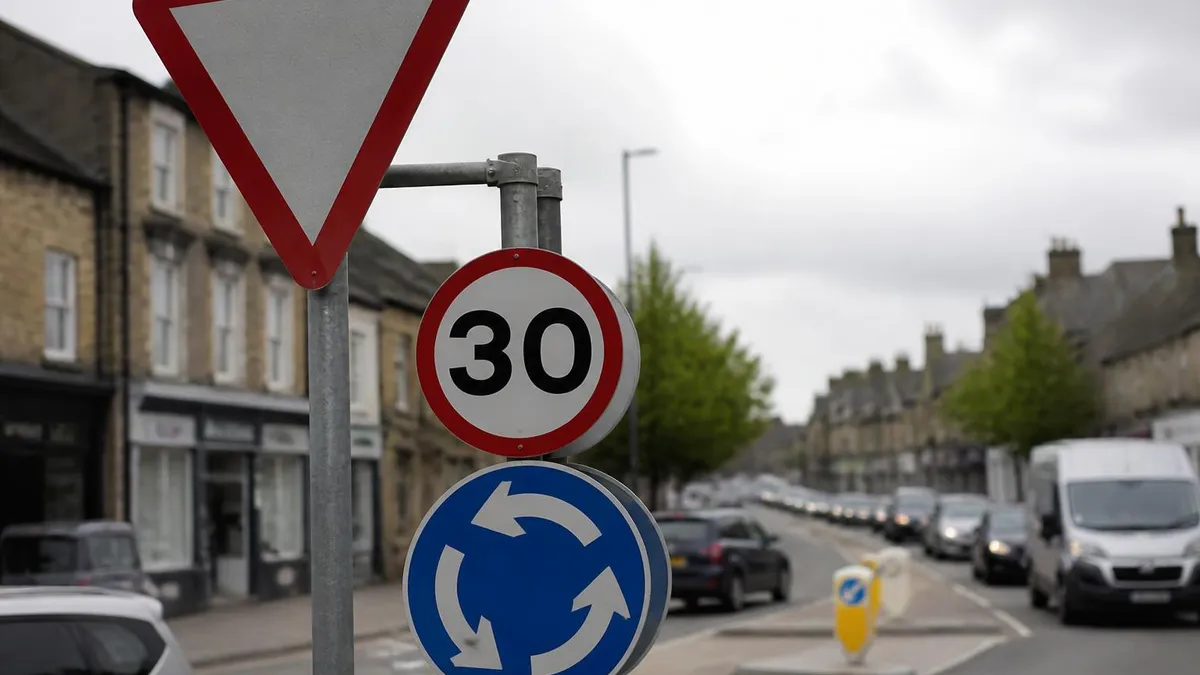
Road signs are another high-yield area for score improvement. The UK has over 300 different road signs, but the theory test draws from a much smaller core set of signs that appear repeatedly across the question bank. Circular signs with red borders give orders; triangular signs warn; rectangular signs inform. Blue circles are mandatory instructions; red circles are prohibitions. Understanding the shape and colour logic first, then learning individual signs within each category, is a more efficient approach than trying to memorise signs in alphabetical or random order.
Motorway rules questions catch many candidates off guard because learner drivers are not yet permitted on motorways and may have limited real-world exposure to them. Questions in this area cover lane discipline, minimum speeds, the rules for smart motorways with variable speed limits, when you may use the hard shoulder, and what to do if you break down. Dedicating a focused revision session specifically to motorway rules — using the relevant chapters of the Highway Code as a primary reference — will pay dividends in the test.
Vulnerable road user questions form another topic area that deserves dedicated attention. The DVSA places significant emphasis on how drivers should behave around cyclists, motorcyclists, pedestrians, and horse riders. Questions test knowledge of safe passing distances for cyclists (at least 1.5 metres at speeds up to 30 mph), what to do when approaching a horse on the road, and how to behave at pedestrian crossings of various types. These questions have clear right answers rooted in Highway Code rules, making them among the most reliably scoreable questions in the bank if you have revised them.
For the hazard perception section specifically, the technique that delivers the most consistent improvement is practising with video clips at the same time of day you plan to sit your actual test. Visual attention and reaction times are influenced by fatigue, and if your test is booked for a morning slot, doing your hazard perception practice in the morning will give you the most relevant calibration. Equally, avoid practising immediately after eating a large meal or watching fast-paced video content — both can temporarily affect your attention bandwidth in ways that do not reflect your best performance.
Finally, consider the role of mental preparation alongside the academic revision. Test anxiety is real and affects performance independently of knowledge level. Techniques such as box breathing (inhale for four counts, hold for four, exhale for four, hold for four) immediately before entering the test room can measurably reduce cortisol levels and improve focus. Candidates who have practised realistic mock tests under timed conditions will also find the actual test less intimidating, because they have already experienced the format and know what to expect — reducing the cognitive load that anxiety creates.
Your theory test pass certificate is valid for two years from the date you pass. If you do not pass your practical driving test within those two years, your theory test certificate expires and you will need to sit and pass the theory test again before you can book a new practical test. This rule catches many candidates who pass their theory test early and then delay starting practical lessons. Book your practical lessons promptly after receiving your theory pass certificate to avoid this costly and time-consuming pitfall.
Resitting the theory test after a failed attempt is more common than most candidates realise, and it should not be a source of shame or discouragement. With a first-time pass rate that hovers around 53%, a significant proportion of eventually successful drivers have experienced a failed attempt. The important thing is to approach the resit strategically rather than emotionally — analyse what went wrong, adjust your preparation accordingly, and book your next appointment with a concrete plan in place rather than vague optimism.
The first step after receiving a fail result is to examine your score breakdown carefully. The DVSA test centre will show you your result immediately after you finish, and your score will be broken down by section — multiple choice overall, and hazard perception overall. If you passed one section but failed the other, focus your resit preparation almost entirely on the section you failed. It is tempting to revise everything uniformly to feel thorough, but targeted preparation for your specific weakness is far more efficient and will deliver a better return on the time you invest.
If you failed the multiple-choice section, identify which topic categories cost you the most marks and build a revision plan that weights those areas heavily. If you scored 38 out of 50 — five marks below the pass mark — then improving by just five marks across 14 topic categories requires only marginal improvement in each. Picking your three weakest categories and studying them intensively for a week each will typically be enough to close that gap and then some.
If you failed the hazard perception section, the most likely cause is either clicking too early on potential hazards before they develop, or clicking too late because you are being overly cautious about what constitutes a genuine developing hazard. Watch your clips back if the platform allows it and try to identify your pattern. Early clickers benefit from practising patience and waiting for the hazard to actively develop before clicking. Late clickers benefit from practising decisiveness and trusting their instinct rather than second-guessing themselves into a low score.
You must wait at least three working days between theory test attempts. Most candidates who resit within one to two weeks without meaningfully changing their preparation approach fail again at a similar score. Waiting two to three weeks and using that time for structured revision produces significantly better outcomes. The three-day minimum is a floor, not a recommendation — treat it as the absolute minimum and plan your resit date based on when you feel genuinely prepared rather than on the earliest available slot.
Some candidates benefit from supplementing self-study with support from their driving instructor for the theory resit. A good instructor can identify knowledge gaps through conversation, recommend specific revision resources, and provide accountability that keeps a study schedule on track. If cost is a concern, even a single one-hour session with an instructor focused specifically on theory revision can be a high-value investment that pays for itself by avoiding the cost of a third or fourth test attempt.
The theory test exists to protect road users — not to act as a bureaucratic hurdle. Every topic it tests has a direct connection to real-world safety, and the knowledge you build during revision will serve you well throughout your driving life. Approaching the resit with that perspective — treating it as an opportunity to genuinely build understanding rather than simply to pass an exam — tends to produce better results and more confident, safer drivers in the long run.
The final stretch of your theory test preparation should shift from learning new material to consolidating and stress-testing what you already know. In the last week before your test, avoid introducing entirely new topic areas — the risk of confusing recently absorbed information with well-established knowledge outweighs the potential benefit of learning something new at the eleventh hour. Instead, use this week to sit full mock tests under realistic conditions: timed, in a quiet room, without interruptions, and including the hazard perception clips in the same session as the multiple-choice questions.
Pay particular attention to your mock test scores on the days two and three before your real test. If you are consistently scoring 47 or above on the multiple-choice section and 60 or above on hazard perception, you are well-prepared and should focus on rest and mental preparation rather than additional cramming.
If your scores are borderline — around 44 or 45 — use those final days to revisit your weakest topic categories one more time, but avoid the temptation to sit additional full mock tests on the day immediately before your appointment. Rest and consolidation serve you better than last-minute drilling at that stage.
On the morning of your test, eat a normal breakfast and stay hydrated. Research on cognitive performance consistently shows that mild dehydration measurably impairs attention and working memory — the two things you need most in a theory test. Avoid consuming excessive caffeine, which can amplify anxiety and affect fine motor control. Arrive at the test centre with time to spare so that you can complete the check-in process calmly, store your belongings in the locker, and take a few slow breaths before entering the test room.
Inside the test room, read each question fully before looking at the answer options. A common error made under pressure is to read the first half of a question, assume you know where it is going, and select an answer based on pattern recognition rather than the actual question being asked. The DVSA question writers are aware of this tendency and occasionally construct questions where the second half of the sentence changes the meaning significantly. Taking three or four extra seconds per question to read carefully is time well spent.
For questions you are genuinely unsure about, use the flag feature without hesitation and move on rather than sitting paralysed for 60 seconds. In most cases, working through the rest of the test and returning to flagged questions with fresh eyes will trigger the recall you need.
The cognitive process of continuing through other questions often unlocks memory that felt inaccessible when you were fixated on a single question. Arriving at the end of the section with five minutes remaining and six flagged questions is a manageable position — far better than spending too long on early questions and running out of time.
After completing the multiple-choice section, take the opportunity during the short break before hazard perception to reset your mental state. Roll your shoulders, take three slow deep breaths, and remind yourself that the hazard perception section tests a skill you have practised specifically — it is not guesswork, but trained pattern recognition. Watch the tutorial video attentively even if you have already seen it during practice, as it confirms the exact interface behaviour for that day's test. Then approach each clip with calm, steady attention, clicking once at the precise moment a hazard begins to actively develop.
When you submit your answers and receive your result, whatever it says, take a moment to acknowledge the work you have put in. A pass means your theory test certificate is valid for two years — use that window promptly by booking your practical lessons and test with momentum.
A fail means you now have more information about exactly where to focus your effort, and you can book a resit with a clear, targeted plan. Either way, the knowledge you have built during your theory test preparation is genuinely useful and will contribute to making you a safer driver throughout your life on the road.
DVSA Questions and Answers

DVLA Test Centre: Complete UK Guide to Finding, Booking & Passing at Your Local Centre in 2026
DVSA Theory Test: What It Covers, How to Prepare, and What to Expect on Test Day

How to Change Theory Test Date: Complete DVSA Rebooking Guide for 2026
Driving Test Centre Near Me: How to Find, Book, and Prepare for Your Local DVSA Centre (2026)
UK Theory Test Pass Mark: Car, Bike, LGV, PCV & ADI Scores
About the Author

Licensed Driving Instructor & DMV Test Specialist
Penn State UniversityRobert J. Williams graduated from Penn State University with a degree in Transportation Management and has spent 20 years as a certified driving instructor and DMV examiner consultant. He has personally coached thousands of applicants through written knowledge tests, skills assessments, and commercial driver licensing programs across more than 30 states.