
DMV Jobs: Roles, Pay, How to Get Hired, and Career Paths 2026 October
🏆 DMV jobs explained: customer service, examiner, investigator, IT roles. State pay scales, benefits, hiring process, and how to advance in DMV careers.

DMV Jobs: The Public-Sector Career You Probably Haven't Considered
Department of Motor Vehicles (DMV) jobs span far more than the counter clerks most people interact with. State DMVs employ tens of thousands of workers across customer service, driver licensing exams, fraud investigation, IT systems, management, and specialized testing roles. Pay falls into standard state government pay scales — typically $30,000 to $70,000 for entry-level through experienced positions, with senior management roles reaching $60,000 to $100,000+. Benefits are typically strong: pension or 401(k) match, comprehensive health insurance, generous paid leave, and stable scheduling that supports work-life balance.
This guide walks through the DMV job market in detail: the major role types, pay ranges, how to apply through state government hiring systems, qualifications needed, what the workplace is actually like, advancement opportunities, state-by-state variation, and the realistic pros and cons of public-sector DMV work. If you're considering a DMV-related career or just curious about the credential landscape, the DMV practice test covers the knowledge that examiners use during driver licensing exams. For information on the customer-facing side, the DMV permit test guide covers the licensing process that DMV staff administer daily.
For workers comparing DMV careers to private-sector alternatives, the most important factor is whether you prioritize stability or upside. Government work trades peak earnings for predictability — you'll never get rich working at the DMV, but you also won't face the layoff cycles that affect private-sector workers. The pension or 401(k)-equivalent benefits compound substantially over 20-30 year careers.
For recent graduates or career changers exploring public-sector options, DMV roles are often the most accessible state government positions. Customer service entry-level jobs hire frequently with minimal credentials beyond a high school diploma. The civil service exam is more about general aptitude than specific subject matter. Once inside the state government system, lateral moves to other agencies become easier as your civil service tenure builds.
For aspiring DMV workers, the most important first decision is which role type to target. Customer service is the easiest entry point but the most stressful day-to-day. Back-office roles like investigations or IT have higher barriers to entry but better quality of life. Driver examiner roles offer outdoor variety but require comfort evaluating others under stress.
For workers who have spent years in private-sector customer service, the transition to DMV customer service can be jarring at first. Government procedures are slower; supervisors have less flexibility; everything is documented. Adapt within the first 6 months or the role probably doesn't fit your style.
Bottom Line
DMV jobs span customer service, driver examiners, investigators, IT roles, hearing officers, and management positions. Pay ranges $30,000-$70,000 for entry-level through experienced positions; senior management $60,000-$100,000+. Benefits are typically strong public-sector packages including pension or 401(k) match, health insurance, and generous leave. Apply through your state's government hiring portal (CalCareers, NY State Jobs, etc.). Most positions require high school diploma plus civil service exam passing; specialized roles require college degree or technical credentials.
The Main DMV Job Categories
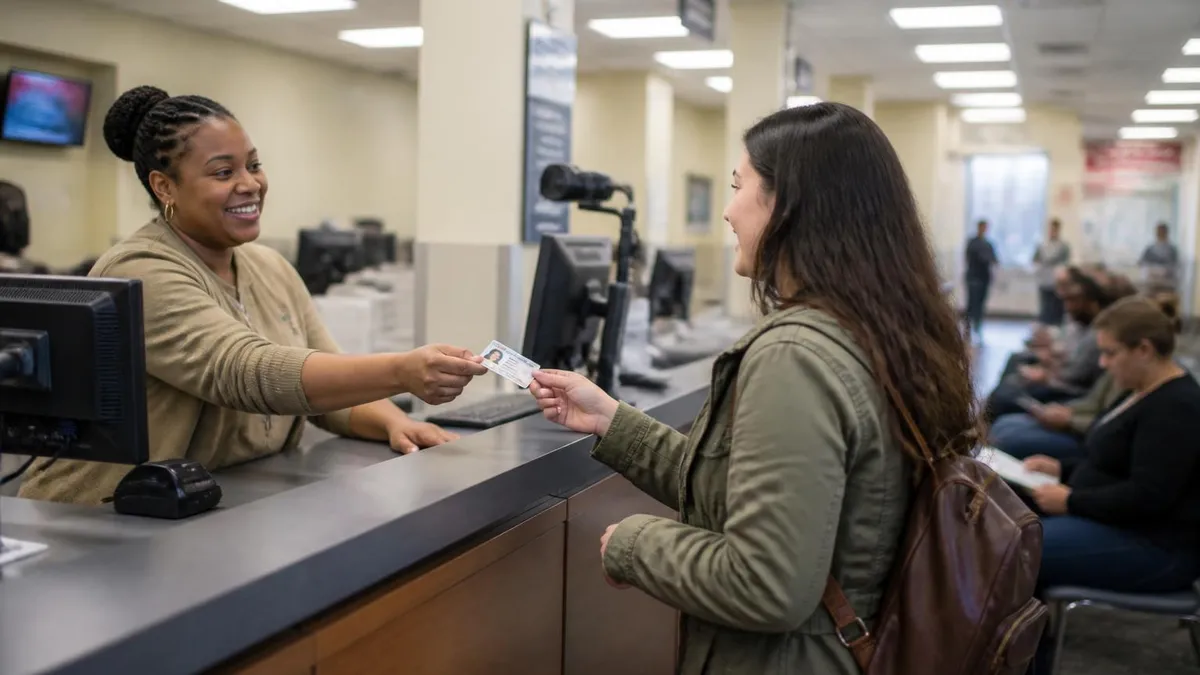
Front-line customer service representatives — also called counter clerks, vehicle registration specialists, or licensing technicians depending on the state — handle the public-facing work that most people associate with DMVs. These workers process driver license applications, renew vehicle registrations, issue IDs, handle title transfers, and respond to a steady stream of customer questions. The role requires patience, attention to regulatory detail, computer literacy, and basic problem-solving. Entry-level pay typically runs $35,000-$48,000 in most states, higher in California, New York, and other high-cost markets.
Driver license examiners administer the actual driving tests that aspiring drivers take. These positions involve outdoor work with applicants, riding along during road tests, evaluating performance against standardized criteria, and producing pass/fail decisions. Examiners often also administer the knowledge tests in some states. Pay ranges $40,000-$58,000 typical for entry-level examiners. CDL skills testers represent a specialized variant — they administer commercial driver license skills tests on commercial vehicles, requiring additional certifications beyond basic examiner credentials.
Investigator roles deserve more attention than they typically receive. Driver license fraud, identity theft, false documents, and licensing system abuses generate enough volume to support specialized investigative staff in every state DMV. These positions blend law enforcement, accounting, and regulatory knowledge. Pay is competitive with similar private-sector investigative roles, particularly given the public-sector benefits package.
IT roles within state government deserve special note. State DMV systems run on aging legacy technology in many cases, with modernization projects that span years. Software developers, database administrators, and project managers with state government experience are in high demand at competitive pay. The work is meaningful and the technology challenges are real.

DMV Role Types and Pay Ranges
Front-line counter clerk handling driver licenses, registrations, IDs, titles. Pay $35,000-$48,000 entry-level, $48,000-$58,000 experienced. High-volume customer-facing role. Most common DMV position by headcount.
Administers driving tests and knowledge tests. Outdoor and indoor work. Pay $40,000-$58,000 entry-level, higher with seniority. Requires patience, fairness, and ability to make consistent pass/fail decisions.
Specialized commercial vehicle examiner. Administers Class A/B/C CDL skills tests. Pay $45,000-$65,000. Requires additional federal certification and demonstrated commercial vehicle knowledge.
Handles fraud cases, suspended license investigations, identity theft, false document detection. Pay $50,000-$80,000. Typically requires college degree. Often involves field investigation and report-writing.
Conducts administrative hearings for license suspensions and revocations. Quasi-judicial role. Pay $55,000-$90,000. Often requires legal background or paralegal experience plus state-specific training.
Software developers, database administrators, network engineers supporting DMV operations. Pay $60,000-$110,000 depending on role and state. Often requires technical certifications and experience with government IT systems.
Manages local DMV office or specific functional unit. Pay $55,000-$90,000. Usually promoted from senior customer service or examiner roles. Combines operational management with HR and budget responsibilities.
Senior DMV leadership including state DMV directors. Pay $80,000-$200,000+ at executive level. Typically requires public administration background plus extensive DMV experience. Politically-appointed in some states.
How to Get Hired at the DMV
Each state has its own government hiring portal that handles DMV applications. California uses CalCareers (jobs.ca.gov); New York uses NY State Jobs (statejobs.ny.gov); Texas uses CAPPS Recruit through the Texas state workforce; Florida uses People First. The application process typically involves submitting an online application with detailed work history, completing a civil service exam in many states, passing a background check including fingerprinting, and interviewing with hiring managers at the specific DMV office or division you applied to.
Civil service exams vary in difficulty and content. Customer service positions typically have basic skills assessments testing reading comprehension, math, and customer service judgment. Investigator and analyst positions have more demanding written exams covering relevant subject matter knowledge. Some specialized roles require pre-employment certifications (CDL examiner certification, etc.) that you may complete after a conditional offer.
Most state hiring processes take 8-16 weeks from application submission to start date. Patience is essential — government hiring is notoriously slower than private sector. The DMV test guide covers the kinds of knowledge that examiners and customer service staff need to master for their roles.
Government hiring rules require certain procedural steps that private sector doesn't use. Veterans preference may apply if you served in the US military. Internal promotional opportunities may be advertised internally before opening to external candidates. Disability accommodations are documented and tracked. Familiarize yourself with these procedures during the application process.
Networking matters even in civil service hiring. Knowing current DMV staff in your area can provide insight into open positions, common interview questions, and workplace culture. Some openings are filled through internal referrals before being heavily advertised externally. Local CDL training schools, driving schools, and government agencies often have informal connections to DMV hiring.
Plan your application timeline well ahead of when you need to start work — government hiring rarely moves quickly.
DMV Job Application Process by State
Apply through CalCareers (jobs.ca.gov). California state government employs over 200,000 workers including substantial DMV staff. Civil service exam typically required for entry positions. Background check via Department of Justice. Strong public union representation through CDF, CSEA, and similar bargaining units. Pay competitive with public sector benefits including CalPERS pension.
Pay Scale and Benefits Detail
DMV pay follows state government pay scales rather than private-sector market rates. Entry-level customer service positions typically run $30,000-$40,000 in lower-cost states ($35,000-$50,000 in California, New York, or Massachusetts). Mid-career senior positions run $45,000-$60,000. Specialized roles (investigators, hearing officers, senior IT) reach $60,000-$90,000. Management positions $70,000-$120,000. Director-level positions vary widely by state and political appointment status.
Benefits often more than compensate for sub-market base pay. Government pension or 401(k) match programs typically contribute 3-12 percent of pay annually. Health insurance is comprehensive with low employee contribution requirements. Paid leave accumulates faster than private sector (10-20 days vacation plus sick time at most states). Holiday pay is generous. Disability, life insurance, and survivor benefits add substantial value. Total compensation including benefits often exceeds equivalent private-sector positions when fully calculated. For workers prioritizing stability over peak income, the public-sector benefit package is genuinely attractive.
The pension impact deserves quantitative attention. A worker earning $50,000 annually with 3 percent annual pension contribution after 25 years would have approximately $40,000-$60,000 annual retirement income from pension alone (depending on plan formulas). This benefit alone often outweighs the headline pay gap with private-sector equivalents over a full career.
Tuition reimbursement for continuing education is available at most state DMVs. Workers pursuing bachelor's degrees or master's programs related to public administration or specific role requirements often qualify for reimbursement up to set annual amounts. This benefit can be valuable for career advancement through additional credentials.
Compare total compensation, not just base pay, when evaluating offers. The benefits gap between public and private sectors often closes or reverses entirely when properly calculated.

Front-line DMV customer service work involves continuous interaction with frustrated, time-pressured, or angry customers. Long lines, complex paperwork issues, and customer expectations that don't match regulatory requirements produce real stress. Workers in these roles develop thick skins quickly or burn out. If you're considering DMV customer service work, honestly assess your patience and emotional resilience. Back-office roles (investigations, IT, audit) offer the public-sector stability without the front-line customer pressure.
Qualifications and Skills That Matter
Entry-level DMV customer service positions typically require high school diploma or GED plus passing the state civil service exam. Strong reading comprehension, basic math, computer literacy, and customer service judgment matter more than specific prior experience. Bilingual candidates (especially Spanish, increasingly Mandarin and Vietnamese in certain states) often receive premium consideration and may qualify for bilingual pay differentials.
Specialized roles have higher requirements. Driver examiners need clean driving records and successful completion of state examiner training programs. Investigators typically require bachelor's degree or equivalent experience plus regulatory knowledge. Hearing officers benefit from paralegal training or law school exposure plus strong written analysis skills. IT roles require technical certifications (network administration, database management, software development) and experience with government IT systems where applicable. Skills that translate well across DMV roles include attention to detail, regulatory awareness, customer service skill, and willingness to follow procedural requirements consistently.
For candidates lacking formal credentials but with strong soft skills, customer service entry-level positions are accessible. The state civil service exam tests general aptitude rather than specific subject matter knowledge for these roles. Strong reading, basic math, and customer service judgment can compensate for limited prior work experience.
For workers without formal credentials, customer service entry-level positions provide pathways to state government careers. Once inside the system, additional training, civil service exams, and tenure unlock broader opportunities across state government beyond the DMV itself.
Steps to Land a DMV Job
- ✓Research your state's government hiring portal and DMV career postings
- ✓Identify role types matching your background and interests
- ✓Complete the state government application with detailed work history
- ✓Take and pass any required civil service exam
- ✓Submit fingerprints for background check
- ✓Prepare for interview with examples of customer service and procedural work
- ✓Be patient — government hiring takes 8-16 weeks typical
- ✓Complete any pre-employment training (examiner certification, etc.)
- ✓Join union or professional association after hire (often automatic in unionized states)
- ✓Plan career progression — civil service exams for promotions, training programs for advancement
Workplace Culture and Daily Reality
DMV workplace culture varies dramatically by state, by office, and by role. Larger urban DMV offices in California, New York, Florida, and Texas process high customer volumes that produce constant pressure on front-line staff. Smaller rural offices have lighter volume but may struggle with limited resources and limited career advancement opportunities. Back-office investigators, auditors, and IT staff work in more typical office environments insulated from public-facing pressure.
The bureaucratic culture is real. Procedures matter more than initiative; following protocol carefully matters more than improvisation. New employees from private-sector backgrounds sometimes struggle with the slower decision-making and more rigid procedural framework. Workers who appreciate stability, predictability, and clear job expectations often thrive in this environment. The trade-off between bureaucracy and stability is a defining feature of public-sector work generally and DMV work specifically.
One understated benefit of DMV work is the predictable end-of-day boundary. When your shift ends, you leave the work at the office. Few private-sector roles offer this clean separation between work and personal time. For workers with strong family commitments or other significant outside-of-work interests, the boundary protection is genuinely valuable.
Office locations matter. Large urban DMVs handle high volumes with corresponding stress. Suburban offices typically have lower volume and more manageable pace. Rural offices have light volume but limited career advancement opportunities. Consider both the job role and the specific office when evaluating openings.
Career Advancement Within DMV
Advancement at most state DMVs follows civil service rules. Years of service matter; demonstrated competence matters; and promotional civil service exams gate movement into higher classifications. The path from entry-level customer service to senior representative typically takes 3-5 years. From senior representative to supervisor takes another 3-7 years with passing of relevant promotional exams. From supervisor to office manager another 3-5 years. Full-cycle advancement from entry-level to office management can take 15-20 years in most state systems.
Faster advancement is possible through specific paths. Lateral movement into investigator or hearing officer roles can accelerate career progression compared to moving up through customer service. IT roles often pay more than customer service from the start and have separate technical advancement tracks. Some workers use DMV experience as a stepping stone into broader state government positions in Department of Public Safety, Department of Transportation, or other related agencies. The advancement is steady but rarely fast.
Some DMV workers use their civil service tenure as a foundation for moving into other state agencies that may pay better or offer different work environments. Lateral moves to Department of Public Safety, Department of Transportation, or other related agencies are common after 3-5 years of DMV experience.
For workers prioritizing pension benefits, staying within the same retirement system (state government) maximizes retirement vesting and benefit calculations. Moving between state agencies often preserves these benefits cleanly.
DMV Jobs by the Numbers
Pros and Cons of DMV Work
Government employment with strong union protections and civil service rules. Layoffs are rare and recessions affect government jobs less than private-sector work. Long-tenured DMV staff typically work the same role for decades.
Pension or 401(k) match, comprehensive health insurance, paid leave, life insurance, disability coverage. Total compensation including benefits often exceeds equivalent private-sector positions when properly calculated.
Standard business hours (with some evening and weekend rotations at high-volume offices). Limited overtime expected. Good work-life balance, particularly for back-office roles. Suits workers prioritizing family or other commitments outside work.
Base pay often runs 10-25 percent below comparable private-sector positions. The benefits package partially offsets this gap but pay-focused candidates often choose private-sector work over DMV roles.
Civil service rules slow promotion timelines significantly compared to private sector. Bright workers can be limited by tenure-based rules rather than promoted on merit alone. Frustrating for ambitious early-career staff.
Procedure-driven environment can feel rigid and slow. Workers preferring innovation and creative problem-solving often struggle. Reward structures favor compliance over initiative.
State Variation in DMV Employment
California DMV is the largest state DMV employer in the US, employing over 9,000 workers across multiple regional offices and headquarters in Sacramento. Texas Department of Motor Vehicles (TxDMV) plus Department of Public Safety drivers license division employs over 8,000 across the two combined operations. New York DMV employs over 4,000. Florida FLHSMV employs over 4,500. These large state systems offer the broadest range of role types and clearest career advancement paths.
Smaller states have proportionally smaller DMV workforces. North Dakota, South Dakota, Vermont, Delaware, and Wyoming DMV operations may have only a few hundred employees total. These smaller systems can offer faster advancement opportunities for high-performing staff but fewer specialized role options. Hawaii, Alaska, and other geographically isolated states have unique recruitment dynamics — they often struggle to recruit experienced staff from outside, which can create faster advancement for in-state workers. Research the specific state DMV before assuming pay scales and advancement patterns from another state apply.
If you're considering relocating for DMV work, research the specific state's employment culture and union representation. States with strong public-sector unions (California, New York, Illinois) tend to have more standardized pay, benefits, and advancement procedures than less-union-organized states.
Federal connections matter too. CDL examiners interact with FMCSA standards; vehicle registration handles federal title and emissions regulations; identification systems connect to federal Real ID requirements. Federal-state coordination is part of DMV work at every level.
DMV Jobs vs Private Sector
- +DMV: stable employment with strong job security
- +DMV: comprehensive benefits including pension and health insurance
- +DMV: predictable schedule with limited overtime expectations
- +DMV: clear career ladder via civil service exams
- +DMV: pension after 20-30 years of service is substantial
- +DMV: meaningful public service mission
- −DMV: lower base pay than private-sector equivalents
- −DMV: slow advancement through civil service rules
- −DMV: bureaucratic culture favors compliance over innovation
- −DMV: high-volume customer-facing work can be stressful
- −DMV: limited opportunities for performance-based bonuses
- −DMV: technology and procedural updates often lag private sector
Pros and Cons at a Glance
| Pros | Cons |
|---|---|
| DMV: stable employment with strong job security | DMV: lower base pay than private-sector equivalents |
| DMV: comprehensive benefits including pension and health insurance | DMV: slow advancement through civil service rules |
| DMV: predictable schedule with limited overtime expectations | DMV: bureaucratic culture favors compliance over innovation |
| DMV: clear career ladder via civil service exams | DMV: high-volume customer-facing work can be stressful |
| DMV: meaningful public service mission | DMV: limited opportunities for performance-based bonuses |
Sample DMV Practice Questions
Try these questions from our free DMV practice tests. The correct answer and an explanation follow each question.
The curved arrow serves as an indication that
- A. the right lane is closed ahead.
- B. a divided highway begins ahead.
- C. a divided highway ends ahead.
- D. traffic must turn left.
Answer: B. a divided highway begins ahead.
This sign advises drivers that a median or divider separates the traffic lanes ahead and that they should proceed cautiously because each route only allows traffic in one direction. Drivers must keep right.
You must do the following before entering a road from an alley or driveway:
- A. Make a horn noise.
- B. Before you reach the sidewalk, come to a complete stop.
- C. Your high-beam headlights should be flashing.
Answer: B. Before you reach the sidewalk, come to a complete stop.
When exiting an alley or driveway, drivers must come to a complete stop before reaching the sidewalk. This is crucial to check for pedestrians who may be using the sidewalk and for vehicles on the main road. Failing to stop can lead to collisions with pedestrians or other vehicles, as visibility is often limited.
When approaching a school bus that is stopped with its lights flashing and its signal arm extended, you are required to do:
- A. Proceed at normal speed, but watch for children.
- B. Stop.
- C. Proceed at 15 mph if no children are present.
Answer: B. Stop.
When a school bus displays flashing red lights and extends its stop arm, it signifies that children are either boarding or exiting the bus. For the safety of these children, drivers in all directions (unless separated by a physical median) are legally required to stop until the lights are off and the arm is retracted.
Which of the following is caused by drowsy driving?
- A. All of the following causes listed below.
- B. Micro-sleeping is the result of this.
- C. Your mental process is slowed.
- D. It has an impact on your judgment.
Answer: A. All of the following causes listed below.
Drowsy driving significantly impairs a driver's abilities, similar to driving under the influence of alcohol. It can lead to 'micro-sleeping,' which are brief, involuntary periods of sleep, and it slows down mental processes, making it harder to react quickly. Additionally, fatigue negatively impacts judgment, increasing the risk of accidents. Therefore, all the listed options are consequences of drowsy driving.
DMV Questions and Answers
About the Author

Licensed Driving Instructor & DMV Test Specialist
Penn State UniversityRobert J. Williams graduated from Penn State University with a degree in Transportation Management and has spent 20 years as a certified driving instructor and DMV examiner consultant. He has personally coached thousands of applicants through written knowledge tests, skills assessments, and commercial driver licensing programs across more than 30 states.
Join the Discussion
Connect with other students preparing for this exam. Share tips, ask questions, and get advice from people who have been there.
View discussion (9 replies)