
Colorado DMV License Renewal Appointment: Complete 2026 October Guide for Drivers and DMV Reps
Master the colorado dmv license renewal appointment process — 🎓 eligibility, fees, online vs in-person steps, and rep prep tips for 2026 October.

Booking a colorado dmv license renewal appointment is one of the most common transactions a dmv customer service representative handles each week, and understanding the full workflow is critical whether you are a driver preparing for your renewal or a candidate preparing for the DMV representative exam. The Colorado Division of Motor Vehicles processes hundreds of thousands of renewals every year, and the rules around eligibility, identity verification, vision testing, and REAL ID compliance can shift from one legislative session to the next. This guide walks through every step you need to know in 2026.
Most Colorado drivers can renew online if their previous renewal was done in person, if their license has been expired for less than one year, and if they hold a non-commercial Class R credential. The online portal at mydmv.colorado.gov accepts payment by debit, credit, or e-check, and the new card arrives by mail in roughly ten business days. Drivers who fail the online eligibility screen are routed to a branch appointment, which is where booking through the official scheduler becomes essential to avoid multi-hour walk-in waits.
For candidates studying for the DMV representative exam, the renewal workflow is a heavily tested topic because it touches identity documents, fee schedules, fraud detection, and customer dispute resolution all at once. Examiners want to confirm you can guide a customer through edge cases — expired military IDs, name changes after marriage, out-of-state surrender, or a medical condition that requires a restricted license. Memorizing the basic steps is not enough; you need to recognize when to escalate and when a self-service path applies.
The 2026 renewal cycle introduced minor but important changes. The standard non-commercial license fee remains $30.87 for a five-year renewal and $43.36 for a ten-year renewal for drivers between 21 and 65. Drivers under 21 or over 65 receive a shorter validity period and a reduced fee. The state also expanded its photo-on-file program, allowing certain drivers to skip the in-branch photo step if their existing photo is less than fifteen years old and their appearance has not materially changed.
Appointments themselves can be booked up to ninety days in advance. Same-week slots are scarce in Denver, Aurora, Colorado Springs, and Fort Collins, while rural offices like Lamar, Cortez, and Sterling typically have openings within forty-eight hours. Representatives are trained to suggest the rural-branch workaround for drivers willing to drive, because the document checklist and fee schedule are identical statewide. Knowing the relative wait times across regions is the kind of soft knowledge that separates strong reps from average ones.
This article covers eligibility, document checklists, fees, online versus in-person workflows, REAL ID upgrade rules, common rejection reasons, and the specific dispute scenarios that appear on the representative certification exam. Read it through once, then return to the sections that match your weakest areas. Every section is built around the actual scripts and decision trees Colorado DMV teams use at the counter, so the material doubles as both a consumer guide and a rep study resource.
Finally, keep in mind that Colorado's rules diverge from California, Texas, New York, and Florida in meaningful ways. If you previously renewed in another state or you are studying a multi-state representative curriculum, do not assume cross-state parity. Colorado uses its own document hierarchy, its own age-based validity tiers, and its own medical reporting thresholds. The sections below isolate Colorado-specific rules whenever a distinction matters for exam answers or customer outcomes.
Colorado DMV License Renewal by the Numbers

Renewal Eligibility & Timeline
Receive Renewal Notice
Verify Online Eligibility
Book Appointment
Complete Renewal
Receive Permanent Card
Booking the appointment itself is the single most common point of friction in the renewal process, which is why representatives encounter so many questions about it. The Colorado DMV uses a centralized online scheduler that lets drivers select office, service type, and time slot in a single flow. Drivers must enter their full legal name, date of birth, and last four digits of their Social Security number to confirm identity before a slot is held. The hold expires after ten minutes if the booking is not confirmed.
A frequent issue: drivers attempt to book a "driver license renewal" slot at an office that only offers titling and registration services. Representatives should know which of the 36 branches handle license services and which do not. Aurora South, Lakewood, Boulder Main, Pueblo Central, and Grand Junction Main are the highest-volume license-issuing offices. Rural offices that do issue licenses often combine the service into a general appointment category, so the dropdown wording differs slightly.
If a driver searches and finds no slots within 30 days at their preferred location, representatives should walk through three alternatives. First, check neighboring offices within a 50-mile radius — availability often varies dramatically between zip codes. Second, consider Saturday hours, which select metro offices began offering in 2025 on a rotating basis. Third, ask whether the customer qualifies for online renewal after all; many people default to in-person bookings out of habit even when self-service is permitted.
Appointment confirmations arrive by email and SMS. Drivers should screenshot the confirmation because some offices require it at check-in, particularly in high-volume metro branches that triage walk-ins separately from appointments. Missing a confirmation does not automatically cancel the booking, but it slows the queue. Representatives can resend a confirmation from the back-office console using the appointment reference number, which is a quick win during phone-support calls.
Rescheduling is allowed up to two hours before the appointment with no penalty. After that window, the slot is forfeited, and the customer must book a new one. Repeated no-shows trigger a soft block: the system flags the customer for staff override on the next attempt. This rarely affects ordinary drivers but can create friction for fleet managers booking multiple renewals on behalf of employees. Representatives should know the staff-override flow and when to escalate to a supervisor.
For customers studying the representative exam, expect at least two scenario questions about appointment booking. One typically asks how to handle a customer who claims they cannot find any appointments — the correct answer involves checking alternate offices and verifying online eligibility, not blaming the system or promising a same-day walk-in.
The second asks how to handle a customer who arrives late; policy is a 15-minute grace period before the slot is released. For more practice on these scenarios, drivers and reps can review how do i speak to a dmv representative in ny style questions which often parallel Colorado's protocols.
Finally, accessibility accommodations deserve a separate mention. Drivers needing wheelchair access, ASL interpretation, or large-print materials should request these at booking, not at arrival. The system has a free-text accommodations field, but representatives often need to phone the branch directly to confirm interpreter availability. Building this courtesy into the booking workflow is a frequent exam topic under the broader heading of customer service and accessibility compliance.
DMV Practice Test Questions
Prepare for the DMV - Representative Exam exam with our free practice test modules. Each quiz covers key topics to help you pass on your first try.
DMV - Representative Consumer Protection a...
DMV Exam Questions covering DMV - Representative Consumer Protection and Dispute Resolution. Master DMV Test concepts for certification prep.
DMV - Representative Vehicle Inspections a...
Free DMV Practice Test featuring DMV - Representative Vehicle Inspections and Safety Standards. Improve your DMV Exam score with mock test prep.
DMV - Representative Advertising and Sales...
DMV Mock Exam on - Representative Advertising and Sales Practices. DMV Study Guide questions to pass on your first try.
DMV - Representative Bonds and Business Re...
DMV Test Prep for - Representative Bonds and Business Records. Practice DMV Quiz questions and boost your score.
DMV - Representative Dealer-Specific Regul...
DMV Questions and Answers on - Representative Dealer-Specific Regulations. Free DMV practice for exam readiness.
DMV - Representative Registration and Tran...
DMV Mock Test covering - Representative Registration and Transfer Fees. Online DMV Test practice with instant feedback.
DMV - Representative Sales Contracts and D...
Free DMV Quiz on - Representative Sales Contracts and Disclosures. DMV Exam prep questions with detailed explanations.
DMV - Representative Salesperson Licensing...
DMV Practice Questions for - Representative Salesperson Licensing Requirements. Build confidence for your DMV certification exam.
DMV - Representative Unlawful Acts and Con...
DMV Test Online for - Representative Unlawful Acts and Conduct. Free practice with instant results and feedback.
DMV - Representative Vehicle Code Definitions
DMV Study Material on - Representative Vehicle Code Definitions. Prepare effectively with real exam-style questions.
DMV - Representative Vehicle Registration ...
Free DMV Test covering - Representative Vehicle Registration Procedures. Practice and track your DMV exam readiness.
DMV Representative Basic Arithmetic
DMV Exam Questions covering Representative Basic Arithmetic. Master DMV Test concepts for certification prep.
Online vs In-Person: What a DMV Customer Service Representative Recommends
Colorado's online renewal portal handles roughly 82% of all eligible renewals. It is the fastest path: most drivers finish the transaction in under ten minutes, and the new card arrives by mail within seven to fourteen business days. Eligibility requires a non-commercial license, an existing on-file photo less than fifteen years old, and a license that has been expired for less than twelve months. Drivers upgrading to REAL ID must visit a branch the first time, but subsequent renewals can return to online status.
Representatives recommend online renewal whenever a customer is eligible because it frees branch capacity for transactions that genuinely require staff. The portal accepts Visa, Mastercard, Discover, and ACH e-check. A small service fee applies to card payments. Drivers should print or screenshot the digital receipt because it serves as a temporary license for 30 days until the permanent card arrives. If the card does not arrive within fifteen business days, the customer should call the central DMV line, not the branch.
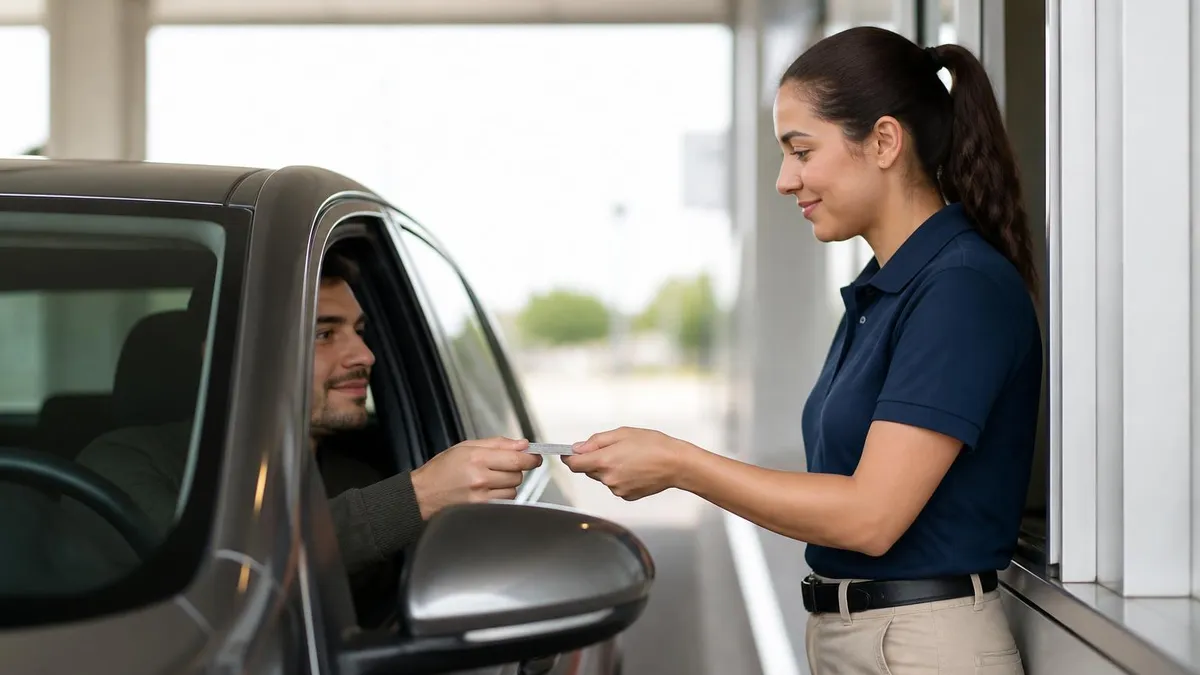
Online Renewal vs Booking an Appointment: Which Path Wins?
- +Online renewal finishes in under ten minutes for eligible drivers
- +No travel time or parking costs at a branch office
- +Available 24/7 — book renewal at 2 a.m. if needed
- +Lower service fees compared to in-person card payments
- +Automatic confirmation email with reference number
- +Reuses your existing photo if under fifteen years old
- +Frees up appointment slots for drivers who genuinely need them
- −Cannot upgrade to REAL ID through online renewal
- −Not available if license expired more than one year ago
- −No option for name changes or address corrections to other states
- −Requires valid debit/credit card or US bank account for e-check
- −Cannot accommodate accessibility requests like ASL interpretation
- −No live representative to clarify edge-case eligibility questions
Pros and Cons at a Glance
| Pros | Cons |
|---|---|
| Online renewal finishes in under ten minutes for eligible drivers | Cannot upgrade to REAL ID through online renewal |
| No travel time or parking costs at a branch office | Not available if license expired more than one year ago |
| Lower service fees compared to in-person card payments | No option for name changes or address corrections to other states |
| Automatic confirmation email with reference number | Requires valid debit/credit card or US bank account for e-check |
| Reuses your existing photo if under fifteen years old | Cannot accommodate accessibility requests like ASL interpretation |
| Frees up appointment slots for drivers who genuinely need them | No live representative to clarify edge-case eligibility questions |
DMV License Renewal Document Checklist
- ✓Current Colorado driver license (even if recently expired)
- ✓Proof of identity — passport, birth certificate, or permanent resident card
- ✓Proof of Social Security number — SSA card, W-2, or pay stub with full SSN
- ✓Two proofs of Colorado residency dated within the last twelve months
- ✓Proof of legal name change if applicable — marriage certificate or court order
- ✓Vision screening report if renewing with a corrective-lens restriction change
- ✓Medical examiner's certificate for commercial license holders
- ✓Payment method — debit, credit, e-check, money order, or cash at most branches
- ✓Appointment confirmation screenshot or printed email
- ✓REAL ID document packet if upgrading credential for federal ID purposes
- ✓Power of attorney form if a representative is renewing on the driver's behalf
- ✓Out-of-state surrender license if you previously held credentials elsewhere
Bring two proofs of residency dated within the last twelve months — not just one
The single most common reason renewal appointments fail is insufficient proof of residency. Colorado requires two separate documents — utility bill, bank statement, mortgage statement, lease agreement, or government correspondence — each dated within the past twelve months and showing your current Colorado address. A single document is not enough, even if it is government-issued.
Renewal fees in Colorado are tiered by age and credential type. Drivers between 21 and 65 pay $30.87 for a five-year renewal or $43.36 for a ten-year renewal — the ten-year option became standard in 2018 and remains the default unless the driver requests otherwise. Drivers under 21 and over 65 receive shorter validity windows, typically three years and four years respectively, with proportionally reduced fees. Commercial licenses carry their own fee schedule, ranging from $66 to $108 depending on endorsements and hazmat status.
REAL ID upgrades carry no additional fee beyond the standard renewal cost in Colorado, which makes the state more affordable than some neighboring jurisdictions. However, the upgrade requires an in-person visit and the full document packet, which represents a hidden time cost for drivers who could otherwise renew online. Representatives should clearly explain this trade-off, especially to drivers who fly frequently and would benefit from REAL ID compliance before the May 2025 federal enforcement deadline.
Payment options vary slightly by branch. All offices accept Visa, Mastercard, Discover, and personal checks. American Express is accepted online but not at all branches. Cash is accepted at most offices but not at the Denver Central location, which transitioned to cashless operations in 2023. Money orders and cashier's checks are universally accepted. Card transactions incur a service fee of 1.5% to 2.5% depending on the processor, while e-check and cash transactions carry no fee.
Discounts are limited but worth knowing. Veterans with a service-connected disability rating can request a fee waiver by presenting a current VA award letter at the branch. Surviving spouses of fallen first responders are also eligible under Colorado law. There is no senior citizen fee discount, which surprises some drivers; the reduced fee for over-65 renewals reflects the shorter validity period, not a senior subsidy. Representatives should be ready to clarify this distinction without sounding dismissive.
Late renewal penalties kick in once a license has been expired for thirty days. The penalty is modest — typically $20 added to the standard fee — but driving on an expired license remains a primary offense that can result in citations, insurance complications, and registration issues for the vehicle. Representatives should always emphasize the legal exposure rather than just the dollar amount when speaking to drivers who let their license lapse.
Refund requests are rare but governed by clear policy. If a driver pays for renewal and then becomes ineligible — for example, due to a medical revocation discovered during the in-branch process — the fee is refundable minus a $10 processing charge. Refunds are issued to the original payment method and typically post within ten business days. Cash refunds require a supervisor signature and are processed by check rather than cash on hand, a policy that occasionally frustrates customers but exists to protect against till discrepancies.
Fee disputes are one of the most common escalations a DMV representative handles. The exam tests this scenario heavily under the consumer protection and dispute resolution category. The key principle: fees are statutory, set by the legislature, and cannot be negotiated by branch staff. The representative's job is to verify the correct fee was charged, document the customer's concern, and escalate to a supervisor only if there is a credible billing error. Empathy without empty promises is the correct posture.

If your Colorado license has been expired for more than one year, you cannot simply renew — you must retake the full written knowledge exam and, in some cases, the road skills test. This is true even if your driving record is otherwise clean. Booking an appointment before your one-year mark is critical to avoid significant additional time and cost.
Application rejections and customer disputes are where DMV representatives earn their stripes. The most common rejection reasons in Colorado are insufficient residency documentation, an expired underlying identity document, a name mismatch between the SSA record and the presented identity proof, an unresolved citation hold from another state, and a flagged medical condition. Each rejection follows a documented script: explain the reason, hand the customer a written denial slip, and outline the cure path. The slip is critical because it gives the customer a paper trail for any subsequent appeal.
Name mismatches are particularly delicate. A driver who recently married may present a passport with her maiden name, a marriage certificate, and a new Social Security card with her married name. The representative must verify the SSA record matches the presented name on the license application. If the SSA database has not yet been updated, the renewal cannot proceed, and the customer must visit the Social Security office first. Representatives should know how to explain this without implying the customer made a mistake.
Address verification disputes often arise when a customer's two residency documents are technically valid but one is dated outside the twelve-month window. Policy gives the representative no discretion to accept an out-of-window document, but a strong rep will explain the rule clearly, suggest alternative documents the customer might have on hand or at home, and rebook the appointment if necessary. The dispute escalates only when the customer insists the rule is wrong, at which point the supervisor steps in to confirm policy without changing the outcome.
Vision screening failures are a special category. A driver who fails the in-branch screening is referred to a licensed optometrist or ophthalmologist for a full examination. The driver returns with a completed vision report, and the renewal proceeds with any necessary restrictions added — typically a corrective-lens requirement coded as B on the license back. Representatives should never speculate about a driver's vision condition; the script is to refer, not diagnose. This is a common exam scenario, and the correct answer always involves referral plus accurate paperwork.
Medical reporting is another nuanced area. Colorado law requires drivers to self-report seizure disorders, certain cardiovascular conditions, and progressive neurological diseases. Physicians can also report under specific circumstances, though Colorado is not a mandatory physician-reporting state like California. When a medical flag appears in the system, the representative cannot complete the renewal until the medical review unit clears the file. The customer receives a written notice with the medical unit's contact information, and the representative documents the interaction without entering medical details into the general appointment notes.
Fraud detection is a quieter but critically important function. Representatives are trained to spot tampered identity documents, mismatched signatures, and behavioral red flags that suggest identity theft. The training includes basic counterfeit-detection techniques and the escalation script for involving the fraud investigations unit. The DMV representative exam includes a section on these protocols, and resources like the dmv representative practice questions cover the most-tested fraud scenarios in depth.
Finally, the customer experience itself matters. Even a denied application should leave the customer with a clear understanding of what went wrong, what to bring next time, and how to escalate if they believe the denial was incorrect. Representatives who close denied appointments with empathy and clarity generate fewer follow-up complaints, fewer escalations to the state ombudsman, and stronger satisfaction scores. This soft-skill dimension is increasingly weighted in exam scoring under the consumer protection rubric.
Final preparation tips for both renewing drivers and DMV representative candidates focus on three areas: documentation, timing, and communication. For drivers, pre-flight your document packet 48 hours before your appointment. Lay every required document on a table and physically check each one against the checklist. Confirm dates are within the required windows, names match exactly across documents, and signatures are legible. This 15-minute exercise prevents the most common cause of failed appointments by a wide margin.
For representatives preparing for the certification exam, the most effective study strategy combines flashcard review of statutory fees and validity periods with full scenario simulations covering escalations. The exam rewards candidates who can both recite the correct policy and explain the reasoning. Memorization alone is rarely enough at the higher difficulty tiers; the exam writers deliberately construct ambiguous scenarios that require judgment, and the model answers reflect both the rule and the empathic application of it.
Timing is the second axis. If you are renewing your own license, book the appointment as soon as the renewal notice arrives — typically sixty days before expiration. This window gives you margin to reschedule, gather missing documents, or address unexpected eligibility issues. Waiting until the final week creates avoidable stress and increases the chance you will be forced into a less convenient office or a less convenient time slot. For representatives, the timing lesson translates into queue management and proactive customer communication.
Communication is the third axis, and it is the area where strong representatives most clearly outperform average ones. Customers arrive at the DMV with a mix of anxiety, time pressure, and incomplete information. A representative who opens the interaction with a clear summary of what will happen — "I will verify your documents, take your photo, run the vision screen, collect payment, and you will leave with a temporary license today" — sets calm expectations and reduces friction throughout. Scripted openings sound robotic when delivered poorly but professional when delivered with warmth.
For drivers who anticipate edge cases — out-of-state surrender, REAL ID upgrade, name change, medical flag — call the central DMV line in advance to confirm your document packet covers every requirement. Phone representatives have access to the same eligibility console branch staff use, and a five-minute call can save a two-hour failed appointment. The phone line is busiest Monday morning and Friday afternoon; mid-week mid-morning calls typically connect within fifteen minutes.
Practice questions remain the most efficient prep tool for representative candidates. Working through realistic scenarios builds pattern recognition that pure textbook study cannot match. Use the quiz tiles throughout this article to drill consumer protection, dispute resolution, vehicle inspection, and safety standards content. Track which categories you score lowest in and focus repeat sessions there. Most candidates need ten to fifteen practice sessions across the full curriculum before they consistently score above the certification threshold.
Last, remember that the DMV is a public-service organization, not a punitive bureaucracy. Both drivers and representatives benefit when the interaction is treated as a collaboration toward a successful renewal. Customers who arrive prepared, ask clear questions, and listen carefully to representative guidance routinely complete the process faster and with better outcomes. Representatives who treat each customer as an individual rather than a queue number consistently earn higher performance reviews and faster promotion paths within the agency.
Sample DMV - Representative Exam Practice Questions
Try these questions from our free DMV - Representative Exam practice tests. The correct answer and an explanation follow each question.
A driver's license may be revoked for which of the following offenses?
- A. Parking in a fire lane once
- B. Failure to signal a lane change
- C. Vehicular homicide or DUI causing injury
- D. Driving 10 mph over the speed limit
Answer: C. Vehicular homicide or DUI causing injury
Serious offenses such as vehicular homicide or DUI causing bodily injury typically result in license revocation, not just suspension.
Text: 'A driver convicted of a DUI for the first time may face license suspension of up to one year, fines, and mandatory alcohol education classes.' Which consequence is NOT listed for a first DUI conviction?
- A. License suspension
- B. Mandatory alcohol education
- C. Vehicle impoundment
- D. Fines
Answer: C. Vehicle impoundment
The passage lists suspension, fines, and education classes but does not mention vehicle impoundment.
Notice: 'Drivers must report any change of address to the DMV within 10 days of moving. Failure to do so may result in a fine. Your license remains valid during this period.' What happens to your license if you fail to report an address change within 10 days?
- A. It is immediately suspended
- B. It becomes invalid after 10 days
- C. A fine may be issued but the license remains valid
- D. The DMV will revoke driving privileges
Answer: C. A fine may be issued but the license remains valid
The notice states the license remains valid but a fine may result from failing to report within 10 days.
State law requires that a salesperson license renewal be submitted within 60 days before expiration. What may happen if renewal is submitted after the license expires?
- A. The license automatically renews with a small late fee in all states
- B. The licensee may need to reapply as a new applicant and retake the exam
- C. The DMV grants a 6-month grace period automatically
- D. There is no penalty for late renewal
Answer: B. The licensee may need to reapply as a new applicant and retake the exam
Allowing a license to expire may require the individual to go through the full application process again, including retaking the exam.
DMV Questions and Answers

DMV Road Sign Test: Complete Guide to Passing on Your First Try in 2026

DMV Practice Questions: Topics, Strategy and Where to Find Them

DMV Learners Permit Practice Test: Complete 2026 Prep Guide for First-Time Test Takers
DMV Representative Practice Test Video Answers

Virginia DMV Driving Test: Complete 2026 Guide to Passing Your Road Skills Exam
About the Author
Licensed Driving Instructor & DMV Test Specialist
Penn State UniversityRobert J. Williams graduated from Penn State University with a degree in Transportation Management and has spent 20 years as a certified driving instructor and DMV examiner consultant. He has personally coached thousands of applicants through written knowledge tests, skills assessments, and commercial driver licensing programs across more than 30 states.
Join the Discussion
Connect with other students preparing for this exam. Share tips, ask questions, and get advice from people who have been there.
View discussion (8 replies)