
What Is the DLAB? Defense Language Aptitude Battery Guide 2026 October
Complete guide to the DLAB (Defense Language Aptitude Battery): what it tests, score requirements by language, how to prepare, and what scores qualify for. ✍🏼

The DLAB—Defense Language Aptitude Battery—is the military's gatekeeper test for language training. It doesn't test knowledge of any specific language. Instead, it measures your raw aptitude for learning a new one. Your DLAB score determines which Defense Language Institute (DLI) programs you qualify for and, by extension, which linguist jobs and career paths are open to you.
If you're pursuing a career in military intelligence, signals intelligence, special operations, or any field that uses foreign language skills, understanding the DLAB is essential. This guide explains what the test measures, how it's structured, what scores qualify for which language categories, and how to maximize your performance.
What Is the DLAB?
The Defense Language Aptitude Battery is a standardized test developed by the Defense Language Institute and administered by the military to assess candidates' ability to learn a foreign language. Unlike language proficiency tests that measure what you already know, the DLAB tests how quickly and effectively you can learn new linguistic rules when presented with unfamiliar language material.
The test uses an artificial language—not a real language but a constructed linguistic system with consistent rules. You're taught those rules in brief instruction segments, then tested on your ability to apply them correctly. This design eliminates prior language knowledge as an advantage, though familiarity with grammatical concepts (cases, agreement, word order variation) does help you process the rules more efficiently.
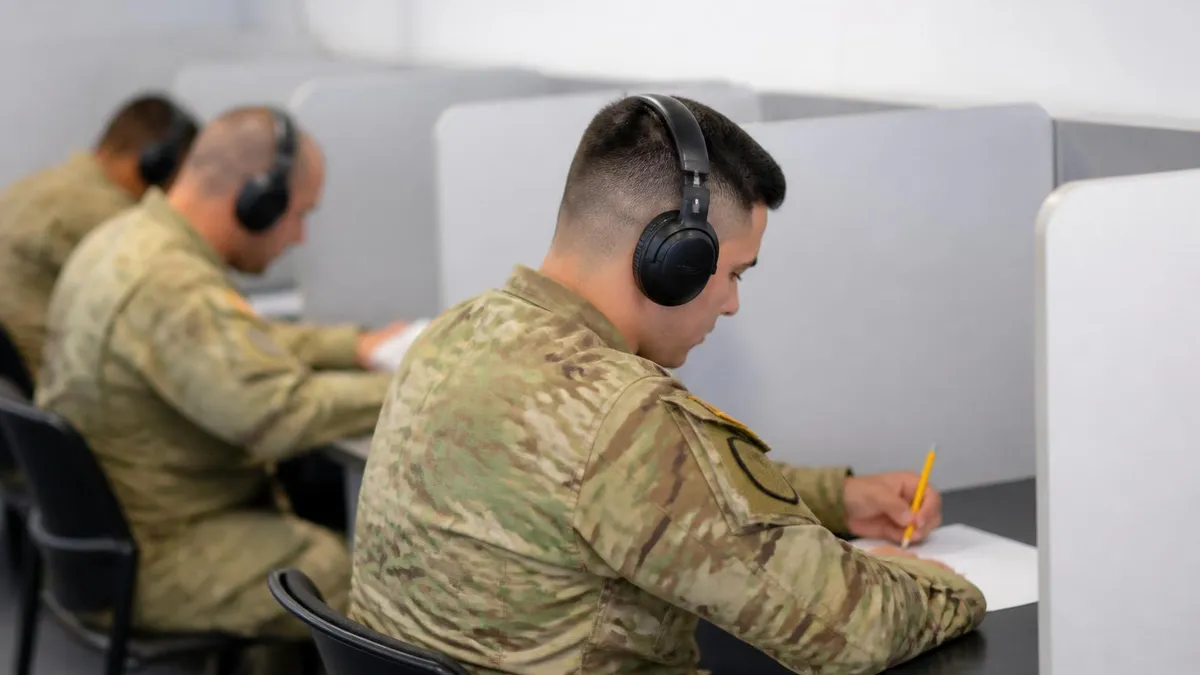
The DLAB takes approximately 60 to 75 minutes, is administered at Military Entrance Processing Stations (MEPS) or military training facilities, and produces a score on a scale of 0 to 176. Your score determines which language difficulty categories you qualify to train in at DLI.
What the DLAB Tests
The DLAB has two main sections that together assess your language learning aptitude:
Listening section. You hear audio clips in the constructed language—words, phrases, and sentences with rules explained through an audio-visual introduction. Then you're tested on whether you can apply those phonological and grammatical rules to novel examples. This section tests sound discrimination, auditory memory, and your ability to parse unfamiliar sound patterns.
Reading section. Written rules are presented for the constructed language, and you're asked to apply them correctly to example sentences. This section tests grammatical pattern recognition, rule application, and your ability to work with linguistic concepts like case marking, agreement, and word order.
Neither section requires prior knowledge of any foreign language. But familiarity with concepts like subject-verb agreement, noun cases (nominative, accusative, dative), and flexible word order gives you a significant processing advantage—you'll recognize what the rules are describing faster than someone encountering these concepts for the first time.
DLAB Score Requirements by Language Category
The Defense Language Institute categorizes languages by learning difficulty for English speakers. Your DLAB score determines which categories you qualify for:
Category I languages (minimum score: 85) — The most accessible for English speakers, primarily due to vocabulary overlap and similar syntax: Spanish, French, Portuguese, Italian, Romanian. These typically require approximately 26 weeks of full-time training at DLI.
Category II languages (minimum score: 95) — Moderately difficult: German and Indonesian fall here. German's complex grammar and case system make it harder than Category I despite Indo-European roots. Approximately 34 weeks at DLI.
Category III languages (minimum score: 105) — Significantly different from English in structure, vocabulary, or writing system: Russian, Hebrew, Thai, Hindi, Hindi, Greek, Turkish, and others. Approximately 46 weeks at DLI.
Category IV languages (minimum score: 111) — The most challenging for English speakers: Arabic, Chinese (Mandarin and Cantonese), Japanese, Korean. Up to 64 weeks at DLI. Category IV qualification opens the most strategically valuable linguist positions.
These minimums are just the floor. Specific MOS, rating, and AFSC (Air Force Specialty Code) requirements for linguist positions may require higher DLAB scores than the category minimum. If you have a specific job in mind, verify its actual DLAB requirement rather than assuming the category minimum is sufficient.
Why Your English Proficiency Matters
One of the best-documented factors in DLAB performance is English grammatical knowledge. The test uses grammatical concepts—noun cases, agreement patterns, morphological rules—and candidates who can recognize these concepts from their English grammar knowledge process the artificial language rules faster and with less cognitive load.
This means that brushing up on English grammar concepts before your DLAB isn't just useful—it's one of the highest-return preparation activities available. Specifically, understand: what a noun case is and how English marks case (nominative vs. objective vs. possessive); subject-verb agreement rules; how adjectives agree with nouns in languages that have this feature; basic sentence structure concepts (subject, predicate, object).
You don't need to become a linguistics student. You just need to be able to recognize these concepts quickly when the test describes them. Someone who hesitates over what a dative case is wastes processing time that should go toward applying the rule. Our DLAB grammar practice tests specifically target these grammatical concepts in the format you'll encounter on the real test.
Preparing for the DLAB
The DLAB is explicitly designed to test aptitude, not learned knowledge—but preparation still matters significantly. Here's why: the test presents unfamiliar linguistic rules under time pressure. Candidates who've practiced processing similar rule types respond faster and more accurately, which means higher scores even though they haven't learned the actual test material.
Effective preparation includes:
Sound discrimination practice. Work with audio materials that challenge you to distinguish similar sounds—particularly sounds not used in English. This trains the auditory processing that the listening section tests. Apps designed for language learners (Pimsleur-style audio, phonology training apps) can build this skill.
Pattern application exercises. Practice applying linguistic rules to example sentences—the core cognitive skill the DLAB tests. Start with simple rules (all nouns take -um as a suffix when they're objects) and add complexity. Our DLAB contextual word order rules practice test and sound-symbol correspondence practice test build exactly these skills.
English grammar review. As noted above, review noun cases, subject-verb agreement, and basic morphological concepts. You're not learning linguistics—you're building the recognitional vocabulary that makes the test's rule descriptions click faster.
Timed practice. Work under time pressure. The DLAB has a consistent pace and doesn't let you linger on items. Practice making decisions quickly—especially for the reading section where time management is critical.
DLAB Score and Career Implications
Your DLAB score doesn't just determine which DLI languages you're eligible for — it shapes your entire career trajectory if you're pursuing a language-related military specialty.
In the Army, linguist MOS positions (like 35P, Cryptologic Linguist) have DLAB minimums that typically exceed the base category requirements. The higher your DLAB score, the more language options are on the table and the stronger your competitive position for high-demand language assignments.
In the Air Force, DLAB scores matter for 1N3 (Cryptologic Language Analyst) and related AFSC positions. Navy CTI (Cryptologic Technician, Interpretive) has its own DLAB requirements. Each branch's specific requirements are set at the MOS/AFSC/rating level, so always verify with your recruiter or career counselor.
Beyond initial language assignment, a high DLAB score signals language learning aptitude that can support subsequent training in additional languages, reassignment to high-demand language positions, and career advancement in intelligence and special operations fields where multilingual capability is valued.
If you're targeting a Category IV language—Arabic, Chinese, Japanese, or Korean—preparing for a score of 111 or higher should be your goal, though scoring higher than the minimum strengthens your assignment options and competitive standing. Use our DLAB exam prep resources including the practice test materials across sound-symbol correspondence and contextual word order rules to build the specific skills the test measures. The DLAB is genuinely trainable with the right preparation—don't leave your language career options to chance.
- ✓Review the official DLAB exam content outline
- ✓Take a diagnostic practice test to identify weak areas
- ✓Create a study schedule (4-8 weeks recommended)
- ✓Focus on your weakest domains first
- ✓Complete at least 3 full-length practice exams
- ✓Review all incorrect answers with detailed explanations
- ✓Take a final practice test 1 week before exam day
About the Author

Educational Psychologist & Academic Test Preparation Expert
Columbia University Teachers CollegeDr. Lisa Patel holds a Doctorate in Education from Columbia University Teachers College and has spent 17 years researching standardized test design and academic assessment. She has developed preparation programs for SAT, ACT, GRE, LSAT, UCAT, and numerous professional licensing exams, helping students of all backgrounds achieve their target scores.
Join the Discussion
Connect with other students preparing for this exam. Share tips, ask questions, and get advice from people who have been there.
View discussion (8 replies)