
DLAB Tips: How to Ace the Defense Language Aptitude Battery Test 2026
Top DLAB tips to boost your score on the Defense Language Aptitude Battery. Free dlab practice test strategies, study plans, and expert advice. 🎯
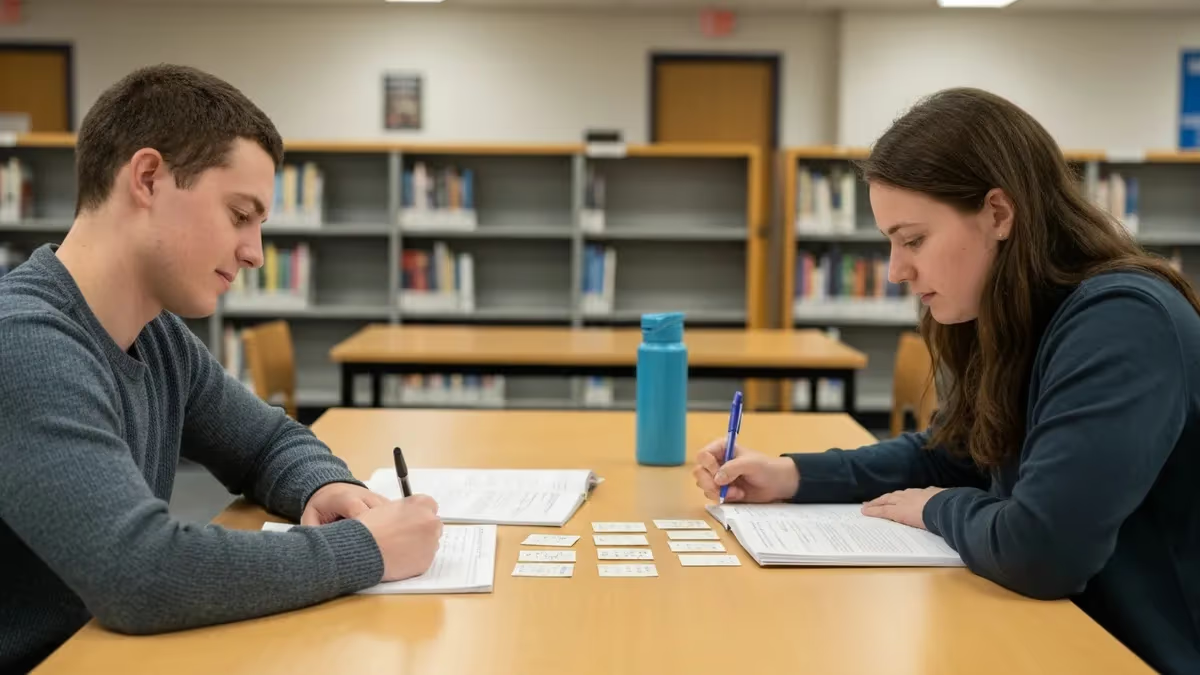
If you are preparing for the Defense Language Aptitude Battery test, having the right dlab tips can make the difference between qualifying for a coveted military language position and falling short of the required score. The DLAB is unlike any other military entrance exam — it tests your raw ability to learn an unfamiliar language by presenting you with a completely invented linguistic system and asking you to apply its rules under strict time pressure. Understanding the structure of the test and practicing the right way is the most important thing you can do before exam day.
Most candidates are surprised to discover that the DLAB does not test knowledge of any real language. Instead, the exam presents audio recordings in a made-up language alongside written grammatical rules, and you must apply those rules to answer multiple-choice questions. This means that prior experience with Spanish, French, or Mandarin gives you almost no direct advantage — what matters is your ability to process new linguistic patterns quickly and accurately. The good news is that this skill is trainable with consistent, focused practice using a quality dlab practice test.
The exam is scored on a scale from 0 to 176, and different military language programs require different minimum scores. The Defense Language Institute's most demanding programs — those involving Category IV languages like Arabic, Chinese, Japanese, and Korean — typically require a DLAB score of 110 or higher. Less intensive programs may accept scores in the 85 to 95 range. Knowing your target score before you begin studying gives you a concrete benchmark to measure your progress against and helps you calibrate how much preparation time you will need.
One of the most common mistakes candidates make is underestimating how mentally exhausting the DLAB can be. The exam lasts approximately 2.5 hours and requires sustained concentration throughout. Each section builds cognitive demands on top of previous sections, meaning fatigue in the final portion can significantly drag down your overall score. Building mental stamina through timed practice sessions is just as important as mastering the content itself. Candidates who practice in simulated exam conditions consistently outperform those who only study the rules casually.
Time management is another critical factor that separates high scorers from average ones. The DLAB is divided into portions that test different linguistic skills — phonological awareness, morphological pattern recognition, syntax application, and comprehensive rule usage — and each portion has its own time constraints. If you spend too long on any single question, you risk running out of time on later questions that might be easier for you. Learning to make quick decisions and move forward is a skill that must be built through deliberate timed practice.
The structure of this article will walk you through every aspect of DLAB preparation, from understanding the exam format and scoring to building a week-by-week study schedule. We cover the most effective study strategies, common pitfalls to avoid, and the specific types of questions you will encounter. Whether you have four weeks or four months before your scheduled exam date, the strategies in this guide will help you walk into the testing room with confidence and a clear plan for maximizing your score.
Throughout this guide, we reference free and paid resources that can supplement your preparation. The most valuable resource you can use is high-quality practice material that mirrors the actual exam format as closely as possible. Working through realistic DLAB practice problems trains your brain to recognize patterns faster, reduces test-day anxiety, and reveals which question types require additional focus before your real exam date arrives.
Free DLAB - Defense Language Aptitude Battery Study Tools
Interactive DLAB - Defense Language Aptitude Battery resources on PracticeTestGeeks, free to start:
- DLAB - Defense Language Aptitude Battery practice test — 300+ questions with instant scoring and answer explanations
- DLAB - Defense Language Aptitude Battery flashcards — review key terms and concepts card by card
- DLAB - Defense Language Aptitude Battery study guide — topic-by-topic overview of what the exam covers
- DLAB - Defense Language Aptitude Battery cheat sheet — one-page printable summary for last-minute review
DLAB by the Numbers
DLAB Study Schedule: 6-Week Prep Plan
- ▸Read official DLAB exam overview and scoring guide
- ▸Take one untimed diagnostic practice test to establish a baseline
- ▸Identify your weakest question types from the diagnostic
- ▸Review the phonological discrimination section instructions carefully
- ▸Practice distinguishing minimal pairs in unfamiliar sound systems
- ▸Listen to recordings of languages you have never studied (Arabic, Hungarian, Finnish)
- ▸Complete phonological discrimination drills for 30 minutes daily
- ▸Review any phonetics basics such as consonants, vowels, and stress patterns
- ▸Study how agglutinative languages build words from root + affixes
- ▸Practice applying made-up prefix and suffix rules to nonsense words
- ▸Complete at least three timed fictional grammar rule practice sets
- ▸Focus on tracking which rule applies to which grammatical context
- ▸Practice identifying subject-object-verb vs. other word-order patterns
- ▸Work through invented-language sentence completion exercises
- ▸Time yourself strictly — no more than 40 seconds per question
- ▸Review errors and categorize them by type (misapplied rule vs. missed pattern)
- ▸Take one full-length timed DLAB simulation each week
- ▸Simulate real test conditions: no interruptions, no notes, strict timing
- ▸Score each section separately to track section-by-section progress
- ▸Increase daily practice session length to build cognitive endurance
- ▸Focus exclusively on question types where your accuracy is below 70%
- ▸Do one final full-length timed test two days before the exam
- ▸Rest the day before — avoid cramming
- ▸Prepare logistics: ID, sleep schedule, meal plan for exam morning
Building an effective DLAB study plan requires understanding what the exam is actually measuring. Unlike vocabulary or grammar tests you may have encountered in school, the DLAB assesses your underlying capacity to internalize new linguistic structures — a skill that psychologists often call language learning aptitude. Researchers have found that this aptitude is composed of several distinct but related sub-skills: phonemic coding ability (the capacity to identify and store unfamiliar sounds), grammatical sensitivity (noticing how words function in sentences), inductive language learning ability (detecting patterns from examples), and rote learning memory for foreign language material.
Each of these four aptitude components maps directly onto a specific section of the DLAB. The phonological portion tests phonemic coding ability by playing audio clips in a fabricated language and asking you whether two sounds are the same or different, or which of several spoken words matches a target sound. The morphology section tests inductive learning and grammatical sensitivity by presenting a miniature grammar rulebook for a fictional language and asking you to apply those rules to novel examples. The syntax section combines all these skills by presenting more complex sentences where multiple rules must be applied simultaneously.
One of the most effective preparation strategies is to deliberately expose yourself to unfamiliar real languages before the exam. Spending 20 minutes per day listening to recordings in languages like Finnish, Turkish, Hungarian, or Swahili — all of which have very different sound systems and grammatical structures from English — trains your ear to process unfamiliar phonemes without panic. This type of exposure does not require you to understand what is being said; the goal is simply to normalize the experience of hearing and processing completely foreign speech patterns, which is exactly what the DLAB audio sections simulate.
Grammar rule application is the section where most candidates lose the most points, and it is also the section most amenable to targeted practice. The key insight is that the DLAB's fictional grammar rules are always internally consistent — they never contradict themselves within a single question set. This means that if you carefully read the rules before attempting the questions, you can answer correctly even if the rules feel completely counterintuitive.
The mistake most test-takers make is rushing through the rule presentation to get to the questions, then trying to reconstruct the rules from memory while under time pressure. Instead, slow down during the rule-reading phase and make a brief mental outline of the key distinctions before you start answering.
Practicing with the dlab test format specifically — rather than generic aptitude test preparation materials — is essential because the DLAB's question types are highly specific. Generic IQ test prep or even most military entrance exam prep will not adequately simulate the experience of applying fictional grammatical rules under time pressure. Seek out practice materials that closely replicate the audio-and-rule format of the actual exam. The more your practice environment resembles the testing environment, the more effectively your trained responses will transfer to the real exam.
Another strategy that high scorers consistently use is active error analysis. After every practice session, do not simply note your score and move on. Instead, review every question you got wrong and categorize the error: Did you misread a rule? Did you apply the right rule to the wrong grammatical context? Did you run out of time and guess? Each error category requires a different corrective action. Misread rules require slower, more deliberate rule-reading habits. Wrong-context applications require more practice with distinguishing when each rule fires. Time pressure guesses require more timed practice to build speed without sacrificing accuracy.
It is also worth noting that the DLAB has a significant working memory component. Many of the harder questions require you to hold multiple grammatical rules in mind simultaneously while parsing a sentence. Working memory capacity is trainable — activities like dual n-back training, learning musical notation, or practicing mental arithmetic can all help improve your ability to track multiple pieces of information at once. Dedicating even fifteen minutes per day to working memory exercises during your six-week prep period can measurably improve your performance on the most demanding DLAB question types.
Key DLAB Exam Skill Areas to Master
Phonological discrimination is the foundation of DLAB performance. The exam plays audio clips in a fabricated language and asks you to identify whether sounds are identical or different, and which spoken word matches a written or spoken target. To build this skill, practice active listening with unfamiliar real languages daily — languages like Finnish, Arabic, or Mandarin expose you to phonemic contrasts that do not exist in English, training your brain to detect subtle acoustic differences without defaulting to familiar sound categories.
A common mistake is passive listening: playing foreign-language audio in the background while doing other tasks. For DLAB prep, listening must be active and analytical. Focus on specific sounds: Is that a short or long vowel? Is that consonant aspirated or not? Does the stress fall on the first or second syllable? Practicing this kind of deliberate phonological attention for 20 to 30 minutes daily over four to six weeks will meaningfully improve your accuracy on the phonological discrimination portion of the real exam.
Advantages and Challenges of DLAB Preparation
- +The DLAB's fictional language format means no prior language knowledge is required — anyone can prepare effectively
- +The exam's consistent internal logic rewards careful rule-reading, making it very learnable with the right approach
- +DLAB skills like phonological discrimination and pattern recognition transfer to actual language learning at DLI
- +A high DLAB score opens access to higher-paying and more strategically valuable military language specialties
- +Preparation materials are widely available online including free practice tests that closely mirror the real exam
- +The six-month retest window gives candidates who fall short a clear second opportunity with experience on their side
- −The exam cannot be retaken for six months, so underperforming on your first attempt has significant consequences
- −The audio-only phonological sections cannot be adequately prepared for using text-only study materials
- −The time pressure is intense — many test-takers find themselves unable to complete all sections without timed practice
- −Working memory demands are high and cannot be significantly improved in the days immediately before the exam
- −Test anxiety can disproportionately hurt performance on the DLAB because errors tend to cascade across rule-dependent questions
- −Score requirements vary by military branch and language assignment, creating confusion about target scores during preparation
Pros and Cons at a Glance
| Pros | Cons |
|---|---|
| The DLAB's fictional language format means no prior language knowledge is required — anyone can prepare effectively | The exam cannot be retaken for six months, so underperforming on your first attempt has significant consequences |
| The exam's consistent internal logic rewards careful rule-reading, making it very learnable with the right approach | The audio-only phonological sections cannot be adequately prepared for using text-only study materials |
| DLAB skills like phonological discrimination and pattern recognition transfer to actual language learning at DLI | The time pressure is intense — many test-takers find themselves unable to complete all sections without timed practice |
| A high DLAB score opens access to higher-paying and more strategically valuable military language specialties | Working memory demands are high and cannot be significantly improved in the days immediately before the exam |
| Preparation materials are widely available online including free practice tests that closely mirror the real exam | Test anxiety can disproportionately hurt performance on the DLAB because errors tend to cascade across rule-dependent questions |
| The six-month retest window gives candidates who fall short a clear second opportunity with experience on their side | Score requirements vary by military branch and language assignment, creating confusion about target scores during preparation |
Complete DLAB Prep Checklist Before Exam Day
- ✓Confirm your target DLAB score based on the specific military language program you are applying for
- ✓Take a full untimed diagnostic practice test to establish your baseline score and identify weak areas
- ✓Complete at least four full-length timed DLAB practice tests under real exam conditions before your scheduled date
- ✓Spend at least 20 minutes daily listening actively to recordings in an unfamiliar foreign language
- ✓Practice the fictional grammar rule application section until your accuracy consistently exceeds 75%
- ✓Work through phonological discrimination exercises at least three times per week for a minimum of four weeks
- ✓Review all practice test errors and categorize them by type before moving on to the next session
- ✓Build your exam-day stamina by completing back-to-back timed sections without breaks at least twice during prep
- ✓Confirm your exam location, required identification documents, and arrival time at least one week in advance
- ✓Get eight or more hours of sleep the two nights before the exam — cognitive performance drops sharply with fatigue

Know Your Minimum Score Before You Study
Different military branches and language training programs require different DLAB minimums — scores range from 85 for some assignments up to 110 or higher for Category IV languages like Arabic and Mandarin. Researching your specific target score before you begin studying gives you a concrete benchmark and lets you calibrate exactly how much preparation time you actually need. Aiming for 10 to 15 points above your minimum creates a comfortable buffer against test-day performance variance.
Understanding how DLAB scores are calculated helps you focus your preparation energy on the sections that matter most. The exam is scored using a formula that weights different sections according to their length and difficulty. The total raw score is converted to a scaled score in the 0–176 range, which is what military branches and language training programs use for qualification decisions.
Critically, there is no penalty for wrong answers on the DLAB — every unanswered question costs you more than a random guess does. This scoring structure has direct implications for your test-taking strategy: always answer every question, even if you must guess.
The phonological discrimination section, while it appears straightforward, is surprisingly high-stakes. Research on the Modern Language Aptitude Test — a close relative of the DLAB — consistently shows that phonological coding ability is the single best predictor of success in foreign language training.
Candidates who perform poorly on the phonological portion of the DLAB often struggle even when they score well on the grammatical rule application sections, because the linguistic processing skills they lack will also be needed during actual language training at DLI. This is worth knowing: a strong phonological score may matter more than your overall composite score in some evaluation contexts.
Score validity periods for the DLAB are also important to know. The exam score is typically valid for two years from the date of testing. If you are planning a military career path that involves language training but the timing of your enlistment or commission date is more than two years after your DLAB date, you may need to retest. Confirming the validity period with your recruiter before scheduling your exam ensures that your score will still be on file when it is actually needed for your language assignment.
Many candidates ask whether studying a real foreign language before taking the DLAB will help their score. The answer is nuanced: direct language knowledge does not transfer because the DLAB uses a completely invented linguistic system. However, the process of learning a foreign language builds exactly the kinds of meta-linguistic awareness, phonological sensitivity, and grammatical pattern recognition that the DLAB measures.
Candidates who have studied two or more foreign languages typically score higher on the DLAB than monolingual candidates with equivalent academic backgrounds — not because they know more vocabulary, but because the language-learning process itself trained the underlying aptitude skills the DLAB measures.
The relationship between DLAB score and actual language training success at DLI is well-established in military research. Soldiers, sailors, airmen, and marines with DLAB scores above 120 graduate from DLI language programs at significantly higher rates and in significantly less time than those with scores in the 85–100 range. This is worth keeping in mind when you set your preparation goals: every additional point you earn on the DLAB has real-world implications for how likely you are to successfully complete your language training and go on to perform your intended military occupational specialty.
You can access comprehensive study materials — including the official dlab exam preparation PDF — to supplement your timed online practice. The combination of printed reference material for reviewing rules and structures alongside timed digital practice tests that simulate exam conditions creates the most complete preparation environment. Use printed materials for slow, analytical study of the rule systems and phonological concepts, and use timed digital practice to build the speed and automaticity you need to execute under real exam pressure.
It is also worth understanding the testing environment you will encounter. The DLAB is administered at Military Entrance Processing Stations (MEPS) or at authorized military testing facilities. The exam is computer-based, with the audio portions delivered through headphones.
You will not be allowed to take notes during the exam, which is one reason why deliberate mental encoding strategies — like creating brief rule summaries before beginning each question set — are so important to practice during your preparation period. Walking into the exam with a well-rehearsed mental process for handling each section type reduces cognitive load and allows you to allocate more attention to actually answering questions correctly.
If you do not achieve your target DLAB score on your first attempt, you must wait a full six months before retesting. This waiting period makes it critical to treat your first attempt as your primary opportunity and to invest in thorough preparation before your scheduled exam date. Do not take the DLAB as a trial run — the six-month delay can significantly set back your military language career timeline and affect enlistment or assignment decisions that are time-sensitive.
Test-day execution is where all your preparation comes to fruition, and there are several concrete strategies that high-scoring candidates consistently report using. The first and most important is arriving at the testing facility early — at least 30 minutes before your scheduled start time. The DLAB requires significant cognitive resources, and starting the exam while still mentally processing a stressful rush to the facility will cost you points. Give yourself buffer time for parking, check-in procedures, and a few minutes of calm, focused breathing before you are seated at your testing station.
During the exam itself, manage your time at the section level, not the question level. If you are spending more than 45 seconds on a single question, mark your best guess and move on. The questions at the end of each section are worth just as many points as the questions at the beginning, and running out of time on the final questions of a section is one of the most preventable score-limiting mistakes on the DLAB.
Practice this discipline during your timed practice sessions — train yourself to make a decision and commit to it within a defined time window, even when you are not fully confident in your answer.
The audio sections of the DLAB require a specific listening posture. Rather than trying to understand or translate what you hear, focus exclusively on the phonological feature the question targets. If the question asks whether two sounds are the same or different, direct all your attention to that specific comparison. If the question asks you to identify which of four spoken words matches a target, listen for the specific phonemes that distinguish the options rather than trying to process the whole word holistically. This feature-focused listening strategy is more accurate and faster than holistic processing under time pressure.
For the grammatical rule application sections, establish a consistent procedure and follow it for every question set. Read all the rules once, create your brief mental summary, answer the questions in order, and do not go back unless you have time at the end of the section. Inconsistent procedures — sometimes reading rules twice, sometimes jumping to the questions immediately — introduce variability that hurts both speed and accuracy. The more automatic your section procedure becomes through practice, the less cognitive overhead it consumes on test day, leaving more mental resources for the actual content of the questions.
Managing test anxiety is a practical preparation concern, not just a psychological nicety. High anxiety impairs working memory function — the exact cognitive resource the DLAB depends on most heavily. If you know you are prone to test anxiety, incorporate stress inoculation into your preparation by practicing under conditions that feel uncomfortable: take practice tests in a busy library rather than at home, use strict time limits that feel tight, and practice continuing after making a mistake rather than stopping to ruminate. Building a confident, automatic exam procedure reduces the conditions under which anxiety is triggered.
After completing the exam, your score will typically be available within a few days. Compare your result against your target score and, if you achieved your goal, begin the administrative steps for your language training assignment. If you did not reach your target, start planning your six-month preparation period immediately rather than waiting.
Use your performance on the actual exam to identify which sections cost you the most points, and build your retake preparation around targeted work on those specific areas. Take a practice dlab test within the first week of your retake preparation period to re-establish your baseline and measure how much your first attempt's experience changed your starting point.
Remember that your DLAB score is one of the most portable credentials in a military language career. It follows your service record and influences assignment decisions not just at initial enlistment but throughout your career. Language-qualified military personnel earn special pay, access to unique assignment opportunities, and career advancement advantages that compound over the length of a service career.
Treating your DLAB preparation as a significant investment in your long-term military career — rather than just another bureaucratic box to check — will give you the motivation to put in the preparation hours that actually make a difference on exam day.
In the final days before your DLAB exam, shift your preparation from intensive practice to consolidation and rest. The two nights before the exam, prioritize sleep above all else — research on cognitive performance consistently shows that sleep deprivation impairs working memory, processing speed, and pattern recognition ability more severely than almost any other variable. A candidate who completes five weeks of solid preparation and then sleeps well the last two nights will outperform a candidate who crams until midnight before the exam in the vast majority of cases.
On the morning of your exam, eat a balanced meal that includes complex carbohydrates and protein. Avoid foods high in simple sugars that cause energy crashes, and limit caffeine to your normal daily amount — this is not the day to experiment with energy drinks or double espresso shots if those are not part of your regular routine. Hydration also matters: mild dehydration measurably impairs cognitive function, so drink water consistently in the hours before your exam time rather than trying to hydrate all at once immediately before the test.
When you sit down at your testing station, take thirty seconds before the first section begins to settle yourself. Take three slow, deep breaths, loosen any physical tension in your shoulders and jaw, and remind yourself of the preparation you have done. Anxiety is partly a perception of unpreparedness — if you have followed a disciplined six-week preparation plan, you genuinely are ready. Anchoring your mental state to that factual preparation record is a concrete anxiety management technique that competitive test-takers use across many high-stakes exam contexts.
During the exam, if you notice yourself becoming flustered — perhaps after a sequence of questions you were uncertain about — use the moment between sections as a micro-reset. Take two slow breaths, refocus on the present section, and release any rumination about previous sections. Mistakes in earlier sections cannot be corrected, but the sections ahead of you can still be answered well. Candidates who practice this compartmentalization skill during their timed practice runs are much better equipped to execute it under real exam pressure.
After the DLAB, regardless of how you feel about your performance, avoid the temptation to immediately analyze every question you can remember. Post-exam rumination rarely produces useful insights and often produces inaccurate ones — human memory for test content is notoriously unreliable and biased toward recalling the questions that felt hardest. Give yourself a full day to decompress before beginning to think analytically about your performance. Wait for your official score report, then use that objective data — not your subjective feelings immediately after the exam — as the basis for any decisions about next steps.
For candidates who are preparing for the DLAB as part of a broader military career transition, it is worth connecting with a military language recruiter or career counselor early in your preparation period. These professionals can clarify exactly which DLAB score you need for your target assignment, explain how the score interacts with other factors in language training selection, and advise you on timing your exam relative to your broader enlistment or commissioning timeline. The administrative and strategic dimensions of your DLAB preparation matter just as much as the cognitive preparation itself.
The Defense Language Aptitude Battery is a genuine assessment of how your brain processes new linguistic information — but it is also a learnable test with a well-defined format and predictable question types. Candidates who approach it with systematic preparation, consistent daily practice, and a clear understanding of what each section actually measures will consistently outperform their apparent baseline aptitude.
Your DLAB score is not just a reflection of innate talent — it is a product of how seriously and strategically you prepare. Start early, practice often, and approach each session with the specific goal of improving the skills the exam actually tests.
Sample DLAB - Defense Language Aptitude Battery Practice Questions
Try these questions from our free DLAB - Defense Language Aptitude Battery practice tests. The correct answer and an explanation follow each question.
The DLAB (Defense Language Aptitude Battery) is administered by the US military primarily to assess which capability?
- A. A recruit's potential to learn a foreign language
- B. A recruit's current foreign language proficiency
- C. A recruit's ability to translate military documents
- D. A recruit's knowledge of world geography
Answer: A. A recruit's potential to learn a foreign language
The DLAB measures language-learning aptitude — potential, not current ability.
In a verb-initial language: 'Ran quickly fox the brown.' What is the standard word order of this language?
- A. VSO (Verb-Subject-Object)
- B. VOS (Verb-Object-Subject)
- C. SOV (Subject-Object-Verb)
- D. SVO (Subject-Verb-Object)
Answer: A. VSO (Verb-Subject-Object)
The verb 'ran' comes first, followed by the adverb 'quickly,' then the subject 'fox the brown.' This is a VSO pattern where the verb precedes both the subject and any objects. Languages like Welsh and Classical Arabic use this order.
A visual grammar rule shows arrows: Word A → Word B means B must agree with A. An image shows: [Noun: feminine] → [Adjective]. In a test language, feminine nouns require adjective suffix '-af'. The noun 'Talu' (feminine) is modified by 'bren' (long). What is the correct adjective form?
- A. Brenaf
- B. Bren
- C. Brenal
- D. Afbren
Answer: A. Brenaf
The arrow shows the adjective must agree with the feminine noun by taking '-af': 'brenaf.'
In a test language, prepositions follow their objects (postpositions). 'In the house' (house=kasa, in=en) becomes:
- A. en kasa
- B. kasa en
- C. kasa alone
- D. en alone
Answer: B. kasa en
A postposition rule places the relational word after its object, giving 'kasa en' (house in).
Take the full DLAB - Defense Language Aptitude Battery practice test
DLAB Questions and Answers




About the Author

Educational Psychologist & Academic Test Preparation Expert
Columbia University Teachers CollegeDr. Lisa Patel holds a Doctorate in Education from Columbia University Teachers College and has spent 17 years researching standardized test design and academic assessment. She has developed preparation programs for SAT, ACT, GRE, LSAT, UCAT, and numerous professional licensing exams, helping students of all backgrounds achieve their target scores.
Join the Discussion
Connect with other students preparing for this exam. Share tips, ask questions, and get advice from people who have been there.
View discussion (8 replies)