
What Does CPC Mean? Certified Professional Coder Definition and Overview 2026
💡 What does CPC mean? CPC stands for Certified Professional Coder — the top medical coding credential. Learn the definition, exam details, and career paths.
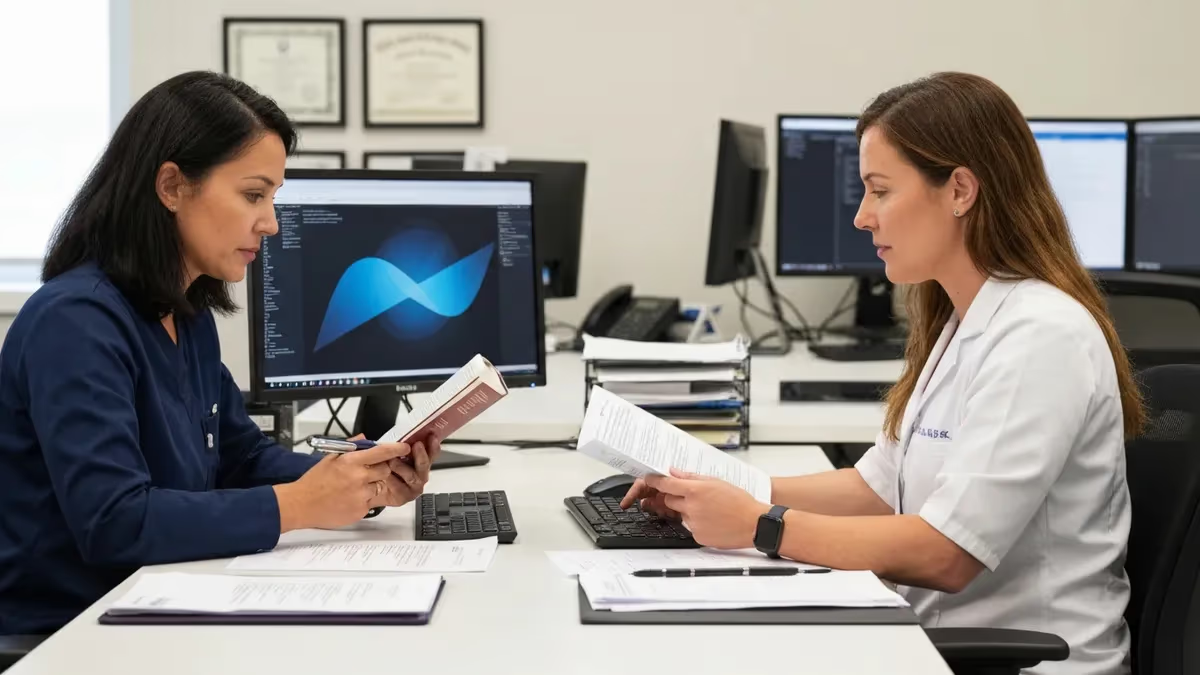
What Does CPC Stand For?
If you've seen "CPC" on a job listing, a resume, or a credentialing website and wondered what it means — you're not alone. The abbreviation shows up across several industries, but in the healthcare world it has one dominant meaning: Certified Professional Coder.
So what's a Certified Professional Coder? It's a nationally recognized credential issued by the AAPC (American Academy of Professional Coders). A CPC proves that someone understands how to translate medical diagnoses, procedures, and services into the standardized codes that drive billing, insurance claims, and healthcare reimbursement. Think of it as the gold standard in medical coding — the credential that employers look for first when they're hiring someone to handle clinical documentation and coding compliance.
The abbreviation draws a huge chunk of search traffic every month because it overlaps with several other acronyms — Cost Per Click, Communist Party of China, and more. But if you're searching in the context of healthcare, medical billing, or coding jobs, CPC meaning almost always points back to this AAPC credential. We'll cover the other uses below, but the rest of this article focuses where most people need it: medical coding.
Medical coding itself is one of those careers most people don't think about until they're staring at a confusing line item on a hospital bill. Every time a doctor sees a patient, a coder has to translate what happened in that room into alphanumeric codes. Those codes drive everything downstream — insurance reimbursements, compliance audits, Medicare and Medicaid claims, and the financial health of the entire practice. Without accurate codes, claims get denied. And without coders who know what they're doing, inaccurate codes pile up fast.
It's also worth pointing out what the CPC is not. It's not a degree. It's not a license to practice medicine. It doesn't require a specific educational background to attempt. The AAPC credential is purely competency-based — you pass the exam, you've demonstrated you know the material. That accessibility is part of why so many people choose medical coding as a second career. A solid training program, focused study, and the CPC exam is often all it takes to make a real move into healthcare without a four-year degree.
One more thing worth knowing before diving in: who is CPC? The title belongs to any coder who has passed the AAPC exam. It's an individual credential, not an organizational designation — a person holds it, not a company or department. You'll see it written as both "CPC" and "CPC certified" in job listings, but they mean the same thing: someone who sat for and passed that 150-question exam and earned the right to use those three letters after their name.
The AAPC was founded in 1988 and now has more than 200,000 members across the US. When an employer anywhere in the country sees CPC on your resume, they know exactly what it means and what you can do on day one. Check out our CPC study resources to see what the exam covers.
- The CPC exam contains 100 multiple-choice questions. (AAPC)
- The CPC exam has a four-hour time limit. (AAPC)
- Passing the CPC exam requires at least 70 correct answers out of 100, equivalent to 70%. (AAPC)
- AAPC lists the CPC exam voucher at $425 USD for one attempt or $499 USD for two attempts. (AAPC)
- For CPC candidates with two attempts, the second voucher becomes available after results are released for an unsuccessful first attempt. (AAPC)
- A CPC exam voucher must be used within one year of purchase or its payment is forfeited. (AAPC)
- Maintaining CPC certification requires annual AAPC membership and 36 continuing education units every two years. (AAPC)
- CPC candidates can take the exam on a computer at home with a live remote proctor or at a testing center. (AAPC)
- An active AAPC membership is required to take the CPC exam. (AAPC)
Facts verified Oct 15, 2026 against AAPC. Dates that have passed are removed automatically.
CPC Exam at a Glance
| Item | Detail | Official source |
|---|---|---|
| Number of questions | 100 multiple-choice questions | AAPC |
| Time limit | 4 hours | AAPC |
| Passing score | 70% (70 of 100 correct) | AAPC |
| Exam fee | $425 for one attempt; $499 for two attempts | AAPC |
| Retake policy | Second voucher becomes available after failed first-attempt results | AAPC |
| Validity | Exam voucher: one year from purchase | AAPC |
| Renewal | Annual AAPC membership and 36 CEUs every two years | AAPC |
| Delivery | Computer-based at home with a live remote proctor or at a testing center | AAPC |
| Eligibility | Active AAPC membership required | AAPC |
| Score release | Within 7–10 business days; timing may vary | AAPC |
| Testing window | Annual exam blackout begins December 30 | AAPC |
Facts verified Oct 15, 2026 against AAPC. Dates that have passed are removed automatically.

Exam: 100 multiple-choice questions, 4 hours, open book
Fee: $425 for one attempt ($499 for two attempts)
Validates: ICD-10-CM, CPT, and HCPCS Level II coding systems
CPC-A: Apprentice designation for new coders without 2 years of experience — same exam, upgraded once experience is verified
The CPC Definition — What It Really Means
The CPC credential isn't just a certificate you hang on a wall. It's proof that you can accurately assign codes from three major coding systems — and that distinction matters a lot in day-to-day practice. Here's what a CPC must know:
- ICD-10-CM — the International Classification of Diseases, 10th Revision. These codes identify diagnoses, symptoms, and medical conditions. There are over 70,000 of them.
- CPT (Current Procedural Terminology) — codes that describe the medical, surgical, and diagnostic services a provider performs. Maintained by the American Medical Association.
- HCPCS Level II — codes for products, supplies, and services not covered by CPT, including ambulance rides, durable medical equipment, and certain drugs.
Getting those codes right is what separates a clean claim from a rejected one. Hospitals, physician offices, insurance companies, and outpatient clinics all depend on accurate coding to get paid — and to stay compliant with regulations. A what is CPC search often leads people here: it's the person who makes that entire system work.
Medical coders don't diagnose patients or make clinical decisions. But they do have to understand what those decisions mean in coding terms. When a surgeon performs a laparoscopic appendectomy, a CPC has to know which CPT code applies — and whether any modifiers are needed based on what actually happened during the procedure. Get it wrong and the claim gets denied, delayed, or flagged for audit. That's real money and real compliance risk on the line.
The AAPC built the CPC exam to test practical knowledge, not just textbook recall. That's why it's open book but still hard — you're not memorizing codes, you're learning how to find and apply them correctly under time pressure. It's a different skill set than most people expect going in.
It's also worth noting the scale of what medical coders support. US healthcare processes hundreds of millions of claims annually. Each one requires accurate codes to route through the billing system, get adjudicated by an insurer, and result in payment to the provider. Even a small error rate across that volume represents enormous financial exposure.
Credentialed coders who understand coding guidelines deeply are genuinely valuable — not just as technicians but as the people who keep the financial infrastructure of healthcare functioning accurately. That's why hospitals and billing companies pay real salaries for people who hold this credential, and why the CPC has remained the dominant standard in the field for decades.
CPC vs. CPC-A — What's the Difference?
You'll see both CPC and CPC-A on resumes and LinkedIn profiles. They're not the same thing, though they start from the same exam.
The CPC-A designation stands for Certified Professional Coder – Apprentice. It's awarded to candidates who pass the same 150-question exam but don't yet have two years of on-the-job coding experience. Once a CPC-A logs and verifies that experience through AAPC, the "A" is removed and they hold a full CPC credential.
It's a practical path — you can prove your knowledge before you've landed your first job, then upgrade the designation as your career grows. A lot of coding programs actually encourage students to sit for the CPC exam before graduation so they're job-ready on day one with a CPC-A in hand. Some employers hire CPC-As at a lower starting rate with the understanding that the full credential — and a raise — is coming once experience hours are logged.
The CPC jobs market is broader than most people expect. Employers include hospital outpatient departments, physician group practices, medical billing and revenue cycle management firms, health insurance companies, government health agencies like VA and CMS contractors, and telehealth companies. Remote positions have expanded dramatically since 2020 — it's now common for experienced CPCs to work entirely from home, coding records for clients across multiple states. The CPC certification also opens doors to compliance auditing, coding education, and healthcare consulting roles that scale with a career over decades.
CPC Career Paths
New coders who pass the AAPC exam without two years of experience earn the CPC-A designation. Entry-level roles include medical coder, coding specialist, and billing and coding associate. Typical starting salaries range from $35,000 to $45,000 depending on location and employer type.
Most CPC-As upgrade to full CPC within 1-2 years. Building experience in a specialty area — like orthopedics, cardiology, or behavioral health — during this period makes the eventual upgrade more valuable on the job market.

Other CPC Meanings
Before going further into the certification path, it's worth briefly addressing the disambiguation question — because "what does cpc mean" and "cpc definition" searches pull people from several very different contexts.
In digital advertising, CPC stands for Cost Per Click. It's the metric that tells you how much an advertiser pays each time a user clicks on their ad in Google Ads, Meta Ads, or any other PPC platform. If you're a marketer wondering what's CPC in your campaign dashboard, that's your answer — it has nothing to do with medical coding.
In politics and international affairs, CPC usually refers to the Communist Party of China — the ruling party of the People's Republic of China, founded in 1921. This is the dominant definition in news, academic, and geopolitical contexts. Some Western sources use CCP (Chinese Communist Party) for the same organization.
In Canadian law enforcement, CPC refers to the Canadian Police College — a federal institution in Ottawa that provides advanced training for officers from agencies across the country.
The context is everything. If someone says "I'm a CPC" and they work in healthcare, they're a Certified Professional Coder. If they work in digital marketing, they might be referencing their familiarity with CPC bidding strategies. And in a political science classroom, the abbreviation points to an entirely different organization altogether. For the rest of this article, CPC means Certified Professional Coder.
CPC Abbreviation — Quick Reference
The most common professional meaning — a credential issued by AAPC that validates expertise in ICD-10-CM, CPT, and HCPCS Level II medical coding.
- ▸Issued by AAPC since 1988
- ▸150-question exam, 5h40m, open book
- ▸Required or preferred by most healthcare employers
A paid advertising metric showing how much an advertiser pays per ad click. Dominant meaning in Google Ads, Meta Ads, and digital marketing contexts.
- ▸Key PPC campaign metric
- ▸Varies by industry, keyword competition, and ad quality score
- ▸Higher CPC = more expensive traffic; lower CPC = cheaper clicks
The ruling political party of the People's Republic of China, founded in 1921. Primary definition in international news and geopolitical contexts.
- ▸Also written CCP (Chinese Communist Party) in some Western sources
- ▸Founded 1921, current membership exceeds 90 million
- ▸Governs China as the sole ruling party
A federal training institution in Ottawa providing advanced law enforcement education for officers from agencies across Canada.
- ▸Located in Ottawa, Ontario
- ▸Offers courses not available at provincial academies
- ▸Serves municipal, provincial, and federal officers
CPC-A is the Apprentice designation for new coders. Specialty CPC variants (CPCO, CPCS, CPPM) are advanced AAPC credentials built on the CPC foundation.
- ▸CPC-A: same exam, upgraded once 2 years of experience is verified
- ▸CPCO: Certified Professional Compliance Officer
- ▸CPPM: Certified Physician Practice Manager

How to Get CPC Certified
Earning a CPC takes real preparation — this isn't a credential you can wing. Here's how the process works.
Eligibility and Study
There's no strict prerequisite to sit for the exam, but AAPC recommends completing a medical coding training program first. Most candidates come from community college or vocational programs that cover anatomy, physiology, medical terminology, and the three coding systems. Some transition from clinical roles — nurses, medical assistants, and health information technicians often find the material clicks faster because they already understand what happens in an exam room.
Study time varies by background. Someone with zero healthcare experience might spend four to six months preparing seriously. Someone with clinical experience might be ready in two or three. What matters most isn't how long you study but whether you're doing the right kind of practice — timed mock exams, real coding scenarios, and learning the logic behind guidelines, not just memorizing individual codes.
You don't need a formal AAPC-affiliated program to sit for the exam. Self-study using approved manuals and third-party prep materials works. That said, structured programs tend to produce higher pass rates because they teach systematic case-by-case thinking. Many community colleges offer coding certificate programs aligned directly with the CPC exam blueprint — often including a practice exam voucher.
The Exam
The CPC exam has 100 multiple-choice questions across 17 sections and runs 4 hours. It's open book — you can bring ICD-10-CM, CPT, and HCPCS Level II coding manuals (tabbed, annotated). Open book doesn't mean easy: there's no time to look every code up from scratch. You need to know these manuals well enough to navigate them fast under pressure.
Common exam topics: medical terminology and anatomy, evaluation and management (E&M) coding, surgery across multiple body systems, anesthesia and radiology, pathology and lab, and ICD-10-CM diagnosis coding. A passing score is 70% or higher. AAPC reports first-attempt pass rates in the 60–70% range for well-prepared candidates — serious, but very passable with the right plan. E&M coding and surgery sections trip up the most test-takers, so smart prep allocates extra time there.
CPC Exam Prep Checklist
- ✓Complete a structured medical coding training program or self-study curriculum
- ✓Acquire current editions of ICD-10-CM, CPT, and HCPCS Level II code books
- ✓Tab and annotate your code books before exam day
- ✓Take at least 3 full-length timed practice exams
- ✓Prioritize E&M coding and surgery — the highest-weight exam sections
- ✓Register through AAPC and schedule your exam at an approved testing site
- ✓Join an AAPC local chapter for study group access and networking
Maintaining the Credential
Passing is step one. Keeping the CPC requires 36 CEUs every two years plus an active AAPC membership. That's a reasonable amount of learning spread over 24 months — most CPCs pick up CEUs through workshops, webinars, local chapter meetings, and self-study. Some employers pay for them as a benefit.
The CEU requirement exists because coding doesn't stand still. CPT codes update every January 1. ICD-10-CM updates every October 1. New guidelines roll out, modifiers change, and payer policies shift constantly. A CPC who passed five years ago and never did another hour of continuing education would be working from outdated knowledge — a real liability in a compliance-sensitive environment. The ongoing requirement keeps the credential meaningful over a whole career, not just the year you passed.
Many coders use the CEU period to add specialty credentials: CPCO, CPCS, CPPM, or CPMA. Each adds a focused skill layer and expands your role options. The CPC is the prerequisite for all of them — you can't skip to the specialty without earning the foundation first. Think of the base CPC less as an endpoint and more as the key that unlocks every advanced role in the field.
Is the CPC Worth It?
Short answer: yes, for most people who want a serious healthcare career without a four-year degree. The credential pays for itself relatively quickly. The exam fee runs $425 to $499 plus a few hundred dollars in study materials. Credentialed coders consistently earn $5,000 to $15,000 more annually than non-credentialed ones, according to AAPC salary surveys. At that delta, the investment pays back within the first year of employment.
Medical coding is one of the few healthcare fields where remote work is the norm rather than the exception. If you're looking for a legitimate work-from-home career path in healthcare — not a side hustle, but a real full-time career with advancement potential — the CPC is one of the cleanest routes available. You can complete training remotely, take the exam at a local testing center or via remote proctoring, and land a fully remote job on your first placement.
That said, it's not for everyone. The exam is genuinely difficult, and the ongoing CEU and membership requirements add up over a career. If you're not interested in keeping up with annual coding guideline updates, the day-to-day reality will feel tedious. But if you're detail-oriented, like systematic problem-solving, and want a healthcare career that's in-demand, well-compensated, and increasingly remote-friendly — the CPC is a strong, proven choice. Now you know what CPC means and what the credential actually requires. The next step is deciding whether it's the right path for your career.
CPC Credential — Pros and Cons
- +Recognized nationwide — employers know exactly what it means
- +Competency-based: no degree required, just pass the exam
- +CPC-A path lets you credential before landing your first job
- +Remote work opportunities have expanded significantly since 2020
- +Foundation for specialty credentials (CPCO, CPCS, CPPM, CPMA)
- −Exam fee ($425–$499) plus study materials add up
- −36 CEUs every two years required to maintain the credential
- −First-attempt pass rate is 60–70% — serious preparation required
- −CPT and ICD-10-CM update annually, requiring ongoing learning
- −Salary ROI varies by geography, specialty, and employer type
Sample Certified Professional Coder Practice Questions
Try these questions from our free Certified Professional Coder practice tests. The correct answer and an explanation follow each question.
The medical term 'rhinorrhea' means:
- A. Nosebleed
- B. Runny nose (nasal discharge)
- C. Nasal polyp
- D. Deviated septum
Answer: B. Runny nose (nasal discharge)
Rhin/o means nose and -rrhea means flow or discharge, so rhinorrhea is a runny nose.
The ICD-10-CM Excludes2 note means:
- A. The two conditions cannot occur together
- B. The excluded condition is not included here but may be coded together if both are present
- C. The excluded condition is always coded instead
- D. The condition requires a fifth digit
Answer: B. The excluded condition is not included here but may be coded together if both are present
Excludes2 indicates the excluded condition is not part of the code but may be reported together if the patient has both conditions.
Which suffix means 'surgical fixation' or 'to suture in place'?
- A. -plasty
- B. -pexy
- C. -rrhaphy
- D. -desis
Answer: B. -pexy
-Pexy means surgical fixation or suspension of an organ, such as nephropexy (kidney fixation).
Which ICD-10-CM Excludes note means the two conditions cannot occur together and both codes should never be reported simultaneously?
- A. Excludes1
- B. Excludes2
- C. Code first
- D. Use additional code
Answer: A. Excludes1
Excludes1 indicates a 'pure' exclusion where the two conditions cannot coexist, so both codes should not be assigned for the same patient at the same time.
CPC Questions and Answers

CPC Study Materials: Best Resources for the Certified Professional Coder Exam

CPC Medical Coding Certification: Your Complete Guide to Becoming a Certified Professional Coder

CPC Meaning: What CPC Stands For in Medical Coding Explained

CPC Certification 2026: Complete Guide to Becoming a Certified Professional Coder
About the Author

Certified Internal Auditor & Compliance Certification Expert
University of Illinois Gies College of BusinessBrian Henderson is a Certified Internal Auditor, Certified Information Systems Auditor, and Certified Fraud Examiner with an MBA from the University of Illinois. He has 19 years of internal audit and regulatory compliance experience across financial services and healthcare industries, and coaches professionals through CIA, CISA, CFE, and SOX compliance certification programs.