
CPC Medical Coding Certification: Your Complete Guide to Becoming a Certified Professional Coder
CPC medical certification by AAPC is the gold standard for medical coders. ❓ Exam format, eligibility, salary, and prep timeline explained.

If you've been researching medical coding careers, you've probably bumped into three letters more times than you can count: CPC. And honestly? There's a reason it keeps showing up. The CPC medical credential — short for Certified Professional Coder — is the most recognized coding certification in the United States, issued by the American Academy of Professional Coders (AAPC). It's the one most employers ask for by name in physician offices, outpatient clinics, and ambulatory surgery centers.
Hold a CPC, and you're telling hiring managers something specific: you can read a physician's note, pick out exactly what happened, and assign the right ICD-10-CM, CPT, and HCPCS Level II codes without breaking a sweat.
So what does that actually look like day to day? You're the bridge between clinical care and the billing department. A doctor sees a patient, dictates or types up a note, and then — that's where you come in. You translate that documentation into the standardized codes that insurance companies, Medicare, and Medicaid need to process claims. Get it right, the practice gets paid. Get it wrong, and you're looking at denials, audits, and sometimes worse. It's detailed work. It rewards people who like puzzles and don't mind sitting with a coding manual open for hours at a time.
This guide walks you through everything you need to know about the CPC medical credential — what it covers, who it's for, what the exam actually looks like, how long it takes to prep, what you'll earn, and how you keep the credential once you've got it. Whether you're switching careers from another healthcare role, coming straight out of a coding program, or just curious whether this path makes sense for you, the next 10 minutes will give you a clear picture.

CPC Exam by the Numbers
Key Facts at a Glance
| Item | Value | Details |
|---|---|---|
| Multiple-choice questions on the CPC exam | 100 | |
| Time allowed to complete the exam | 4 hrs | |
| Minimum passing score required | 70% |
Let's clear up a question that trips up a lot of newcomers — what does CPC actually stand for, and who runs it? CPC stands for Certified Professional Coder. It's owned and administered by AAPC, which used to go by the longer name American Academy of Professional Coders before they shortened things up a few years back. AAPC is the largest training and credentialing organization for medical coders in the country, with more than 200,000 members. They didn't invent medical coding, but they did build the certification system that most outpatient employers now use as a hiring filter.
The CPC sits in a family of AAPC credentials. There's the CPC for outpatient physician services. There's the COC for outpatient hospital and ambulatory surgery. The CIC handles inpatient hospital coding. And the CRC focuses on risk adjustment. If you're aiming for work in a doctor's office, urgent care, specialty clinic, or any setting that bills professional fees — meaning the physician's work, not the facility's — the CPC is the credential you want. It's the one that lines up with where most coding jobs actually exist.
One more thing worth flagging early: there's a difference between holding a CPC and holding what AAPC calls a CPC-A. The A stands for Apprentice. It's a temporary designation. We'll get into the details in a minute, but the short version is that if you pass the exam without enough on-the-job experience, you wear the apprentice label until you can document that experience. Same credential, same exam — just an asterisk that comes off later.
Who Actually Hires CPCs?
Physician practices of every specialty, multi-provider clinics, billing companies, ambulatory surgery centers, urgent care chains, telehealth platforms, and insurance carriers all hire CPCs. Hospitals hire them too, but usually for their physician billing departments rather than facility coding. Remote work is common — by some estimates, more than half of working CPCs now code from home at least part of the week.
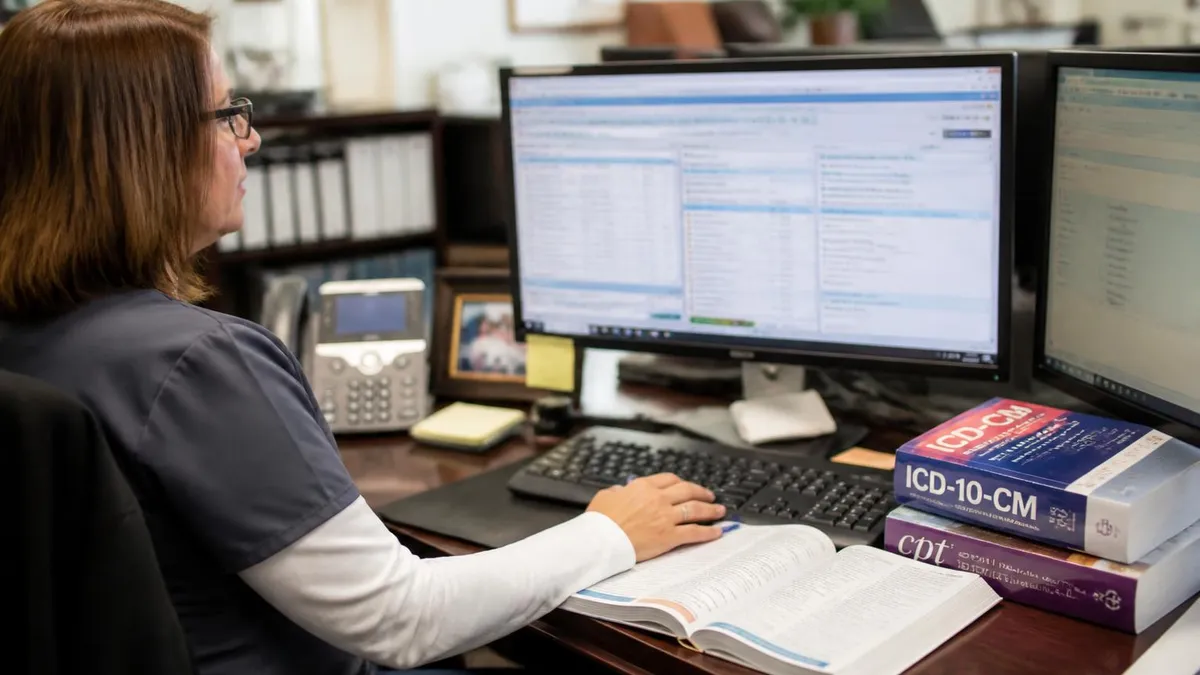
So what does a CPC do on a Tuesday morning? Walk into a typical physician office's billing department and you'll find coders sitting in front of two screens. One displays the electronic health record — progress notes, operative reports, lab results, imaging interpretations. The other has the coding software, which might be 3M, EncoderPro, TruCode, or something built into the EHR.
The coder reads each encounter, pulls out the diagnoses the provider documented, and assigns ICD-10-CM codes for those conditions. Then they look at what the provider actually did — the exam, the procedures, the counseling time — and assign CPT codes for the services. If supplies, drugs, or durable equipment were used, HCPCS Level II codes get tacked on.
It's not just transcription. A good CPC catches missing documentation. They flag the note where the doctor wrote "diabetes" without specifying type or complications. They query the provider when the operative report doesn't quite support the procedure code being billed. They know which modifiers turn a denied claim into a paid one. They keep the practice compliant with payer rules, Medicare's National Correct Coding Initiative edits, and the always-changing landscape of bundling and unbundling. The job is part puzzle, part detective work, part diplomat with busy providers who'd rather see patients than answer documentation questions.
Workflow varies by setting. A solo family practice might have a single coder handling everything from preventive visits to minor procedures. A large multi-specialty group typically has coders assigned by specialty — one team handles dermatology, another handles cardiology, a third covers orthopedics. Big billing companies divide work by provider, by chart type, or by payer. Productivity expectations differ too. Most outpatient CPCs handle somewhere between 80 and 200 charts a day depending on complexity. Quality matters as much as quantity — most employers track accuracy through monthly audits and flag coders whose error rate climbs above 5%.
The Three Code Sets You'll Master
The diagnosis code set. You'll assign codes for every condition the provider documents — from acute illnesses to chronic conditions to symptoms and signs. About 70,000 codes in the current version.
The service and procedure code set, maintained by the AMA. Covers everything from a 15-minute office visit to a complex surgical procedure. Roughly 10,000 codes.
Codes for supplies, drugs, durable medical equipment, and certain services not in CPT. Think injections, ambulance trips, prosthetics, and Medicare-specific services.
Two-character codes appended to CPT or HCPCS codes to add detail — a procedure performed bilaterally, a service that was discontinued, a separately identifiable evaluation and management visit.

Now to the exam itself, because that's where most candidates spend their nervous energy. The CPC exam is 100 multiple-choice questions. You get four hours to finish. There's no proctor over your shoulder reading body language, but if you take it at a testing center the room is monitored. The exam is open book — and that's not a typo.
You're allowed to bring approved code books with you: the AMA's CPT Professional edition, an ICD-10-CM manual, and an HCPCS Level II manual. You can write notes, tab pages, and highlight to your heart's content before exam day. What you can't bring is electronic devices, encoders, or anything pre-printed beyond the standard publisher content.
The 100 questions break out across 17 knowledge areas. Surgical procedures by body system make up a big chunk — integumentary, musculoskeletal, cardiovascular, digestive, you name it. Then there's anesthesia, radiology, pathology and lab, evaluation and management, medicine, anatomy and physiology, medical terminology, ICD-10-CM guidelines, HCPCS, coding guidelines, compliance and regulatory, and a section on practice management.
Some questions are short and direct. Others give you an operative report or progress note and ask you to identify the correct code or codes. Those operative-note questions are where the time pressure shows up — reading carefully takes minutes, and you've only got about 2.4 minutes per question on average.
CPC Exam Details at a Glance
100 multiple-choice questions, four-hour time limit, single sitting. Open book — bring your CPT, ICD-10-CM, and HCPCS Level II manuals. No electronics, no encoders, no pre-printed cheat sheets beyond publisher content. Available at AAPC testing centers, partner Pearson VUE sites, and as an online proctored exam from home.
About that open-book rule — it sounds like a gift, and partly it is, but don't get cocky. The exam is built knowing you have the books. The questions are designed so that if you can't find the right code section quickly, you'll run out of time. Candidates who try to look up every single answer fresh during the exam almost always fail on time.
The coders who pass treat the books as a backup, not a primary source. They've memorized which sections are in which manual, they've tabbed the high-yield guideline pages, and they've worked through enough practice cases that the coding patterns feel familiar.
Eligibility is more relaxed than you might expect. AAPC doesn't require a college degree to sit for the CPC. They don't require a specific number of training hours. They don't require you to have worked in a medical office. Officially, anyone willing to pay the fee and show up can take the exam. That said, AAPC strongly recommends two years of professional coding experience or completion of an AAPC-approved coding course before testing. The recommendation isn't legally binding, but the pass rates back it up — candidates who walk in without preparation rarely walk out with passing scores.
You can take the CPC at a physical testing site or remotely. AAPC partners with Pearson VUE for in-person delivery, and remote proctored options let you test from home with a webcam and lockdown software. Most candidates find the in-person experience less stressful — a quiet room, a desk built for spreading out three code books, and no risk of internet drops mid-exam. If you choose remote, do a system check days ahead, clear your desk, and warn the household that you'll need four uninterrupted hours.
If you pass the CPC exam without two years of documented coding experience, AAPC awards you the CPC-A — Apprentice — credential. You can work as a coder, but the A flag tells employers you're new. To remove it, submit two letters of recommendation plus proof of two years of full-time coding experience (or one year of experience plus 80 hours of completed coursework). Many newcomers earn the CPC-A first, land an entry-level job, and shed the A within 18–24 months.
How long does it take to prep? That depends entirely on your starting point. Someone with a clinical background — a medical assistant, nurse, billing clerk, or scribe — already knows medical terminology and basic anatomy. They might be ready in three to four months of focused study. A career-changer with no healthcare exposure typically needs six to nine months, sometimes longer. AAPC's flagship prep program runs 16 weeks for the standard pace and 32 weeks for the extended version, and a lot of students stretch even those out to fit work and family schedules.
The good news is that you have options. AAPC offers its own coding training courses, both live online and self-paced, at price points that range from around $1,800 for the basic program to several thousand for bundled packages that include code books and exam vouchers. Community colleges run medical coding certificates that often map to CPC eligibility.
Vocational schools and online providers like Career Step, Penn Build, and CareerStep offer programs at various price points. There are also free resources — YouTube channels run by working coders, AAPC's own webinars, and forums where people share study tips. A common path: pair a structured course with a couple of practice exam books and at least one full-length timed mock exam before you sit for the real thing.
Don't skip practice exams. Seriously — this is where many candidates fall short. Reading textbook chapters builds knowledge. Working through real operative notes builds the muscle memory that lets you read fast, scan for keywords, and find the correct code in your CPT book in under a minute.
Aim for at least 300 practice questions before exam day, and complete at least two full-length timed simulations. The first time you sit down with 100 questions and a four-hour clock, you'll learn things about pacing that no study guide can teach you. That's the rehearsal. The exam itself should feel familiar by the time you walk in.
Your CPC Exam Prep Checklist
- ✓Master medical terminology and anatomy basics before touching code books — coding without anatomy is guessing.
- ✓Complete an AAPC-approved or equivalent prep course (16-week or self-paced).
- ✓Buy current-year CPT Professional, ICD-10-CM, and HCPCS Level II manuals — last year's editions won't cut it.
- ✓Tab, highlight, and annotate your books before exam day; learn where every guideline section lives.
- ✓Work through at least 300 practice questions, including full-length timed mock exams.
- ✓Join AAPC as a member to access discounted exam pricing and study resources.
- ✓Schedule the exam four to six weeks out — gives you a deadline without sprinting.
Let's talk money, because nobody trains for months without wanting to know what's on the other side. Salary numbers for CPCs vary by region, employer type, and years of experience, but the broad picture looks like this: a brand-new CPC-A landing an entry-level position typically earns $40,000 to $48,000.
Once the apprentice tag drops and you've got two or three solid years in, you're usually looking at $50,000 to $60,000. Experienced CPCs in higher cost-of-living regions, in specialty areas like surgery or interventional radiology, or in supervisory roles can clear $70,000. Remote positions sometimes pay a little less than on-site because the employer pool is larger and competition tightens.
A few factors push salaries up. Multiple certifications — say, holding a CPC plus a CPMA (Certified Professional Medical Auditor) — typically add $5,000 to $10,000. Specialty expertise matters: cardiology, orthopedics, and neurosurgery coders often command premium pay because the documentation is dense and the procedure codes are complex. Geographic location matters too. Coders in the Northeast and on the West Coast generally earn more than coders in the Southeast or Midwest. AAPC publishes an annual salary survey that's worth reading before you negotiate.
Beyond salary, the lifestyle pieces are part of why this credential has stayed popular. Remote work is genuinely common — many coding jobs are fully home-based, with productivity measured by chart volume and accuracy rather than seat time. The work is consistent year-round. Healthcare doesn't slow down for recessions the way some industries do. And once you've got the credential plus a few years of experience, switching jobs is straightforward — there's almost always demand somewhere in the country.
CPC Certification Pros and Cons
- +Most widely recognized medical coding credential in the US — opens doors at almost every outpatient employer
- +Remote work options are abundant and often available within the first year of employment
- +No college degree required to sit for the exam, making it accessible to career-changers
- +Solid salary trajectory with clear paths to specialization and higher pay
- +AAPC includes a free retake with the exam fee, lowering the risk of first-attempt failure
- −Initial training and exam costs can run $2,000–$4,000 before you earn your first paycheck
- −First-attempt pass rate hovers around 60–65% — preparation is non-negotiable
- −CPC-A apprentice tag can slow your initial job search until you build experience
- −Annual recertification requirements (CEUs and membership fees) add ongoing costs
- −Code sets update yearly — staying current is part of the job, not optional
One last thing that catches new coders off guard: the credential isn't a one-and-done. You earn the CPC, and then you have to keep it. AAPC requires 36 Continuing Education Units every two years to maintain the credential. CEUs come from AAPC-approved webinars, conferences, articles in the Healthcare Business Monthly magazine, in-house compliance training, and other approved sources. Each unit roughly equals one hour of learning. The clock starts on the day you pass the exam, and you submit your CEUs through your AAPC online account. Plus you maintain AAPC membership, which renews annually at around $205 for individual members.
It sounds like a lot until you do it for a year and realize that simply doing your job exposes you to plenty of CEU opportunities. Most employers offer in-house training that counts. AAPC chapter meetings — local in-person or virtual gatherings — typically award one or two CEUs each. The Healthcare Business Monthly magazine, included with membership, runs articles with CEU quizzes at the back. Plan ahead, log your units as you earn them, and the renewal cycle becomes a non-event rather than a scramble.
If you're sitting on the fence about whether the CPC medical credential is worth it, here's the honest summary. It's not a shortcut to wealth. It's not glamorous. But it's one of the most reliable healthcare credentials you can earn without a four-year degree, and it leads to work that's interesting, technical, often remote, and consistently in demand.
The exam is hard, the prep is real, and the apprentice phase can feel slow — but most CPCs we've talked to say they'd do it again. Map out your prep timeline, pick a study route that fits your life, and book that exam date. The path is well-worn and the destination is solid.
Below are the questions that come up most often from people researching the CPC medical certification — pulled from AAPC's published guidance, working coder forums, and the most-searched queries we see month after month. If yours isn't here, AAPC's website and the Reddit r/MedicalCoding community are both worth a look.
Sample Certified Professional Coder Practice Questions
Try these questions from our free Certified Professional Coder practice tests. The correct answer and an explanation follow each question.
How do medical coders ensure compliance with coding standards?
- A. By assigning random codes
- B. By staying updated with coding standards and regulations
- C. By selecting codes without considering regulations
- D. By tracking patient behavior
Answer: B. By staying updated with coding standards and regulations
Medical coding standards and regulations, such as those from CMS, AMA, and WHO, are frequently updated to reflect changes in medical practice, technology, and healthcare policy. Professional medical coders must continuously engage in ongoing education, training, and professional development to remain proficient and ensure their coding practices are always compliant. This vigilance prevents errors, reduces audit risks, and ensures accurate reimbursement.
A coder notices that the discharge summary is missing from the medical record 24 hours after patient discharge. What is the most appropriate action?
- A. Query the attending physician for the missing document
- B. Code from the history and physical only
- C. Delay billing indefinitely without notification
- D. Use the operative report as a substitute for the discharge summary
Answer: A. Query the attending physician for the missing document
The coder should query the attending physician to obtain the missing discharge summary before finalizing the code assignment.
An auditor finds that a coder has been assigning diagnosis codes from the patient's problem list without verifying that the physician addressed those conditions during the current encounter. This violates which coding guideline?
- A. The guideline requiring use of the most specific code available
- B. The guideline that conditions must be documented, evaluated, treated, or managed at the encounter to be coded
- C. The requirement to code to the highest level of specificity
- D. The rule about sequencing principal diagnosis first
Answer: B. The guideline that conditions must be documented, evaluated, treated, or managed at the encounter to be coded
ICD-10-CM guidelines state that additional diagnoses may be coded only if they are documented, evaluated, treated, managed, or affect patient care during the encounter.
What are ICD codes used for in medical coding?
- A. To track patient medications
- B. To classify and code diseases and conditions
- C. To schedule medical procedures
- D. To monitor patient progress
Answer: B. To classify and code diseases and conditions
ICD (International Classification of Diseases) codes are specifically designed to provide a standardized way of classifying and reporting diagnoses, symptoms, and causes of injury or disease. These codes are critical for medical record-keeping, epidemiological studies, and for justifying the medical necessity of treatments and procedures to insurance payers. They form the basis for understanding a patient's health status.
CPC Questions and Answers
About the Author

Certified Internal Auditor & Compliance Certification Expert
University of Illinois Gies College of BusinessBrian Henderson is a Certified Internal Auditor, Certified Information Systems Auditor, and Certified Fraud Examiner with an MBA from the University of Illinois. He has 19 years of internal audit and regulatory compliance experience across financial services and healthcare industries, and coaches professionals through CIA, CISA, CFE, and SOX compliance certification programs.
Join the Discussion
Connect with other students preparing for this exam. Share tips, ask questions, and get advice from people who have been there.
View discussion (8 replies)