
CPC Study Guide 2026 October: Complete Certification Prep Roadmap
Master the cpc scientific approach with this CPC study guide. 📚 Exam format, schedule, practice questions, and proven prep strategies for certification.

This CPC certification study guide takes a cpc scientific approach to preparing for the American Academy of Professional Coders exam, walking you through every topic, timing strategy, and resource you need to pass on your first attempt. Whether you are a career changer eyeing medical coding or a billing professional ready to formalize your skills, this roadmap distills hundreds of hours of preparation into a structured 12-week plan you can actually follow without burning out or skipping the foundational anatomy work that trips up so many test takers.
The Certified Professional Coder credential remains the gold standard for outpatient medical coding in the United States, recognized by hospitals, physician practices, payer organizations, and remote coding vendors across all fifty states. Earning it signals that you can accurately assign ICD-10-CM, CPT, and HCPCS Level II codes under real-world production pressure. The exam itself is a 100-question, four-hour open-book test that asks you to demonstrate code selection, modifier use, compliance awareness, and surgical coding judgment.
Before you spend a dollar on study materials, you need an honest assessment of your starting point. Test takers with prior healthcare experience, billing exposure, or a coding course already completed often need eight to ten weeks. Total beginners coming in cold should plan on sixteen to twenty weeks of disciplined study, roughly ten hours per week, with extra emphasis on anatomy, physiology, and medical terminology before touching a CPT manual. Skipping that foundation almost always shows up as a low score in the surgery section.
One reason candidates struggle is that they confuse the CPC with adjacent credentials. People searching for cpc logistics sometimes land on coding pages by mistake, and others wonder about cpc of the liver or what is cpc blood test because the acronym appears in dozens of medical and industrial contexts. For our purposes, CPC means one thing only: the AAPC Certified Professional Coder credential, focused on physician office and outpatient facility coding.
This guide is organized so each section answers a specific question. You will learn how the exam is structured, how many questions appear in each domain, what passing actually requires, which study resources offer the best return on your time, and how to build a week-by-week schedule that integrates lecture review, code-book tabbing, and timed practice. Every recommendation here is based on the current 2026 AAPC exam blueprint and feedback from coders who passed within the last twelve months.
Expect to invest between twelve hundred and twenty-five hundred dollars total when you factor in coursework, code manuals, AAPC membership, exam registration, and a quality question bank. That sounds steep until you compare it against the median certified coder salary of roughly fifty-eight thousand dollars and the fact that most employers offer ten to fifteen percent more for credentialed coders versus uncertified billing clerks. The credential pays for itself in the first few months of post-certification employment.
By the end of this study guide, you will know exactly what to study, when to study it, which mistakes to avoid, and how to walk into the testing center confident that you can finish in time. Use the table of contents on the right to jump to whichever section matches your current stage of preparation, and bookmark the practice quiz tiles so you can hammer weak domains as soon as you identify them.
CPC Study Guide by the Numbers
Key Facts at a Glance
| Item | Value | Details |
|---|---|---|
| Exam Questions | 100 | Multiple choice |
| Exam Duration | 4 hr | Open code books |
| Passing Score | 70% | On scored items |
| Exam Fee | $399 | Member rate, single attempt |

12-Week CPC Study Schedule
- ▸Memorize 200 prefixes, roots, and suffixes
- ▸Drill body system terminology with flashcards
- ▸Complete chapter quiz on terminology
- ▸Review 11 organ systems
- ▸Map common procedures to anatomical regions
- ▸Take anatomy diagnostic quiz
- ▸Read ICD-10-CM official guidelines
- ▸Tab and color-code ICD-10 manual
- ▸Practice 50 diagnosis coding questions
- ▸Drill infectious disease and neoplasm coding
- ▸Practice combination and laterality codes
- ▸Review external cause and Z codes
- ▸Learn 2025 E/M guidelines
- ▸Code 40 office visit scenarios
- ▸Master MDM grid application
- ▸Apply anesthesia modifiers and base units
- ▸Code 30 integumentary procedures
- ▸Practice global package rules
- ▸Drill fracture care coding
- ▸Code endoscopy and bronchoscopy cases
- ▸Review separate procedures
- ▸Master catheterization coding
- ▸Code colonoscopy with biopsy
- ▸Practice cardiac device codes
- ▸Apply professional vs technical modifiers
- ▸Code lab panels correctly
- ▸Drill chemotherapy administration
- ▸Memorize key modifier definitions
- ▸Drill DMEPOS and J-code scenarios
- ▸Practice modifier 25, 59, 51, 76
- ▸Review HIPAA and NCCI edits
- ▸Take first 100-question timed exam
- ▸Analyze missed questions by domain
- ▸Rework all missed questions
- ▸Take second timed mock exam
- ▸Finalize tabbing and rest before test day
Understanding the CPC exam blueprint is the single most valuable thing you can do before opening a textbook. The 2026 exam contains 100 multiple-choice questions delivered either in a live remote-proctored format from home or at an AAPC-approved testing facility. You have four hours of total testing time, and the exam is open book, meaning you may bring your current-year ICD-10-CM, CPT Professional Edition, and HCPCS Level II manuals along with handwritten tabs and highlights.
The blueprint groups questions into seventeen distinct domains, but they roll up into three big buckets that drive your study allocation. Medical concepts including anatomy, terminology, pathophysiology, and pharmacology account for roughly fifteen questions. Surgical and procedural coding from the CPT manual accounts for around sixty questions across all body systems plus radiology, pathology, and medicine. The remaining questions cover ICD-10-CM diagnosis coding, HCPCS Level II, evaluation and management, anesthesia, modifiers, compliance, and coding guidelines.
Passing requires a 70 percent score on the scored items, which translates to correctly answering at least 70 of the 100 questions. The AAPC includes a small number of unscored pretest questions you cannot identify, so treat every question as if it counts. You will receive your pass or fail result within seven to ten business days, along with a domain-level performance breakdown that highlights exactly where you fell short if you need to retest.
The current pass rate for first-time candidates hovers around 54 percent, which is sobering until you look at the data more carefully. Candidates who complete a structured course, take at least two full-length timed practice exams, and follow a written study schedule pass at rates above 80 percent. Candidates who self-study without practice exams or who attempt the test within six weeks of starting fail at much higher rates. Preparation discipline, not raw intelligence, determines outcomes.
Eligibility is straightforward at the apprentice level. Anyone can sit for the exam without prior experience, and passing without two years of on-the-job coding experience earns you the CPC-A designation. The A is removed once you submit verifiable work experience or complete the AAPC Practicode program. Many employers hire CPC-A holders directly into entry-level positions, so the apprentice status is not a barrier to launching your career.
Eligibility, fees, and accommodations vary slightly by jurisdiction, so confirm details at https://posicionamientoweb.club/cpc before you register. You will also want to verify that your state does not require additional licensure for billing roles, although the CPC itself is a national credential with no state-by-state variation in test content. Active AAPC membership at one hundred fifty dollars annually is required to register and to maintain your credential through continuing education units.
Plan to budget for one full exam attempt plus the option of a free retake if you fail. AAPC bundles the retake with the standard registration fee in most current packages, so a second chance is essentially included. Use that retake intelligently by waiting at least four weeks, focusing study on the domains where you scored lowest, and taking two more full-length practice exams before sitting again. Most candidates who fail their first attempt and prepare properly pass on attempt two.
CPC Practice Test Questions
Prepare for the CPC Certified Professional Coder Practice exam with our free practice test modules. Each quiz covers key topics to help you pass on your first try.
CPC Anatomy, Physiology & Medical Terminology
CPC Exam Questions covering Anatomy, Physiology & Medical Terminology. Master CPC Test concepts for certification prep.
CPC - Certified Professional Coder Anesthe...
Free CPC Practice Test featuring - Certified Professional Coder Anesthesia Coding and Modifiers. Improve your CPC Exam score with mock test prep.
CPC - Certified Professional Coder Complia...
CPC Mock Exam on - Certified Professional Coder Compliance and Regulatory Guidelines. CPC Study Guide questions to pass on your first try.
CPC - Certified Professional Coder CPT Sur...
CPC Test Prep for - Certified Professional Coder CPT Surgery: Integumentary System. Practice CPC Quiz questions and boost your score.
CPC - Certified Professional Coder Evaluat...
CPC Questions and Answers on - Certified Professional Coder Evaluation and Management (E/M). Free CPC practice for exam readiness.
CPC - Certified Professional Coder HCPCS L...
CPC Mock Test covering - Certified Professional Coder HCPCS Level II Codes. Online CPC Test practice with instant feedback.
CPC - Certified Professional Coder ICD-10-...
Free CPC Quiz on - Certified Professional Coder ICD-10-CM Diagnosis Coding. CPC Exam prep questions with detailed explanations.
CPC - Certified Professional Coder Radiolo...
CPC Practice Questions for - Certified Professional Coder Radiology and Pathology Coding. Build confidence for your CPC certification exam.
CPC Compliance, Regulatory & Legal Guidelines
CPC Test Online for Compliance, Regulatory & Legal Guidelines. Free practice with instant results and feedback.
CPC CPT Medicine: Cardiovascular and Speci...
CPC Study Material on CPT Medicine: Cardiovascular and Specialty Procedures. Prepare effectively with real exam-style questions.
CPC CPT Surgery: Musculoskeletal System
Free CPC Test covering CPT Surgery: Musculoskeletal System. Practice and track your CPC exam readiness.
CPC Health Information & Data Content
CPC Exam Questions covering Health Information & Data Content. Master CPC Test concepts for certification prep.
Best CPC Exam Study Materials
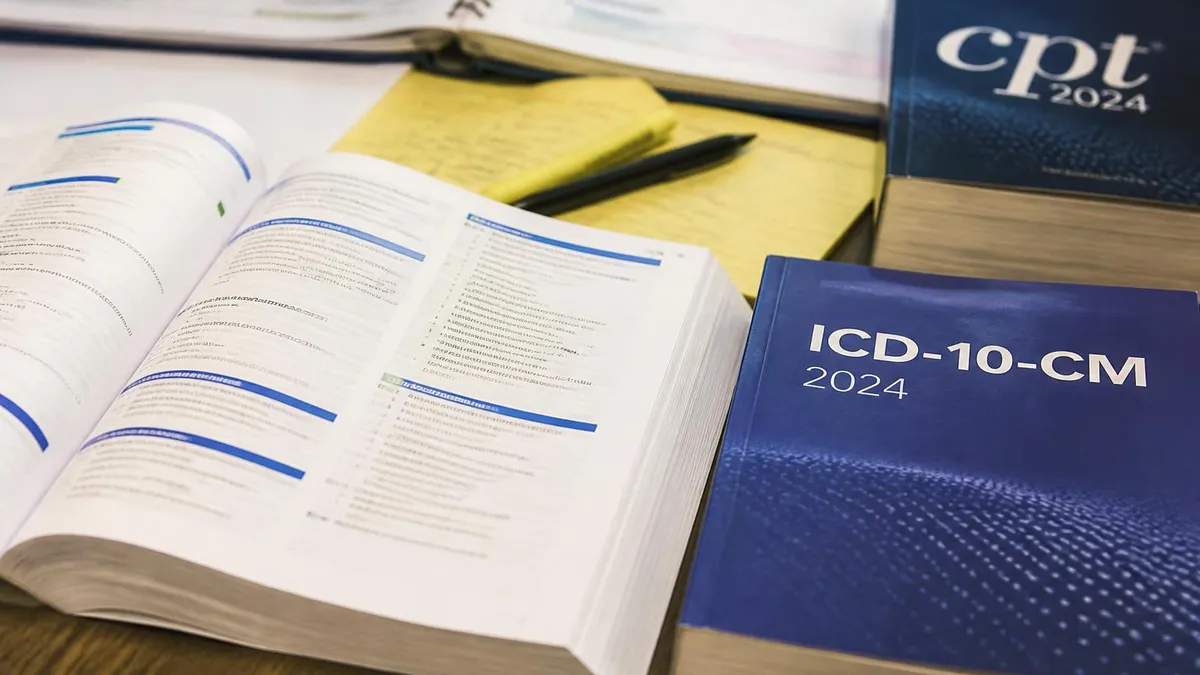
The three required reference manuals are the AMA CPT Professional Edition, the ICD-10-CM for Physicians Professional Edition, and the AAPC HCPCS Level II manual. Buy the current calendar year editions because exam content updates each January to match the new code sets. Spiral-bound versions sit flat during the exam and let you flip pages faster than perfect-bound copies, which matters when every minute counts during the open-book test.
Avoid using outdated editions even if a friend offers them free. Annual code changes routinely add, delete, and revise hundreds of codes, and a wrong answer driven by an obsolete code reference is a wasted question. Plan to spend roughly three hundred dollars on the three manuals together, and treat them as consumables that you will tab, highlight, and write inside as part of your preparation strategy.
Self-Study vs Formal CPC Course: Which Approach Fits You?
- +Lower total cost, often under $500 for materials only
- +Flexible pacing around work and family commitments
- +Choose study materials matched to your learning style
- +Skip topics you already know from healthcare experience
- +Build deeper independent research skills used on the job
- +Avoid scheduled class meetings or instructor pacing
- +Use saved budget for premium question banks and mock exams
- −No instructor to clarify confusing guideline interpretations
- −Easier to procrastinate without external deadlines
- −Risk of skipping weak areas that need the most work
- −No structured curriculum that maps to the exam blueprint
- −Limited peer support compared to cohort learning models
- −Self-assessment of readiness is harder without instructor feedback
CPC Exam Pre-Test Checklist
- ✓Confirm AAPC membership is active and exam is scheduled
- ✓Purchase current-year CPT, ICD-10-CM, and HCPCS Level II manuals
- ✓Tab and color-code each manual using AAPC-approved methods
- ✓Complete at least two full-length timed practice exams
- ✓Score 75 percent or higher on three consecutive domain quizzes
- ✓Review all missed practice questions and document patterns
- ✓Confirm government-issued photo ID matches your AAPC name
- ✓Test your home computer and webcam for remote proctoring
- ✓Prepare a quiet exam space free of papers and electronics
- ✓Get eight hours of sleep the two nights before the exam
- ✓Pack water, snacks, and approved manuals the night before
- ✓Arrive or log in 30 minutes early to handle check-in

The 20-Minute Rule for Code Lookups
During the real exam you have roughly 2 minutes and 24 seconds per question. If a single question is eating more than 4 minutes, flag it and move on. Coming back with fresh eyes after answering 20 easier questions almost always produces a faster, more confident answer than grinding through immediately.
Once you understand what is cpc credentialing at a structural level, your study strategy should shift toward domain-by-domain mastery rather than passive textbook reading. The biggest scoring opportunity sits in the surgery section because it contains roughly sixty of the one hundred questions. Spending forty percent of your total study hours on CPT surgery is not overkill, it is proportional to the test weighting and the historical pattern of where candidates lose points.
Inside the surgery section, integumentary, musculoskeletal, cardiovascular, and digestive system coding consistently produce the most missed questions. Each of these areas has its own quirks. Integumentary requires careful tracking of lesion type, size, and method of removal before you can choose between excision, destruction, or shaving codes. Musculoskeletal demands fluency with fracture care, application of casts, and the global package rules that determine whether a follow-up visit is bundled. Treat each subsystem as its own mini study unit.
Evaluation and management coding deserves dedicated attention even though it represents a smaller share of total questions. The 2021 and 2023 E/M guideline revisions overhauled how you select office visit codes, eliminating the old history and exam requirements in favor of medical decision making or time-based selection. Memorize the MDM grid, practice classifying problems addressed and data reviewed, and drill twenty office visit scenarios per week throughout your prep cycle.
Anesthesia coding intimidates many candidates but follows a tight, predictable formula. Each anesthesia code has a base unit value, you add time units in fifteen-minute increments, and you apply physical status modifiers P1 through P6 plus any qualifying circumstance add-on codes. Once you internalize the formula, anesthesia questions become some of the fastest in the exam because the calculation path is consistent. Drill thirty anesthesia scenarios over two weeks and your accuracy on this domain will spike.
HCPCS Level II covers drugs, durable medical equipment, ambulance services, and a long list of supplies that CPT does not address. The trick here is recognizing when a service requires a HCPCS code rather than a CPT code. Common test traps include chemotherapy J-codes, immunization administration, orthotics, and certain injections. Read the AAPC HCPCS introduction carefully and practice fifty HCPCS questions to build pattern recognition for when to leave the CPT manual behind.
Modifiers carry weight far beyond their question count because they appear inside other coding questions throughout the exam. Modifiers 25, 26, 50, 51, 57, 58, 59, 76, and 78 show up constantly. Memorize the definition and typical use case for each. The XE, XS, XP, and XU modifiers replace 59 in many payer contexts and the exam expects you to know when each applies. Write the most common modifiers on a single index card and review them every morning during prep.
Compliance and coding guidelines round out the blueprint. Expect questions on HIPAA privacy rules, the False Claims Act, NCCI procedure-to-procedure edits, medically unlikely edits, advance beneficiary notices, and basic fraud and abuse concepts. These questions reward common sense and careful reading more than memorization, so plan for a focused two-day review near the end of your study cycle rather than spreading it thin across twelve weeks.
AAPC permits handwritten notes and tabs in your code manuals but strictly prohibits printed or photocopied content taped or glued inside. Proctors do check, and disqualification means losing your exam fee. Use only blank adhesive tabs and write notes directly on the manual pages in your own handwriting.
Test day time management separates candidates who pass from those who run out of time at question 80. With four hours and one hundred questions, your target pace is roughly two minutes and twenty-four seconds per question. That sounds generous until you face a multi-step surgical case that requires looking up three CPT codes, a modifier, and confirming an ICD-10-CM diagnosis match. Real questions can take seven or eight minutes apiece if you are not disciplined about flagging and moving on.
Build a three-pass strategy and rehearse it during practice exams. On pass one, answer every question you can solve in under three minutes and flag anything longer. On pass two, return to the flagged questions with the remaining time and tackle them with calmer focus. On pass three, use your final twenty minutes to review flagged answers and verify any guesses. Never leave a question blank because there is no penalty for wrong answers and a one-in-four chance of correct guessing.
For surgery questions, read the operative note from bottom to top before scanning the answer choices. The CPT code description in the operative summary often matches one answer almost verbatim. Then verify the rest of the procedure narrative supports that code rather than a similar-sounding alternative. For evaluation and management questions, identify the place of service first, then the patient type, then count MDM elements or time. Following the same decision tree every time builds speed.
Your code manual tabs should be set up before exam day with a consistent color and labeling system. Use one color for ICD-10-CM chapter starts, another for CPT section starts, and a third for high-frequency modifier and guideline pages. Practice tabbing during your final two weeks so you can find any reference within fifteen seconds. Tabs that you fumble through cost more time than no tabs at all, so refine the system before exam day.
Hydration, blood sugar, and bathroom strategy matter more than candidates expect. Drink water in moderation before and during the exam but avoid downing a full bottle that triggers a restroom break at question 40. The exam clock does not stop for breaks during the live remote-proctored version, and break rules at testing centers vary. Eat a balanced meal with protein and complex carbohydrates ninety minutes before you start, and bring a small snack like nuts or a protein bar for the half-hour mark.
Mental fatigue is the silent killer at hour three. Build endurance by taking your practice exams at the same time of day you will sit for the real exam, in a quiet space, without phone or web distractions. Doing two full-length mocks at the actual four-hour length is far more useful than five short sessions because it trains your concentration to hold past the two-hour wall where most candidates start guessing.
If you finish the exam and the system confirms submission, your unofficial pass or fail result may appear immediately on screen depending on your testing format. Official scoring with domain breakdowns arrives within seven to ten business days. Whether you pass or fail, save the domain breakdown email because it becomes the roadmap for your continuing education plan or your retake study focus. A passing score also unlocks your CPC digital badge, ready to add to your resume and LinkedIn profile the same day.
The final two weeks before your CPC exam are about consolidation, not new learning. If you reach week eleven and still have entire domains you have never studied, push your exam date back rather than cramming. AAPC allows date changes for a modest fee, and one rescheduled exam is far cheaper than one failed attempt plus a retake cycle. Honest self-assessment during week ten saves you money, time, and morale damage.
Use those final two weeks for full-length timed practice exams, missed-question review, and code book tabbing refinement. Take your first mock at the start of week eleven, score it, and produce a written list of the three lowest-scoring domains. Spend three days hammering those domains with focused question drills of thirty to fifty questions per session. Then take your second mock at the start of week twelve, repeat the analysis, and use the remaining days for light review and rest.
If your career goals point toward a specific job type, align your final review with that target. Hospital outpatient coders see different case mixes than physician practice coders, and remote coders need extra fluency with EHR-driven workflows. Reviewing job descriptions and salary ranges for certified professional coder certification roles in your geographic area helps you stay motivated during the grueling final stretch and confirms which domains matter most for your first post-credential role.
Build a small support network even if you study alone. AAPC local chapters host free or low-cost study groups, and online communities on Reddit, Facebook, and Discord run daily practice question threads. Posting a confusing question and getting three different coder perspectives often clarifies a guideline faster than rereading the manual. Pay it forward by answering questions in domains where you feel strong, because teaching cements your own understanding more effectively than passive reading.
Treat the week of your exam as a taper, not a sprint. Cut study hours in half, get extra sleep, eat balanced meals, and avoid trying to learn any new content in the final 48 hours. Cramming new material at the end usually displaces well-learned material and produces worse exam-day performance. Trust your twelve weeks of preparation, do a final 30-minute review of high-frequency modifiers and guidelines the night before, and then put the books away and rest.
On exam day itself, log in or arrive thirty minutes early, complete check-in calmly, arrange your code manuals in a consistent layout, and take three deep breaths before the timer starts. You have prepared for this with discipline and structure, and you know the material. Apply your three-pass timing strategy, flag what stumps you, and trust the system you built. Most candidates who follow a structured twelve-week plan and complete at least two full-length practice exams pass on their first attempt with comfortable margin.
After you pass, your work is not done. You will need 36 continuing education units every two years to maintain the CPC credential, and AAPC offers webinars, conference attendance, and online quizzes that all count toward CEU accumulation. Many employers reimburse continuing education costs and AAPC membership renewal, so confirm those benefits during your job search. The CPC opens doors throughout your career as long as you keep the credential active and continue learning as code sets evolve each January.
Sample Certified Professional Coder Practice Questions
Try these questions from our free Certified Professional Coder practice tests. The correct answer and an explanation follow each question.
A physician performs a transthoracic echocardiogram (TTE) with Doppler and color flow mapping, complete study. Which CPT code applies?
- A. 93306
- B. 93303
- C. 93304
- D. 93308
Answer: A. 93306
CPT 93306 describes echocardiography, transthoracic, real-time with image documentation, complete, with spectral Doppler echocardiography and with color flow Doppler echocardiography.
Why is it important to verify code updates each year?
- A. To ensure reimbursement is maximized.
- B. To prevent coding errors and ensure compliance.
- C. To change the provider's credentials.
- D. To reduce patient visits.
Answer: B. To prevent coding errors and ensure compliance.
Medical codes are updated annually to reflect changes in medical practice, new technologies, and revised guidelines. Verifying these updates is essential for coding professionals to prevent errors, ensure accurate reporting of diagnoses and procedures, and maintain compliance with payer rules and federal regulations. Staying current avoids claim denials, audits, and potential penalties for incorrect coding.
The femur is located in which region of the body?
- A. Upper arm
- B. Lower leg
- C. Thigh
- D. Forearm
Answer: C. Thigh
The femur is the long bone of the thigh, extending from the hip to the knee.
Which CPT modifier indicates a procedure was performed bilaterally?
- A. -50
- B. -51
- C. -52
- D. -53
Answer: A. -50
Modifier -50 is appended to report bilateral procedures performed during the same operative session.
CPC Questions and Answers

What Is a CPC? Certified Professional Coder Guide 2026

CPC Exam Requirements by State: AAPC Certification Guide 2026

CPC Medical Coding Certification: Your Complete Guide to Becoming a Certified Professional Coder

Certified Professional Coder Jobs: CPC Career Guide 2026

CPC Study Materials: Best Resources for the Certified Professional Coder Exam
About the Author

Certified Internal Auditor & Compliance Certification Expert
University of Illinois Gies College of BusinessBrian Henderson is a Certified Internal Auditor, Certified Information Systems Auditor, and Certified Fraud Examiner with an MBA from the University of Illinois. He has 19 years of internal audit and regulatory compliance experience across financial services and healthcare industries, and coaches professionals through CIA, CISA, CFE, and SOX compliance certification programs.
Join the Discussion
Connect with other students preparing for this exam. Share tips, ask questions, and get advice from people who have been there.
View discussion (8 replies)