
CPC Certification Awarded By: Who Grants the Certified Professional Coder Credential
Learn who awards the CPC certification, how to earn it, and what steps to take. 🎓 Complete guide to the Certified Professional Coder credential by AAPC.
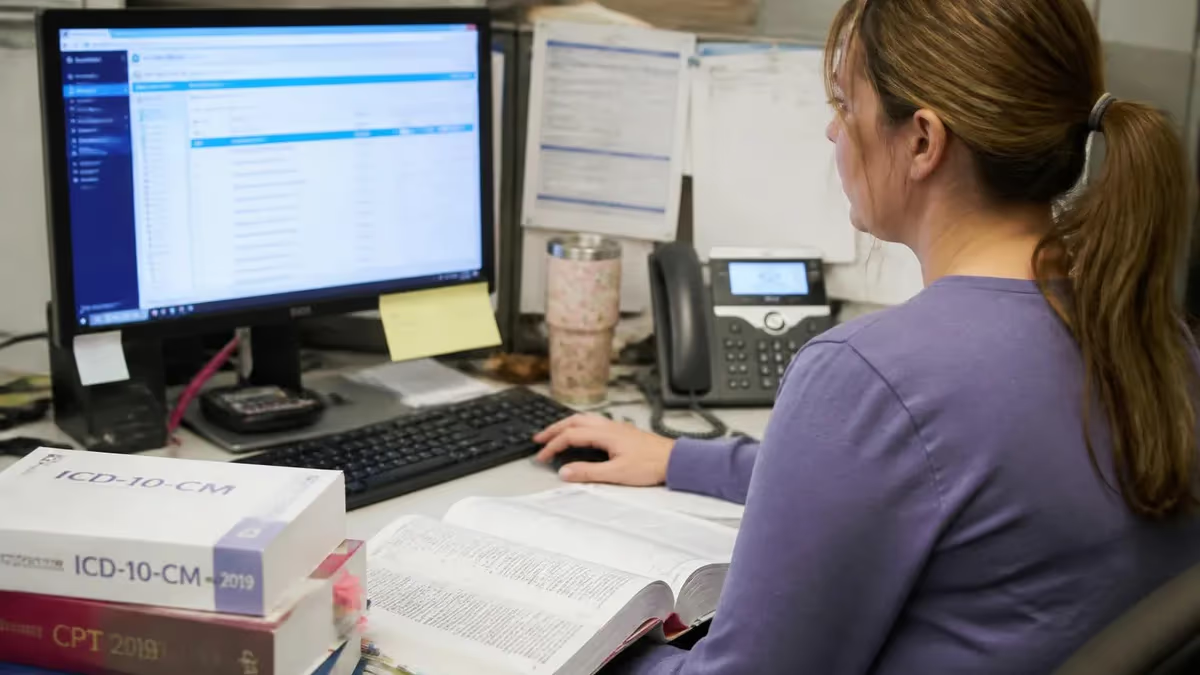
The cpc certification — one of the most recognized credentials in medical coding — is awarded by the American Academy of Professional Coders (AAPC), the world's largest medical coding and billing association. Understanding that the certification as a certified professional coder cpc is awarded by the AAPC is the essential first step for anyone pursuing a career in outpatient physician office coding. Founded in 1988 and headquartered in Salt Lake City, Utah, the AAPC has credentialed more than 200,000 active CPC holders across the United States, making it the gold standard of professional coding recognition for outpatient settings.
The AAPC designed the CPC credential to validate a coder's ability to accurately translate physician services, procedures, diagnoses, and supplies into standardized CPT, ICD-10-CM, and HCPCS Level II codes. Employers — from small physician practices to large hospital systems — treat the CPC as a reliable signal of competence, ethical conduct, and commitment to ongoing education. The credential is not simply a one-time achievement; it must be maintained through continuing education units (CEUs) every two years, ensuring that certified coders stay current with code updates, payer policies, and regulatory changes.
Many aspiring coders wonder what separates the CPC from other credentials on the market. While AHIMA offers the CCS and CCS-P, and other organizations offer their own certifications, the AAPC's CPC is specifically designed for outpatient and physician-based coding environments. It tests a broad range of competencies including anatomy, physiology, medical terminology, CPT surgical coding, evaluation and management (E/M) guidelines, anesthesia coding, radiology, pathology, medicine, and compliance. Passing the CPC exam signals mastery across all these domains, not just a narrow specialty slice.
Preparation for the CPC exam is a serious undertaking. Most candidates spend between 12 and 16 weeks studying before attempting the 150-question, five-hour and 40-minute examination. The AAPC recommends candidates complete a formal medical coding program before sitting for the exam, though it is not strictly required. Many test-takers pair their coursework with practice exams, reference guides, and study groups to build both their knowledge base and their test-taking speed. For those who want a structured path, exploring resources for certified professional coder cpc preparation is a smart early investment.
The CPC credential carries significant weight in the job market. According to AAPC salary surveys, CPC-credentialed coders earn measurably more than their non-credentialed peers, with many employers offering salary premiums of 10 to 20 percent for certified staff. Beyond salary, the CPC opens doors to positions that non-certified coders simply cannot access, particularly in compliance-sensitive environments such as federally qualified health centers, large multi-specialty practices, and healthcare systems operating under strict OIG oversight. Remote coding roles, which have expanded dramatically since 2020, almost universally require at minimum an active CPC or equivalent credential.
It is worth clarifying a common source of confusion: "CPC" appears in several unrelated contexts. In logistics and supply chain management, CPC can refer to Cost Per Click or various carrier/freight certifications. In laboratory medicine, "CPC of the liver" refers to a clinicopathologic conference discussing liver pathology cases. The "CPC blood test" is an entirely different concept in clinical diagnostics. None of these usages have any relationship to the AAPC's Certified Professional Coder designation. This article focuses exclusively on the AAPC CPC medical coding credential — the one relevant to healthcare professionals seeking to validate their coding expertise.
Whether you are a recent graduate of a health information technology program, a medical assistant looking to transition into coding, or an experienced biller seeking to formalize your skills, the CPC certification represents the most direct path to recognized professional status in outpatient medical coding. The sections below walk through exactly who awards the CPC, what the exam covers, how to apply, what it costs, and how to maintain your credential once earned — everything you need to move confidently from candidate to certified coder.
CPC Certification by the Numbers
Key Facts at a Glance
| Item | Value | Details |
|---|---|---|
| Exam Duration | 5 hr 40 min | 150 questions, open book with tabbed references |
| Minimum Passing Score | 70% | 105 out of 150 correct answers required |
| Required Every 2 Years | 36 CEUs | To maintain active CPC credential |

CPC Exam Format & Structure
| Section | Questions | Time | Weight | Notes |
|---|---|---|---|---|
| Medical Terminology & Anatomy | 10 | ~23 min | 6.7% | Body systems, directional terms, anatomical structures |
| ICD-10-CM Diagnosis Coding | 15 | ~34 min | 10% | Signs, symptoms, conditions, sequencing rules |
| CPT Surgery & Procedures | 55 | ~75 min | 36.7% | Integumentary, musculoskeletal, cardiovascular, and more |
| Evaluation & Management (E/M) | 20 | ~27 min | 13.3% | Office visits, hospital care, 2021 E/M guidelines |
| Anesthesia, Radiology, Pathology & Medicine | 25 | ~34 min | 16.7% | Includes HCPCS Level II codes and modifiers |
| Compliance & Regulatory | 25 | ~27 min | 16.7% | HIPAA, fraud and abuse, billing guidelines |
| Total | 150 | 5 hours 40 minutes | 100% |
To earn the certified professional coder credential, candidates must meet eligibility requirements set by the AAPC and successfully pass the CPC exam. The eligibility bar is intentionally accessible: there is no strict educational prerequisite requiring a college degree or a specific health information program.
However, the AAPC strongly recommends — and most successful candidates possess — either formal training in medical coding or at least two years of professional coding experience in a physician office or outpatient setting before attempting the exam. Candidates who sit for the exam without adequate preparation typically struggle with the time pressure and the depth of coding knowledge required.
The application process begins on the AAPC's official website. Candidates create an AAPC member account, select their preferred testing format (in-person at a Prometric testing center or remotely proctored online), and pay the applicable exam fee. AAPC members pay a discounted rate — typically around $300 to $399 — while non-members pay a higher fee. Many candidates choose to purchase an AAPC membership alongside their exam registration because the annual membership fee of roughly $170 more than pays for itself through the discounted exam rate, access to study resources, and the professional network the AAPC provides throughout a coder's career.
Once registered, candidates receive a confirmation and testing window. For in-person testing, exams are available at hundreds of Prometric centers nationwide, with appointments typically available within two to four weeks of registration. Remote proctored testing uses AAPC's online platform and requires a compatible computer, stable internet connection, webcam, and a private, quiet testing environment. Both delivery modes present identical exam content and time limits. Candidates should confirm their system meets all technical requirements well in advance of their scheduled exam date to avoid last-minute complications.
The CPC exam is open book, which surprises many new candidates. Test-takers are allowed to bring their own tabbed and highlighted CPT manual (current year), ICD-10-CM codebook, and HCPCS Level II reference. However, the exam is specifically designed so that simply looking up every answer is not feasible within the time limit — candidates who haven't internalized code ranges, guidelines, and sequencing rules will run out of time before completing all 150 questions.
Effective use of reference materials requires practice, and this is one reason timed practice exams are so critical to preparation. For candidates wondering about requirements beyond the exam itself, reviewing what certified professional medical coder jobs remote since yesterday typically demand can help contextualize the full credential picture.
Candidates who do not pass the CPC exam on their first attempt are not disqualified. The AAPC allows retakes, though each retake requires payment of a retake fee (typically around $150 for members). There is no mandatory waiting period between attempts, though the AAPC recommends candidates allow themselves adequate additional preparation time before retesting. The AAPC also offers a "CPC-A" (CPC Apprentice) designation for candidates who pass the exam but have not yet met the two-year experience requirement; the CPC-A converts to a full CPC once the experience threshold is satisfied and documented.
International candidates may also sit for the CPC exam, though the credential is specifically calibrated to the US healthcare system, US payer rules, and US coding guidelines. Coders working in Canada, the UK, or Australia will find that some regulatory content does not map directly to their local systems. For US-based candidates, however, the CPC is the most directly applicable outpatient coding credential available. It is recognized by virtually every major US health system, physician group, staffing agency, and remote coding company as evidence of baseline coding competence and professional accountability.
After passing the exam, the AAPC issues the official CPC credential certificate and updates the candidate's AAPC profile to reflect active certified status. This status is publicly verifiable through the AAPC's online credential verification tool, which employers routinely use to confirm that a candidate's listed credential is genuine and current. New CPCs are also recognized at AAPC chapter meetings and regional events, and many employers mark the achievement with a salary adjustment or title change to reflect the newly earned credential.
What the CPC Exam Tests: Key Content Areas
CPT surgery coding represents the largest single content area on the CPC exam, accounting for roughly 37 percent of all questions. Candidates must demonstrate proficiency across all major surgical subsections including integumentary, musculoskeletal, respiratory, cardiovascular, digestive, urinary, reproductive, nervous system, and eye and ear procedures. This means understanding how to select the correct code based on the surgical approach, the extent of the procedure, and any bundling rules that apply under the National Correct Coding Initiative (NCCI) edits.
Mastering surgery coding also requires knowing when and how to apply CPT modifiers such as -22 (increased procedural services), -51 (multiple procedures), -59 (distinct procedural service), and -62 (two surgeons). Candidates frequently miss questions by selecting anatomically correct codes but failing to apply the right modifier to reflect the clinical scenario. Timed practice with realistic surgery coding scenarios — particularly for complex wound repairs, endoscopies, and orthopedic procedures — is the most reliable method for building the speed and accuracy needed to score well in this section.

Is Pursuing the CPC Certification Worth It?
- +Awarded by AAPC, the most widely recognized medical coding credentialing body in the US
- +Opens access to higher-paying remote and in-office coding positions
- +Validates expertise across a broad range of CPT, ICD-10-CM, and HCPCS coding domains
- +Recognized by virtually every major US health system, hospital group, and staffing agency
- +CPC-credentialed coders earn 10–20% more than non-credentialed peers on average
- +Membership in AAPC's 200,000+ professional network provides ongoing career support
- −Exam fee and study materials can cost $500–$1,000+ in total upfront investment
- −Requires 36 CEUs every two years to maintain active credential status
- −The 5-hour 40-minute timed exam is demanding and stressful for many first-time candidates
- −First-time pass rate is approximately 54%, meaning nearly half of candidates must retake
- −The CPC is outpatient-focused and does not cover inpatient facility coding (CCS is better for that)
- −New candidates without coding experience earn a CPC-A rather than full CPC until experience is met
CPC Certification Prep Checklist: 10 Must-Do Steps
- ✓Register for AAPC membership to access discounted exam fees and official study materials.
- ✓Purchase or verify access to the current-year tabbed CPT manual, ICD-10-CM codebook, and HCPCS Level II reference.
- ✓Complete a structured medical coding course covering all CPC content domains before exam registration.
- ✓Review the official AAPC CPC candidate guide to understand exactly what topics will be tested.
- ✓Take at least three full-length, timed 150-question practice exams under realistic conditions.
- ✓Study the 2021 E/M guidelines in depth, focusing on medical decision making and time-based coding.
- ✓Drill CPT Surgery sections by organ system, practicing both code selection and modifier application.
- ✓Review all NCCI edits, MUEs, and common compliance scenarios covered in the regulatory section.
- ✓Join a local AAPC chapter or online study group to discuss difficult coding scenarios with peers.
- ✓Schedule your exam at least three weeks out and confirm your testing environment meets all AAPC requirements.

Open Book Does Not Mean Easy
The CPC exam allows tabbed CPT, ICD-10-CM, and HCPCS references, but candidates have only about 2 minutes and 16 seconds per question. Coders who rely on looking up every answer will not finish. Studies of repeat test-takers consistently show that speed comes from memorizing code ranges and guidelines — not from avoiding the books entirely, but from knowing exactly where to look before you open them.
The salary and career benefits of the CPC certification are among the most concrete reasons candidates invest in the credential. According to the AAPC's most recent salary survey, the median annual salary for a CPC-credentialed coder in the United States is approximately $57,000 to $68,000 depending on years of experience, geographic location, and employment setting.
Remote coders with CPC credentials and three or more years of experience often command salaries at the higher end of that range, particularly in high-cost states such as California, New York, and Massachusetts. Entry-level CPC holders typically start between $38,000 and $48,000 and see significant salary growth within their first three to five years.
The CPC is particularly valuable for professionals seeking remote work opportunities, which have proliferated across the healthcare industry since 2020. Large health information management companies such as Ciox Health, Optum, and Cognizant Health Sciences specifically list active CPC certification as a minimum requirement for remote medical coding positions. Similarly, physician practice management companies, revenue cycle management firms, and health insurance payers routinely require the CPC for their coding and auditing staff. Without the credential, candidates are often screened out at the application stage regardless of their practical experience.
Beyond base salary, many employers offer CPC holders additional compensation in the form of annual CEU reimbursement, paid membership dues, performance bonuses tied to coding accuracy rates, and opportunities for advancement into coding auditor, compliance officer, or coding educator roles. Each of these advanced positions typically pays a significant premium above standard coder salaries. Coding auditors with CPC credentials and several years of specialty coding experience frequently earn $75,000 to $90,000 or more, particularly in hospital or large multi-specialty group settings where audit findings directly impact revenue integrity.
The CPC also serves as a launching pad for specialty credentials offered by the AAPC. Once a coder holds an active CPC, they can pursue specialty certifications such as the Certified Professional Coder — Payer (CPC-P), the Certified Interventional Radiology Cardiovascular Coder (CIRCC), the Certified Surgical Services Manager (CSSM), or any of the AAPC's organ-system–specific specialty credentials. These add-on certifications further narrow a coder's expertise and typically command additional salary premiums. Many coders build a career progression plan around the CPC as a foundation, adding specialty credentials as their clinical experience deepens in a specific area of medicine.
For those interested in the entrepreneurial path, the CPC credential also supports the establishment of independent coding and auditing consulting businesses. Independent medical coding consultants with active CPC credentials can command hourly rates of $35 to $75 or more depending on specialty, complexity, and turnaround requirements. Many established physician practices, urgent care chains, and ambulatory surgery centers outsource their coding to credentialed independents rather than hiring full-time staff, creating a strong market for self-employed CPC holders who can deliver accurate, timely work product without the overhead of a full-time employee relationship.
For healthcare professionals already working in adjacent roles — medical assistants, front-desk staff, billing specialists, or clinical documentation improvement specialists — the CPC can represent a career pivot that dramatically expands earning potential without requiring a return to school for a second degree. Many of these professionals find that their existing clinical or billing knowledge gives them a meaningful head start in CPC preparation, since they already understand medical terminology, common diagnoses, and the general workflow of a physician office. Formalizing that knowledge with the CPC credential unlocks compensation and career trajectory that informal experience alone cannot provide.
The nationwide demand for certified professional coders shows no sign of abating. The US Bureau of Labor Statistics projects steady growth in health information technology occupations driven by an aging population, increased healthcare utilization, and the complexity of value-based payment models that require more precise and detailed coding than traditional fee-for-service arrangements. For any professional considering a healthcare career that combines clinical knowledge with analytical and technical skills — without requiring clinical licensure — the CPC certification represents one of the most efficient and high-return credential investments available in today's job market.
Active CPC holders must complete 36 continuing education units (CEUs) every two years and pay the AAPC's annual renewal fee to maintain their credential. Failing to meet the CEU requirement on time results in the credential being suspended and eventually revoked. Reinstating a lapsed CPC requires retesting — the same full 150-question exam. Track your CEU deadlines carefully and begin accumulating credits early in each two-year cycle rather than rushing to complete them in the final months.
Maintaining the CPC credential after you earn it requires a disciplined approach to continuing education and professional engagement. The AAPC mandates 36 CEUs over each two-year credentialing cycle, with at least one CEU in medical ethics required within every cycle.
CEUs can be earned through a wide variety of approved activities including AAPC-hosted webinars and workshops, local chapter meetings, national conference attendance, completion of AAPC online courses, passing specialty credential exams, and publishing coding-related articles in peer-reviewed or professional publications. The diversity of CEU sources makes it relatively easy to accumulate credits in ways that align with your professional development interests.
Annual AAPC membership renewal is a prerequisite to maintaining active CPC status. The membership fee (currently around $170 per year) covers access to the AAPC member portal, the official Codify coding reference platform (a significant resource for daily coding work), monthly member publications, and discounts on AAPC events and additional credential exams.
Many employers cover the annual membership fee as a standard professional development benefit for their credentialed coding staff, recognizing that the AAPC's resources directly support the accuracy and efficiency of their coding operations. If your employer does not currently offer this benefit, it is well worth raising during a performance review or benefits negotiation.
The AAPC's chapter network also plays an important role in helping CPC holders stay current. There are AAPC chapters in virtually every major US metropolitan area, and many hold monthly meetings that feature coding scenario workshops, guest speakers from local payers and compliance offices, and CEU-eligible educational sessions. Chapter involvement provides a valuable community of practice — a group of credentialed peers you can turn to for a second opinion on a difficult coding scenario, for referrals when a colleague needs a qualified coder, or simply for moral support during the stressful period leading up to a credential renewal deadline.
The AAPC also offers a structured pathway for CPC holders who want to stay ahead of annual code changes. Each October, the AAPC releases its code change webinars covering the new CPT codes, revised guidelines, and deleted codes that take effect January 1 of the following year.
Attending these sessions early ensures that CPC holders begin the new coding year with accurate knowledge rather than scrambling to catch up after errors have already appeared on claims. Payers begin processing claims under new codes on January 1 with no grace period for late learners, making proactive education essential for maintaining high coding accuracy rates.
For CPC holders who eventually want to explore online education options or courses that can count toward CEUs, understanding the landscape of approved providers is important. The AAPC maintains a list of approved CEU providers beyond its own offerings, and many community colleges, health system continuing education departments, and professional associations offer AAPC-approved coding courses.
When evaluating any course for CEU eligibility, always confirm AAPC approval before enrolling to avoid investing time and money in content that won't count toward your renewal requirement. To explore how online courses can support both initial CPC preparation and ongoing CEU accumulation, reviewing the options for cpc certification awarded by AAPC-aligned programs is a practical next step.
Specialty credentials add another dimension to the CPC maintenance landscape. When a CPC holder adds a specialty credential such as the CPMA (Certified Professional Medical Auditor) or CPCO (Certified Professional Compliance Officer), the CEU requirements for the specialty credential are typically separate from the base CPC renewal requirements, though some CEUs may be applicable to both. Managing multiple credential renewal cycles simultaneously requires careful calendar management. Many experienced CPC holders maintain a simple spreadsheet tracking their current CEU count, remaining requirement, credential expiration dates, and upcoming CEU-earning opportunities to ensure nothing falls through the cracks.
Ultimately, the CPC is not a credential you earn once and set aside — it is a living professional asset that reflects your commitment to staying current in a field where accuracy directly impacts patient care, organizational revenue, and regulatory compliance. The two-year renewal cycle, far from being a burden, is actually one of the CPC's greatest strengths: it guarantees that every active CPC holder has recently engaged with updated coding guidelines, new payer policies, and evolving compliance requirements. Employers and patients alike can trust that a coder with an active CPC credential is not operating on outdated knowledge.
Practical exam-day strategy can make or break a CPC candidate's score regardless of how thorough their preparation has been. One of the most important habits to develop during practice is time management by section. Because the CPC exam has 150 questions in 340 minutes, a strict pace of roughly 2 minutes and 16 seconds per question is required.
Experienced candidates recommend spending no more than 90 seconds on straightforward questions — terminology definitions, single-code selections, simple diagnosis coding — and banking that saved time for the complex surgery and E/M scenarios that legitimately require 3 to 4 minutes of codebook navigation and guideline review.
Effective codebook tabbing and indexing before exam day is one of the highest-use preparation activities a CPC candidate can undertake. The AAPC permits highlighting, tabbing, and written annotations in printed codebooks (but not printed notes from other sources or sticky notes on individual pages of some editions — check current rules). Many candidates invest significant time creating consistent color-coded systems: one color for important guidelines, another for commonly confused code ranges, a third for modifiers.
When exam day arrives, this investment pays back in seconds saved on every lookup — seconds that accumulate to meaningful advantages on a time-pressured 150-question test.
Practice exams should be taken under conditions that closely simulate the real exam environment. This means no music, no phone, no food breaks longer than a few minutes, and a firm time limit enforced without exception. Many candidates who study thoroughly but never simulate exam conditions experience significant performance anxiety and time management problems on test day simply because the physical and mental experience of sitting for nearly six hours of focused, high-stakes coding is unfamiliar.
Taking at least two or three full-length timed practice exams removes this unfamiliarity and allows candidates to walk into their actual exam with a sense of settled confidence about what the experience will feel like.
On exam day itself, the sequence in which you attack questions matters. Most successful CPC candidates recommend answering every question you know confidently first, marking uncertain questions for review, and returning to flagged items with remaining time. This approach ensures that you never run out of time before answering questions you know, and that your most uncertain answers benefit from any remaining time rather than consuming it from questions further down the exam. The AAPC's testing platform (both in-person and online) allows flagging and review within each section, so take full advantage of this feature.
For anatomy and medical terminology questions, which open the exam, most experienced candidates recommend moving through them quickly. If you have completed a formal coding program or worked in a clinical environment, many of these questions will be answerable from memory without codebook reference. Saving codebook time here is important because it cannot be carried between sections — you must use your time within the flow of the exam as structured. A common mistake is spending too long confirming answers you already know, which leaves insufficient time for the surgery coding scenarios that genuinely require careful codebook work.
After the exam, regardless of outcome, take time to debrief your experience. If you passed, note which sections felt hardest and ensure those areas receive attention during your CEU activities to maintain your accuracy. If you did not pass, the AAPC provides score reports that identify which content areas contributed to the shortfall, giving you a targeted roadmap for focused study before your retake attempt.
Many candidates who retake the exam after reviewing their score report and addressing specific weaknesses pass on their second attempt with a much higher degree of confidence because they are not starting over — they are building on a foundation they have already partially constructed.
The journey to becoming a certified professional coder is demanding, but it is also deeply rewarding. The CPC credential, awarded by the AAPC to those who demonstrate comprehensive knowledge of medical coding systems, guidelines, and compliance requirements, has opened professional doors for hundreds of thousands of coders across the United States.
Whether your goal is a stable in-office position at a local physician group, a fully remote career coding from home, or an independent consulting practice serving multiple clients, the CPC provides the credentialed foundation that makes those opportunities accessible. The investment in preparation is real — but so is the return.
Sample Certified Professional Coder Practice Questions
Try these questions from our free Certified Professional Coder practice tests. The correct answer and an explanation follow each question.
A 45-year-old patient undergoes open repair of a reducible umbilical hernia. Which CPT code is most appropriate?
- A. 49580
- B. 49582
- C. 49587
- D. 49585
Answer: D. 49585
CPT 49585 is used for open repair of a reducible umbilical hernia in patients older than 5 years, while 49580 is for children 5 years and younger.
A patient presents to the emergency department with an altered mental status after accidentally taking a double dose of their prescribed oxycodone. How should the ICD-10-CM codes be sequenced?
- A. Altered mental status code first, followed by the poisoning code for oxycodone.
- B. Poisoning code for oxycodone first, followed by the altered mental status code.
- C. Adverse effect code for oxycodone first, followed by the altered mental status code.
- D. A single combination code for poisoning by oxycodone with altered mental status.
Answer: B. Poisoning code for oxycodone first, followed by the altered mental status code.
For a poisoning, the ICD-10-CM guidelines state to sequence the poisoning code first (from categories T36-T50), followed by any code(s) for the manifestation(s). Since the patient took an incorrect dose, it is classified as a poisoning, not an adverse effect. The poisoning code (T40.2X1A) would be sequenced first, followed by the code for altered mental status (R41.82).
In CPT, what does the term 'separate procedure' indicate?
- A. The procedure requires a separate operative report
- B. The procedure is integral to a larger service and should not be billed when done with a related procedure
- C. The procedure must be billed with modifier -59
- D. The procedure is reimbursed at a separate rate
Answer: B. The procedure is integral to a larger service and should not be billed when done with a related procedure
A 'separate procedure' designation means the code is bundled when performed alongside a related, more complex procedure.
Which CPT code range covers intermediate wound repair?
- A. 12001-12007
- B. 12031-12057
- C. 13100-13160
- D. 11040-11047
Answer: B. 12031-12057
Intermediate wound repair codes (12031-12057) include repairs requiring layered closure of subcutaneous tissue and non-muscle fascia or contaminated wounds needing single-layer closure.
CPC Questions and Answers

CPC Study Materials: Best Resources for the Certified Professional Coder Exam

Certified Professional Coder Requirements: Everything You Need to Earn Your CPC Certification

CPC Online Courses: Best Certified Professional Coder Course Options

Certified Professional Coder Certification: CPC Exam Guide

Certified Professional Coder Practice Exam: Complete CPC Test Prep Guide
About the Author

Certified Internal Auditor & Compliance Certification Expert
University of Illinois Gies College of BusinessBrian Henderson is a Certified Internal Auditor, Certified Information Systems Auditor, and Certified Fraud Examiner with an MBA from the University of Illinois. He has 19 years of internal audit and regulatory compliance experience across financial services and healthcare industries, and coaches professionals through CIA, CISA, CFE, and SOX compliance certification programs.
Join the Discussion
Connect with other students preparing for this exam. Share tips, ask questions, and get advice from people who have been there.
View discussion (8 replies)