
State Cosmetology Boards: Contact Info & Functions 2026 October
State cosmetology board contacts and roles for GA, IL, IN, KS, LA, MD, MO, NY, SC. Phone numbers, licensing rules, and exam info. 🆕
Every working cosmetologist in the United States answers to a state cosmetology board. These agencies are the unsung referees of the beauty industry, setting the rules that decide who can hold shears, mix color, perform chemical services, or run a salon. If you have ever wondered why a license earned in Georgia does not automatically work in Illinois, the answer sits with these 50-plus regulators.
They are not all named the same way either. Some call themselves a dept of cosmetology; others sit inside a larger labor or licensing department, like South Carolina's LLR. A few states bundle barbering and cosmetology together; others split them entirely. Either way, the function is the same: protect the public from unsafe practice while keeping a fair path open for new pros to join the trade.
This guide walks through what state cosmetology boards actually do, how they differ across regions, and how to reach the ones candidates ask about most.
You will see direct contact details for the Georgia cosmetology board phone number, the Illinois state board of cosmetology, the Indiana board of cosmetology, the Kansas cosmetology state board, the Louisiana cosmetology board (LA board of cosmetology), Maryland state cosmetology board, the Missouri state cosmetology board, the New York board of cosmetology, and LLR cosmetology SC. We will also touch on Texas, California, and a handful of smaller boards so you can see how the patterns repeat.
By the end you will know who to call, what they regulate, and where to start your own application without going down the wrong rabbit hole. Whether you are a high-school graduate weighing your first cosmetology program, a working stylist planning a cross-state move, or a salon owner trying to decode an inspection notice, the framework below applies to every state in the country.
Key Facts at a Glance
| Item | Value | Details |
|---|---|---|
| Training hours required, varies by state | 700-1500 | |
| Typical written + practical exam fee range | $20-$100 | |
| License renewal cycle in most states | 1-2 yrs |
Those four numbers explain almost every question candidates have. The hour range alone is huge. New York requires 1,000 hours for a full cosmetology license. Indiana asks for 1,500. Massachusetts and South Carolina sit closer to 1,500 too. Kansas wants 1,500. Georgia accepts as few as 1,500 with strict practical performance. Renewal cycles vary the same way. Texas runs a two-year cycle. Maryland renews every two years on the licensee's birthday.
Louisiana sticks with annual renewal tied to the calendar year. Florida, by contrast, allows up to a two-year window with a CE catch-up grace period if you miss the deadline. None of this is consistent because cosmetology law is written at the state level, not federal. That is also why each board sets its own fees, its own continuing education hours, and its own list of approved schools.
Fees follow the same uneven pattern. Initial application costs typically run between $40 and $150. The exam itself adds another $50 to $150 for the written portion plus a similar fee for the practical. Renewal fees usually sit between $50 and $125. Late-renewal penalties can push that total up sharply, sometimes doubling the base cost if you miss the window. School tuition is wholly separate and varies even more, from $5,000 at a community college program to $20,000 at a private academy with brand-name product partnerships.
The shared piece is the mission. Every state cosmetology board is built around public safety. Sanitation, infection control, chemical handling, and basic salon licensing all flow from that single concern. When a state legislature creates a dept of cosmetology, the law sounds the same from one capital to another: protect consumers, set minimum competency, and discipline practitioners who break the rules. The details, though, are where things get interesting, and that is where state-by-state differences matter most to anyone planning a career or a move.
Why one license does not cross state lines
Cosmetology licenses are state-issued. If you move from New York to Georgia, the Georgia State Board of Cosmetology will look at your training hours, your exam scores, and your time in practice before granting reciprocity. Some boards grant it freely once they verify hours; others require a state-specific law and rules exam. Always call the destination state board first. Do not assume an out-of-state license transfers, even between neighbors like Maryland and Virginia.
Regional patterns matter when you study how these boards behave. The Northeast tends to run lean agencies inside larger Departments of State or Licensing, with the New York board of cosmetology operating under the New York Department of State Division of Licensing Services.
The South leans toward standalone cosmetology boards with their own websites and phone lines, like the Georgia State Board of Cosmetology and Barbers and the Louisiana State Board of Cosmetology in Baton Rouge. The Midwest runs the gamut: Illinois, Indiana, Kansas, and Missouri each take a slightly different approach. The Far West, including California and Texas, runs some of the largest regulatory bodies in the country because of sheer population.
Why does structure matter? A standalone board with its own staff usually moves faster on license issuance and complaint resolution but may have longer phone-hold times during exam season. An umbrella agency like Illinois IDFPR or South Carolina LLR offers consolidated online portals where you can manage multiple credentials but may route specific cosmetology questions through general help desks.
Standalone boards also tend to have stronger industry representation on the board itself, since members are typically active cosmetologists, salon owners, or educators appointed by the governor. Umbrella-agency boards lean more on career bureaucrats who may regulate cosmetology one day and electricians the next, which has tradeoffs for consistency and depth. The cards below summarize the structural setup region by region.
New York places cosmetology under the Department of State Division of Licensing Services in Albany. Maryland runs the Maryland State Cosmetology Board under the Department of Labor in Baltimore. Both lean on written PSI/Pearson VUE exams and require licensee renewal every 2 to 4 years.
Georgia State Board of Cosmetology and Barbers sits in Macon under the Secretary of State. The Louisiana State Board of Cosmetology operates from Baton Rouge with its own enforcement staff. South Carolina puts cosmetology inside LLR (Labor, Licensing & Regulation) in Columbia, hence LLR cosmetology SC.
Illinois sits under IDFPR in Springfield and Chicago. Indiana operates the Indiana State Board of Cosmetology and Barber Examiners through the Professional Licensing Agency in Indianapolis. Kansas runs an independent Cosmetology Board in Topeka. Missouri keeps the State Board of Cosmetology and Barber Examiners in Jefferson City.
California's Board of Barbering and Cosmetology in Sacramento regulates more than 600,000 licensees, the largest in the country. The Texas Department of Licensing and Regulation in Austin took over cosmetology rule-making in 2005 and runs digital portal-based renewals statewide.
Now look closer at the boards readers ask about most. The tabbed view below splits them by region so phone numbers and websites are easy to find. Phone numbers and addresses do change occasionally, so always verify on the official board page before submitting anything. The exam vendor for most states is PSI Services or Pearson VUE, and both run digital booking systems separate from the board itself.
A handful of states still use Continental Testing or a state-managed exam, so check before assuming your scheduled exam route applies. The fee you pay the vendor is separate from the fee you pay the board, and the two charges show up at different points in the application process. Keep both receipts; either one may be requested if a question arises.
One more practical tip before you scroll through: state board email replies typically take three to five business days during normal months and ten or more days during May and June, the busiest exam window in the country. If your question is time-sensitive, the phone line will get you a faster answer, even if you wait on hold. Online portal status pages update overnight in most states, so a missing license usually shows up by the next morning if your application was processed cleanly.
If a license has been delayed more than 30 days past your exam pass date, that is the right time to escalate by phone, not email, and ask for a supervisor to review the file. Boards expect that kind of follow-up and have internal procedures specifically for stalled applications, so do not feel awkward making the call.
New York Board of Cosmetology — operates under the NYS Department of State, Division of Licensing Services, 1 Commerce Plaza, 99 Washington Avenue, Albany, NY 12231. Main phone (518) 474-4429. The board enforces appearance enhancement licensing including cosmetology, esthetics, nail specialty, and natural hair styling. Required training: 1,000 hours for cosmetology. Exam vendor: PSI.
Maryland State Cosmetology Board — also called the md state board of cosmetology, located at the Department of Labor, 1100 N. Eutaw Street, Room 121, Baltimore, MD 21201. Phone (410) 230-6320. Required training: 1,500 hours. Renewal: every 2 years on the licensee's birth month. Maryland accepts reciprocity from most states after exam by endorsement.
Knowing the phone number is one thing; knowing what the board actually controls is more useful. State cosmetology boards do far more than print licenses. They write the rules that govern your school, set the curriculum minimums, approve the textbooks, license the instructors, and inspect salons. They also handle complaints, run disciplinary hearings, and revoke licenses when public safety is at risk. Inspections are the function consumers see least but feel most directly: a single failed inspection can shut down a salon for weeks, force retraining for staff, and trigger a public record entry that future clients can search.
Boards also operate the public license lookup tools that clients, employers, and other regulators use to verify credentials. If you have ever Googled a stylist's name and found a search result that confirms their active license number and expiration date, that data feed comes straight from the state board's registry.
Some boards now publish disciplinary action histories alongside license status, which means consumers can see warnings, suspensions, and revocations issued in the past several years. That transparency has changed how stylists handle complaints. A board record stays public for years, which is a strong incentive to resolve disputes quickly and document client interactions carefully.
On the school side, boards approve every program that wants to teach licensed cosmetology in the state. That approval covers everything from instructor qualifications and student-teacher ratios to the brand of mannequin heads used in practicals. School inspectors visit programs annually, audit student transcripts, and verify that hours are being honestly recorded. If a program loses approval, current students are usually grandfathered into a teach-out plan at another school. Every state has slightly different scope, but the core list below is consistent.
Most state cosmetology boards have eliminated walk-in service. Calls are answered between 9 a.m. and 4 p.m. local time, and the team will ask for your license number or application ID. Have it ready. For status updates, the online portal is usually faster than the phone line, especially during exam-season peaks in May, August, and December.
Now look at the practical reach of these boards. The checklist below covers the seven domains every state regulator touches in some form. If a function is missing in your state, it is usually because another agency handles it, like a state department of health for blood-borne pathogen training, or a state fire marshal for salon facility safety.
Some larger states even split duties further, with a separate sub-agency handling instructor certification or apprenticeship-route licensure. Use this list as a quick reference before contacting a board with a question, and you will skip a lot of unnecessary transfers between offices. Knowing exactly which domain your question falls into helps the staff route your call faster and gets you a real answer on the first attempt instead of a callback two days later.
- ✓Licensing of cosmetologists, estheticians, nail technicians, instructors and salon owners
- ✓Approval of cosmetology schools, curriculum hours and instructor qualifications
- ✓Administration or oversight of written theory and practical skill examinations
- ✓Salon and shop inspection programs covering sanitation and infection control
- ✓Investigation of consumer complaints and unlicensed-practice enforcement
- ✓Disciplinary action including fines, license suspension and revocation hearings
- ✓Continuing education approval and license renewal processing every 1 to 4 years
States fall into two broad camps when it comes to regulatory tone: stricter and lighter. Stricter states like Maryland, New York, and California require more hours, more documentation, and more in-person inspections. Lighter states like Florida and Arizona have moved toward online renewals, fewer mandatory CE hours, and faster reciprocity.
Several states have started experimenting with hybrid models: tougher initial licensing but lighter renewal requirements, on the theory that strong entry standards do most of the public-safety work while heavy renewal rules mostly burden mid-career pros. Other states tie license fees directly to inspection budgets, so a higher fee actually funds more frequent salon visits. There are tradeoffs on both sides. The breakdown below shows what each approach looks like for working professionals trying to decide where to base a career or open a salon.
- +Stricter boards raise the floor for sanitation, protecting clients from infection
- +Tougher inspection programs reduce the number of fly-by-night operators
- +Higher training-hour requirements give new graduates more chair time before licensing
- +Strong complaint processes give clients real recourse when something goes wrong
- +Stricter CE rules keep working pros current on chemical safety and new techniques
- −Lighter regulation lets new licensees enter the workforce faster
- −Lower renewal fees in lighter states save licensees money over a career
- −Online-first portals in lighter states cut wait times for status updates
- −Stricter states can take months to process reciprocity from other regions
- −Heavy CE requirements add cost burden for solo booth-renters and small salons
None of this means one approach is wrong. A licensee in a stricter state will defend the tougher standards because clients trust the credential. A licensee in a lighter state will defend the lower friction because it keeps the trade open to working-class entrants. Both views are reasonable, and the boards themselves shift over time as new legislation passes.
Look at recent state legislatures: more than a dozen have lowered required training hours since 2020, including New Hampshire and Tennessee, to make entry more accessible. Other states have raised inspection budgets to crack down on counterfeit nail salons that skip sanitation entirely.
The boards also work together more than people realize. Most participate in the National Interstate Council, which standardizes the written exam content outline used by roughly 30 states. That cooperation makes endorsement smoother between participating states. Reciprocity arrangements between geographically close states, like Indiana and Illinois or Maryland and Virginia, can shave weeks off the process for stylists who relocate for family or career reasons. Even so, every state holds the final say. No federal agency can override a state cosmetology board's licensing decision.
If you are preparing for any cosmetology licensing exam, the most important step after registering with your board is sitting practice questions on the topics the exam vendor actually scores. PSI and the NIC both publish content outlines that mirror the questions on test day. Sanitation and infection control, hair structure, chemistry of cosmetic services, and state law are the four areas that appear on nearly every state-specific test.
A short practice block under timed conditions is the single best way to find out where you stand before exam day. Free attempts are the cheapest insurance policy in the entire licensing process. They also let you spot the question types that consistently trip you up, which is the data you need to focus your remaining study time.
One last note on contacting your board. If you are calling about a missing license, a delayed exam result, or a disciplinary letter, send a written follow-up through the board's portal or by certified mail. Verbal answers are not always entered into the case file, and staff turnover is real. A documented email or portal message gives you a timestamped record if the issue ever escalates.
The same rule applies when you are transferring credentials between states. Ask the source state board to send official verification directly to the destination board rather than relying on a printed copy you carry yourself. Direct board-to-board verification is the standard for reciprocity in nearly every state, and skipping that step is the single most common reason endorsement applications get held up.
And if you are still in school or just deciding whether cosmetology is the right path, treat your state board's website as the single source of truth for school accreditation. Some private programs market themselves aggressively without holding current approval. A quick check on the board's list of approved schools can save you thousands of dollars and many wasted hours.
The same is true for instructor licenses: only an instructor with a current license issued by your state board can legally sign off on your training hours. If you suspect your program is operating outside the rules, the board's complaint line is the right first call. Boards take school-related complaints seriously because they directly affect the credibility of every credential they issue.
The frequently asked questions below cover the rest of the issues candidates raise most often when they contact a state cosmetology board for the first time, from license renewals to reciprocity to school selection to the specifics of contacting any of the boards we covered above. If you do not see your question listed, the official board website always carries the most current version of the rule, and the phone numbers above will connect you to a staff member who can walk you through the steps.
Sample Cosmetology Practice Questions
Try these questions from our free Cosmetology practice tests. The correct answer and an explanation follow each question.
Which government body issues cosmetology licenses and regulates the practice of cosmetology in each US state?
- A. Federal Trade Commission (FTC)
- B. State board of cosmetology
- C. OSHA
- D. Department of Education
Answer: B. State board of cosmetology
Each state has its own board of cosmetology (or similar regulatory body) that establishes licensing requirements, sets standards of practice, and enforces cosmetology laws within that state.
What must a salon post visibly on its premises according to most state board regulations?
- A. A menu of all available services and prices
- B. Valid cosmetology licenses for all practicing staff
- C. The salon owner's business plan
- D. Customer reviews and ratings
Answer: B. Valid cosmetology licenses for all practicing staff
Most state boards require that all cosmetology licenses (for both the salon establishment and individual practitioners) be posted in a visible location within the salon.
Practicing cosmetology without a valid license is considered:
- A. A minor infraction with no consequences
- B. Illegal and can result in fines and penalties
- C. Acceptable with a student permit only
- D. Legal if supervised by a licensed professional
Answer: B. Illegal and can result in fines and penalties
In all US states, practicing cosmetology without a valid license is illegal and can result in fines, cease-and-desist orders, and other legal penalties.
Which disinfection method is NOT acceptable for salon implements in most US state board regulations?
- A. Immersion in EPA-registered disinfectant
- B. UV sanitizing cabinet for disinfection
- C. Autoclave sterilization
- D. Barbicide solution
Answer: B. UV sanitizing cabinet for disinfection
UV sanitizing cabinets maintain cleanliness and reduce surface contamination but do not meet the standard for disinfection, so most state boards do not accept UV cabinets as a disinfection method.
COSMETOLOGY Questions and Answers
About the Author
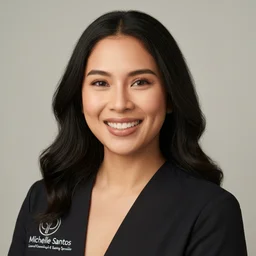
Licensed Cosmetologist & Beauty Licensing Exam Specialist
Paul Mitchell SchoolsMichelle Santos is a licensed cosmetologist with a Bachelor of Science in Esthetics and Salon Management from Paul Mitchell School. She has 16 years of salon industry experience and 8 years preparing students for state cosmetology board exams in theory, practical skills, and sanitation. She specializes in licensure preparation for cosmetologists, estheticians, and nail technicians.