
COA Practice Questions 2026 October: Complete Study Guide for Certified Ophthalmic Assistant Exam Prep
Master COA practical questions with our free study guide. 500+ practice questions, exam tips & schedules. Start your prep today! 📝
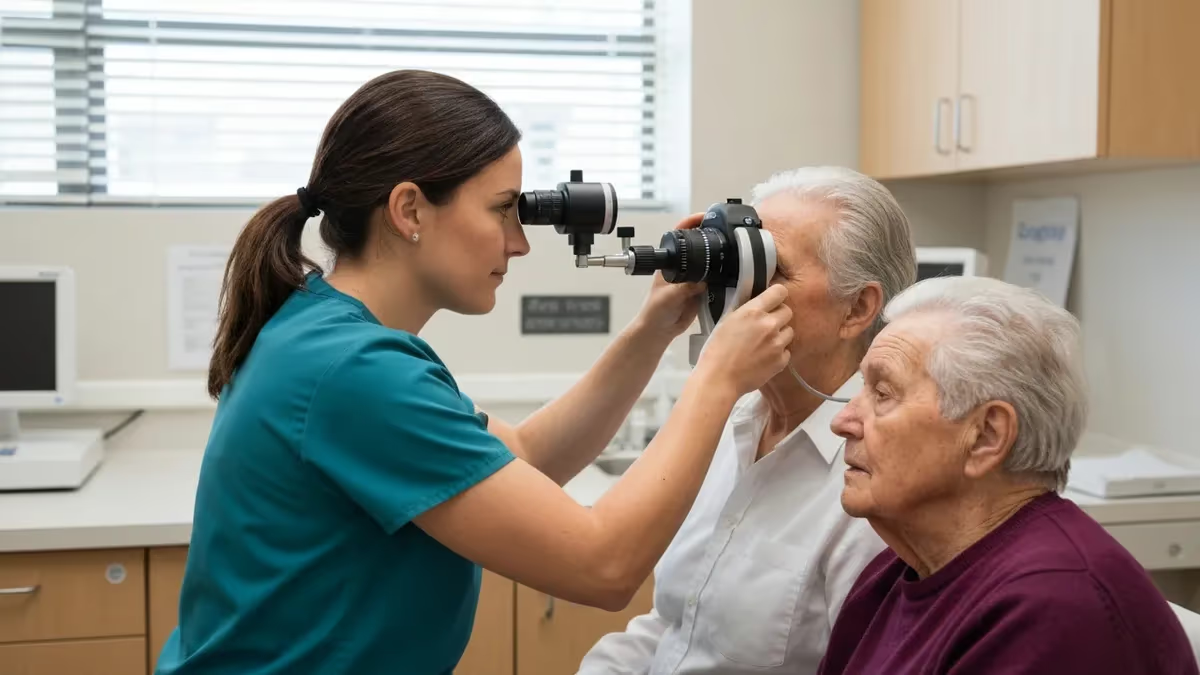
If you are preparing for the Certified Ophthalmic Assistant exam, working through targeted COA practical questions is the single most effective strategy you can adopt. The Joint Commission on Allied Health Personnel in Ophthalmology (JCAHPO) administers the COA credential, which validates your competency across clinical skills, patient care, and ophthalmic science. Whether you are a brand-new ophthalmic technician stepping into a structured study plan or a seasoned assistant refreshing your knowledge, understanding which question types appear most frequently on the exam gives you a measurable edge over candidates who rely on textbooks alone.
The COA exam covers a broad range of domains, from visual acuity testing and tonometry to contact lens fundamentals and patient history documentation. Each domain carries a different percentage weight, meaning some topic areas demand more of your study time than others. Candidates who practice with domain-specific questions consistently outperform those who study passively. Research from allied health credentialing bodies shows that active recall through practice testing can improve retention by up to 50 percent compared to re-reading, making practice questions your most powerful prep tool available.
One area that confuses many first-time candidates is the breadth of terminology they encounter. Terms like acetyl-coa and coenzyme a acetyl coa appear in biochemistry contexts, while abbreviations like COA meaning in ophthalmology refers specifically to the Certified Ophthalmic Assistant designation. Understanding these distinctions early prevents wasted study time and helps you approach the correct body of knowledge. Our coa practice questions resource library is organized by domain so you always know which clinical skill area you are drilling at any given moment.
The exam consists of 200 questions, of which 170 are scored and 30 are unscored pretest items. You will not know which questions are being evaluated, so treat every item with the same level of seriousness. The time limit is three hours, giving you approximately 54 seconds per question. Candidates who have practiced under timed conditions routinely report feeling far more comfortable during the actual exam because they have already trained their pacing instincts through repeated simulation of real testing conditions.
Ophthalmic assistants who earn the COA credential are recognized professionals across eye care practices, hospital ophthalmology departments, and ambulatory surgical centers throughout the United States. The credential signals to employers that you meet a nationally validated standard of clinical competency. Many practices actively prefer COA-credentialed candidates for roles involving direct patient interaction, instrument operation, and pre-examination workup. A strong foundation built through consistent practice with COA exam-style questions is what converts study effort into a passing score and, ultimately, career advancement.
This comprehensive study guide walks you through everything you need to know: the exam format, the highest-yield topic areas, proven study strategies, a week-by-week schedule, and direct access to free practice quizzes. Whether you have six months to prepare or six weeks, the structured approach outlined here will help you allocate your time efficiently. Every section below is designed to bring you one step closer to confidently walking into your exam center and earning the COA credential that validates your expertise as an ophthalmic assistant.
COA Certification by the Numbers
Key Facts at a Glance
| Item | Value | Details |
|---|---|---|
| Scored Exam Questions | 170 | Out of 200 total |
| Exam Time Limit | 3 hrs | ~54 sec per question |
| Approximate Passing Score | 75% | Subject to standard setting |
| Clinical Content Domains | 8 | Weighted by importance |
| Credential Renewal Cycle | 3 yrs | Continuing education required |
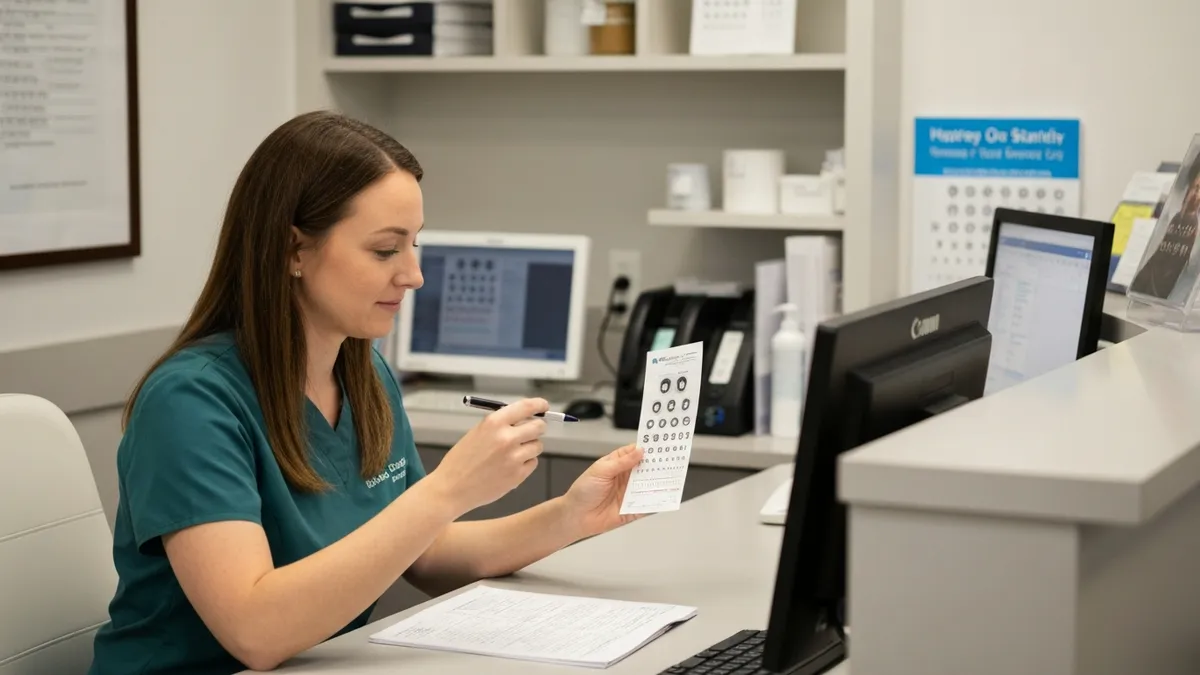
COA Exam Study Schedule
- ▸Download JCAHPO COA exam content outline
- ▸Complete a baseline diagnostic practice test
- ▸Review visual acuity protocols and Snellen chart use
- ▸Study refraction basics and lensometry concepts
- ▸Learn Goldmann applanation and non-contact tonometry technique
- ▸Practice 20 tonometry and glaucoma questions daily
- ▸Review optic nerve anatomy and glaucoma risk factors
- ▸Study normal vs. elevated IOP ranges and clinical significance
- ▸Drill patient history documentation question sets
- ▸Study cover test and alternate cover test techniques
- ▸Review common strabismus types and their clinical presentations
- ▸Practice charting abbreviations and SOAP note structure
- ▸Complete contact lens fundamentals practice quizzes
- ▸Study ophthalmic pharmacology drug classes and indications
- ▸Review basic optics: vergence, prism, and lens power
- ▸Take a full-length timed practice exam and score by domain
- ▸Identify bottom two domains from week 4 practice exam
- ▸Focus 60% of study time on weakest content areas
- ▸Complete two additional full-length timed practice tests
- ▸Review all incorrect answers with explanation resources
- ▸Light review of notes and high-yield flash cards only
- ▸Confirm exam appointment time, location, and required ID
- ▸Practice relaxation and focus techniques the night before
- ▸Get a full 8 hours of sleep before exam day
Understanding which content areas carry the most weight on the COA exam is the foundation of an efficient study plan. JCAHPO publishes a detailed content outline that breaks the exam into eight primary domains: history taking and patient communication, visual assessment, ocular motility and alignment, tonometry, optics and refraction, contact lenses, ophthalmic pharmacology, and general medical knowledge. Among these, visual assessment and optics together account for the largest proportion of scored items, making them non-negotiable study priorities for every candidate regardless of clinical background.
Visual assessment questions on the COA exam test your ability to measure and record visual acuity at distance and near, interpret pinhole acuity results, perform color vision screening with tools like the Ishihara plates, and administer visual field tests including confrontation fields and Amsler grid testing.
Candidates frequently underestimate the depth of knowledge required here. You need to understand not just how to administer these tests but why each test is performed, what abnormal results indicate, and which conditions they help diagnose. Practice questions that ask you to interpret results are more valuable than those that merely ask you to name the test.
Tonometry and glaucoma represent another high-yield domain that requires both procedural knowledge and clinical reasoning. You should be comfortable explaining the difference between Goldmann applanation tonometry, non-contact tonometry, and Schiotz tonometry, as well as knowing when each method is preferred clinically. Glaucoma-related questions often probe your understanding of the relationship between intraocular pressure, optic nerve damage, and visual field loss. Practice with scenario-based questions that present a patient case and ask you to identify the appropriate next step in management or diagnostic workup.
Ocular motility and alignment is a domain where many candidates lose points due to insufficient preparation. The COA exam tests your ability to perform and interpret the cover test, alternate cover test, Hirschberg corneal light reflex test, and versions and ductions assessments. You also need to understand the six extraocular muscles, their innervations, and the clinical patterns of weakness associated with cranial nerve palsies. Strabismus terminology — esotropia, exotropia, hypertropia, hypotropia — must be second nature. Working through dedicated ocular motility practice quizzes is the best way to internalize this material before exam day.
Patient history and documentation questions are often straightforward but easy to rush through incorrectly under time pressure. These items test your knowledge of chief complaint documentation, past ocular and medical history, medication reconciliation, allergy documentation, and the correct use of abbreviations in ophthalmic charting. Pay close attention to questions involving HIPAA compliance, informed consent, and appropriate scope of practice for a COA versus a COT or ophthalmologist. These legal and ethical items appear on every exam administration and are frequently missed by candidates who focus exclusively on clinical technique.
Contact lens fundamentals deserve dedicated study sessions because the topic spans multiple sub-domains: lens design, fitting principles, patient instruction, care and handling, and complications. Questions may ask you to identify the base curve, diameter, and power of a soft lens prescription, recognize signs of contact lens-related complications like giant papillary conjunctivitis or microbial keratitis, or explain the proper insertion and removal technique to a new lens wearer. Many of these items are application-level questions rather than pure recall, so practicing with scenario-based question sets is essential for contact lens content mastery.
Ophthalmic pharmacology rounds out the high-yield domain list. You need to know the major drug classes used in eye care — mydriatics, cycloplegics, miotics, beta-blockers, prostaglandin analogs, antihistamines, antibiotics, antivirals, and corticosteroids — along with their mechanisms of action, indications, contraindications, and common side effects. Pharmacology questions on the COA exam are frequently paired with patient scenarios, asking you to identify which medication class is most appropriate for a given condition or to recognize a side effect profile. Building a structured pharmacology reference sheet early in your study plan pays dividends throughout your preparation.
COA Meaning: Exam Question Strategies by Domain
Visual assessment questions on the COA exam are best approached by reading every answer choice carefully before selecting one. Many items present subtle differences between options — for example, distinguishing between 20/40 corrected acuity and 20/40 uncorrected acuity. When you encounter a scenario-based visual assessment question, identify what the examiner is truly asking: is it the technique, the interpretation, or the appropriate clinical response? Anchor your reasoning to standard clinical protocols rather than individual practice habits you may have developed on the job.
A common pitfall in this domain is confusing pinhole acuity with best-corrected visual acuity. Pinhole testing eliminates refractive error as a variable, so improvement through the pinhole suggests a refractive cause for reduced vision rather than a pathological one. Exam questions often hinge on this distinction. Practice with at least 30 visual assessment questions before your exam, focusing specifically on result interpretation items. If you score below 70 percent on your practice sets, allocate an additional two to three hours reviewing the visual acuity protocols outlined in the JCAHPO study guide.
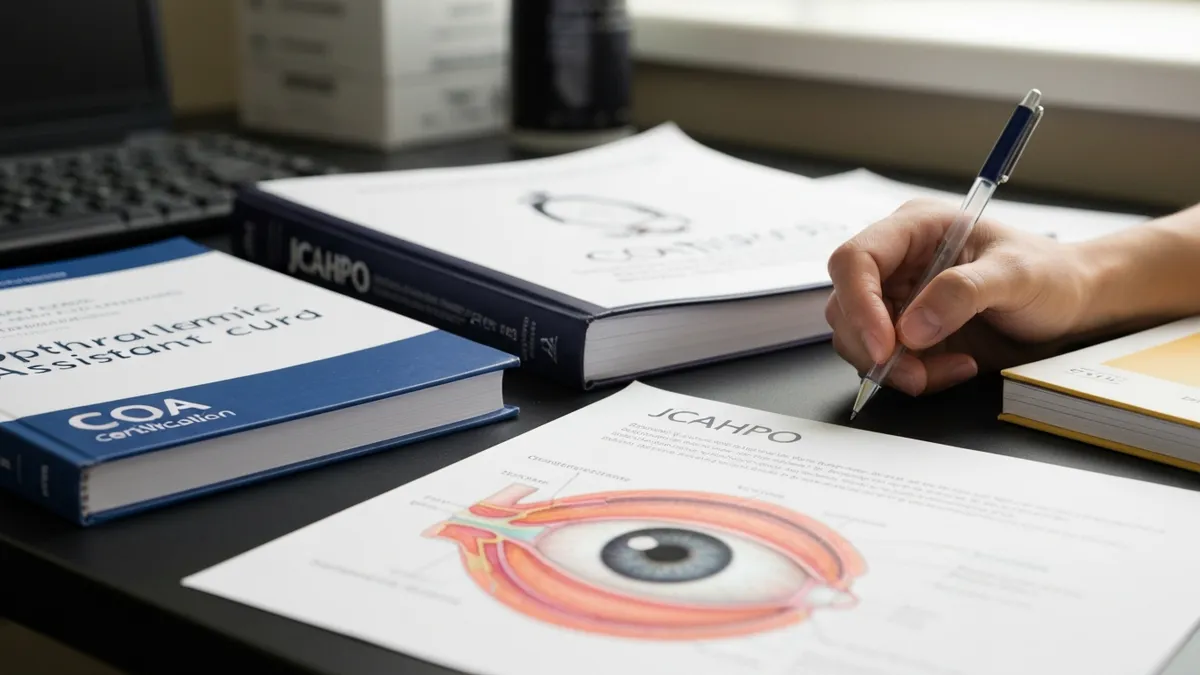
COA Practice Questions: Timed Exams vs. Untimed Study Sets
- +Timed practice exams simulate real test-day conditions and reduce anxiety
- +Pacing drills train you to spend approximately 54 seconds per question
- +Full-length timed tests reveal endurance weaknesses early in your prep
- +Scoring by domain identifies your strongest and weakest content areas
- +Repeated timed exposure builds automaticity in recognizing question patterns
- +Test-day surprises are minimized when you have rehearsed the full format
- −Timed sets can feel discouraging early in prep when accuracy is still low
- −Time pressure may prevent deep learning from incorrect answers mid-set
- −Untimed study sets allow more careful reading of explanations per question
- −Mixing untimed and timed practice without a plan can create inconsistent results
- −Some candidates over-rely on timed tests and skip domain-specific deep dives
- −Short untimed sets may be better suited for learning new material in early weeks
COA Exam Prep Checklist: 10 Steps to a Passing Score
- ✓Download the official JCAHPO COA content outline and highlight every domain weight percentage.
- ✓Take a full-length baseline practice test in the first week to identify your starting knowledge level.
- ✓Build a study schedule that allocates more time to domains with higher exam weight.
- ✓Complete at least 300 COA practical questions across all eight content domains before exam day.
- ✓Review every incorrect answer with a written explanation — do not just mark and move on.
- ✓Create a pharmacology reference sheet covering all drug classes tested in the COA exam.
- ✓Practice at least three full-length timed exams to build pacing and stamina under pressure.
- ✓Join an ophthalmic assistant study group or online forum to discuss difficult concepts with peers.
- ✓Confirm your exam eligibility, application status, and testing center details at least two weeks out.
- ✓Schedule a light review day the day before the exam and prioritize sleep over last-minute cramming.

Active Recall Beats Passive Reading Every Time
Studies consistently show that answering practice questions — even before you feel ready — accelerates learning far more than re-reading notes or textbooks. For the COA exam, candidates who complete 300 or more practice questions before test day pass at significantly higher rates than those who rely on reading alone. Start your practice questions in week one, not after you finish studying all the content.
Understanding the COA pass rate gives you important context for calibrating your preparation intensity. JCAHPO does not publicly publish granular pass rate data by year, but allied health credentialing research and candidate surveys suggest that first-time pass rates for the COA exam hover between 55 and 70 percent depending on the candidate cohort and preparation level. This means roughly one in three candidates who sit for the exam on their first attempt does not pass — a sobering statistic that underscores why structured, rigorous practice with COA exam-style questions is non-negotiable, not optional.
The most common reasons candidates fail the COA exam fall into three categories: inadequate preparation time, poor domain distribution in studying, and test anxiety that disrupts performance on exam day. Candidates who fail most often report spending the majority of their study time on content they already know well while neglecting weaker domains. This is a natural but costly tendency. The solution is to use your baseline practice test scores to drive your study plan rather than your comfort level. Study what is hard, not what feels good to review.
Score reporting for the COA exam is typically immediate — you receive a preliminary pass or fail notification at the testing center immediately after completing the exam. Official score reports from JCAHPO are delivered within a few weeks and include domain-by-domain performance breakdowns. If you pass, your COA credential is valid for three years, after which you must complete continuing education requirements to renew. If you do not pass, you can reapply after a mandatory waiting period and are permitted a limited number of retake attempts within a defined window.
The exam uses a scaled scoring system rather than a simple percentage correct. This means your raw score — the number of questions you answer correctly — is converted to a scaled score that accounts for item difficulty across different exam versions. JCAHPO sets the passing scaled score through a standard-setting process involving subject matter experts. Practically speaking, most candidates need to answer approximately 75 percent of scored items correctly to achieve a passing scaled score, though the exact threshold can vary slightly between exam forms.
Understanding what the COA credential means in practical career terms can sustain your motivation through the demanding study period. COAs are recognized by employers across the United States as having demonstrated validated clinical competency. The credential is portable — it follows you from one employer to another and from one state to another, unlike state licensure requirements that vary by jurisdiction. Many eye care employers actively list COA certification as a preferred or required qualification in their job postings, and credentialed candidates typically command higher starting salaries than non-credentialed ophthalmic assistants.
The average salary for a COA in the United States ranges from approximately $38,000 to $55,000 annually, with geographic variation playing a significant role. Metropolitan areas with high costs of living, particularly in California, New York, and the Pacific Northwest, tend to offer higher compensation. Academic medical centers and multi-subspecialty ophthalmology practices also tend to pay above the national median compared to solo-practice settings. Earning the COA credential is often the first step in a structured career progression toward the Certified Ophthalmic Technician (COT) and Certified Ophthalmic Medical Technologist (COMT) designations, which command even higher compensation.
Candidates who earn the COA credential also gain access to ongoing professional development resources through JCAHPO and affiliated ophthalmic organizations including the American Society of Ophthalmic Administrators and the American Academy of Ophthalmology. These organizations offer continuing education courses, annual conferences, and subspecialty training programs that help COAs expand their skill sets over time. The COA credential, once earned, is the foundation of a lifelong professional identity in the ophthalmic care field — and every practice question you complete today is an investment in that career trajectory.
Before scheduling your COA exam, verify that you meet JCAHPO eligibility requirements: a high school diploma or equivalent and a minimum of one year of full-time ophthalmic assisting experience within the past three years. Applications must be submitted and approved before you can book your testing appointment. Processing can take several weeks, so plan well ahead of your target exam date to avoid missing your preferred testing window.
Test-day strategy is a dimension of COA exam preparation that many candidates overlook entirely, focusing all their energy on content knowledge while neglecting the performance skills needed to execute under pressure. Arriving at the testing center well-rested and having eaten a balanced meal is not a cliche — it is documented performance science. Cognitive fatigue and hypoglycemia measurably impair working memory and processing speed, two cognitive functions heavily engaged during a 200-question standardized exam. Treat the night before your exam as part of your preparation, not as downtime.
Time management during the exam itself requires a strategy you practice in advance, not one you improvise on test day. The recommended approach for most COA candidates is the two-pass method: on the first pass, answer every question you can answer confidently within 45 seconds, flagging any question that requires extended deliberation. On the second pass, return to flagged items with your remaining time. This method ensures you never run out of time before reaching questions you could have answered easily, a costly and entirely preventable mistake.
When you encounter a question you are unsure about, use structured elimination rather than guessing randomly. Start by identifying and eliminating any answer choice that is clearly incorrect — you will typically be able to eliminate at least one or two options even on the most challenging items. This improves your odds from 25 percent to 50 percent or better on the remaining choices. Then use clinical reasoning to differentiate between surviving options. Ask yourself: which of these choices reflects best clinical practice in an ophthalmic setting with a COA-level scope of responsibility?
Reading question stems carefully is particularly important for COA exam items that include qualifiers like always, never, most likely, best, or first. These words fundamentally change the correct answer. A question asking what you would do first is asking about sequencing, not just clinical knowledge. A question asking which finding is most likely is asking about prevalence and probability, not just possibility. Train yourself to underline or mentally flag these qualifier words during practice so the habit is automatic on exam day when cognitive load is highest.
Managing test anxiety is a legitimate preparation task for many COA candidates, especially those who have been out of formal academic settings for several years. Research-backed techniques include diaphragmatic breathing practiced for five minutes before entering the testing room, cognitive reframing of anxiety symptoms as excitement rather than dread, and brief progressive muscle relaxation during the exam if permitted. Some candidates find that a short walk around the parking lot immediately before entering the testing center helps regulate arousal to an optimal performance level.
After completing the exam, resist the temptation to dissect your performance by recalling specific questions and second-guessing your answers. That cognitive energy is wasted because you cannot change your responses once submitted. Instead, focus forward: if you receive a passing score, begin planning your continuing education requirements for the three-year renewal cycle. If you need to retake, use the domain performance breakdown in your score report to build a targeted remediation plan rather than simply repeating the same general study approach that did not produce a passing score the first time.
The COA exam is genuinely achievable for any candidate who commits to structured, evidence-based preparation. The content is learnable, the question formats are predictable once you have seen enough practice items, and the clinical knowledge tested reflects skills you are already building through your daily work as an ophthalmic assistant.
What separates passing candidates from failing ones is almost never raw intelligence — it is preparation quality, practice volume, and the strategic discipline to study what is hard rather than what is comfortable. Start your practice questions today, stay consistent through your study schedule, and you will be well positioned to earn your COA credential.
Building momentum in your COA preparation requires more than just accumulating practice hours — it requires deliberate practice with intentional review. Every time you complete a set of COA practical questions, spend at least as much time reviewing your incorrect answers as you spent answering them. This review phase is where the actual learning happens. Read the full explanation for each wrong answer, identify whether you made an error due to a knowledge gap, a misread question stem, or faulty reasoning, and then target that specific weakness in your next study session.
Spaced repetition is one of the most powerful evidence-based learning strategies available for credentialing exam preparation. Rather than reviewing all your practice question mistakes once and moving on, revisit difficult items after one day, then three days, then one week. This spaced review pattern exploits the psychological spacing effect, which causes memory consolidation to be significantly stronger when material is encountered multiple times across distributed intervals rather than massed into a single intensive session. Many COA candidates find that a digital flashcard system using spaced repetition algorithms dramatically improves their retention of pharmacology, anatomy, and clinical procedure details.
Partnering with a study buddy or joining a COA exam prep group can provide accountability, motivation, and the cognitive benefit of teaching concepts to others. When you explain a clinical concept like the mechanism of a prostaglandin analog to a study partner, you consolidate your own understanding far more deeply than by reading it silently. Study groups also help you discover question types and content areas you may have overlooked in your independent study plan, particularly for the lower-frequency domains that nonetheless occasionally appear on the exam.
Practice questions organized by domain allow you to measure your competency in each content area independently. Use your domain scores to calculate the gap between your current performance and the target passing threshold for each area. Prioritize your study time in proportion to both domain weight on the exam and your current performance gap. A domain that carries 15 percent of the exam weight and where you are scoring 55 percent deserves far more of your weekly study hours than a domain that carries 8 percent of the exam weight and where you are already scoring 80 percent.
Simulation of the actual testing environment during your practice sessions improves exam-day performance beyond what content knowledge alone can deliver. When you sit for a timed full-length practice exam, do so at a desk with no phone, no food, and no music — exactly the conditions you will encounter at the Pearson VUE testing center. Take breaks only at the same points where the real exam allows them. The more your practice environment matches the real testing environment, the less cognitive bandwidth you will waste adapting to unfamiliar conditions when it actually counts.
Do not neglect the optics and refraction domain during your final preparation weeks. Many ophthalmic assistants feel less confident in this area because optical theory can feel abstract compared to the hands-on clinical procedures they perform daily. However, optics questions are highly learnable and frequently test the same core concepts: lens vergence, prism diopters, the lensometer, keratometry readings, and the relationship between sphere and cylinder power in spectacle prescriptions. Investing ten focused hours in optics review can meaningfully improve your overall score without requiring advanced mathematics — just clear conceptual understanding of the principles.
Finally, trust the process. Every COA candidate who passes the exam went through the same cycle of feeling overwhelmed, finding their footing through consistent practice, and building confidence question by question. The credential is rigorous by design because it signals to employers and patients alike that you have met a meaningful standard of clinical excellence. The effort you invest in your preparation is directly proportional to the confidence you will feel walking into your exam — and the career opportunities that will open to you once your COA credential is officially conferred.
Sample COA - Certified Ophthalmic Assistant Practice Questions
Try these questions from our free COA - Certified Ophthalmic Assistant practice tests. The correct answer and an explanation follow each question.
A Certified Ophthalmic Assistant is performing confrontation visual field testing on a patient. The assistant and patient are seated facing each other. To properly test the patient's right eye, the assistant should instruct the patient to cover their left eye and the assistant should cover their:
- A. Left eye, looking at the patient's nose
- B. Right eye, looking at the patient's right eye
- C. Left eye, looking at the patient's right eye
- D. Right eye, looking at the patient's left eye
Answer: B. Right eye, looking at the patient's right eye
Confrontation visual field testing compares the patient's peripheral vision to the examiner's. To test the patient's right eye, the patient covers their left eye. The examiner then covers their own right eye (the one directly opposite the patient's covered eye) and instructs the patient to look at the examiner's open (left) eye. This allows for a direct comparison of the temporal field of the patient's right eye and the nasal field of the examiner's left eye, and vice versa.
A 5-year-old child presents for an eye exam. The ophthalmic assistant observes that the child's right eye is deviated upwards compared to the left eye. This condition is best described as a:
- A. Right Exotropia
- B. Right Hypertropia
- C. Left Hypotropia
- D. Left Esotropia
Answer: B. Right Hypertropia
Hypertropia refers to a vertical misalignment where one eye is deviated upward relative to the other. Since the right eye is higher, it is termed a right hypertropia. Alternatively, this could be described as a left hypotropia (the left eye being lower), but Right Hypertropia is the more direct description based on the observation.
A new patient presents for a comprehensive eye exam. During the history taking, the assistant learns the patient's father has glaucoma. Where in the SOAP note or patient record should this information be primarily documented?
- A. Chief Complaint (CC)
- B. History of Present Illness (HPI)
- C. Review of Systems (ROS)
- D. Family History (FH)
Answer: D. Family History (FH)
Information about medical conditions affecting blood relatives, especially inheritable eye diseases like glaucoma, is documented in the Family History section. This helps the physician assess the patient's risk factors for developing similar conditions.
A patient calls stating they suddenly see flashes of light and a 'shower of floaters' in one eye. Which of the following is the most appropriate action for the ophthalmic assistant to take?
- A. Schedule the patient for the next available routine appointment.
- B. Advise the patient to monitor the symptoms for 24 hours and call back if they worsen.
- C. Instruct the patient to come to the clinic for an emergency evaluation immediately.
- D. Document the call and place it in the physician's message box for review at the end of the day.
Answer: C. Instruct the patient to come to the clinic for an emergency evaluation immediately.
The symptoms of sudden flashes and a shower of floaters are classic signs of a potential retinal tear or detachment, which is an ocular emergency requiring immediate evaluation and possible intervention to prevent permanent vision loss. The other options would dangerously delay necessary care.
Take the full COA - Certified Ophthalmic Assistant practice test
COA Questions and Answers

COA Roles and Responsibilities: A Complete Career Overview for Certified Ophthalmic Assistants

COA Certification Online: Complete Training Guide & Requirements for 2026

COA Meaning 2026: What Is a Certified Ophthalmic Assistant?

COA 2025 Results: Complete Guide to COA Exam Scores, Pass Rates & Next Steps

COA Practice Test PDF 2026: Free Certified Ophthalmic Assistant Exam Questions
About the Author

Educational Psychologist & Academic Test Preparation Expert
Columbia University Teachers CollegeDr. Lisa Patel holds a Doctorate in Education from Columbia University Teachers College and has spent 17 years researching standardized test design and academic assessment. She has developed preparation programs for SAT, ACT, GRE, LSAT, UCAT, and numerous professional licensing exams, helping students of all backgrounds achieve their target scores.
Join the Discussion
Connect with other students preparing for this exam. Share tips, ask questions, and get advice from people who have been there.
View discussion (7 replies)