
COA Meaning 2026 September: What Is a Certified Ophthalmic Assistant?
📚 Get ready for your COA Meaning 2026 September: What Is a Certified certification. Practice questions with step-by-step answer explanations and instant scoring.

COA Meaning: Certified Ophthalmic Assistant Explained
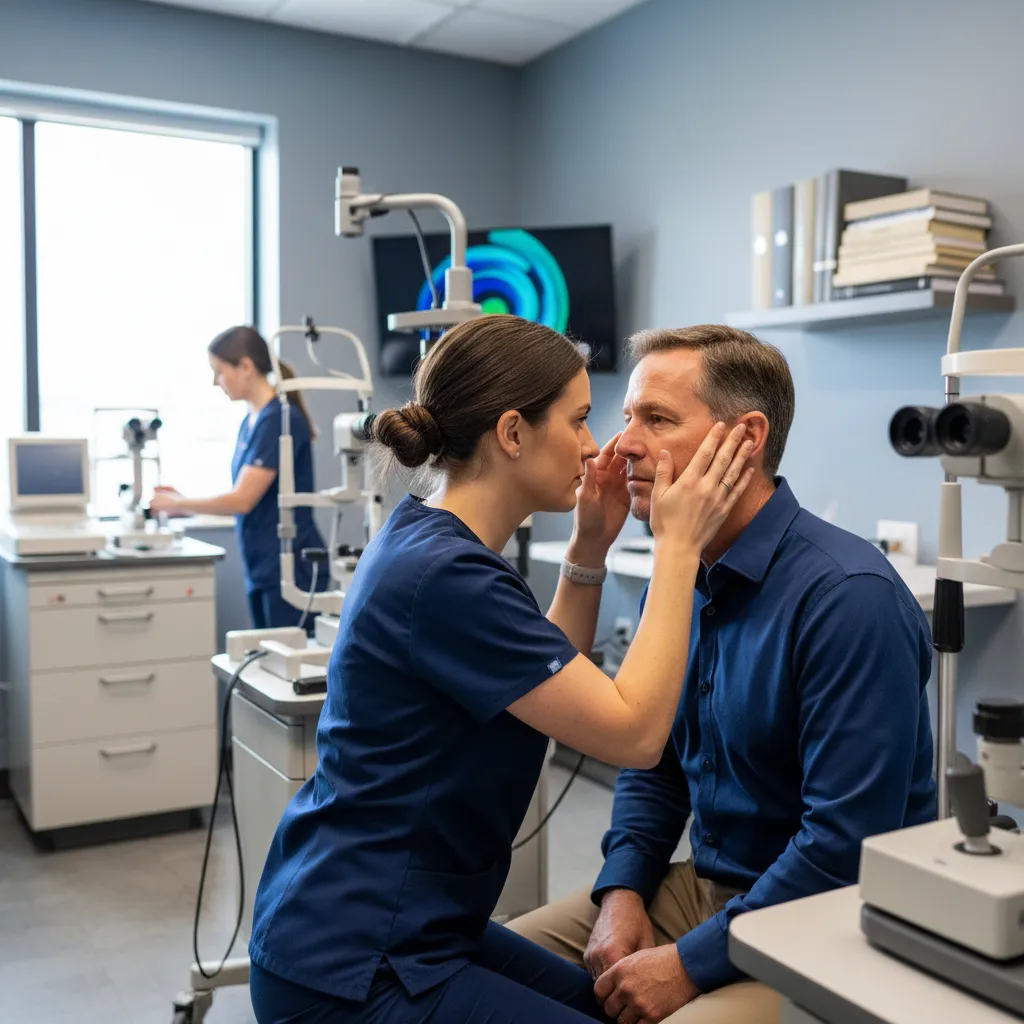
COA stands for Certified Ophthalmic Assistant — the entry-level certification in the ophthalmic technician career ladder, awarded by the Joint Commission on Allied Health Personnel in Ophthalmology (JCAHPO). A COA is a trained eye care professional who works directly alongside ophthalmologists, performing clinical tasks that free physicians to focus on diagnosis and surgery. If you've ever had your vision measured, your eye pressure checked, or drops put in before seeing an eye doctor — a COA likely handled those steps.
The credential is nationally recognized across the United States and opens doors to work in private ophthalmology practices, hospital eye clinics, surgery centers, and academic medical centers. It's one of three ophthalmic technician levels: COA at entry, coa certification → Certified Ophthalmic Technician (COT) → Certified Ophthalmic Medical Technologist (COMT). Most people start at COA and ladder up over time.
Confused because COA appears in other contexts? Fair enough — it also stands for "Certificate of Authenticity" (collectibles, memorabilia), "Chart of Accounts" (accounting), "Coenzyme A" (biochemistry), and "City of Austin" (Texas). In healthcare, though, COA means Certified Ophthalmic Assistant almost exclusively. This guide focuses on the medical credential and what it takes to earn it.
What Does a COA Do?
A COA performs the preliminary work-up before patients see the physician. The scope is broader than most people expect. On a typical day you might take a patient history, measure visual acuity with a Snellen chart, perform automated perimetry (visual field testing), check intraocular pressure with a tonometer, administer eye drops for dilation, and document findings in the electronic health record. You're the person who assembles the clinical picture the doctor reads when walking into the exam room.
COAs also assist during minor procedures — holding instruments, maintaining sterile fields, prepping surgical equipment. In busy practices you might see 20–30 patients per day, moving efficiently between exam lanes. The work is hands-on and technically precise. Poor visual acuity measurements or incorrect pressure readings directly affect clinical decisions, so accuracy matters.
The difference between a COA and a general medical assistant is specificity: COAs train exclusively in ophthalmic procedures. They understand eye anatomy, optics, refractive errors, and the instrumentation specific to eye care. A general MA cross-trained into ophthalmology is not a COA — the credential requires a dedicated examination and documented patient contact hours.

COA Exam: What to Expect
The COA examination is administered by JCAHPO at Pearson VUE testing centers. It's a 200-question, multiple-choice exam with a 3.5-hour time limit. Questions span eight content domains weighted by clinical importance — visual acuity and refractometry together account for roughly 30% of the exam. The remaining domains cover ocular motility, tonometry, contact lenses, optics, patient history, and ophthalmic medications and procedures.
The passing score is a scaled 75. JCAHPO uses a pass/fail model — you receive your result immediately on screen at the testing center, and a formal score report follows within a few weeks. If you don't pass, you can retest after a 90-day waiting period. Most candidates who study consistently for 6–8 weeks pass on the first attempt.
Preparation matters more than raw clinical hours. The exam tests theoretical knowledge and applied reasoning, not just hands-on skill. Candidates who've been working clinically for years sometimes underperform because they haven't reviewed the underlying optics and anatomy. A structured study plan using JCAHPO's content outline, combined with coa practice test questions, gives you the fastest path to a passing score.
COA Salary and Career Outlook
Certified Ophthalmic Assistants earn a median salary of $38,000–$48,000 per year in the United States. Entry-level positions in smaller markets start near $34,000; experienced COAs in large metropolitan hospitals or academic centers can earn $52,000+. The COT credential adds roughly $6,000–$12,000 to base salary, and COMT-level technologists in surgical settings can reach $65,000–$75,000.
Job growth is strong. The Bureau of Labor Statistics projects allied health positions in eye care to grow 12–15% through 2032, driven by the aging baby boomer population's rising rates of cataracts, glaucoma, and macular degeneration. Ophthalmologists are in short supply relative to patient demand — practices increasingly rely on ophthalmic technicians to expand capacity. The coa jobs market is particularly active in Sun Belt states (Florida, Arizona, Texas) and in large hospital systems expanding their ophthalmology departments.
Earning the COA credential and then pursuing the COT is the standard career ladder. The COT requires 4 years of experience (or COA + 1 year) and a harder exam, but the salary and scope of practice jump significantly. COMTs often supervise other technicians, operate advanced diagnostic equipment, and assist in surgical suites. The full journey from COA to COMT typically takes 5–8 years of active clinical work.

COA Career Details
COA (Certified Ophthalmic Assistant) — entry level. Prerequisite: 1 year clinical experience. Exam: 200 questions. Scope: preliminary patient work-up, visual acuity, tonometry, basic procedures.
COT (Certified Ophthalmic Technician) — intermediate. Prerequisite: COA + 1 year (or 4 years total). Harder exam, broader scope: slit-lamp photography, advanced refractometry, contact lens fitting, more complex surgical assist duties.
COMT (Certified Ophthalmic Medical Technologist) — advanced. Prerequisite: COT + 1 year. The highest JCAHPO technician credential. Scope includes advanced imaging, supervising junior staff, and complex surgical assistance. Salary can exceed $70K in high-demand settings.
COA vs Other Medical Abbreviations
COA is one of the most context-dependent abbreviations in professional settings. Before assuming it means Certified Ophthalmic Assistant, consider where you saw it. In finance and accounting, COA almost always means Chart of Accounts — the complete list of financial account categories a company uses for bookkeeping. In the collectibles and authentication world, COA is Certificate of Authenticity, the document that verifies a signed item's provenance. In biochemistry labs, COA is Coenzyme A, a molecule central to fatty acid metabolism and the citric acid cycle.
In Texas and municipal government contexts, COA frequently stands for City of Austin. Law enforcement uses COA as Course of Action — the sequence of steps in a tactical plan. Military and firearms communities use it similarly. You'll also see it in pharmaceutical quality control (Certificate of Analysis) and in supply chain documentation (Country of Assembly or Certificate of Approval).
The ophthalmic meaning dominates in clinical and healthcare job postings. If you see COA in a job listing at an eye clinic, it means Certified Ophthalmic Assistant. If you see it on a signed sports jersey or collectible card, it means Certificate of Authenticity. Context is everything. When in doubt, look at the surrounding industry language for clues — a job posting that mentions "slit lamp" or "JCAHPO" is unambiguously about eye care, while one mentioning "general ledger" or "QuickBooks" is about accounting.
For anyone in healthcare specifically weighing an eye care career, understanding what the COA credential represents is the first step. The ophthalmic assistant exam is the gateway to a stable, growing profession with clear advancement pathways — from COA to COT to COMT — that reward continuous learning and clinical precision.
Is COA Certification Worth It?
Yes — for anyone planning a career in eye care, COA certification is essentially required. Uncertified ophthalmic assistants exist, but they're paid less, have narrower job options, and can't advance to COT or COMT without first earning the COA. Most ophthalmology practices now list JCAHPO certification as a preferred or required qualification in job postings. The exam investment ($175–$205) pays back within the first month of employment as a certified versus uncertified assistant.
For career changers with a medical background — medical assistants, dental assistants, nursing assistants — the transition is particularly smooth. Clinical documentation, patient interaction, and basic anatomy knowledge all transfer directly. The ophthalmic-specific material (optics, tonometry, slit-lamp basics) is learnable in 6–8 weeks of focused study. The field rewards people who like detailed technical work, care about precision, and enjoy building long-term patient relationships — ophthalmology practices often see the same patients for decades.
If you're already working in an eye clinic without certification, talk to your employer about covering the exam fee. Many practices reimburse the cost as a condition of continued employment or as part of an annual education benefit. The certified ophthalmic assistant credential is a one-time investment with recurring returns throughout your career.
- ✓Confirm your exam appointment and location
- ✓Bring required identification documents
- ✓Arrive 30 minutes early to check in
- ✓Read each question carefully before answering
- ✓Flag difficult questions and return to them later
- ✓Manage your time — don't spend too long on one question
- ✓Review flagged questions before submitting


COA Pros and Cons
- +COA has a defined, publicly available content blueprint — candidates know exactly what to prepare for
- +Multiple preparation pathways (self-study, courses, coaching) accommodate different learning styles and schedules
- +A growing ecosystem of study resources means candidates at any budget level can access quality preparation materials
- +Clear score reporting allows candidates to identify specific strengths and weaknesses for targeted remediation
- +Professional recognition associated with strong performance provides tangible career and academic benefits
- −The scope of tested content requires substantial preparation time that competes with existing professional or academic commitments
- −No single resource covers the full content scope — candidates typically need multiple study tools for comprehensive preparation
- −Test anxiety and exam-day performance variability mean preparation effort does not always translate linearly to scores
- −Registration, preparation, and potential retake costs accumulate into a significant financial investment
- −Content and format can change between exam versions, making older preparation materials less reliable
About the Author

Educational Psychologist & Academic Test Preparation Expert
Columbia University Teachers CollegeDr. Lisa Patel holds a Doctorate in Education from Columbia University Teachers College and has spent 17 years researching standardized test design and academic assessment. She has developed preparation programs for SAT, ACT, GRE, LSAT, UCAT, and numerous professional licensing exams, helping students of all backgrounds achieve their target scores.
Join the Discussion
Connect with other students preparing for this exam. Share tips, ask questions, and get advice from people who have been there.
View discussion (7 replies)