
CNA Exam Eligibility: Age, Diploma and Background Rules 2026 October
Cna eligibility requirements explained — 📝 age, diploma, GED, felony rules, training hours, and state-by-state differences for 2026 October.
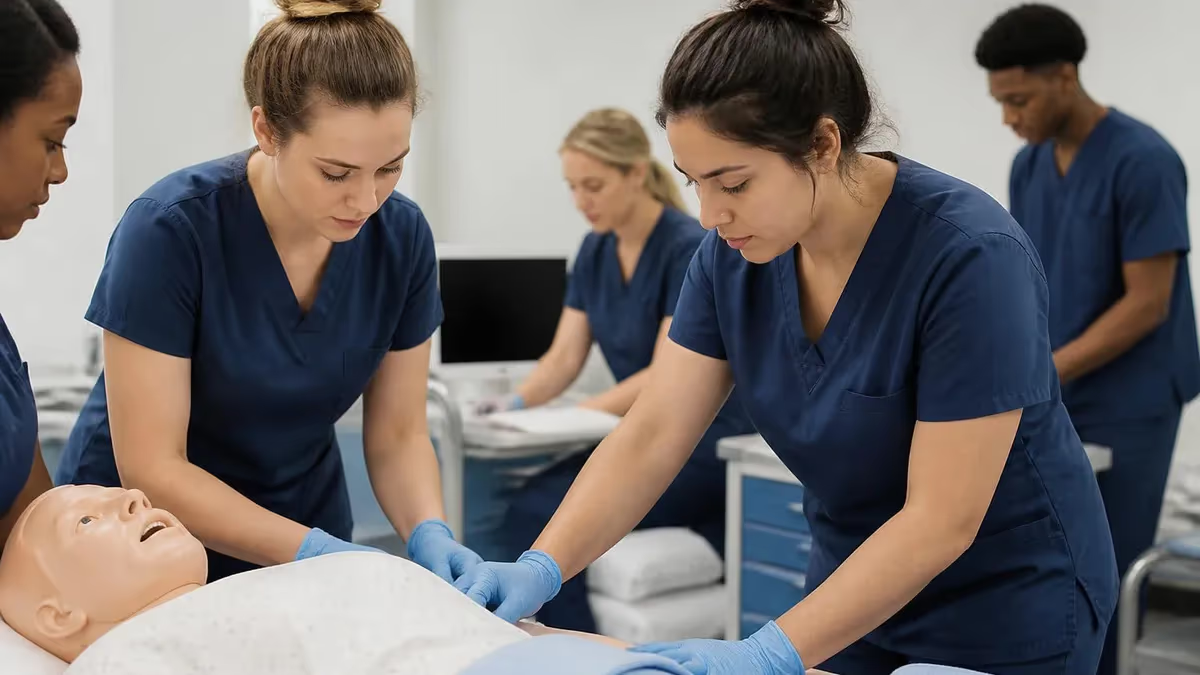
So You Want to Sit for the CNA Exam — Here’s What It Actually Takes
You don’t need a nursing degree. You don’t need a four-year plan. But you do need to hit a short list of cna eligibility requirements before a state will let you near the exam — and those rules shift a lot depending on where you live. Some states let you test at 16. Others won’t even take your fingerprints until you’re 18. A felony from a decade ago might block one applicant and barely register for another.
Here’s the short version. To sit for the CNA exam you need three things in most states: a minimum age (usually 16 or 18), proof of a state-approved training program (typically 75 to 175 hours), and a clean enough background check. That’s it. No high school diploma is required in many states — though a handful of programs ask for one. No GED either, in most cases. The big gatekeeper isn’t school. It’s the cna requirements set by your state nurse aide registry.
Quick reality check. The Nurse Aide Training and Competency Evaluation Program — NATCEP for short — sets the federal floor at 75 training hours. Roughly half the states ask for more. California wants 160. Maine wants 180. Florida lets you challenge the exam with zero formal classes if you can prove equivalent work history. New York runs 100 hours and won’t budge.
The whole process — application, training, exam scheduling, and license issue — runs about 4 to 12 weeks for most students. That’s if everything moves clean. Background snags can stretch it to six months. Failed skills sections add another testing window. Want the full timing breakdown? Check our guide on cna classes for state-by-state program lengths.
This guide covers every gate you have to clear: age, education, training hours, the background check, and the rare paths that let you skip class entirely. State differences for Florida, California, Texas, and New York get their own section. Bookmark this — most candidates trip on a detail their training program forgot to mention.
CNA Eligibility At A Glance
Key Facts at a Glance
| Item | Value | Details |
|---|---|---|
| Min Age (most states) | 16-18 | |
| Diploma Required? | No | |
| Time to License | 4-12 wks | |
| Total Cost Range | $300-$1,500 |
Age Requirements: 16, 17, or 18 — and Why It Matters
Most states draw the line at 18. A surprising number — including New York, Texas, Pennsylvania, Ohio, and several others — let you start training and sit the exam at 16. The catch? Employers can still set their own hiring age higher than the state minimum.
Here’s how the cna age requirement usually plays out. If you’re 16 or 17, you can enroll in an approved program, pass the state exam, and get listed on the nurse aide registry. But many long-term care facilities require workers to be 18 because of labor laws around lifting, shift hours, and direct patient contact. A 17-year-old certified CNA in Texas might still struggle to find a job at a nursing home until their birthday.
What about cna at 16? It’s legal in plenty of states. New York and Florida both allow it. The smarter move is checking with your local high school — some districts run dual-credit CNA programs that let juniors train during the school day and test before graduation. Free tuition. Real certification. Resume head start.
Under 16? Almost nowhere will take you. The only exception is a few high school career and technical education tracks that let you start coursework at 15 but require you to wait until 16 to test. If you’re asking about getting certified at 14 or 15, the honest answer is: not yet.
Want to know exactly how long the path takes from your first class to your first paycheck? Our breakdown of how long does it take to become a cna walks through it month by month.
What Every State Actually Checks
Strip away the paperwork and every CNA application comes down to three gates:
- Age — 16 in roughly half of US states, 18 in the rest. No state will take you under 16.
- Approved training — 75 federal minimum hours from a state-approved program. Your program must be on the registry’s approved-provider list or your hours don’t count.
- Background clearance — fingerprint-based FBI + state criminal history check. Certain felonies are lifetime bars; others are case-by-case.
That’s it. No diploma test, no SAT, no essay. Hit those three gates and you’re eligible to test.
Diploma, GED, and the "No School Required" Reality
Short answer: do you need ged for cna? In most states — no. Federal nurse aide rules don’t mandate a high school diploma or GED. The Nursing Home Reform Act of 1987 set the standard, and education level was never part of it. States that adopt the federal minimum stay quiet on the diploma question.
But some programs add their own requirements. Community colleges almost always ask for a diploma or GED to enroll in any course, including CNA training. Hospital-based programs sometimes do too. Red Cross CNA classes? Usually require a diploma. Private vocational schools? Mixed bag — some take anyone over 16 who can pay tuition.
So do you need high school diploma for cna testing? Generally no. The state exam doesn’t check your transcripts. You just need proof you completed an approved training program. Where you completed it is your problem, not the registry’s.
Looking for cna classes no diploma required? They exist. Try local workforce development programs (often free), nursing home in-house training (you train where you’ll work — free or paid), and some online hybrid programs from for-profit schools. The state-by-state list on our cna classes guide shows which routes accept students without a diploma in each state.
Can you skip school entirely? Sometimes. Florida runs a challenge exam — you pay the test fee, prove relevant care experience, and sit for both written and skills sections without taking any classes. It’s narrow and competitive. We cover it in detail below.
Education Routes to CNA Eligibility
- Typical Length: 8-16 weeks
- Diploma Required: Yes, in most
- Cost: $400-$1,200
- Best For: Career-changers with HS diploma
- Typical Length: 4-8 weeks
- Diploma Required: Usually no
- Cost: $0 (grant-funded)
- Best For: Unemployed adults, no HS
- Typical Length: 2-6 weeks
- Diploma Required: No
- Cost: Free + paid training
- Best For: Anyone who wants a job first
- Typical Length: 1-2 school years
- Diploma Required: In progress OK
- Cost: Free (district-funded)
- Best For: Students aged 16-17
Training Hour Requirements by State
Federal floor: 75 hours total — 16 of those hands-on clinical. Most states stack more on top.
Here’s the practical impact. A Maine program runs 180 hours minimum and usually takes 4 to 8 weeks at a normal pace. Florida’s 75-hour program can wrap in 2 weeks if you’re full-time. California’s 160 hours splits 60 theory + 100 clinical, and most schools spread it over 4 to 6 weeks. The reason these numbers matter is that some states won’t recognize out-of-state training that falls below their hour requirement.
Move from Florida to California with your fresh CNA license? You might have to add 85 hours of coursework before California’s registry will reciprocate. Same with the reverse — Florida is generally easier to enter but trickier to leave for stricter states. Reciprocity is real but rarely automatic.
Want a breakdown of program duration? Our guide on how long is cna training covers part-time, full-time, accelerated, and weekend-only schedules so you can pick something that fits your life.
Bottom line on hours: ask your state registry directly. Their website lists exact requirements, approved programs, and which out-of-state hours they’ll accept. Don’t trust a program’s sales pitch — verify with the registry.
Training Hours by State (Sample)
Minimum-floor states. Fastest path to certification. Includes Florida (75), Idaho (80), Indiana (105), Iowa (75), and several others. Programs wrap in 2 to 4 weeks at full-time pace. Best for candidates who need to start earning quickly.
Caveat: Moving to a stricter state later may require additional hours before reciprocity kicks in.
Background Checks and the Felony Question
Every state runs a cna background check before issuing certification. Every state. There’s no exception. The check covers criminal history (state and federal), abuse registry searches, sex offender registry, and fingerprint-based FBI lookups.
So can you be a cna with a felony? Sometimes. It depends on the felony type, how long ago, and your state’s specific disqualifying-offense list. The federal Patient Protection statute permanently bars convictions for: murder, rape, kidnapping involving a patient, abuse of a vulnerable adult, and certain drug trafficking offenses. Those are lifetime bans, no path to certification, anywhere in the US.
Other felonies? More flexible than people think. A 15-year-old felony drug possession charge with clean time since? Most states will certify you after review. A recent felony theft? Probably blocked for 7 to 10 years depending on state. Misdemeanors are usually fine unless they involve patient care, drug crimes, or violence.
Each state publishes a disqualifying offenses list. California’s runs about 50 specific crimes. Texas uses a discretionary review board. Florida bans certain felonies for life but allows others after 3 years. Your best move: request your own background check first (it’s about $25), see what shows up, then call the state registry to ask if those specific charges are blocking.
Pro tip — if you’ve got a record and you’re thinking about training, don’t pay tuition before you call the registry. Some programs will refund. Some won’t. Better to know your status first.
Every year, thousands of candidates pay $400-$1,200 for a CNA program, finish it, then get denied certification because of a criminal history flag they didn’t know would be a problem. Most program tuition is non-refundable once classes start.
Do this first: Order your own background check ($25 from your state police), find your state’s disqualifying offenses list, and call the nurse aide registry to ask directly if your record is a barrier. Five minutes on the phone can save you a year of wasted tuition.
Can You Skip Training and Take the Exam Directly?
Mostly no. But there are a few real paths. The most common question we get: can you take cna exam without class? In about 5 states yes, in narrow conditions.
Florida runs the most accessible challenge exam. You pay the $155 test fee, submit a packet showing you’ve done equivalent caregiving work (military medic experience, foreign nursing credentials, hospital tech background, even substantial unpaid family caregiving with documentation), and sit for the written + skills sections. Pass both and Florida issues your CNA — no formal classroom hours required.
Texas allows challenge exams for active military medics, foreign-trained nurses, and currently-enrolled nursing students who’ve completed a fundamentals course. The application process takes 60 to 90 days. New York doesn’t allow exam challenges at all — you train or you don’t certify, full stop. California allows it only for current LVN/RN students who’ve completed clinicals.
So can i take a cna test without classes in your state? Call the registry. Don’t trust general internet advice on this — challenge rules change yearly and vary wildly. Even within states that allow it, the documentation bar is high. Most challenge-exam applicants get denied for paperwork issues, not skills.
If you don’t qualify for a challenge, the fastest legal path is a 2-week intensive program in a 75-hour state. Florida, Idaho, Wyoming, and several others run accelerated tracks. You can be certified and working in about a month. That’s the rule. Most everywhere else, you train.
Pre-Application Eligibility Checklist
- ✓I am at least 16 (or 18 in stricter states) on the exam date.
- ✓I have a state-issued photo ID and Social Security number ready to submit.
- ✓I have ordered my own background check and reviewed it for surprises.
- ✓I have confirmed my training program appears on the state registry's approved-provider list.
- ✓I have proof of current TB test (within last 12 months) and updated immunization record.
- ✓My training program completion is within 24 months of my exam date (most states' validity window).
- ✓If I have any criminal history, I have called the registry to confirm it isn't disqualifying.
- ✓I have the application fee plus exam fee ready ($125-$255 depending on state).
- ✓I have my training program's signed completion certificate (not just a transcript).

State Spotlights: Florida, California, Texas, New York
Each state runs its own nurse aide registry. Same federal floor, very different application of the rules. Here’s the quick rundown.
Florida. Minimum age 16. No diploma required. 75-hour training minimum. Background check via Florida Department of Law Enforcement. Allows challenge exam for experienced caregivers. Exam fee $155. Most accessible state in the country for new CNAs. Renewal every 2 years with no continuing-ed requirement.
California. Minimum age 16 to train, 18 to certify. No diploma required for state programs (community colleges usually require one). 160 training hours — highest in the country. Background check through DOJ + FBI live scan. No challenge exam except for nursing students. Renewal every 2 years with 48 hours continuing education.
Texas. Minimum age 16. No diploma required. 100-hour training minimum. Background check via Texas DPS fingerprinting. Allows challenge exam for military medics and foreign-trained nurses. Discretionary review for criminal history. Renewal every 2 years with 24 CE hours.
New York. Minimum age 16 to train, exam at 17+. No diploma required by state — but most NY programs ask for one. 100-hour training minimum. Background check via NYS DOH. No challenge exam, ever. Renewal every 2 years with 12 in-service hours instead of formal CE.
For the full path from application to first paycheck, check our complete cna certification guide. We list every state’s registry website, exam vendor (Pearson VUE vs Headmaster vs Prometric), and reciprocity rules.
Starting CNA at 16 vs Waiting Until 18
- +Free training through high school career-track programs in most states
- +Resume and paycheck before college applications go out
- +Direct exposure to the medical field — helps confirm or rule out nursing
- +Many states allow full licensure at 16; you start earning earlier
- +Junior or senior year clinical hours count toward state requirements
- −Most nursing-home employers won't hire under 18 due to lifting and shift-hour laws
- −Reciprocity in stricter states may require additional hours after age 18
- −Background check timing — under 18 sometimes triggers parental-consent steps
- −Some private programs limit enrollment to 18+ regardless of state minimum
- −Limited shift options (no overnight) until you turn 18 in many facilities
The Application: What You Actually Submit
Once you’ve picked a state and confirmed eligibility, here’s what goes in the envelope (or upload portal).
Standard packet: completed application form (state-specific, usually 4 to 8 pages), proof of training program completion (signed certificate from your school), photo ID, social security number, fingerprint card or live-scan receipt, background check fee (varies $25 to $85), exam fee (typically $100 to $170), and one or two passport-style photos. Some states also want a TB test result and proof of immunizations.
How long does processing take? Usually 2 to 4 weeks for the application review. Background checks add another 1 to 3 weeks. Exam scheduling depends on test center availability — busy states sometimes have 6-week waits for openings. Total: figure on 4 to 10 weeks from submission to exam day.
After you pass, the state issues your certification number and adds you to the nurse aide registry. That’s your cna license — employers verify it through the registry, not through any physical card. The card itself is mostly cosmetic.
If you fail the skills section, most states let you retake 2 to 3 times within a year before you have to retrain. Written section retakes work the same way. Fail too many times and you start over.
Common Mistakes That Block Eligibility
People get denied for paperwork. Not for being unqualified. Here are the traps.
Wrong state for training. You train in one state, then move and try to certify in another with a stricter hours requirement. Your program doesn’t count. You retrain. Always check reciprocity before enrolling out of state.
Expired training. Most states require you to take the exam within 24 months of program completion. Wait too long and your training expires. You retake the class. There’s no extension.
Unaddressed background flags. You assume an old misdemeanor won’t matter. The registry flags it. You wait 60 extra days for a review board. Sometimes you get denied. Call the registry first if anything’s on your record.
Wrong program. You pay for an “online CNA course” that’s not on your state’s approved list. You’re not eligible. Always verify your program appears on your state nurse aide registry’s approved-provider list. Always.
Missing documents. You submit an application without your TB test or without an immunization record. The state mails it back. You lose 3 weeks. Make a checklist, double-check it, then submit.
Ready to test your knowledge? Try our free cna practice test to see where you stand on the actual exam content before you sit for it.
Sample CNA Practice Questions
Try these questions from our free CNA practice tests. The correct answer and an explanation follow each question.
Which of the following diseases requires Airborne Precautions?
- A. MRSA
- B. Tuberculosis (TB)
- C. Influenza
- D. Clostridium difficile (C. diff)
Answer: B. Tuberculosis (TB)
Tuberculosis is transmitted via airborne droplet nuclei that remain suspended in the air and requires an Airborne Precautions room with negative pressure ventilation.
The purpose of a gait belt during a transfer is to:
- A. Restrict the resident's movement
- B. Provide a firm grip for the CNA to safely assist the resident
- C. Eliminate the need for the resident to bear weight
- D. Hold the resident's clothes in place
Answer: B. Provide a firm grip for the CNA to safely assist the resident
A gait belt gives the CNA a secure grip around the resident's waist, enabling safer guiding and support during transfers and ambulation.
Orthostatic hypotension is BEST described as:
- A. Blood pressure that is consistently high
- B. A drop in blood pressure when moving from lying to standing
- C. A rise in blood pressure during exercise
- D. Blood pressure that changes with each heartbeat
Answer: B. A drop in blood pressure when moving from lying to standing
Orthostatic (postural) hypotension is a drop of ≥20 mmHg systolic when rising from lying or sitting to standing, causing dizziness and risk of falls.
While emptying the trash in a client's room, you get stuck by a needle that should have been placed in the sharps container. What is the first thing to do?
- A. Try to squeeze blood out.
- B. Call your personal physician.
- C. Wash the site for several minutes.
- D. Fill out an Incident Report.
Answer: C. Wash the site for several minutes.
In the event of a needle stick injury, the immediate first aid response is to thoroughly wash the affected area with soap and water for several minutes. This action helps to cleanse the wound and reduce the potential for infection. After this immediate step, the incident should be reported and medical evaluation sought.
Take the full CNA practice test
CNA Questions and Answers
About the Author

Registered Nurse & Healthcare Educator
Johns Hopkins University School of NursingDr. Sarah Mitchell is a board-certified registered nurse with over 15 years of clinical and academic experience. She completed her PhD in Nursing Science at Johns Hopkins University and has taught NCLEX preparation and clinical skills courses for nursing students across the United States. Her research focuses on evidence-based exam preparation strategies for healthcare certification candidates.
Join the Discussion
Connect with other students preparing for this exam. Share tips, ask questions, and get advice from people who have been there.
View discussion (8 replies)