
CMRT Certification: The Complete 2026 Guide to Earning the Certified Maintenance & Reliability Technician Credential
Earn your CMRT certification with this 2026 guide covering exam format, 🎓 the four pillars, costs, pass rates, study schedules, and free practice questions.
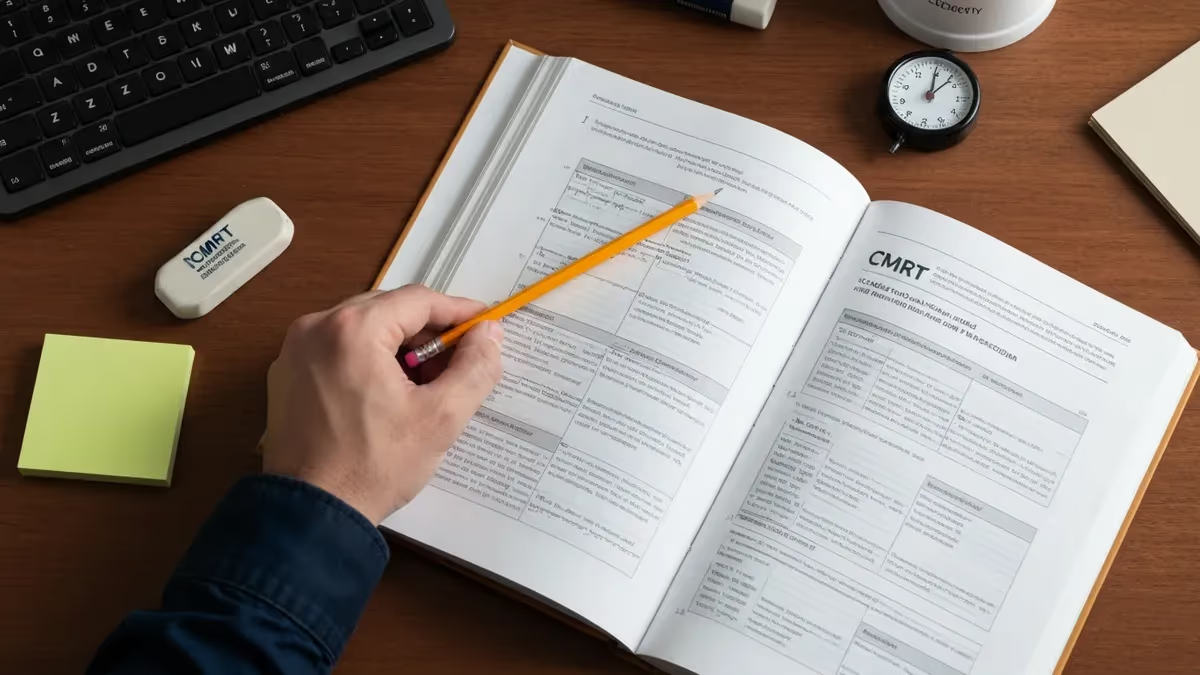
The cmrt certification is one of the most respected entry-level credentials in the industrial maintenance world, and demand for it keeps climbing as plants modernize. Offered by the Society for Maintenance & Reliability Professionals (SMRP), the cmrt validates that a technician can perform the hands-on tasks that keep equipment running: troubleshooting, preventive maintenance, corrective repairs, and basic reliability practices. If you turn wrenches, read prints, or chase vibration faults for a living, this credential turns experience into proof employers recognize across the United States and beyond. Practice with the free Certified Maintenance and Reliability Technician practice test on PracticeTestGeeks (9 questions with answer explanations).
Many people first hear the term cmrt and assume it relates to gaming mods like the cmrt assetto corsa HUD overlay, but in the professional context it stands for Certified Maintenance & Reliability Technician. That naming overlap is why search results mix racing telemetry with industrial certification pages. This guide focuses entirely on the SMRP credential, the body of knowledge behind it, and the practical steps you take to pass. We will cover eligibility, exam format, the four content pillars, costs, and proven study tactics that actually move your score.
Earning the certified maintenance & reliability technician cmrt certification signals to a hiring manager that you do not just fix things when they break; you understand why they break and how to prevent it. That mindset shift, from reactive repair to proactive reliability, is exactly what modern facilities pay a premium for. Whether you work in food processing, automotive assembly, pharmaceuticals, oil and gas, or municipal utilities, the cmrt gives you a portable, vendor-neutral standard that travels with you from one employer to the next throughout your career.
The exam itself is computer-based, multiple choice, and grounded in real shop-floor scenarios rather than abstract theory. You will see questions about lockout/tagout sequencing, lubrication intervals, alignment tolerances, predictive technologies like thermography and ultrasonic testing, and the documentation that ties it all together in a CMMS. SMRP designed it around tasks technicians perform weekly, so candidates with three to five years of genuine hands-on experience often find the material familiar even before they crack open a single study guide or practice test.
Versioning matters too. SMRP periodically updates the body of knowledge, and you may encounter references to cmrt 6.4 and the newer cmrt 6.5 frameworks in study materials and forums. These version numbers describe the edition of the content outline and question bank, not a different certification. Always confirm you are studying the current edition so your practice questions match the live exam weighting. Using outdated material is one of the most common and avoidable reasons capable technicians underperform on test day.
This article is built to be your single reference point. By the end you will know how many questions the exam contains, how long you get, what each domain covers, how much certification costs, what realistic pass rates look like, and how to build a study schedule that fits around full-time shift work. We have also embedded free practice quizzes throughout so you can test your readiness as you read rather than waiting until you feel completely prepared. Let us start with the numbers that define the cmrt.
- The CMRT examination contains 175 multiple-choice questions. (Society for Maintenance & Reliability Professionals Certifying Organization)
- CMRT examinees have three hours to complete the examination. (pearsonvue.com)
- The CMRT exam costs USD 250 for SMRP members, USD 300 for nonmembers, and USD 195 for sustaining sponsor employees or U.S. veterans. (Society for Maintenance & Reliability Professionals Certifying Organization)
- CMRT retake candidates must reapply and pay the applicable examination fee as new candidates. (Society for Maintenance & Reliability Professionals Certifying Organization)
- CMRT candidates must wait six months before taking the examination again. (pearsonvue.com)
- CMRT certification is valid for three years. (Society for Maintenance & Reliability Professionals Certifying Organization)
- CMRT renewal requires 50 course hours from at least two qualifying activity categories during the three-year certification cycle. (Society for Maintenance & Reliability Professionals Certifying Organization)
- The CMRT examination is delivered by computer at Pearson VUE testing facilities. (Society for Maintenance & Reliability Professionals Certifying Organization)
- The CMRT examination has no specific education or work-experience prerequisites. (Society for Maintenance & Reliability Professionals Certifying Organization)
Facts verified Oct 20, 2026 against Society for Maintenance & Reliability Professionals Certifying Organization. Dates that have passed are removed automatically.
CMRT Exam at a Glance
Facts verified Oct 20, 2026 against Society for Maintenance & Reliability Professionals Certifying Organization. Dates that have passed are removed automatically.
Free Certified Maintenance and Reliability Technician Study Tools
Interactive Certified Maintenance and Reliability Technician resources on PracticeTestGeeks, free to start:
- Certified Maintenance and Reliability Technician flashcards — review key terms and concepts card by card
- Certified Maintenance and Reliability Technician study guide — topic-by-topic overview of what the exam covers
- Certified Maintenance and Reliability Technician cheat sheet — one-page printable summary for last-minute review
CMRT Certification by the Numbers

CMRT Eligibility & Requirements
SMRP recommends three to five years of practical maintenance experience. There is no hard minimum, but the exam assumes real shop-floor exposure to repairs, PMs, and troubleshooting on industrial equipment.
Unlike the CMRP credential aimed at managers, the CMRT has no formal education prerequisite. A high school diploma or technical certificate is helpful but not mandatory for sitting the exam.
You submit an application through SMRP, pay the exam fee, and receive an authorization to test. Approval is typically fast since eligibility is experience-based rather than transcript-based.
Exams are delivered at proctored testing centers or via approved online proctoring. You schedule within your authorization window, usually 90 days, and bring valid government-issued photo identification.
Understanding the exam structure is half the battle, so let us break down exactly what you face. The cmrt exam contains roughly 110 multiple-choice questions delivered over a 2.5-hour window. Not every question counts toward your score; SMRP seeds a handful of unscored pilot items to validate future questions, but you will not know which ones, so you treat every item as if it matters. The format is single-best-answer, four options each, with no penalty for guessing, which means you should never leave a question blank.
Content is organized around the SMRP Body of Knowledge, which mirrors the five pillars of the broader reliability discipline but emphasizes the technician-level tasks. The heaviest weighting falls on maintenance execution: corrective maintenance procedures, preventive maintenance, and the safe, documented completion of work orders. Expect a strong cluster of questions on lockout/tagout, confined space awareness, and the permit systems that govern when and how you may touch energized or pressurized equipment. Safety threads through nearly every domain rather than sitting in its own silo.
The second major area covers reliability fundamentals. Here you encounter failure modes, root cause concepts, criticality ranking, and the basics of how predictive technologies feed a reliability program. You do not need to be a vibration analyst, but you should recognize what a rising vibration trend, a hot bearing on a thermal image, or an ultrasonic leak signature is telling you. Questions often present a symptom and ask you to choose the most appropriate next diagnostic step or the most likely failure mechanism behind the reading.
A third cluster addresses equipment-specific knowledge: lubrication and tribology, mechanical systems and alignment, bearings, belts, couplings, pumps, and basic fluid power. This is where many bench technicians score well because it reflects daily work. You will be asked about lubricant selection, contamination control, shaft alignment tolerances, and the consequences of soft foot or pipe strain. The questions reward technicians who understand cause and effect, not just procedure memorization, so think about why a tolerance exists before answering.
The fourth area ties everything together through documentation and business processes. Expect questions on CMMS data quality, work order coding, spare parts and storeroom basics, and how accurate records drive better reliability decisions. SMRP wants technicians who close out work orders properly because incomplete data is the silent killer of reliability programs. If you have ever skipped the failure code field because you were busy, the exam will gently remind you why that field exists and what analysis it ultimately enables downstream.
Finally, a portion of the exam measures professionalism and continuous improvement: how technicians communicate, escalate, and participate in kaizen or 5S initiatives. These questions are usually the most intuitive because they rely on workplace judgment rather than technical recall. Browsing a free cmrt question set early in your preparation is the fastest way to calibrate which domains feel comfortable and which need focused review before you commit to a test date and pay the exam fee.
CMRT 6.4 vs CMRT 6.5 Body of Knowledge
The cmrt 6.4 edition served as the standard content outline for several years and remains referenced in many older study guides, instructor-led courses, and used textbooks circulating in the secondhand market. It organizes the body of knowledge around the established maintenance and reliability pillars, with detailed task statements covering corrective work, preventive maintenance, lubrication, alignment, and documentation that technicians learned to expect.
If your employer purchased training material a few years ago, it is likely built on 6.4. The core competencies have not changed dramatically, so 6.4 material is far from useless. However, exact question weighting and a handful of updated task definitions differ from the newer release, so candidates should treat 6.4 resources as supplemental rather than the single source of truth when sitting a current exam.

Is the CMRT Certification Worth It?
- +Vendor-neutral credential recognized across every major industry in the US
- +No college degree required, only practical maintenance experience
- +Lower exam cost than most engineering or management certifications
- +Validates hands-on skills employers struggle to verify from a resume
- +Strong stepping stone toward the higher-level CMRP credential
- +Often triggers a pay raise, shift premium, or promotion eligibility
- +Portable across employers, states, and even international facilities
- −Requires real shop-floor experience to pass comfortably
- −Recertification every three years demands ongoing CMUs
- −Study material editions (6.4 vs 6.5) can confuse new candidates
- −Exam covers a broad range, so weak domains drag the whole score
- −Some smaller employers do not yet reward it with higher pay
- −Self-study discipline is needed since structured courses cost extra
Pros and Cons at a Glance
| Pros | Cons |
|---|---|
| Vendor-neutral credential recognized across every major industry in the US | Requires real shop-floor experience to pass comfortably |
| No college degree required, only practical maintenance experience | Recertification every three years demands ongoing CMUs |
| Lower exam cost than most engineering or management certifications | Exam covers a broad range, so weak domains drag the whole score |
| Validates hands-on skills employers struggle to verify from a resume | Some smaller employers do not yet reward it with higher pay |
| Strong stepping stone toward the higher-level CMRP credential | Self-study discipline is needed since structured courses cost extra |
CMRT Application & Prep Checklist
- ✓Confirm you have three to five years of hands-on maintenance experience
- ✓Create your SMRP account and review current eligibility criteria
- ✓Verify whether you qualify for member exam pricing before applying
- ✓Submit the CMRT application and pay the exam fee
- ✓Confirm your study material aligns with the cmrt 6.5 edition
- ✓Schedule your exam within the authorization window you receive
- ✓Build a six-to-twelve-week study schedule around your shift work
- ✓Take a baseline practice test to identify your weakest domains
- ✓Drill lubrication, alignment, and predictive maintenance question sets
- ✓Review lockout/tagout and safety permit procedures thoroughly
- ✓Complete at least two full-length timed practice exams
- ✓Gather your government-issued photo ID for test-day check-in
Experience beats cramming on the CMRT
The CMRT rewards genuine shop-floor exposure more than last-minute memorization. Technicians with three or more years of varied repair work consistently outperform those who try to study their way around a lack of practical experience. If you are early in your career, spend a few months requesting cross-training on pumps, alignment, and lubrication before you book the exam.
Let us talk money, because the total cost of cmrt certification is more than just the exam fee. SMRP members typically pay around $160 to sit the exam, while non-members pay a higher rate, often in the $300 range once you account for the gap. Because SMRP membership itself carries an annual fee, many candidates run the math and find that joining first, then registering at the member rate, lands close to the same total while unlocking member resources, networking, and discounted recertification down the road. Always check current pricing on the official SMRP site before budgeting.
Beyond the exam fee, factor in study materials. A quality preparation course or instructor-led bootcamp can run several hundred dollars, though many technicians pass using a combination of free practice questions, the SMRP body of knowledge outline, and an affordable study guide. The cmrt assetto corsa search confusion aside, do not waste money on irrelevant material; verify every resource targets the SMRP credential and the current edition. Free quizzes like the ones embedded throughout this guide reduce the amount of paid material you actually need to buy.
If you do not pass on the first attempt, retake fees apply, which is another reason to invest in proper preparation upfront rather than treating the first sitting as a free diagnostic. A failed attempt costs you both the retake fee and a chunk of time before you can test again. Budget as if you intend to pass once, and you will spend less overall than someone who books the exam underprepared, fails, and then has to pay for both the retake and the additional study materials they should have used initially.
Recertification is the cost most candidates forget. The CMRT is valid for three years, after which you must recertify by earning Continuing Maintenance and Reliability Units, commonly called CMUs, or by retaking the exam. CMUs come from approved training, conference attendance, on-the-job projects, teaching, and professional activities. Tracking these as you go is far easier than scrambling at year three. Set a calendar reminder each year to log your CMUs so recertification becomes a simple paperwork exercise rather than a stressful, expensive re-examination.
For employers, the cost equation is even more favorable. A few hundred dollars to certify a technician is trivial compared with the downtime saved when that technician executes a predictive catch or a properly documented PM. Many companies reimburse the full cost of cmrt certification as part of their training budget, and some tie a pay bump or shift differential to passing. If your employer has a tuition or certification reimbursement policy, ask before you pay out of pocket; you may recover the entire amount.
When you weigh the complete picture, exam fee, materials, membership, and recertification, the CMRT remains one of the highest-return credentials in industrial maintenance. The lifetime earnings lift from moving into reliability-focused roles dwarfs the upfront spend. For a fuller breakdown of how this credential fits into a broader career path, the cmrt assetto corsa resource page collects printable study aids you can use offline to keep your total preparation budget low while still covering every domain thoroughly.

Once SMRP approves your application, you typically have a limited authorization window, often 90 days, to schedule and sit the exam. Missing that window can require reapplying and paying again. Book your testing appointment early in the window so you have room to reschedule if life or a plant shutdown interferes with your plans.
The career impact of earning your cmrt is where the credential truly pays off. Maintenance and reliability roles are facing a well-documented skills gap as experienced baby-boomer technicians retire faster than new talent enters the trades. Facilities are competing for qualified maintenance professionals, and a recognized certification instantly differentiates you from applicants who list only on-the-job experience. The certified maintenance & reliability technician cmrt designation after your name signals verified competence, which shortens hiring decisions and strengthens your position in salary negotiations from day one.
Salary data consistently shows certified technicians earning more than their uncertified peers performing similar work. While exact figures vary by region, industry, and shift, many certified maintenance technicians in the US earn solid five-figure salaries with overtime pushing total compensation considerably higher. The certification often unlocks access to reliability technician, planner-scheduler, and predictive maintenance specialist roles that pay a premium over general maintenance positions. Over a full career, that differential compounds into tens of thousands of dollars in additional lifetime earnings.
Beyond pay, the CMRT opens doors to more interesting and less reactive work. Reliability-focused technicians spend less time firefighting breakdowns at 3 a.m. and more time on planned, scheduled, condition-based work. That shift improves quality of life as much as it improves the plant's uptime. Employers increasingly route their certified technicians into precision maintenance, root cause analysis teams, and continuous improvement projects, which are exactly the assignments that build the resume you need for future advancement into supervisory or engineering-support roles.
The CMRT also functions as a stepping stone to the CMRP, the Certified Maintenance & Reliability Professional credential aimed at engineers, planners, and managers. Many professionals earn the CMRT early in their hands-on career, then pursue the CMRP once they move toward planning or leadership. Holding the technician credential first demonstrates that your reliability knowledge is grounded in real execution, not just theory, which gives your eventual CMRP far more credibility with the teams you will one day lead and mentor.
Cmrt compliance is another angle worth understanding, especially in regulated industries. Facilities in pharmaceuticals, food and beverage, and oil and gas often need documented proof that maintenance personnel meet a defined competency standard for audits and insurance purposes. A workforce stacked with certified technicians helps satisfy those cmrt compliance expectations and reduces the risk of findings during regulatory or customer audits. From the employer's seat, certifying the team is as much a risk-management decision as a talent-development one, which is why budgets keep growing.
Finally, the credential builds professional identity and community. SMRP membership connects you to a national network of reliability professionals, conferences, technical papers, and local chapters. That community accelerates your learning far beyond what any single employer can teach, and it keeps you current as technologies evolve. To see how the credential fits into a broader certification ladder, explore the certified maintenance & reliability technician cmrt certification resources that walk through each tier of the maintenance and reliability career path in detail.
With the background covered, here are the practical, battle-tested tips that separate candidates who pass comfortably from those who scrape by or fail. First, start with a diagnostic practice test before you study anything. A baseline score tells you exactly which domains, corrective, preventive, predictive, lubrication, alignment, or documentation, need the most attention. Studying everything equally wastes time you do not have when you work full-time shifts. Let your weakest two or three domains absorb sixty percent of your study hours, and merely maintain the areas where you already test well.
Second, simulate real exam conditions at least twice before test day. Set a 2.5-hour timer, sit in a quiet room, and complete a full-length practice exam without notes. The goal is to build stamina and pacing. At roughly 110 questions in 150 minutes, you have about 80 seconds per question, so you must learn to flag tough items and move on rather than burning five minutes on a single tricky scenario. Many capable technicians lose points simply by mismanaging the clock, not by lacking knowledge.
Third, study the why behind every procedure, not just the steps. The exam loves questions that present a slightly altered scenario, and rote memorization breaks down the moment the wording changes. If you understand why you align a coupling within tolerance, why you control oil contamination, or why you complete the failure code field, you can reason your way to the correct answer even on an unfamiliar question. Conceptual understanding is your insurance against the curveballs SMRP deliberately includes to separate true technicians from memorizers.
Fourth, use your daily work as living study material. For the weeks leading up to the exam, treat every PM, repair, and alignment job as a flashcard. Ask yourself what failure mode you are preventing, what predictive indicator would have caught it earlier, and how you would document it in the CMMS. This turns your regular shift into reinforcement and makes abstract exam topics concrete. Technicians who consciously connect study material to real equipment retain far more than those who only read at the kitchen table.
Fifth, build a small study group or find a mentor who already holds the credential. Explaining a concept out loud to a coworker exposes the gaps in your own understanding faster than silent reading ever will. A mentor who passed recently can also tell you which topics carried the most weight on their sitting and which study resources actually mirrored the live exam. Even a single weekly check-in keeps you accountable to your schedule when motivation dips during a long preparation cycle.
Sixth, manage test-day logistics so nothing derails your focus. Confirm your testing center location or online proctoring setup the day before, sleep well, eat a real meal, and arrive early with valid photo identification. Read every question fully before looking at the answers, eliminate obviously wrong options first, and never leave a question blank since there is no guessing penalty. Trust your preparation, work the clock, and you will walk out of the cmrt exam knowing you gave yourself every advantage to pass on the first attempt.
Finally, plan your recertification from the moment you pass. Open a simple spreadsheet, log every training session, conference, and qualifying project, and tally your CMUs as you earn them. Three years arrives faster than you expect, and the technicians who track CMUs continuously sail through recertification while procrastinators face a stressful scramble or a full retake. Treat the CMRT not as a one-time test but as the start of a documented, lifelong commitment to maintenance and reliability excellence that keeps paying dividends.
Sample Certified Maintenance and Reliability Technician Practice Questions
Try these questions from our free Certified Maintenance and Reliability Technician practice tests. The correct answer and an explanation follow each question.
A certified maintenance technician is tasked with inspecting a bank of electrical cabinets for potential issues without de-energizing the equipment. Which of the following predictive maintenance techniques is the safest and most effective for identifying loose connections or overloaded circuits in this scenario?
- A. Motor Circuit Analysis
- B. Acoustic Monitoring
- C. Vibration Analysis
- D. Infrared Thermography
Answer: D. Infrared Thermography
Infrared thermography is a non-contact technology that detects temperature anomalies in electrical components. It can safely identify hot spots caused by loose connections or overloaded circuits while the equipment is energized, preventing potential failures and enhancing safety.
A technician is developing a predictive maintenance plan for a plant's critical assets. The primary goal is to transition from a time-based maintenance schedule to a condition-based approach. What is the fundamental principle of this transition?
- A. Performing maintenance only after a failure has occurred to minimize costs.
- B. Scheduling maintenance at fixed intervals regardless of equipment condition.
- C. Using real-time equipment data to determine when maintenance is actually necessary.
- D. Replacing components based on their average expected lifespan.
Answer: C. Using real-time equipment data to determine when maintenance is actually necessary.
The core principle of predictive maintenance (PdM) is to use condition-monitoring technologies to collect real-time data on the health of equipment. This data-driven approach allows maintenance to be scheduled only when needed, based on the actual condition of the asset, rather than on a fixed time schedule or after a failure.
What does the Safety Data Sheet (SDS) Section 8 provide that is most directly useful to a maintenance technician handling a chemical?
- A. First aid measures and emergency response procedures
- B. Exposure limits and required engineering controls and PPE
- C. Physical and chemical properties such as boiling point and vapor pressure
- D. Regulatory compliance information and transportation requirements
Answer: B. Exposure limits and required engineering controls and PPE
SDS Section 8 (Exposure Controls/Personal Protection) specifies permissible exposure limits, threshold limit values, and the controls and PPE needed to protect workers.
Before using a portable electric grinder for a cutting task, a maintenance technician performs a pre-use inspection. Which of the following is a required step in this inspection?
- A. Verifying the grinder's warranty is still valid.
- B. Checking that the guard is in place and secure.
- C. Ensuring the grinder has been recently calibrated.
- D. Measuring the voltage at the electrical outlet.
Answer: B. Checking that the guard is in place and secure.
A fundamental safety and maintenance practice is to perform a pre-use inspection on all tools and equipment. For a grinder, ensuring the safety guard is properly positioned and secure is a critical step to protect the user from sparks and potential wheel failure.
Take the full Certified Maintenance and Reliability Technician practice test
CMRT Questions and Answers

CMRT (Certified Maintenance & Reliability Technician) Test

CMRT Meaning: What Certified Maintenance & Reliability Technician Really Means in 2026

CMRT Certified Maintenance and Reliability Technician Practice Test PDF (Free Printable 2026)
CMRT Practice Test

Boost Your Career with the Maintenance & Reliability Technician Certification
How this page was made: written with AI tools. Exam facts are checked against the official sources listed below. Not reviewed by a subject-matter expert. Editorial policy
Sources & references
Exam facts on this page (fees, format, dates, passing scores) are checked against these official sources; the date is our last check. Editorial policy
- pearsonvue.com — Retake policy, time limit · verified Oct 2026
- smrp.org — Fees, test dates, test delivery, eligibility, score validity, renewal, exam format, registration, retake fee, score release · verified Oct 2026