
CLEP Chemistry: Complete Study Guide, Exam Format & Free Practice Tests 2026
Master clep chemistry with our complete study guide: exam format, topics, pass rates, free practice tests, and proven prep strategies for 2026. ❓

The CLEP Chemistry exam is one of the most rigorous yet rewarding tests offered by the clep college board, giving students the opportunity to earn up to 3 college credits by demonstrating college-level chemistry knowledge. Whether you are a high school student who excelled in AP Chemistry, a working adult returning to school, or a self-studier using free resources, passing this exam can save you hundreds of dollars and weeks of class time. Understanding what the exam covers and how to prepare strategically is the foundation of any successful outcome. Practice with the free CLEP practice test on PracticeTestGeeks (150+ questions with answer explanations).
CLEP Chemistry tests a broad range of topics drawn from a typical one-semester introductory college chemistry course. The exam covers atomic structure, molecular bonding, stoichiometry, thermodynamics, kinetics, equilibrium, electrochemistry, and nuclear chemistry. These topics appear at varying depths, and the exam is designed to reward students who can apply concepts — not just memorize definitions. A strong conceptual grasp paired with the ability to solve quantitative problems is what separates passing scores from failing ones on this demanding test.
The clep chemistry exam is offered year-round at over 2,000 testing centers across the United States, and many colleges accept a score of 50 (on the 20–80 scale) as equivalent to passing a one-semester general chemistry course. Some institutions require higher scores, particularly those with competitive science programs, so always verify your target school's credit policy before registering. The American Council on Education (ACE) recommends a score of 50 for credit equivalency, and the vast majority of four-year colleges follow this guideline.
Preparing for clep chemistry requires a realistic assessment of your current knowledge base and a structured study plan. Most test-takers report needing 8 to 16 weeks of dedicated preparation, depending on their chemistry background. Those who took AP Chemistry or a college-level course in the last two years often need less time, while students with only a high school chemistry foundation may need the full 16 weeks to cover every topic with enough depth to succeed. Diagnostic practice tests are the fastest way to identify which areas demand the most attention.
One of the greatest advantages of CLEP testing is cost-efficiency. A single CLEP exam costs $97 through the College Board, compared to the $3,000–$5,000 price tag of a standard three-credit college course at a public university. Multiply that across multiple exams and the savings become transformational — students who pass four to six CLEP exams can realistically save a full semester of tuition. The clep chemistry exam is one of the highest-value exams in the program because general chemistry is a required course in dozens of degree programs in science, health, and engineering.
Free and low-cost preparation resources have dramatically expanded in recent years. Modern States is the most widely recommended free option, offering a complete video course aligned to CLEP objectives and even providing free vouchers to cover the exam registration fee for eligible students. Khan Academy's chemistry modules, OpenStax Chemistry textbooks, and official CLEP practice materials from the College Board round out a strong free study ecosystem. Combining multiple resource types — video lectures, textbook reading, flashcards, and timed practice exams — consistently produces better outcomes than relying on any single source.
This guide covers everything you need to know about the CLEP Chemistry exam: detailed exam format, the complete topic breakdown, a realistic study schedule, expert strategies for tackling the toughest question types, and access to free practice tests. Read every section carefully, use the checklist to track your preparation milestones, and take advantage of the quiz resources embedded throughout this page to assess your readiness before test day.
Free CLEP Study Tools
Interactive CLEP resources on PracticeTestGeeks, free to start:
- CLEP Practice Test Biology 1 — 25 questions with instant scoring and answer explanations
- CLEP flashcards — review key terms and concepts card by card
- CLEP study guide — topic-by-topic overview of what the exam covers
- CLEP cheat sheet — one-page printable summary for last-minute review
CLEP Chemistry by the Numbers
- CLEP exams are multiple-choice, and the number of questions depends on the subject; for example, American Government has about 100 questions in 90 minutes. (College Board)
- The CLEP College Composition exam has 50 multiple-choice questions and 2 essays, with a total testing time of 125 minutes. (College Board)
- Most CLEP exams take about 90 to 120 minutes to complete, depending on the exam subject. (College Board)
- CLEP scores are reported on a 20–80 scale, and the American Council on Education recommends that colleges grant credit for a score of 50 or higher, though each college sets its own policy. (College Board)
- Each CLEP exam costs $97, plus a separate test center administration fee or a remote proctoring fee. (College Board)
- Taking a CLEP exam at home with remote proctoring adds a $30 remote proctoring fee on top of the $97 exam fee. (College Board)
- You can't retake a CLEP exam of the same title within three months of the first test date; if you do, the score is canceled and the fees are forfeited. (College Board)
- CLEP scores for exams taken on or after July 1, 2022, stay available for 10 years from the test date; older scores stay available for 20 years. (College Board)
- CLEP exams are taken on computer either at one of more than 2,000 CLEP test centers or at home with remote proctoring through Proctortrack by Verificient. (College Board)
Facts verified Oct 16, 2026 against College Board. Dates that have passed are removed automatically.
CLEP Exam at a Glance
| Item | Detail | Official source |
|---|---|---|
| Number of questions | Multiple choice; e.g. ~100 questions (American Government), ~60 (College Algebra) | College Board |
| Number of questions (College Composition) | 50 multiple-choice questions + 2 essays | College Board |
| Time limit | About 90–120 minutes, depending on subject | College Board |
| Passing score | 50 on a 20–80 scale (ACE recommendation) | College Board |
| Exam fee | $97 per exam + center/remote admin fee | College Board |
| Exam fee (Remote proctoring fee) | $30 remote proctoring fee | College Board |
| Retake policy | Wait 3 months before retaking the same title | College Board |
| Validity | Scores available 10 years (exams from July 1, 2022 on) | College Board |
| Delivery | Test center or at home with remote proctoring | College Board |
| Eligibility | Anyone at a test center; remote: age 13+ (18+ in Illinois), in the U.S. or DANTES-funded | College Board |
| Score release | Immediately on screen; portal within 24 hours | College Board |
| Score release (College Composition / Spanish with Writing) | 2–3 weeks after exam day | College Board |
| Registration opens | Open year-round via My CLEP portal | College Board |
| Testing window | Year-round, scheduled with the test center | College Board |
Facts verified Oct 16, 2026 against College Board. Dates that have passed are removed automatically.
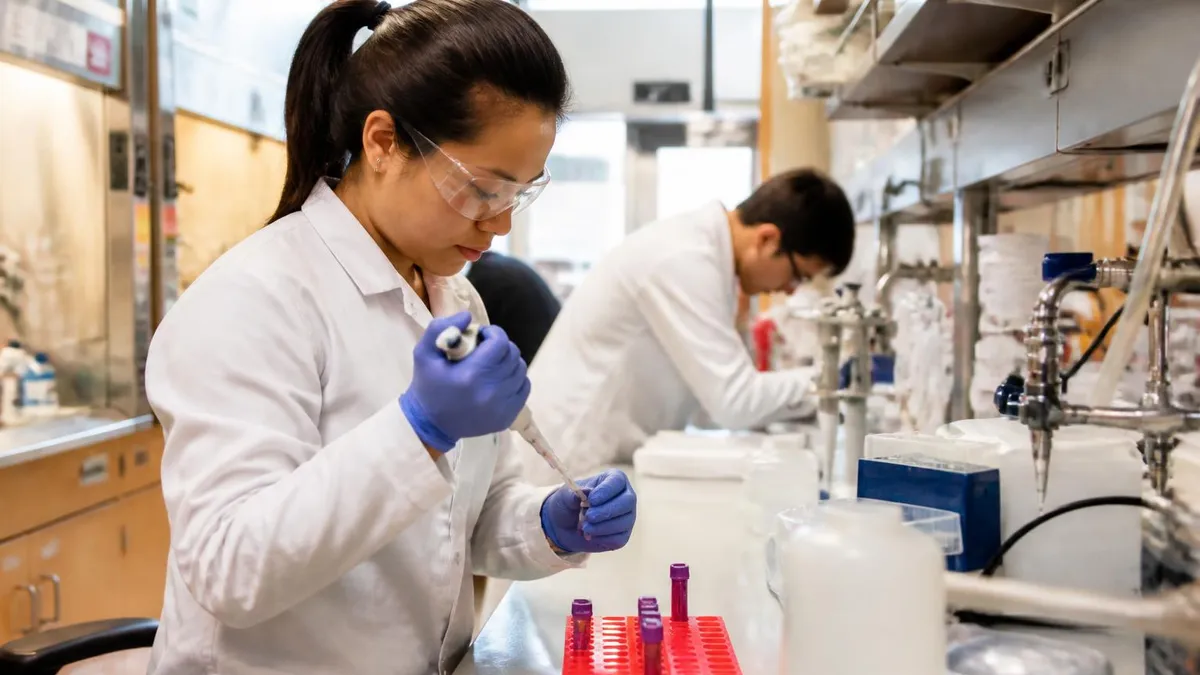
CLEP Chemistry Exam Format
| Section | Questions | Time | Weight | Notes |
|---|---|---|---|---|
| Structure of Matter | 25 | ~30 min | 33% | Atomic theory, bonding, molecular geometry |
| States of Matter | 17 | ~20 min | 23% | Gases, liquids, solids, solutions |
| Reaction Types | 15 | ~18 min | 20% | Acids/bases, oxidation-reduction, precipitation |
| Equations & Stoichiometry | 10 | ~12 min | 13% | Balancing equations, mole calculations |
| Thermodynamics & Kinetics | 8 | ~10 min | 11% | Energy, equilibrium, reaction rates |
| Total | 75 | 90 minutes | 100% |
Understanding the content areas of the CLEP Chemistry exam in depth allows you to allocate your study time proportionally and avoid over-preparing in areas that carry less weight. Structure of matter is the single largest category, accounting for approximately one-third of all questions. This section includes atomic theory and electron configuration, chemical bonding (ionic, covalent, metallic, and hydrogen bonds), molecular geometry using VSEPR theory, Lewis dot structures, and intermolecular forces. Students who master this category have a significant advantage because these concepts also underpin questions in other sections.
States of matter represents the second-largest block of content on the exam. The gas laws — Boyle's, Charles's, Gay-Lussac's, and the combined ideal gas law — appear frequently, as do concepts around vapor pressure, phase diagrams, colligative properties of solutions, and the kinetic molecular theory. One particularly tricky area for many students is understanding how real gases deviate from ideal behavior under high pressure or low temperature conditions. Knowing the van der Waals equation conceptually — even without needing to memorize the constants — can help you answer qualitative questions correctly.
Reaction types is a content area that rewards careful attention to chemical logic rather than memorization alone. Acid-base chemistry, including the Brønsted-Lowry and Lewis definitions, pH calculations, and buffer systems, accounts for a significant portion of this section. Oxidation-reduction reactions, including the ability to assign oxidation states and balance redox equations using the half-reaction method, are also heavily tested. Students preparing using modern states clep courses consistently report that the reaction types section is where their weakest performance occurs, making it a priority area for targeted review.
Equations and stoichiometry questions test your ability to work with the mole concept, convert between grams, moles, and molecules, interpret chemical formulas and equations, and perform limiting reagent calculations. These questions are among the most straightforward on the exam if you have a solid algebraic foundation, but they are also the questions most commonly missed due to unit errors and arithmetic mistakes under timed conditions. Practicing 20 to 30 stoichiometry problems per week in the final month before your exam will dramatically reduce these errors.
Thermodynamics and kinetics, while the smallest content area by weight, contains some of the most conceptually demanding material on the exam. You will need to understand Hess's Law, enthalpy, entropy, Gibbs free energy, and the relationship between the equilibrium constant and temperature. Reaction rate laws, collision theory, activation energy, and the effect of catalysts on reaction kinetics round out this section. A practical tip: draw energy diagrams for common reactions — exothermic versus endothermic, catalyzed versus uncatalyzed — until you can reproduce them from memory, as visual pattern recognition accelerates recall under test conditions.
Nuclear chemistry and laboratory chemistry are minor but recurring topics that should not be completely neglected. Nuclear decay modes (alpha, beta, gamma), half-life calculations, and fission versus fusion reactions appear in a small number of questions. Laboratory procedures such as titration, gravimetric analysis, and the interpretation of experimental data also show up occasionally. These topics are best reviewed in the final two weeks of preparation as a brief survey rather than a deep dive, ensuring you can answer the handful of related questions without sacrificing time better spent on structure and reactions.
Effective content review means engaging with the material actively rather than passively. Instead of simply reading a chemistry textbook, work problems as you go, pause to predict outcomes before checking answers, and explain concepts aloud as if teaching someone else. Research on learning science consistently shows that retrieval practice — forcing yourself to recall information without looking at notes — is far more effective than rereading for long-term retention. Building this habit early in your CLEP Chemistry preparation will pay dividends on exam day when you need fast, accurate recall across all five content areas.
Best Ways to Study for CLEP Tests
Modern States offers the most comprehensive free preparation for CLEP tests, including a full video lecture series for Chemistry taught by college instructors. Their Freshman Year for Free program also provides eligible students with vouchers to cover the $97 exam fee entirely, making it possible to earn college credit at zero cost. Supplementing Modern States with Khan Academy's chemistry modules — which cover atomic structure, chemical bonding, stoichiometry, and thermodynamics — creates a powerful free study combination that rivals paid prep courses.
OpenStax Chemistry is a peer-reviewed, freely available college-level chemistry textbook that aligns closely with CLEP exam objectives. It includes end-of-chapter problems with worked solutions, which are ideal for mastering stoichiometry and equilibrium calculations. The College Board's official CLEP Chemistry exam guide, available on their website, includes a sample question set that reflects the actual test's difficulty and style. Reviewing these official questions early in your prep helps calibrate your expectations and focus your remaining study hours on the highest-yield areas.
Is CLEP Chemistry Worth It? Pros and Cons
- +Saves $3,000–$5,000 compared to taking general chemistry at a four-year university
- +Earns 3 transferable college credits accepted at over 2,900 colleges nationwide
- +Exam costs only $97, with free vouchers available through Modern States for eligible students
- +Test can be taken year-round at over 2,000 proctored testing centers across the US
- +Ideal for students with strong AP Chemistry or self-study backgrounds who want to skip introductory coursework
- +Passing frees up your schedule for upper-division science electives relevant to your major
- −Exam covers a broad range of topics requiring 8–16 weeks of dedicated preparation
- −Some competitive universities (pre-med programs, engineering schools) do not accept CLEP Chemistry credit
- −No partial credit — you either earn the full 3 credits or none, based on a single exam score
- −Cannot use a calculator on the exam, making quantitative problems more mentally demanding
- −Failed attempts cost $97 each and there is a mandatory 3-month wait before retesting
- −Laboratory science requirements at some schools cannot be fulfilled by CLEP (lab credit excluded)
CLEP Chemistry Exam Prep Checklist
- ✓Complete a full diagnostic practice test in the first week to identify your weakest content areas.
- ✓Review all five content areas: structure of matter, states of matter, reaction types, stoichiometry, and thermodynamics.
- ✓Memorize the polyatomic ions, common oxidation states, and activity series for metals.
- ✓Practice balancing chemical equations daily until you can balance complex redox reactions confidently.
- ✓Master the gas laws (Boyle's, Charles's, combined, ideal) with at least 20 calculation problems each.
- ✓Study acid-base chemistry including pH calculations, buffer systems, and titration curves.
- ✓Review VSEPR theory and be able to predict molecular geometry for any common molecule.
- ✓Take at least three full-length, timed 90-minute practice exams under real test conditions.
- ✓Verify your target college's CLEP credit policy and minimum accepted score before registering.
- ✓Register for your exam at least two weeks in advance through the College Board website.

No Calculator Allowed — Practice Mental Math Now
Unlike AP Chemistry or most college exams, CLEP Chemistry does not permit a calculator. This means stoichiometry, gas law, and thermodynamics problems must be solved using mental math and estimation. Students who practice no-calculator problem sets for at least four weeks before test day consistently report finishing with 10–15 minutes to spare, while those who rely on calculators during prep often run out of time on exam day.
The CLEP Chemistry scoring scale runs from 20 to 80, with the College Board's recommended passing score set at 50. At a score of 50, ACE recommends that colleges grant 3 semester hours of credit, equivalent to a grade of C in a standard introductory chemistry course. Achieving a score of 60 or above qualifies for credit equivalent to a B grade at institutions that differentiate by score level, though most schools simply apply the flat three-credit award at 50 or higher without distinguishing between score bands above the cutoff.
National pass rate data for CLEP Chemistry consistently places the passing rate between 48% and 54%, making it one of the more challenging exams in the CLEP catalog. This is notably harder than CLEP exams in social sciences or humanities, which often have pass rates above 65%. The difficulty reflects the quantitative and conceptual demands of general chemistry compared to subjects where familiarity with broad themes and strong reading comprehension skills can carry a student to a passing score with less rigorous preparation.
First-time pass rates are highest among students who took AP Chemistry in high school (estimated at 70–75%) and lowest among students with only a standard high school chemistry course background (estimated at 35–40%). This gap underscores the importance of honest self-assessment before registering. If your chemistry background is limited, a 12 to 16-week preparation window using structured resources gives you the best chance of joining the passing group on your first attempt — and avoiding the $97 re-registration fee and three-month waiting period that come with a failed attempt.
College credit policies vary significantly across institutions, and researching your specific school's policy before registering is one of the most important steps you can take. Some universities accept CLEP Chemistry credit freely toward general education science requirements. Others accept it only as elective credit, which means it does not fulfill the lab science requirement that many STEM and pre-health programs mandate. A small number of highly selective institutions — particularly those with strong research science programs — do not accept any CLEP science credits, viewing the lab component as non-negotiable.
Military service members and their dependents have access to significantly reduced CLEP exam costs through the Defense Activity for Non-Traditional Education Support (DANTES) program, which covers the $97 exam fee at approved testing sites on military installations. Many community colleges and regional universities actively promote CLEP credit as part of their prior learning assessment programs, and some institutions offer credit for scores as low as 45 if a departmental review confirms competence. Always call the registrar's office directly to confirm current policy, as credit decisions are ultimately made at the institutional level and published policies sometimes lag behind actual practice.
The return on investment calculation for CLEP Chemistry is compelling even when factoring in study materials. A $93 exam fee plus $30 for a study guide totals $123 — compared to approximately $1,500 to $5,000 for a three-credit general chemistry course at a typical four-year institution. Even at a community college charging $150 per credit hour, CLEP saves over $300 while also eliminating 15 weeks of class attendance. For part-time students juggling work and family responsibilities, the time savings alone often represent the greatest value, reducing the number of semesters needed to complete a degree.
Students who pass CLEP Chemistry also gain a psychological advantage entering upper-division science coursework: they have already demonstrated competence on a rigorous standardized exam, which builds confidence and establishes productive study habits that carry forward through more advanced courses. The discipline required to self-study for CLEP Chemistry mirrors the independent learning skills that graduate and professional schools look for, making the preparation process itself a valuable credential-building experience beyond the credit hours earned.
Not all colleges accept CLEP Chemistry credit toward lab science requirements, and policies change annually. Competitive pre-med and engineering programs frequently require on-campus general chemistry with laboratory components, which CLEP cannot replace. Confirm your target school's current acceptance policy directly with the registrar or department before paying the $97 exam fee, as refunds are not available after registration.
The most common mistake CLEP Chemistry test-takers make is over-relying on memorization at the expense of conceptual understanding. The exam is deliberately designed to test application — you will encounter questions that require you to reason through an unfamiliar scenario using chemical principles, not simply recall a fact. Students who spend 80% of their prep time making flashcards for element symbols and periodic trends often find themselves unprepared for the multi-step reasoning questions that determine the difference between a score of 45 and a score of 55.
Underestimating the quantitative component is a second critical mistake. Because the exam forbids calculators, many students assume the math must be simple enough to dismiss, and they focus almost entirely on conceptual content. In reality, stoichiometry and gas law calculations require fluency with unit conversions, proportional reasoning, and scientific notation — skills that rust quickly without regular practice. Dedicating 30 to 40 minutes per study session to calculation problems throughout your preparation, rather than cramming math practice into the final week, ensures these skills remain sharp on test day.
A third common error is neglecting to review the scoring structure before test day. CLEP uses a rights-only scoring model — there is no penalty for wrong answers. This means guessing on questions you are uncertain about is always strategically correct. Students who skip questions hoping to return to them later sometimes run out of time and leave points on the table unnecessarily. The optimal strategy is to answer every question in order, mark difficult ones for review, and return to flagged questions only if time permits after completing the full exam.
Poor time management during the exam itself accounts for many preventable failures. With 75 questions in 90 minutes, you have exactly 72 seconds per question on average. Calculation-heavy questions in stoichiometry and thermodynamics can easily consume two to three minutes if you are not careful, leaving insufficient time for the conceptual questions that are faster to answer. Practicing full-length timed exams builds the intuition needed to allocate time appropriately — experienced test-takers learn to recognize within the first 15 seconds whether a question will take 30 seconds or 3 minutes, and they adjust their approach accordingly.
Skipping the official College Board practice materials is a mistake that costs students percentage points they could have captured easily. The College Board publishes an official CLEP Chemistry study guide with sample questions that reflect the actual exam's format, difficulty, and phrasing conventions. The way questions are worded on official materials differs subtly from third-party prep books, and exposure to these conventions reduces the disorientation that causes test-takers to misread questions under pressure. If you use only commercial prep books, spend at least two sessions working through the College Board's own sample questions before your test date.
Finally, many students underestimate the importance of clep testing center logistics and arrive underprepared for the administrative experience. CLEP exams are delivered on computer at Pearson VUE and College Board testing centers. The interface includes a flagging and review feature, a built-in periodic table (non-interactive), and a countdown timer. Familiarizing yourself with the computer-based testing interface through the College Board's free tutorial — available on their website — eliminates the cognitive overhead of learning a new interface on exam day when your mental energy should be focused entirely on chemistry.
Building recovery strategies for hard questions is a sophisticated prep technique that separates high scorers from borderline passers. When you encounter a question you cannot answer from direct recall, work backward from the answer choices using elimination logic. Chemistry questions often include two obviously incorrect options that can be dismissed immediately based on units, sign conventions, or magnitude.
Narrowing four choices to two and making an educated guess gives you a 50% chance on questions you might otherwise skip entirely — and on a 75-question exam, getting half of your guesses right on 10 difficult questions adds five points to your raw score, which can be the difference between passing and failing.
In the final two weeks before your CLEP Chemistry exam, your preparation strategy should shift from content acquisition to performance optimization. Stop introducing new material and instead focus exclusively on reinforcing what you already know, identifying and closing remaining gaps through targeted practice, and building exam-day confidence through simulated testing. This transition is psychologically difficult for many students who feel compelled to cover one more chapter or review one more topic, but the research on test preparation is clear: cramming new content in the final days is counterproductive and increases test anxiety.
Take a full-length practice exam under strict test conditions at least three days before your scheduled test date. Simulate the actual testing environment as closely as possible: sit at a desk, remove all distractions, set a 90-minute timer, and do not use a calculator or reference materials.
When you review your results, categorize every missed question by content area and identify whether the error was due to a knowledge gap, a misreading of the question, a calculation error, or a time management failure. Each error type requires a different remediation strategy, and treating all mistakes as knowledge gaps leads to inefficient final-week review.
Prioritize sleep in the final week of preparation. Cognitive research consistently demonstrates that memory consolidation occurs primarily during sleep, meaning the chemistry concepts you studied that day become more accessible and durable after a full night of rest. Students who sacrifice sleep to study additional hours in the days before a high-stakes exam typically perform worse than those who study moderately and sleep well, because the sleep-deprived brain has impaired working memory, slower processing speed, and reduced ability to retrieve stored information accurately — all of which are critical functions during a timed chemistry exam.
On the morning of your exam, eat a protein-rich breakfast and arrive at the testing center 20 to 30 minutes early. Bring two valid forms of ID as required by College Board policy. Do not study in the waiting room — your prep is complete, and reviewing notes immediately before the exam typically increases anxiety without improving recall. Instead, use the time to take slow, deep breaths and mentally rehearse the test-taking strategies you have practiced: managing time per question, using elimination for uncertain answers, and flagging questions efficiently for review.
During the exam, use the embedded periodic table strategically. While it does not include all the information you might want (ionization energies and electronegativities are not typically shown), it does provide atomic masses, atomic numbers, and element symbols — which are sufficient for stoichiometry calculations and for answering questions about periodic trends by comparing elements' positions on the table. Students who forget to use the periodic table during the exam miss an easy opportunity to check their work on calculation problems and verify element-based answers.
After the exam, your score is reported immediately on screen. Scores at or above 50 on the 20–80 scale indicate a passing performance, and the College Board will send an official score report to your designated institution within two to three weeks. If you passed, begin the credit transfer process immediately by contacting your registrar with your score report.
If your score fell below 50, use the content feedback provided in your score report to guide a targeted six-to-eight-week remediation plan before scheduling your next attempt. You must wait three months between attempts, but students who use that interval strategically — focusing exclusively on their weakest content areas — have strong second-attempt pass rates.
The broader CLEP program offers 34 exams across subjects ranging from clep tests in mathematics, sciences, and humanities to business, history, and foreign languages. Students who pass CLEP Chemistry often go on to attempt additional CLEP exams in related subjects, accelerating their degree completion timeline significantly. The habits of self-directed study, strategic resource selection, and disciplined practice that you build while preparing for CLEP Chemistry are fully transferable to every subsequent exam — and to the independent learning demands of upper-division college coursework itself.
Sample CLEP Practice Questions
Try these questions from our free CLEP practice tests. The correct answer and an explanation follow each question.
In order to ensure that a research study measures what it is intended to, researchers must carefully consider its design. This is also known as:
- A. reliability
- B. observation
- C. validity
- D. sampling
Answer: C. validity
Validity in research refers to the extent to which a study accurately measures what it intends to measure. If a research design is valid, its findings genuinely represent the phenomenon being studied and are not influenced by extraneous factors. This ensures that the conclusions drawn from the research are meaningful and accurate.
What four characteristics set sounds apart from one another?
- A. Texture, frequency, intensity, and interval
- B. Tempo, duration, frequency, and timbre
- C. Duration, frequency, intensity, and timbre
- D. Pulse, duration, frequency, and timbre
Answer: C. Duration, frequency, intensity, and timbre
The four fundamental characteristics that distinguish one sound from another are duration, frequency, intensity, and timbre. Duration refers to how long a sound lasts, frequency determines its pitch, intensity relates to its loudness, and timbre describes the unique quality or 'color' of a sound that allows us to differentiate between different instruments or voices.
A hypothesis becomes a ____________ if it has been confirmed and accepted.
- A. law
- B. fact
- C. theory
- D. conclusion
Answer: C. theory
In the scientific method, a hypothesis is a testable explanation for an observation. If a hypothesis is repeatedly confirmed through extensive experimentation and observation, and it explains a broad range of related phenomena, it can then be elevated to the status of a scientific theory. A theory is a well-substantiated, comprehensive explanation supported by a vast body of evidence.
Which of these is not a dynamic marking?
- A. Fortissimo
- B. Piano
- C. Forte
- D. Andante
Answer: D. Andante
Dynamic markings in music indicate the loudness or softness of a passage; "fortissimo" (very loud), "piano" (soft), and "forte" (loud) are all common dynamic terms. "Andante," however, is a tempo marking, indicating a moderate walking pace. Therefore, "Andante" is not a dynamic marking.
CLEP Questions and Answers

CLEP College Algebra: Exam Topics, Free Prep & Passing Score Guide

CLEP Classes: Best Free and Paid Courses to Pass Your Exam

CLEP Exams 2026–2026 — Types of CLEP Tests, Cost, and How to Get College Credit

CLEP Exam: What It Is, How It Works, and How to Pass

CLEP Exams 2026: The Complete Guide to Credit-By-Examination
How this page was made: written with AI tools. Exam facts are checked against the official sources listed below. Not reviewed by a subject-matter expert. Editorial policy
Sources & references
Exam facts on this page (fees, format, dates, passing scores) are checked against these official sources; the date is our last check. Editorial policy
- clep.collegeboard.org — Passing score, score release, score validity, fees, eligibility, registration, retake policy, test dates, exam format, test delivery · verified Oct 2026