
Commercial Driver's License Training: ELDT Programs & Schools Guide
🗨️ Compare ELDT-registered CDL training programs, costs ($3,500-$8,500), durations (3-7 weeks), employer-paid options, and funding for new drivers.

Stepping into commercial driver's license training in 2026 looks nothing like it did five years ago. Since February 2022, every new applicant for a Class A or Class B CDL—or an upgrade, or a HazMat/Passenger/School Bus endorsement—has to complete federally regulated Entry-Level Driver Training (ELDT) from a school listed on the FMCSA's Training Provider Registry. That single rule reshaped the whole industry.
Here's what it means in practice. You can't just show up at the DMV, pass a written test, take a road test, and walk out with a Class A. The skills test won't even be scheduled until your ELDT certificate is on file with FMCSA. So choosing the right program isn't a soft decision—it's a structural one that affects your timeline, your wallet, and how confident you'll feel behind 80,000 pounds of trailer.
This guide walks through everything that actually matters when shopping for CDL training: how ELDT works, what the classroom and behind-the-wheel pieces really look like, how long the typical program runs, what costs to expect, and which employer-paid options are worth a serious look. We'll cover funding angles too—WIOA grants, GI Bill, VA benefits—because the sticker price is rarely what you actually pay.
If you're brand new to trucking and just trying to figure out where to start, you're in the right place. If you've been driving local for a few years and want to upgrade your endorsements, the same ELDT rules apply—and most of the advice below still fits. The road from "I want a CDL" to "I'm a licensed driver pulling loads" is shorter than most people think. It's also more expensive and more bureaucratic than glossy school brochures admit. Both things are true.
The Federal Motor Carrier Safety Administration runs the show on training standards. Every provider—public school, private trucking academy, community college, or in-house carrier program—has to register on the Training Provider Registry (TPR), document a specific curriculum, and submit completion certificates electronically. If a school isn't on the TPR, their training is worthless for your CDL application. Period.
You can look up any program directly at tpr.fmcsa.dot.gov. The registry will show you whether the school is active, what classes they offer (Class A, Class B, HazMat, Passenger, School Bus, upgrade), and whether they've had any compliance issues. Spend ten minutes there before paying any school a dollar. Seriously. It's the cheapest fraud check available.
Beyond the federal requirements, your state DMV layers on its own road test, knowledge test, and sometimes additional classroom hours. California adds extras around air brakes documentation. Texas tightens the medical certification timing. New York wants more documentation than most. Your school should walk you through the state-specific quirks—if they can't, that's a flag.
One thing worth knowing up front: ELDT is a standard, not a minimum hour count for behind-the-wheel time. The regulation specifies topics that must be covered and proficiency that must be demonstrated. So one school might give you 40 hours of seat time and another might give you 120, and both can technically be "ELDT compliant." Hours matter. Ask.
Before you hand over a deposit, go to tpr.fmcsa.dot.gov and confirm the school is actively registered for the exact license class you need. A school not on the TPR cannot legally certify your training, which means your CDL application will be rejected at the DMV. This is the single most important due-diligence step in the whole process—and it's free, fast, and public.
So what does ELDT-compliant commercial driver's license training actually look like day to day? It's split into two pieces: theory (classroom) and behind-the-wheel (range plus public road). Theory has 31 topics the FMCSA mandates—basic operation, safe driving, advanced operating practices, vehicle systems, non-driving activities like trip planning, hours-of-service, post-crash procedures, and so on. You'll cover all of it whether you like it or not.
Theory can be delivered online, in person, or hybrid. Some schools run it as a self-paced LMS course you knock out in a week. Others pack it into a five-day classroom block. Both work. What matters is whether the instructor is engaged, whether the materials are current, and whether you actually get to ask questions when you're stuck on something like hours-of-service split-sleeper-berth rules (because you will get stuck on that one).
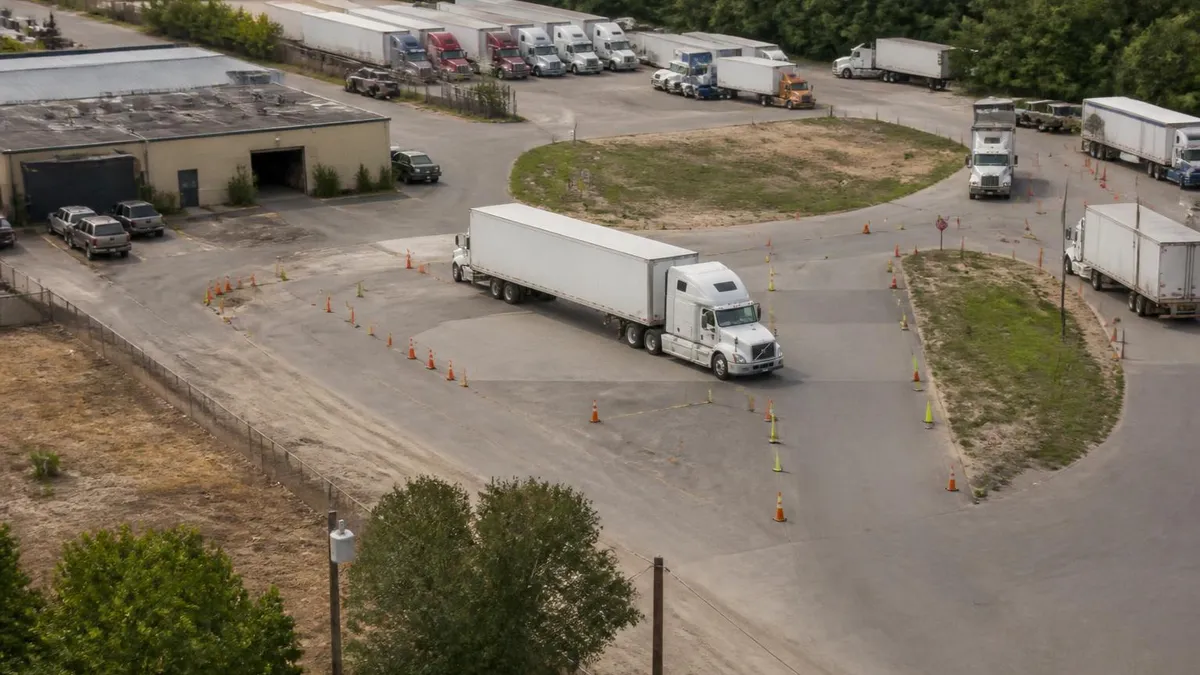
Behind-the-wheel is where the program separates itself from the pack. Range training comes first—backing maneuvers, alley docks, straight-line backing, offset backing, parallel parking, pre-trip inspection. Then public road: city driving, highway, hill descent, lane changes with a full trailer. Most quality programs give you at least 40 hours of seat time over three to four weeks. Some go to 80 or even 120 hours.
Don't fixate only on total hours, though. Stick time matters—the actual minutes you are the driver, not the passenger. A program advertising "160 hours of training" might mean 40 hours stick time and 120 hours sitting in the back of a training truck watching another student. Ask the school to break that down explicitly.
Main Types of CDL Training Programs
Standalone schools focused only on commercial driver's license training. Typically 3-4 weeks full-time, $4,000-$7,000 all-in, the fastest path from enrollment to road test. Quality varies widely across providers, so always cross-check the FMCSA Training Provider Registry plus recent Google reviews before paying.
Run by public colleges as part of workforce development. Usually 4-8 weeks because they fit a semester rhythm, costing $2,500-$6,000. Often Pell Grant–eligible and on state WIOA approved-provider lists. Slower pace but generally solid instruction, lower out-of-pocket cost, and good for tactile learners.
Major carriers like Schneider, Werner, Roehl, CRST, Prime, and Stevens Transport run their own academies. Tuition is free or very cheap in exchange for a 6-12 month driving contract. Includes paid lodging during training and a guaranteed first job, but watch the clawback if you leave early.
Small one-on-one ELDT-registered instructors, sometimes working out of a single tractor. More expensive per hour but deeply personalized and flexible. Rare in most states—you'll have to vet them carefully through the TPR and direct references from former students.
Schools approved for the Post-9/11 GI Bill and VA Vocational Rehabilitation (Chapter 31). Many community colleges qualify, along with national chains like Roadmaster and US Truck Driver Training School. Veteran-friendly programs often include extra job placement support and partner with veteran-friendly carriers.
Theory delivered remotely through a self-paced LMS, behind-the-wheel completed in person at a partner range. Good for working adults who can't drop everything for a month. Just confirm both the theory provider and the partner range are TPR-registered for the exact license class you need.
Let's talk timelines. Most private CDL schools run their flagship Class A program in 3 to 4 weeks full-time. Community colleges stretch it to 6 to 8 weeks because they're working around a semester schedule. Employer-sponsored programs are usually the fastest of all—some hit 3 weeks because they have unlimited equipment, paid range time, and instructors with no other distractions.
If you can only train part-time, expect to double or triple those numbers. A weekends-only program might run 12 to 16 weeks. That works for people who can't quit their day job, but realistically, full-time is the way through. You retain skills better with daily exposure. A two-week gap between range sessions and you'll feel like you've forgotten how to back up.
One scheduling factor most candidates underestimate: the DMV road test wait. After you finish training and pass your school's internal evaluation, you still have to book the actual state skills test. Depending on your state, that wait can be one week or six. Pad your timeline accordingly. California and Florida especially have long DMV queues. Some schools have third-party examiner agreements that bypass the DMV queue—ask about that during enrollment.
And expect at least a few extra days for medical certification (DOT physical), permit application, and any state-specific paperwork. From day one to truck driver: realistic minimum is 5 weeks. Realistic average is closer to 7 or 8. Worth padding your personal budget with that delta in mind—rent doesn't stop because you're between paychecks during training.

Behind-the-Wheel Training Components
The single most-failed part of the CDL skills test, and the place where examiners tank candidates fastest. You'll memorize a full inspection routine—engine compartment fluid checks, in-cab gauges and switches, full walkaround of lights and tires, brake check sequence—and recite it out loud to the examiner while pointing to each component. ELDT programs drill this hard because it's also the one section that's identical across every state. Expect 8 to 15 hours of practice on pre-trip alone in a quality program, plus daily repetition outside formal class time. Bring a checklist; build the muscle memory.
Now the part everyone wants to know: cost. Private trucking academies typically charge $3,500 to $8,500 for a full Class A program, all-in. The lower end usually corresponds to a no-frills school in a low-cost state. The upper end usually means an established chain with better equipment, smaller class sizes, and a road-test pass-rate guarantee.
What's actually included matters as much as the sticker price. A $5,000 program that covers your DOT physical, permit fees, manuals, range fuel, and your first skills-test attempt is genuinely cheaper than a $4,200 program that nickel-and-dimes every line item. When you call a school for a quote, ask exactly what's included and exactly what's not. Get it in writing if you can.
Community college programs run $2,500 to $6,000 typically. They tend to be Pell Grant–eligible if you qualify, which can knock the out-of-pocket cost down dramatically. They're also more likely to accept WIOA workforce development funding (we'll get to that). The trade-off: pace is slower, class sizes are bigger, equipment is often older.
Then there's the question of retake fees, manual purchase, hotel-stay if the school is in another city, fuel for commuting, and lost wages while you train full-time. Build a full budget, not just the tuition line. Most candidates underestimate the total by 20 to 30 percent. A realistic full-cost figure for someone paying privately and traveling to attend, without funding assistance, lands closer to $9,000 to $11,000 once you include lost income for those weeks. That number drops fast with WIOA, Pell, or a sponsoring carrier—sometimes to zero out of pocket.
Employer-paid CDL training looks free upfront, but every major carrier program comes with a contract clawback. If you quit (or get fired) before completing the agreed 6-12 month driving commitment, you owe a prorated chunk of the training cost back—usually $3,000 to $7,000. Read the contract carefully. Ask how the clawback prorates month by month. Don't sign without understanding the exact dollar figure if you leave at the 3-month, 6-month, and 9-month marks.
Employer-sponsored schools deserve their own deep look because—for a lot of new drivers—they're the smartest entry point. The big names in CDL training through carriers include Schneider, Werner, Roehl, Prime Inc, CRST, US Xpress, and Stevens Transport. Each runs its own ELDT-registered academy. Each pays for your tuition. Each, in exchange, asks you to drive for them on a contract.
Schneider's program runs about 4 weeks at one of their training campuses (mostly in Texas, Indiana, and Wisconsin). They cover lodging, transportation to the school, and a small weekly stipend during training. After you finish, you do a few weeks with a mentor on the road. Contract is typically 12 months solo driving.
Werner runs a similar model out of Omaha. Roehl has their famous "Get Your CDL" program out of Wisconsin—widely considered one of the better-quality carrier schools because they limit class sizes and use newer equipment. Their contract is also 12 months. Prime Inc out of Springfield, Missouri, is one of the largest training carriers and offers both solo and team contracts.
The trade-off is straightforward. You get free CDL training, paid lodging, and a guaranteed job afterward. You give up some flexibility for a year. If you know you want to drive long-haul anyway, this is hard to beat. If you're unsure whether long-haul fits your life, paying for your own school and keeping your options open might be worth the extra $5,000.
A practical middle path some drivers take: pay for your own private school, get the CDL in hand without any contract obligation, then choose your starting carrier with full leverage. You'll spend more upfront but you won't be locked into routes or equipment that don't fit you.
What to Verify Before Enrolling in Any CDL School
- ✓School is actively listed on the FMCSA Training Provider Registry at tpr.fmcsa.dot.gov for your exact license class
- ✓Program matches the license class you need (Class A, Class B, or endorsement-specific upgrade)
- ✓Total behind-the-wheel hours and your actual stick time (not just ride-along time) are spelled out in writing
- ✓Instructor-to-student ratio in the truck cab is reasonable (1:2 or 1:3 is fine; 1:5 or more is not)
- ✓Tuition includes pre-trip materials, range fuel, DOT physical exam, permit fees, and your first skills-test attempt
- ✓Job placement assistance or carrier partnerships are documented in writing, not just promised verbally
- ✓Refund and withdrawal policy is clear, written, and reasonable if you change your mind mid-program
- ✓Recent Google, Yelp, and Indeed reviews come from actual former students (not just school marketing copy)
- ✓School's first-attempt state skills-test pass rate is shared openly and is above 70 to 75 percent
- ✓If using funding, school is on your state's WIOA-approved list, VA-approved list, or Pell-eligible roster

Funding is the other piece most candidates underestimate. The federal WIOA (Workforce Innovation and Opportunity Act) program will often cover the full cost of CDL training if you're unemployed, underemployed, or coming off a layoff. The catch: you apply through your state workforce development office, and the school has to be on your state's approved provider list. Many community colleges and chain academies are. Smaller private schools sometimes aren't.
WIOA isn't a check that arrives in the mail. It's a voucher the workforce office issues directly to the school. You typically need an intake appointment, an eligibility determination, and a career counselor sign-off. The process takes 2-6 weeks, so plan ahead. Bring your last pay stub, ID, social security card, and any layoff documentation to the intake.
For veterans, the GI Bill and VA Vocational Rehabilitation cover most accredited CDL programs. The Post-9/11 GI Bill is the most generous, and many schools are approved for it. Vocational Rehabilitation (Chapter 31) goes further for service-connected disabled veterans, often covering tools, fees, and a monthly housing allowance on top of tuition. Talk to your local VA education counselor before picking a school—they'll tell you which ones are approved in your state.
State-level grants exist too. Several states run their own workforce training grants for in-demand fields, and trucking always qualifies. Ask the school's enrollment counselor what state funding they accept—they deal with this every day and know the local landscape. Some unions and trade associations also offer scholarships for trucking school, especially for second-career adults transitioning out of declining industries like coal or manufacturing. Worth a Google search for your specific state plus "CDL training scholarship."
Private School vs Employer-Sponsored Training
- +Private school = full flexibility on your first job choice
- +Private school = no clawback if you change your mind
- +Employer-sponsored = free or very low out-of-pocket cost
- +Employer-sponsored = guaranteed job offer at graduation
- +Employer-sponsored = often includes paid lodging during training
- +Both options produce a valid CDL when school is TPR-registered
- −Private school = $3,500 to $8,500 out of pocket if no funding
- −Private school = you have to find your own first driving job
- −Employer-sponsored = 6-12 month driving contract locks you in
- −Employer-sponsored = clawback debt if you quit early
- −Employer-sponsored = limited choice of routes and equipment year one
- −Both options require you to pay for the DOT physical separately
How do you actually pick a school once you've narrowed it down to two or three candidates? Visit in person if you can. A 30-minute tour will tell you more than any website. Look at the trucks—are they modern, clean, well-maintained, or are they 15-year-old retired fleet vehicles with cracked windshields? Look at the range—is it big enough for proper maneuver practice, or are students stacked on top of each other? Talk to a current student if any are around.
Ask the enrollment counselor: what's your first-attempt pass rate on the state skills test? Any school worth your money tracks this and will tell you. Numbers above 80% are good. Below 70% is a yellow flag. They'll all spin the number, but make them tell you anyway.
Ask about instructor backgrounds. ELDT requires instructors to have at least two years of CDL driving experience or two years of teaching the topic. Some schools go well beyond—former owner-operators or fleet trainers with 20 years of road time. Better instructor = better training. Period.
Finally, check the contract. Some schools charge a non-refundable deposit. Some have liquidated damages clauses if you withdraw partway through. Read every page. If something feels off, push back or walk away. Trucking is a long career—starting it with a school you don't trust is a bad way to begin. And don't be embarrassed to ask the same question twice or to bring a friend to the tour for a second opinion. Schools that bristle at scrutiny are the schools you should avoid.
A few last things worth saying before you make the leap. CDL training is just the start. The first year on the road teaches you more than any classroom can—weather, fuel routes, mountain descents, customer dock etiquette, the rhythm of hours-of-service. The school's job is to get you safe, certified, and licensed. The road's job is to make you a real driver. Don't expect graduation day to feel like an arrival; it's a launch.
Keep your medical card current from day one. The DOT physical only lasts up to 24 months, and many drivers lose driving days because they let it expire. Set a calendar reminder. While you're at it, set one for your CDL renewal too—most states want renewal every 5 to 8 years.
If you're considering endorsements like HazMat, Passenger, or School Bus, ELDT applies to those too. You'll need additional theory and behind-the-wheel hours for each. Most schools can add endorsements to your initial program for an extra $300 to $800 per endorsement. HazMat in particular requires a TSA background check that takes 4-6 weeks, so apply for that early if you want HazMat from day one.
Final point. Pay attention to the soft stuff during training: how you handle stress, how you take feedback from instructors, how you organize your trip-plan paperwork. Trucking culture rewards consistency, calm, and self-management. Drivers who get rattled by an examiner or chew through pre-trip checklists impatiently tend to struggle in the first six months. Build those habits now.
You've got a real career ahead of you. Pick the right school, work the funding angles, finish the program, and ace the skills test. The right commercial driver's license training doesn't drive the truck for you—but it'll put you in the seat with the skills to actually do the job. Good luck out there.
CDL Questions and Answers
About the Author

Licensed Driving Instructor & DMV Test Specialist
Penn State UniversityRobert J. Williams graduated from Penn State University with a degree in Transportation Management and has spent 20 years as a certified driving instructor and DMV examiner consultant. He has personally coached thousands of applicants through written knowledge tests, skills assessments, and commercial driver licensing programs across more than 30 states.
Join the Discussion
Connect with other students preparing for this exam. Share tips, ask questions, and get advice from people who have been there.
View discussion (7 replies)