
LVN to BSN Online: Requirements, Costs, Programs & Timeline Guide 2026 September
LVN to BSN online programs let vocational nurses earn a BSN on a flexible schedule. Compare requirements, cost, accreditation & timelines. 💡

An lvn to bsn online program is one of the most efficient ways for a licensed vocational nurse to climb the nursing career ladder without stepping away from a paycheck. These bridge programs recognize the clinical experience you already carry from years at the bedside and translate it into college credit, allowing you to skip much of the redundant coursework a brand-new student would face.
For working LVNs in California, Texas, and other states, the online format means lectures, discussion boards, and exams fit around twelve-hour shifts rather than fighting against them. If you have wondered what separates a vocational license from a registered nurse credential, the guide on lvn to bsn online breaks down exactly how each title functions and why the bachelor's matters.
The demand driving this surge is not abstract. Hospitals chasing Magnet recognition now require that eighty percent of their nursing staff hold a Bachelor of Science in Nursing, a target set by the Institute of Medicine more than a decade ago and still actively pursued by health systems nationwide. That single policy shift has turned the BSN from a nice-to-have into a hiring filter, and LVNs who only hold a vocational certificate increasingly find themselves capped at long-term care, clinics, and home health roles rather than acute hospital units. An online bridge closes that gap on a schedule you control.
Cost is the second force pushing nurses toward these programs. A traditional four-year BSN can exceed eighty thousand dollars, but an LVN-to-BSN bridge typically runs between fifteen and forty thousand because you are only paying for the credits you still need. Public universities and community college partnerships often land at the lower end, while private and for-profit institutions sit higher. Financial aid, employer tuition reimbursement, and nursing-specific scholarships frequently shave thousands more off the sticker price, making the investment far more approachable than the headline figures suggest at first glance.
Time-to-completion is where online bridges genuinely shine. Depending on whether you already hold an associate degree or are bridging directly from a diploma, you can finish in anywhere from eighteen months to three years of part-time study. Accelerated tracks compress the timeline further for students who can carry a heavier course load, while flexible part-time options stretch it out for nurses juggling family and full-time work. The asynchronous nature of most coursework means you watch lectures at midnight or dawn, whenever your shift schedule finally releases you for a few uninterrupted hours.
It is worth being clear-eyed about what "online" actually means in nursing education, because no reputable program is one hundred percent virtual. The didactic, lecture-based portion of your degree happens online, but clinical hours, the supervised hands-on practice required by every state board of nursing, must be completed in person. Good programs arrange these placements at facilities near your home, sometimes even at the hospital where you already work, so you are not driving hours to a distant site. Understanding this hybrid reality up front prevents an unpleasant surprise later in your studies.
This guide walks through admission requirements, accreditation, real costs, the typical curriculum, and the licensing exam that waits at the finish line. Whether you are an LVN in your first year of practice or a seasoned vocational nurse with a decade behind you, the path to a BSN is more navigable than ever. We will cover how to vet a program for legitimacy, how to budget realistically, and how to prepare for the NCLEX-RN that ultimately converts your hard work into the registered nurse license that unlocks the next stage of your career.
LVN to BSN Online by the Numbers

LVN to BSN Online Pathways at a Glance
For vocational nurses without prior college credit. You complete general-education prerequisites alongside nursing courses, making this the longest track at roughly two to three years of part-time study.
If you already hold an associate degree, much of the prerequisite load transfers in, shrinking your timeline considerably and lowering total cost since you pay only for the remaining upper-division BSN credits.
Designed for students who can carry a heavier course load, this option compresses the bridge into roughly eighteen months of intensive, year-round study without lengthy semester breaks between terms.
Built for nurses working full time, this pathway stretches coursework across more terms with lighter loads, trading a longer finish date for a sustainable balance between work, family, and study.
Admission to an lvn to bsn online program hinges on a handful of core requirements that vary slightly by school but follow a predictable pattern. First and foremost, you need an active, unencumbered vocational nursing license, meaning your LVN or LPN credential is current and free of disciplinary action. Schools verify this directly with your state board, so any lapse or pending investigation can stall your application. Most programs also require a minimum of six months to a year of paid clinical experience, though some accept new graduates who completed their vocational training recently and can document strong academic standing.
Grade point average is the next gatekeeper. The typical floor sits at a 2.5 cumulative GPA, but competitive programs at public universities often expect a 3.0 or higher, particularly in prerequisite science courses. Those prerequisites, anatomy and physiology, microbiology, chemistry, statistics, and human growth and development, form the academic backbone the BSN curriculum builds upon. If you took these during your vocational training, many will transfer; if not, you will complete them before or during the early phase of your bridge program. Transcript evaluation is therefore a critical early step that determines your true timeline and cost.
Accreditation deserves close attention because it directly affects whether your degree counts. Two bodies matter in nursing education: the Commission on Collegiate Nursing Education and the Accreditation Commission for Education in Nursing. A program accredited by either is recognized by employers, qualifies you for federal financial aid, and ensures your credits transfer if you later pursue a master's. Enrolling in an unaccredited program is a costly mistake that can leave you with a worthless diploma and disqualify you from sitting for the licensing exam in many states, so verify this before paying a single dollar.
Beyond the academic and licensing checkboxes, programs frequently require documentation that proves you can safely enter a clinical environment. This includes current immunization records, a recent tuberculosis screening, CPR certification at the healthcare-provider level, a criminal background check, and often a drug screen. These requirements exist because your clinical rotations place you alongside vulnerable patients, and the facilities hosting you demand the same clearances they require of their own employees. Gathering these documents early prevents delays once you are admitted and ready to begin hands-on coursework.
Some programs add a personal statement, letters of recommendation, or an admissions interview to round out the picture. These components let you explain career goals, account for any academic stumbles, and demonstrate the professional maturity that distinguishes a serious bridge student from a casual applicant. A well-written statement that connects your bedside experience to your reasons for advancing can tip a borderline application toward acceptance, especially at programs with limited seats and competitive cohorts. Treat these soft requirements with the same seriousness you give the hard credentials.
Finally, residency and state-specific rules can shape your options. Because clinical placements must comply with the nursing regulations of the state where you practice, an online program based in another state must be authorized to operate and place students in yours. The State Authorization Reciprocity Agreement, known as SARA, simplifies this for many institutions, but you should confirm that your chosen program can legally serve students in your location. Verifying this single detail protects you from enrolling in a program that cannot actually license you where you intend to work as a registered nurse.
How Online LVN to BSN Programs Actually Work
The lecture-based portion of your degree runs fully online through a learning management system. You stream recorded lectures, complete readings, post to discussion boards, and submit assignments on an asynchronous schedule that bends around your shifts rather than forcing you into a fixed classroom time each week.
This flexibility is the entire appeal for working nurses. You might watch a pharmacology lecture at dawn after a night shift and complete a quiz on your day off. Most theory courses, including research, leadership, and pathophysiology, deliver this way, letting you keep earning a full-time income while you study toward your registered nurse credential.
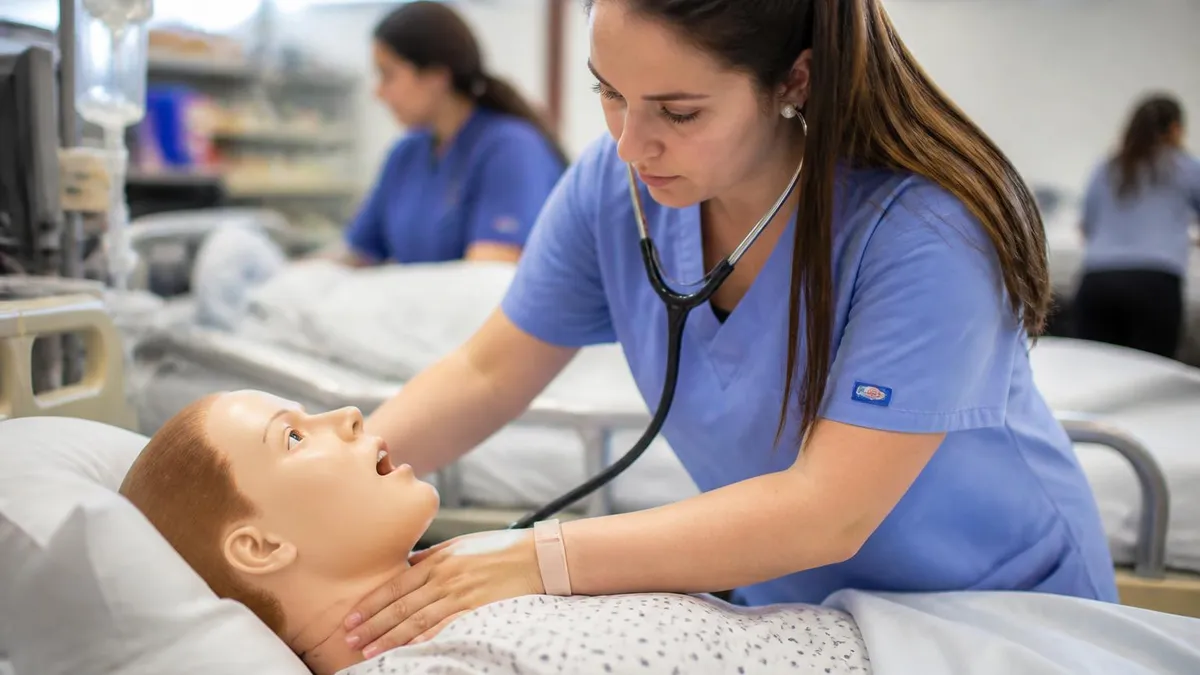
Is an Online LVN to BSN Program Right for You?
- +Keep your full-time nursing income while you study
- +Asynchronous lectures fit around twelve-hour shifts
- +Lower cost than a traditional four-year BSN
- +Faster completion thanks to transferred LVN credit
- +Clinical placements often arranged near your home
- +Unlocks acute-care, leadership, and graduate-school roles
- +Eligible for federal aid and employer reimbursement
- −Clinical hours still require in-person attendance
- −Self-paced format punishes students who lack discipline
- −Online learning can feel isolating without outreach
- −Prerequisite science courses may add time and cost
- −Out-of-state programs need authorization in your state
- −Balancing work, study, and family risks burnout
Your LVN to BSN Online Application Checklist
- ✓Confirm your LVN or LPN license is active and unencumbered.
- ✓Verify the program holds CCNE or ACEN accreditation.
- ✓Check that the program is authorized to enroll students in your state.
- ✓Request official transcripts from every prior school you attended.
- ✓Complete any missing prerequisite science courses.
- ✓Confirm your cumulative GPA meets the program minimum.
- ✓Gather immunization records and a recent TB screening.
- ✓Obtain healthcare-provider-level CPR certification.
- ✓Complete a criminal background check and drug screen.
- ✓Write a personal statement connecting bedside experience to your goals.
- ✓Secure letters of recommendation if required.
- ✓Submit your FAFSA to unlock federal financial aid.
Verify CCNE or ACEN before you pay a cent
An unaccredited program can leave you with a diploma that employers reject, disqualify you from federal aid, and block you from sitting for the NCLEX-RN in many states. Confirm accreditation directly on the CCNE or ACEN website, not just in the school's marketing, before submitting any deposit or signing an enrollment agreement.
The curriculum of an online LVN-to-BSN bridge is engineered to fill the gaps between vocational training and registered-nurse-level practice, which means the coursework leans heavily on theory, leadership, research, and population health rather than the basic skills you already mastered.
Early in the program you will revisit pathophysiology and pharmacology at a deeper level, because a registered nurse is expected to understand not just what medication to give but the cellular mechanisms behind a disease and the full pharmacokinetic picture of every drug administered. This depth separates the clinical reasoning of an RN from the task-focused training of a vocational nurse.
Community and public health nursing is a signature course in nearly every BSN program, and it often surprises students who expected to remain at the bedside. This coursework pushes you out into the community to study how social determinants, epidemiology, and prevention shape the health of entire populations rather than individual patients. You learn to design interventions for groups, understand vaccination campaigns, and recognize the upstream factors that land patients in your hospital in the first place. It is intellectually demanding and frequently the subject of dedicated practice exams because the content is broad.
Nursing research and evidence-based practice form another pillar that distinguishes the bachelor's level. You will learn to read scholarly journals critically, evaluate the strength of clinical studies, and apply current evidence to patient care decisions rather than relying on tradition or routine. This skill is precisely why hospitals value BSN nurses so highly, because they drive quality improvement initiatives and reduce the gap between what research proves and what actually happens at the bedside. Expect at least one full course devoted to research methodology and statistical literacy.
Leadership and management coursework prepares you for the supervisory and coordinating roles that open up once you hold a BSN. You will study delegation, conflict resolution, healthcare finance, staffing models, and the regulatory landscape that governs modern hospitals. Many LVNs find this material genuinely new, since their prior training rarely touched the administrative machinery of a nursing unit. This knowledge becomes the foundation for charge nurse positions, case management, and eventually graduate study toward advanced practice roles that require a bachelor's as the entry point.
Maternal-newborn and pediatric nursing rounds out the specialty content that the BSN demands. Even if your vocational career never took you near labor and delivery or a pediatric ward, your registered nurse license requires competency across the lifespan, and the licensing exam will test you on it. These courses pair didactic instruction with clinical rotations in obstetric and pediatric units, ensuring you can care for a laboring mother, a premature infant, and a sick child with the same confidence you bring to your current patient population. Dedicated practice tests in these areas are invaluable.
The capstone experience ties everything together. Most programs conclude with an integrative clinical practicum where you function as closely to an independent registered nurse as your student status allows, often paired with a preceptor in a real hospital unit.
This is where theory meets reality and where you build the confidence to step into RN practice the moment you pass your licensing exam. Throughout the program, your accumulated coursework and clinical hours position you to sit for the NCLEX-RN, the single national examination that converts your degree into a license to practice as a registered nurse anywhere in the United States.

Because clinical placements must comply with your state's nursing regulations, an online program based elsewhere must be authorized to operate and place students where you live. Many institutions participate in the SARA agreement, but confirm coverage for your state directly. Enrolling without it can leave you unable to license where you intend to work.
Financing an online bridge program is rarely a single transaction; most successful students assemble a patchwork of funding sources that together make the degree affordable. Federal financial aid is the foundation, and completing the Free Application for Federal Student Aid unlocks Pell Grants for eligible students plus low-interest federal loans that carry far better terms than private credit. Because your program is accredited, this aid is fully available, which is yet another reason the accreditation check matters so much before you enroll in any lvn to bsn online pathway you are considering.
Employer tuition reimbursement is often the most overlooked resource, and it can be transformative. Many hospitals and health systems offer thousands of dollars per year toward nursing education precisely because they need BSN-prepared staff to hit their Magnet targets. The catch is usually a service commitment, meaning you agree to remain employed there for a year or two after graduation. For an LVN already working in a hospital that offers this benefit, the program can become nearly free, with the employer covering tuition in exchange for your continued loyalty and the upgraded credential you bring back to the unit.
Nursing-specific scholarships add another layer of savings that many students leave on the table. Professional organizations, hospital foundations, and the federal Health Resources and Services Administration all fund awards aimed at growing the registered nurse workforce. The HRSA Nurse Corps Scholarship Program is especially generous, covering tuition and fees in exchange for a commitment to work in a designated shortage area after graduation. These awards are competitive but far from impossible, and applying to several at once dramatically improves your odds of landing meaningful financial support for your degree.
Budgeting accurately requires looking beyond tuition to the hidden costs that catch students off guard. Textbooks, clinical supplies, uniforms, licensing exam fees, background checks, immunizations, and travel to clinical sites all add up over the length of a program. Setting aside two to three thousand dollars for these ancillary expenses keeps them from derailing your finances midway through. Smart students build this cushion into their plan from day one rather than scrambling to cover an unexpected fee during a busy clinical semester when their attention should be on patients.
The return on investment makes the math worth enduring. The Bureau of Labor Statistics reports that registered nurses earn a median annual wage well above eighty thousand dollars, substantially more than the typical vocational nurse salary that hovers in the low-to-mid fifties. That wage gap of roughly thirty thousand dollars per year means even a forty-thousand-dollar program pays for itself in well under two years of registered nurse earnings. Over a full career, the lifetime difference reaches into the hundreds of thousands of dollars, making the bridge one of the highest-return investments available in healthcare.
Beyond raw salary, the credential expands where and how you can work. Registered nurses qualify for acute-care hospital roles, specialty units, leadership positions, and the graduate programs that lead to nurse practitioner or nurse anesthetist careers. A vocational license, by contrast, increasingly confines nurses to long-term care and outpatient settings. The financial return is real, but the career mobility, the simple fact that the BSN opens doors that stay locked to LVNs, is arguably the larger and more durable payoff of completing the bridge.
Once you are enrolled, succeeding in an online bridge program comes down to discipline, organization, and a few hard-won strategies that experienced students swear by. The first is to treat your asynchronous coursework like scheduled shifts rather than optional tasks you fit in when convenient. Block specific hours on your calendar each week for lectures, reading, and assignments, and protect that time as fiercely as you would protect a clinical rotation. Online programs fail students who drift, not students who study, and the freedom of self-paced learning becomes a trap without firm personal structure imposed from day one.
Your prior bedside experience is a genuine advantage, so lean on it. Unlike traditional students encountering clinical concepts for the first time, you already know how a patient deteriorates, how medications behave in real bodies, and how a unit actually runs. When abstract theory appears in your textbooks, anchor it to scenarios you have lived. This connection between lived practice and academic content cements knowledge far more durably than rote memorization, and it gives you a head start on the clinical-judgment questions that dominate the modern licensing exam you will eventually face.
Building a relationship with your instructors and academic advisors pays dividends throughout the program. Online learning can feel isolating, but faculty respond to students who reach out, ask thoughtful questions, and show genuine engagement. Your advisor is also your best resource for navigating clinical placement logistics, transfer-credit questions, and the inevitable scheduling conflicts between your job and your studies. Nurses who stay in regular contact with their support network finish at far higher rates than those who try to white-knuckle the entire program in silence and isolation from their school.
Preparing for the NCLEX-RN should begin long before your final semester, not after graduation. The exam uses computerized adaptive testing and now emphasizes the Next Generation NCLEX format, which presents complex case studies that test clinical judgment rather than simple recall. Weaving practice questions into your routine from the very start builds the test-taking stamina and reasoning patterns the exam rewards. Targeted practice tests in high-yield areas like community health, maternal-newborn nursing, and pharmacology expose your weak spots while there is still time to strengthen them before the stakes become real.
Managing the clinical-hour requirement demands proactive planning rather than last-minute scrambling. Reach out to your program's clinical coordinator early to understand placement timelines, and if your program allows self-arranged placements, start cultivating relationships at potential host facilities well in advance. If you can complete rotations at your current workplace, the familiarity reduces stress and travel. Whatever the arrangement, treat your clinical hours as the bridge between your vocational past and your registered nurse future, the place where everything you have studied finally becomes real, supervised practice.
Finally, guard your wellbeing across the months of study. Burnout is the silent killer of bridge-program completion, especially for nurses already working full time and managing families. Build genuine rest into your schedule, lean on classmates who understand the grind, and remember why you started, the career mobility, the higher salary, and the professional respect that the registered nurse credential confers. The program is finite, the payoff is permanent, and thousands of vocational nurses have walked this exact path before you and emerged on the other side as fully licensed registered nurses.
BSN Questions and Answers
BSN, RN & BSN-RN: What These Credentials Mean

BSN to NP Programs: Pathways from Bachelor's of Nursing to Nurse Practitioner, Program Types, Costs, and Career Outcomes
ADN to BSN Online: Bridge Programs and Costs Complete Guide

Accelerated BSN Programs by Location: Complete US Guide With Canada Comparison for 2026

Accredited BSN Programs: Complete Guide to CCNE and ACEN Nursing Degrees in 2026
About the Author

Registered Nurse & Healthcare Educator
Johns Hopkins University School of NursingDr. Sarah Mitchell is a board-certified registered nurse with over 15 years of clinical and academic experience. She completed her PhD in Nursing Science at Johns Hopkins University and has taught NCLEX preparation and clinical skills courses for nursing students across the United States. Her research focuses on evidence-based exam preparation strategies for healthcare certification candidates.