
BSN to NP Programs: Pathways from Bachelor's of Nursing to Nurse Practitioner, Program Types, Costs, and Career Outcomes
BSN to NP programs: 🎓 MSN and DNP pathways, online options, costs, admission requirements, specializations, and career outcomes for nurse practitioners.
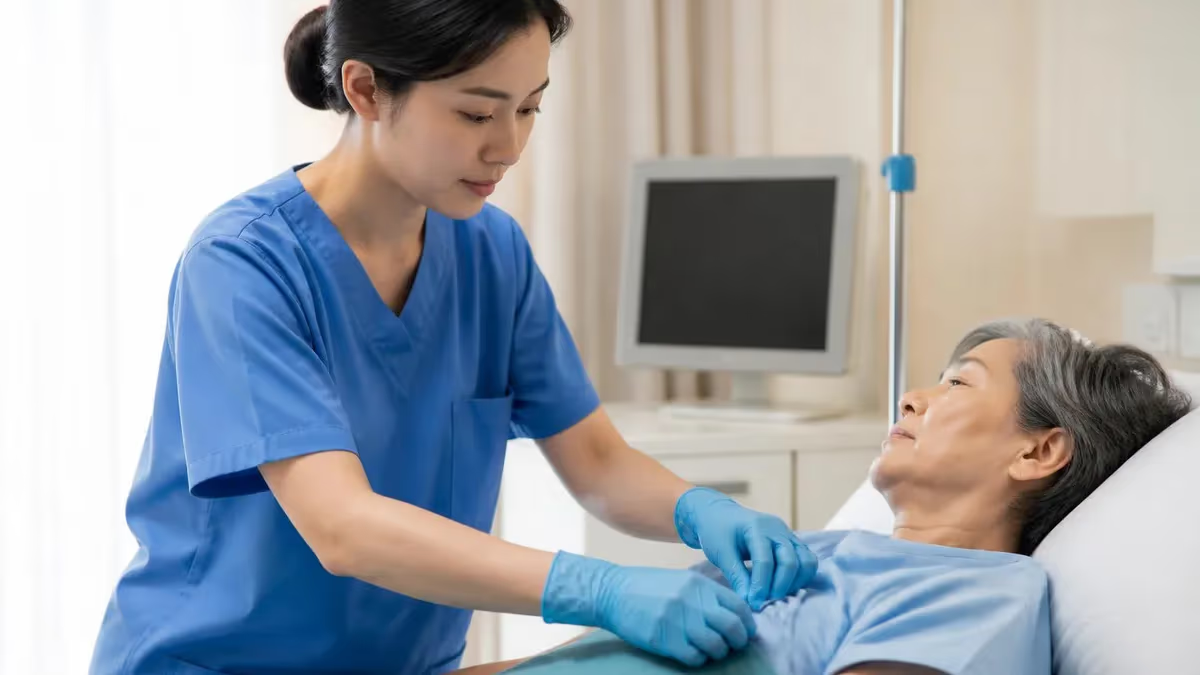
BSN to NP lvn to bsn programs in texas the gap between bedside nursing and advanced practice. After earning a Bachelor of Science in Nursing (BSN) and gaining clinical experience as a Registered Nurse (RN), many nurses pursue a Nurse Practitioner (NP) credential. The pathway requires graduate education — either a Master of Science in Nursing (MSN) or a Doctor of Nursing Practice (DNP) — plus national certification and state licensure.
Two main pathways. The MSN route is faster (2-3 years full-time) and traditionally more common. The DNP route takes 3-4 years and is becoming the preferred terminal practice degree. The AACN recommended in 2004 that DNP become the standard entry-level credential for NPs by 2015. That hasn't happened universally — both MSN and DNP-prepared NPs remain eligible for certification — but DNP is growing.
Why pursue NP. Higher autonomy: NPs diagnose, prescribe, and treat in most states. Higher pay: NP median ~$126,260 vs RN ~$86,070 (BLS 2024). Better hours: many NP roles avoid bedside shift work. Specialization: choose family practice, acute care, pediatrics, psychiatric/mental health, women's health, gerontology. Job growth: NP is one of the fastest-growing occupations (BLS projects 45% growth 2023-2033).
Specialization matters. NPs train in a specific population focus during graduate school. Family Nurse Practitioner (FNP) is the most common (~65% of NPs) and treats patients across the lifespan. Adult-Gerontology Primary or Acute Care NP. Pediatric Primary or Acute Care NP. Psychiatric-Mental Health NP (PMHNP) — fastest-growing specialty. Women's Health NP. Neonatal NP. Once certified in a specialty, you're scope-limited to that population.
This guide covers program types, admission requirements, costs, timeline, online vs in-person options, certification, licensure, and career outcomes. It's intended for BSN-prepared RNs considering NP school.
Pathway Overview
- BSN to MSN-NP: 2-3 years full-time, $35-80k tuition, MSN degree
- BSN to DNP: 3-4 years full-time, $50-120k tuition, DNP degree
- Part-time option: Most programs offer 3-5 year part-time tracks
- Online programs: Most coursework online; clinicals in your community
- Clinical hours: 500-700 hours for MSN, 1,000+ for DNP
- RN experience: Most programs require 1-2 years; some accept new BSN grads
- GRE: Many programs have waived; check current requirements
- Certification: ANCC or AANP exam after graduation
- State licensure: Apply to state BON for APRN/NP license
- Starting salary: $95-110k typical; varies by specialty and region
BSN to MSN-NP pathway. The traditional route. Faster, less expensive, still widely accepted for certification and practice.
Curriculum. The MSN-NP curriculum typically includes 40-50 credit hours over 2-3 years. Core graduate nursing courses (advanced pathophysiology, advanced pharmacology, advanced health assessment — the three Ps), research and evidence-based practice, healthcare policy and leadership, role of the APRN. Specialty courses: clinical management of patients in your population focus (FNP courses cover lifespan primary care, PMHNP covers psychotherapy and psychopharmacology, etc.). Clinical practicum: 500-700 supervised clinical hours in your specialty.
Timeline. Full-time: 2 years (4-5 semesters). Part-time: 3-4 years. Many working RNs do part-time. Some accelerated programs compress to 18-21 months.
Cost. Tuition varies widely. Public in-state: $30,000-45,000 total. Public out-of-state: $50,000-80,000. Private: $60,000-100,000. Online programs often charge in-state rates regardless of residency. Add fees, books, clinical site fees, certification exam fees ($300-400).
Where the MSN-NP makes sense. You want to practice as an NP as quickly as possible. Budget is a major consideration. You don't plan to teach in academia or pursue research. Your employer's tuition reimbursement covers MSN better than DNP. You want to test the waters and could pursue post-MSN DNP later (programs exist).
BSN to DNP pathway. The terminal practice degree. Longer, more expensive, but increasingly preferred — especially for new program entries and some specialties.
Curriculum. 70-90+ credit hours over 3-4 years. All MSN content plus DNP-specific courses: advanced quality improvement, healthcare informatics, leadership and systems thinking, advanced research methods, capstone DNP scholarly project. Clinical hours: 1,000+ minimum (AACN essentials), though many programs exceed.
Timeline. Full-time: 3 years. Part-time: 4-5 years. BSN-to-DNP is a single coordinated program — you don't earn an MSN along the way at most schools (though some award MSN as a milestone).
Cost. Public in-state: $50,000-70,000. Public out-of-state: $80,000-120,000. Private: $90,000-150,000.
Where the BSN-to-DNP makes sense. You want the terminal practice degree. You may want to teach nursing later (DNP is increasingly required for faculty). You're early in your career and the extra year is worth the credential. The school you want only offers BSN-to-DNP for your specialty (some are phasing out MSN-NP).

Compare MSN vs DNP
MSN: 2-3 years. DNP: 3-4 years. Difference: ~1 year.
MSN: $35-80k. DNP: $50-120k. DNP costs $20-40k more typical.
MSN: 500-700 hours. DNP: 1,000+ hours. DNP requires more clinical.
Identical. Both eligible for same certification, same NP licensure, same scope.
Minimal difference. Specialty and location matter far more than degree.
DNP preferred for nursing faculty. MSN can teach clinical but often capped.
Admission requirements. Competitive but achievable for most BSN-prepared RNs.
BSN degree from an accredited program. CCNE or ACEN accreditation required. Some programs accept ADN-BSN (associate's then bachelor's bridge) — fully accredited BSN equivalent.
Active unencumbered RN license. License must be in good standing in at least one state. Multistate (NLC) license preferred for online programs since clinicals may span states.
RN experience. Most programs require 1-2 years of clinical RN experience before matriculation. Some specialties prefer specific experience — acute care NP programs prefer ICU/ED experience, PMHNP programs prefer psychiatric experience. Some programs accept new BSN grads (direct-entry MSN programs) but BSN-to-NP typically means you have RN experience.
GPA. Minimum 3.0 typical; competitive programs want 3.3-3.5+. Science and nursing course GPA matters most.
GRE. Many programs have waived GRE post-2020. Some still require it (Vanderbilt, some Ivy programs). Check current requirements — they change.
References. 2-3 professional references from RN supervisors, nursing faculty, or physicians who can speak to clinical competence.
Personal statement / essay. Why this specialty, why NP, why this program. Tailor to each application.
Resume / CV. Nursing experience, certifications (CCRN, CEN, etc.), continuing education, leadership roles, publications if any.
Interview. Most programs interview top candidates (in-person, video, or both).
Online vs in-person programs.
Online programs. Coursework delivered online (asynchronous lectures, synchronous discussions). Clinicals completed in your local community — you arrange preceptors with school support. Annual on-campus residencies (1-2 weeks) for skills labs and exams at some schools. Flexible for working RNs.
In-person programs. Traditional university campus. More structured cohort experience. Better access to faculty mentorship. May have school-arranged clinical placements. Less flexibility for working full-time.
Hybrid. Coursework on-campus part-time (evenings/weekends), clinicals nearby. Good middle ground for some.
Quality. Accreditation matters more than format. CCNE-accredited online rn to bsn programs (e.g., Vanderbilt online, Duke, Columbia, Georgetown, Frontier) are equivalent to in-person counterparts for certification and licensure. Don't choose based on format alone — research outcomes (certification pass rates, job placement).
NP Specialties
Most common specialty (~65% of NPs). Treat patients across the lifespan: pediatrics, adolescents, adults, elderly. Primary care focus. Excellent versatility — work in clinics, urgent care, retail health, family practice. Strong job market everywhere. Median: $115-125k. Most programs offered as FNP track.
Top BSN-to-NP programs. Many excellent programs exist. Selection depends on specialty, format, cost, location.
Top-ranked (US News, with strong outcomes). Johns Hopkins (Baltimore). Duke (Durham, NC) — strong lvn to bsn programs in texas. University of Pennsylvania (Penn Nursing). Columbia (NYC) — strong DNP program. Vanderbilt (Nashville) — major online presence. University of Washington (Seattle). UCSF (San Francisco). Yale. Emory (Atlanta). University of Michigan. Each offers multiple specialties, MSN and DNP tracks.
Strong online programs. Frontier Nursing University — pioneer in distance education for NP and midwifery, FNP/PMHNP/WHNP tracks. Georgetown University Online — FNP, AGACNP, NMNP, WHNP. Maryville University — large online enrollment. Walden University — large enrollment, fully online. University of Cincinnati Online. Old Dominion University.
Affordable options (in-state public). University of Texas at Arlington Online. Texas Tech HSC. University of South Alabama. University of Central Florida. Florida International University. Western Governors University (limited NP, more flexible MSN). State flagship universities often offer best value for in-state residents.
What to look for. CCNE or ACEN accreditation — non-negotiable. National certification pass rate — published or available on request. Should be 85%+. Time-to-completion data. Cost transparency. Clinical placement support — for online programs, how much does school help find preceptors? Class size and faculty-to-student ratio. Specialty fit — not all programs offer all specialties.
What to avoid. Programs without CCNE/ACEN accreditation (won't be eligible for certification or financial aid). Programs with low certification pass rates. Programs with for-profit reputation issues. Programs that don't disclose clinical placement help (you may be on your own finding preceptors — major issue).
Financing your education. NP school is expensive. Plan funding before applying.
Federal loans. Direct Unsubsidized Loans for grad students (up to $20,500/year). Grad PLUS Loans for additional cost. File FAFSA early.
Employer tuition reimbursement. Many hospitals offer $5,200-15,000/year for nursing degrees. Often requires service commitment after graduation (2-4 years typical). Major reducer of out-of-pocket cost. Ask HR before applying to NP school.
HRSA Nurse Corps Scholarship. Full tuition + stipend in exchange for 2-3 years working at HRSA-designated underserved facility post-graduation. Highly competitive but significant.
NHSC (National Health Service Corps) loan repayment. After graduation, up to $50,000 in loan repayment for 2 years at NHSC site. Stackable benefits.
Indian Health Service. Loan repayment for working in IHS facilities.
VA programs. National Education for Employees Program (NEEP) and Health Professional Scholarship Program (HPSP) for VA nurses.
State programs. Many states have NP loan forgiveness for working in underserved areas.
BSN to NP Numbers

Certification after graduation. Two certifying bodies, exam by specialty.
AANP (American Academy of Nurse Practitioners). Certifies FNP, AGPCNP, and ENP. Exam fees $315 (member) - $425 (non-member). Computer-based, 150 questions, 3 hours. Pass rate 85-87% first attempt.
ANCC (American Nurses Credentialing Center). Certifies FNP, AGPCNP, PMHNP, AGACNP, PNP-PC. Exam fees $295 (member) - $395 (non-member). 175 questions, 3.5 hours. Pass rate 86-88% first attempt.
Specialty-specific certifying bodies. PNCB (Pediatric Nursing Certification Board) — PNP. AACN (American Association of Critical-Care Nurses Certification Corporation) — AGACNP. NCC (National Certification Corporation) — WHNP, NNP.
Eligibility. Graduation from CCNE/ACEN-accredited NP program with required clinical hours in the specialty. Current unencumbered RN license. Application typically accepts when you can document completion.
Recertification. AANP: every 5 years, 100 CE hours + 1,000 practice hours, OR retake exam. ANCC: every 5 years, similar requirements. Plan ongoing CE from day one.
State licensure as APRN/NP. Certification doesn't grant practice rights — state license does.
Apply to State Board of Nursing in state of practice. Documents needed: official transcripts, certification, RN license, background check. Some states require additional CE in pharmacology or controlled substances. Processing time: 4-12 weeks. Plan ahead before starting your job.
Scope of practice varies by state. Full practice authority (27 states + DC + territories): NPs practice independently without physician oversight. Examples: Washington, Oregon, Colorado, Minnesota, Iowa, New Mexico, Arizona, Alaska, Hawaii, Maine, Vermont, New Hampshire, New York, Nevada. Reduced practice (12 states): collaborative practice agreement with physician required. Restricted practice (11 states): supervisory or delegated authority from physician — most restrictive. Examples include Florida, Texas, California (partial — gaining FPA gradually), Georgia.
DEA registration. Required to prescribe controlled substances. Apply after state license issued. Annual renewal, $888 fee (subject to change).
Career outlook. Strong across specialties and regions.
BLS data. 45% projected growth 2023-2033 — among fastest-growing occupations. ~30,000 new NP jobs annually. Median pay $126,260; top 10% over $170,000.
Where NPs work. Outpatient clinics (~45%): family practice, internal medicine, specialty clinics. Hospitals (~30%): acute care, hospitalist, ED, ICU. Other (~25%): urgent care, retail clinics, telehealth, government, academia, research.
Geography. Demand is strong everywhere but salary varies. Highest pay: California ($156k), Nevada ($142k), Washington ($140k), New Jersey ($138k), New York ($136k). Cost of living factors — adjusted, midwest and south often offer better take-home.
Telehealth. Major growth area post-2020. Many NPs now do partial or fully remote work — especially PMHNP, primary care, follow-up management. Telehealth platforms (Talkspace, Cerebral, Hims/Hers) hire NPs in high numbers.
Choose Your Specialty
FNP — see anyone, any age, primary care everywhere. Most flexible.
AGACNP — ICU/ED/hospital. Acute care RN background ideal.
PNP — pediatric clinics, children's hospitals. Peds nursing background helpful.
PMHNP — fastest-growing, highest demand, often remote, top pay.
WHNP — OB/GYN, women's clinics. Reproductive care focus.
AGPCNP — adults only, internal medicine, geriatrics. No kids.
Application timeline. Plan 12-18 months ahead.
18 months out. Decide MSN vs DNP. Choose specialty. Research programs. Visit if possible.
12 months out. Request transcripts. Identify recommenders, give them advance notice. Start drafting personal statement. Take GRE if required.
9 months out. Complete applications. Most programs accept fall semester applications by January for following fall. Some have rolling admissions or multiple start dates (spring, summer, fall).
6 months out. Interviews (October-March typical). Acceptance notifications.
3 months out. Accept admission, financial aid finalization, FAFSA filing for grad school funding.
Pre-start. RN license — ensure unencumbered and in correct state. Compact license if doing online with multi-state clinicals.
During the program. Strategies for success.
Reduce work hours if possible. Going from 36-40 hours/week to 24-32 is common. Some students go part-time RN to focus on school.
Maintain clinical sharpness. Even part-time RN work keeps clinical skills active.
Build clinical relationships early. For online programs, start looking for preceptors 6 months before clinicals begin. School should help but you do the legwork.
Attend clinicals seriously. Clinical hours are where NP skills develop. Show up prepared, ask questions, document well, build relationships with preceptors.
Network. Join AANP and your state NP association. Attend conferences. Connect with NPs in your specialty. Many job opportunities come through network.
Plan for boards. Start board review 4-6 months before graduation. Leik, Fitzgerald, Hollier are popular review sources. APEA, Barkley review courses help. Plan to take exam within 3 months of graduation while content is fresh.
After graduation. The transition to NP practice.
Pass certification exam. Take within 3 months of graduation if possible.
Apply for state APRN/NP license. Can sometimes start while certification pending.
Apply for DEA registration. Necessary for prescribing controlled substances. Takes 4-8 weeks.
Job search. Start 3-6 months before graduation. Many employers hire pre-graduation contingent on board pass.
Onboarding. First NP job has a learning curve. Many employers have NP fellowship/residency programs (6-12 months structured onboarding). Highly recommended for new grads.
Build practice. First 6-12 months are about learning systems, building patient relationships, developing efficiency. Most NPs report comfortable independent practice by 12-18 months.
1. Choosing format before fit. Don't pick fully online because it's convenient if you'd thrive in-person. Pick the program that fits your learning style and career goals.
2. Ignoring clinical placement support. For online programs, the biggest issue is finding preceptors. Programs that don't help you secure clinicals can extend your timeline by 6-12 months.
3. Wrong specialty. You're locked into population scope after graduation. Pick the specialty you'll work in — don't pick FNP because it's flexible if your true interest is psych.
4. Underestimating cost. $50-120k all-in. Plan financing before starting. Employer reimbursement, HRSA programs, federal loans, scholarships — research before applying.
5. Not building network. Many NP jobs come through professional connections. Join AANP, attend conferences, build clinical preceptor relationships.
6. Skipping fellowship/residency. New NPs benefit enormously from structured first-year programs. Apply if available — better long-term than diving into unsupported solo practice.
Salary expectations vary by specialty, geography, experience, and setting. National median is $126,260 (BLS 2024), with 10th percentile at $94k and 90th at $170k+.
By setting. Hospital pays 10-15% higher than outpatient. Locum tenens (temporary contracts) pays $90-130/hour but no benefits. Telehealth is competitive with traditional roles. Academia pays lower base ($85-110k) but offers schedule benefits.
By geography. Highest pay: California, Hawaii, New York, Massachusetts, Washington, Nevada. Lowest: Tennessee, Alabama, Mississippi, West Virginia. Adjusted for cost of living, midwest and south often net better.
By experience. New grad: $95-115k typical. 5+ years: $115-140k. 10+ years with leadership: $140k+. Sign-on bonuses of $5,000-25,000 are common in high-demand areas.
BSN to NP alternatives. If the full NP pathway doesn't fit, consider Nurse Midwife (CNM), Nurse Anesthetist (CRNA — $200k+ but ICU experience required), Clinical Nurse Specialist (CNS), or MSN in Education/Leadership tracks. Physician Assistant (PA) school is a complete pivot to medical training rather than nursing.
Salary by Specialty
Online vs In-Person
Coursework 100% online. Clinicals in your community. Annual on-campus residencies common (1-2 weeks). Best for: working RNs, those in areas without programs, self-directed learners. Concerns: clinical placement may be challenging, less face-to-face networking. Examples: Frontier, Walden, Maryville, Georgetown Online, Vanderbilt Online.
State practice authority dictates how much autonomy you'll have. Full practice authority (FPA) means NPs evaluate, diagnose, prescribe, and manage care without physician oversight. Reduced practice requires a collaborative agreement. Restricted practice mandates ongoing physician supervision.
FPA is now in 27 states plus DC. Recent additions include Massachusetts (2020), Delaware (2021), Kansas (2022), New York (2022), Utah (2023), and California (partial, 2023). The trend strongly favors expanded NP authority — most state-level NP organizations are lobbying for FPA.
What this means for you. Restricted states often pay less since NP revenue requires physician oversight overhead. If geographically flexible, prioritize FPA states. Telehealth-portable specialties (PMHNP especially) can be licensed in multiple states and route work to FPA jurisdictions.
Continuing education. AANP renewal: 100 CE hours every 5 years + 1,000 practice hours, or retake exam. ANCC: 75 CE hours + 1,000 practice hours + professional development. State licenses typically require 30-50 hours per renewal cycle. Many states mandate 25-30 hours of pharmacology CE. Track certificates throughout — don't scramble at renewal.
Application Strategy
Reach (1-2), match (2-3), safety (1-2). Diversify by selectivity.
3.3+ overall, 3.5+ in science/nursing. Take graduate-level prereqs to boost if needed.
ICU for AGACNP, psych for PMHNP, peds for PNP. Strengthens application.
Specific 'why this program,' 'why this specialty.' Avoid generic statements.
Direct supervisors, faculty who know your work. Coach them on what to highlight.
Mock interviews, research program faculty, prepare 5-10 thoughtful questions.
The transition from RN to NP is challenging — the first year is the hardest. As an RN you executed care plans; as an NP you create them. You're the decision-maker now. Diagnostic confidence develops slowly, and it's normal to feel uncertain early.
Time management and burnout are the two biggest first-year struggles. Patient visits are 15-30 minutes, with documentation and follow-up filling remaining hours. Many new NPs run behind and chart at home — set boundaries early, take vacation, use CE time, and seek mentorship.
Long-term outlook is strong. NP is one of healthcare's best careers — job security, good pay, clinical autonomy, intellectual engagement, varied settings. Many NPs work 30+ year careers with continued growth and sub-specialization.
Year-One Strategy
Senior NP or physician who'll answer clinical questions. Crucial first 12 months.
UpToDate, clinical decision rules. Slower but safer — speed comes later.
Don't chart at home routinely. Burnout is real. Protect off-hours fiercely.
Structured first-year programs accelerate growth. Apply if available.
BSN Pros and Cons
- +BSN has a publicly available content blueprint — you know exactly what to prepare for
- +Multiple preparation pathways accommodate different schedules and budgets
- +Clear score reporting shows specific strengths and weaknesses
- +Study communities share current insights from recent test-takers
- +Retake policies allow recovery from a difficult first attempt
- −Tested content scope requires substantial preparation time
- −No single resource covers everything optimally
- −Exam-day performance can differ from practice test performance
- −Registration, prep, and retake costs accumulate significantly
- −Content changes between versions can make older materials less reliable
Pros and Cons at a Glance
| Pros | Cons |
|---|---|
| BSN has a publicly available content blueprint — you know exactly what to prepare for | Tested content scope requires substantial preparation time |
| Multiple preparation pathways accommodate different schedules and budgets | No single resource covers everything optimally |
| Clear score reporting shows specific strengths and weaknesses | Exam-day performance can differ from practice test performance |
| Study communities share current insights from recent test-takers | Registration, prep, and retake costs accumulate significantly |
| Retake policies allow recovery from a difficult first attempt | Content changes between versions can make older materials less reliable |
Sample BSN - Degree Bachelor of Science in Nursing Practice Questions
Try these questions from our free BSN - Degree Bachelor of Science in Nursing practice tests. The correct answer and an explanation follow each question.
A nurse is teaching a patient with type 2 diabetes about the 'Sick Day Rules.' Which instruction is most important?
- A. Stop taking all oral hypoglycemics when ill
- B. Increase fluid intake and continue monitoring blood glucose
- C. Fast until nausea subsides to prevent hypoglycemia
- D. Reduce insulin dose by half when unable to eat
Answer: B. Increase fluid intake and continue monitoring blood glucose
Illness raises blood glucose due to stress hormones; patients must stay hydrated, monitor glucose frequently, and not stop medications without guidance.
When applying a dry sterile dressing, the nurse should use which type of tape application to secure the dressing edges?
- A. Circumferential taping around the entire extremity to ensure firm adhesion
- B. Tape only the center of the dressing to allow drainage to escape the edges
- C. Tape all four sides of the dressing in a picture-frame pattern
- D. Tape diagonally across the dressing for maximal hold
Answer: C. Tape all four sides of the dressing in a picture-frame pattern
Taping all four sides in a picture-frame pattern secures the dressing and maintains a sterile barrier without restricting circulation.
A nurse notes that a patient's IV insertion site is pale, cool, swollen, and the infusion has slowed. The nurse recognizes this as:
- A. Phlebitis
- B. Infection
- C. Infiltration
- D. Air embolism
Answer: C. Infiltration
Infiltration occurs when IV fluid leaks into surrounding tissue, causing pallor, coolness, swelling, and slowed infusion rate.
A patient is receiving IV heparin and the aPTT result is 120 seconds (normal therapeutic range 60–100 seconds). What is the nurse's priority action?
- A. Notify the provider and anticipate a dose reduction
- B. Increase the infusion rate per sliding scale
- C. Administer protamine sulfate immediately
- D. Draw a repeat aPTT in 2 hours
Answer: A. Notify the provider and anticipate a dose reduction
An aPTT above the therapeutic range indicates supratherapeutic anticoagulation, so the nurse must notify the provider to adjust the dose.
Take the full BSN - Degree Bachelor of Science in Nursing practice test
BSN Questions and Answers
Resources for BSN-to-NP candidates. Build a resource toolkit.
Program search. AACN program finder. US News NP rankings (with caveats — rankings are imperfect). NursingProcess.org reviews. Each state's BON website lists in-state programs.
Certification prep. Leik's Family Nurse Practitioner Certification Review (gold standard). Fitzgerald's Family Nurse Practitioner Certification Examination and Practice Preparation. Hollier's review courses. APEA review materials. Barkley & Associates review courses (live and online).
Professional associations. AANP (American Academy of Nurse Practitioners) — primary organization, lobbying, CE, conferences. AACN (American Association of Critical-Care Nurses) — AGACNP-relevant. APNA (American Psychiatric Nurses Association) — PMHNP-focused. NAPNAP (National Association of Pediatric NP/Associates) — PNP-focused. State NP associations.
Clinical resources. UpToDate (subscription). Medscape (free). Dynamed. Epocrates. PubMed for primary literature. Specialty journals (Journal of the American Association of Nurse Practitioners, Nursing for Women's Health, etc.).
Job search. Indeed, LinkedIn, Health eCareers, NP Jobs (npjobs.com). Specialty-specific boards (PMHNP jobs, AGACNP jobs). State NP association job boards.
Final thoughts. BSN to NP is a significant investment of time, money, and energy. The return — clinical autonomy, better pay, flexible career options, and meaningful patient care — is well worth it for most who pursue it.
Plan carefully. Choose specialty thoughtfully. Pick a program that fits your life and goals, not just one that's prestigious or convenient. Use financial aid strategically. Build relationships during school. Network deliberately. The pathway leads to one of healthcare's best careers.
Whether you choose MSN or DNP, online or in-person, FNP or specialty — the destination is the same: practicing as a nurse practitioner, expanding access to care, and building a meaningful career. Take the first step by researching programs, talking to current NPs in your target specialty, and starting your application timeline today.
About the Author

Registered Nurse & Healthcare Educator
Johns Hopkins University School of NursingDr. Sarah Mitchell is a board-certified registered nurse with over 15 years of clinical and academic experience. She completed her PhD in Nursing Science at Johns Hopkins University and has taught NCLEX preparation and clinical skills courses for nursing students across the United States. Her research focuses on evidence-based exam preparation strategies for healthcare certification candidates.