
Best Online RN to BSN Programs: Top Accredited Schools for 2026 October
📚 Compare the best online RN to BSN programs for 2026 October. Accredited, affordable, flexible tracks with admission requirements, costs, and graduation timelines.
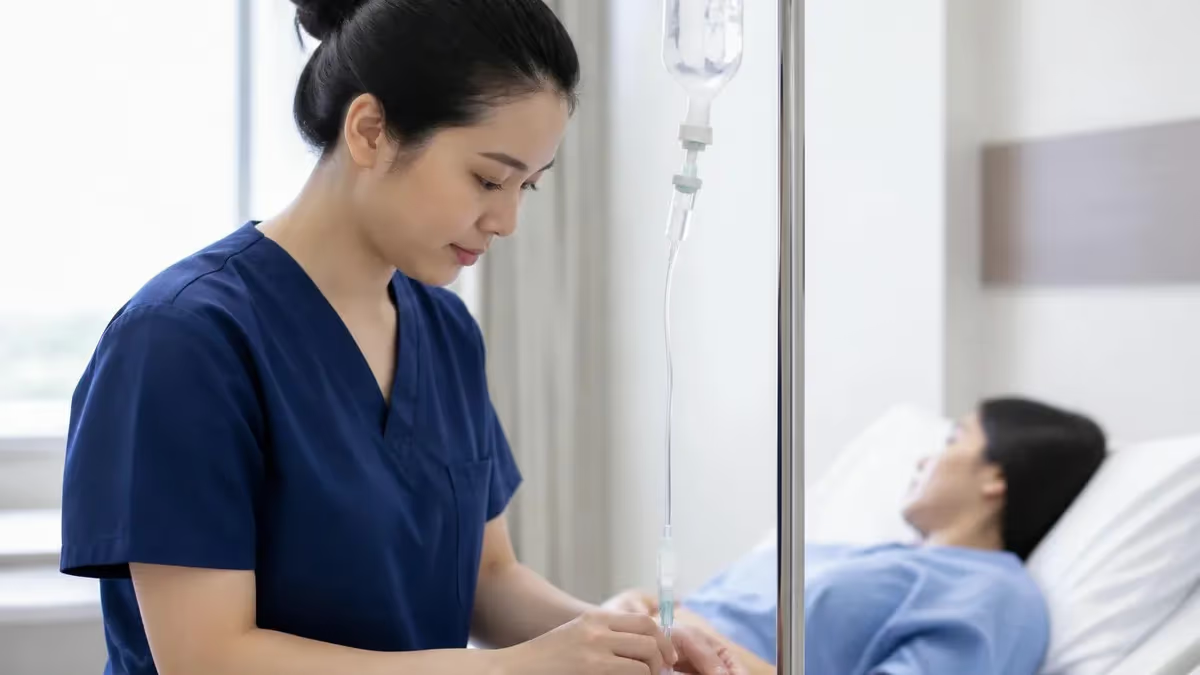
Choosing among the best online RN to BSN programs in 2026 has become a high-stakes decision for working registered nurses who want to qualify for Magnet hospital positions, leadership roles, and graduate study without leaving the bedside. The right program protects your license, fits a 36-hour clinical schedule, and finishes in 12 to 18 months while costing less than $15,000 in total tuition. The wrong program drags out for three years, charges $40,000, and leaves you with credits that will not transfer into a future MSN.
This guide ranks and explains the strongest accredited online rn to bsn programs RN to BSN tracks in the United States, focusing on schools that hold CCNE or ACEN accreditation, accept a wide range of community college transcripts, and price tuition at a flat per-credit rate. We compare admission requirements, course sequencing, capstone format, technology requirements, and the realistic week-by-week workload so you can match a program to your shift pattern rather than the other way around.
Demand for BSN-prepared nurses keeps climbing because hospitals tracking Magnet status need at least 80 percent of their direct-care RNs to hold a baccalaureate, a target the original Institute of Medicine report set for 2020 that most facilities still have not reached. That gap is why employers reimburse tuition aggressively, why bridge programs have multiplied, and why competition for the best seats fills cohorts months before the official deadline.
Most online RN to BSN students are already licensed and working, which changes everything about course design. You will not repeat med-surg, pharmacology, or skills labs. Instead, you complete upper-division coursework in community and public health nursing, nursing research and evidence-based practice, leadership and management, informatics, and population-focused care. A capstone project replaces traditional clinical rotations, and most schools let you complete required practicum hours inside your current workplace.
Pricing varies wildly. Public state universities such as Western Governors, Fort Hays State, and Texas Woman's University price the full degree between $6,000 and $12,000. Mid-tier private schools land around $15,000 to $20,000. For-profit chains can exceed $30,000 and frequently load on extra fees. Tuition reimbursement programs at HCA, Ascension, Kaiser, and the VA can cover 60 to 100 percent of these totals if you stay employed through the contract period.
Throughout this article we reference timeline data, employer expectations, and curriculum benchmarks pulled from CCNE-accredited programs that currently enroll more than 500 students per year. If you want a broader view of fully online nursing pathways before narrowing in on the RN to BSN track, our companion guide to BSN Online Programs: Complete Guide to Online Nursing Degrees walks through entry-level, accelerated, and bridge formats side by side.
By the end of this guide you will know which programs to apply to first, which prerequisites to finish at a community college before applying, how to negotiate transfer credit, and how to budget your study hours so you can finish in three or four semesters rather than dragging the degree out across the rest of the decade.
Online RN to BSN Programs by the Numbers

Top-Ranked Online RN to BSN Programs for 2026
Competency-based, six-month terms with flat $4,085 tuition. Students who pass courses quickly can finish in 12 months for under $9,000. Best for self-disciplined nurses who can study 20+ hours per week.
Public Kansas school with rolling admissions, per-credit pricing near $230, and eight-week terms. Strong reputation for transfer-friendly evaluations and a manageable workload for night-shift nurses.
CCNE-accredited with one of the lowest in-state per-credit rates in the country. Cohort model with strong faculty interaction, capstone tied to community population health projects.
Big Ten research university offering a fully online RN to BSN at non-resident rates that still beat most private schools. Excellent feeder to OSU graduate nursing programs.
Largest online RN to BSN by enrollment, with five-week courses and six start dates per year. Simplified for nurses who want predictable pacing and quick graduation.
Admission requirements for the best online RN to BSN programs share a common backbone, but small differences decide who gets in fastest. Every CCNE or ACEN program requires an unencumbered RN license in the state where you practice, completion of an associate degree or hospital diploma in nursing, and a minimum cumulative GPA that usually sits between 2.5 and 3.0. A handful of elite programs raise the floor to 3.25, and Western Governors uses competency assessments instead of a GPA cutoff.
Prerequisite coursework is where applicants most often stall. Even though you already hold a nursing license, BSN-completion programs expect you to have finished college-level English composition, statistics, human anatomy and physiology with lab, microbiology with lab, lifespan psychology, and a humanities elective. If any of these are missing from your ADN transcript, complete them at a regionally accredited community college before applying so you do not delay your start by an entire term.
Transfer credit policies separate generous programs from punitive ones. The best schools award a block of 60 to 70 lower-division credits the moment you submit your RN license and ADN transcript, leaving only 30 to 32 upper-division nursing credits to complete. Less flexible programs evaluate course by course, sometimes rejecting credits older than ten years and forcing you to repeat content you already learned. Always request a pre-admission transcript evaluation in writing before you commit a deposit.
Background checks, immunization records, CPR certification, and proof of malpractice insurance round out the file. If your capstone practicum will happen at your current employer, you also need a letter from your nurse manager confirming preceptor availability. Some programs run their own background screen through CastleBranch or Verified Credentials, which adds a $75 to $125 fee that is rarely waived.
Standardized tests are almost never required for the RN to BSN bridge. You will not take the TEAS, HESI A2, or GRE because the admissions committee already trusts your NCLEX-RN result as proof of clinical readiness. This is one of the major advantages of the bridge format and a sharp contrast to entry-level BSN tracks, which we cover in detail in our guide to Online RN to BSN Programs: Accredited 12-Month Tracks in 2026.
If you trained originally as an LPN or LVN and moved into RN practice through a state-approved bridge, your transcript may still list LPN coursework that does not fully satisfy BSN prerequisites. Schools differ widely on how they evaluate that mixed history, so request a degree audit early and budget time for a bridge math, science, or English course if needed.
Finally, application deadlines for the best programs cluster around early February for summer starts, mid-May for fall, and late September for spring. Rolling admission schools accept applicants year-round but still fill cohorts to capacity, so submitting six to eight weeks before your target start date gives you the best shot at the cohort and the financial aid window.
BSN Practice Test Questions
Prepare for the BSN - Degree Bachelor of Science in Nursing exam with our free practice test modules. Each quiz covers key topics to help you pass on your first try.
BSN Community and Public Health Nursing
BSN Exam Questions covering Community and Public Health Nursing. Master BSN Test concepts for certification prep.
BSN Maternal-Newborn and Women's Health Nu...
Free BSN Practice Test featuring Maternal-Newborn and Women's Health Nursing. Improve your BSN Exam score with mock test prep.
BSN Medical-Surgical Nursing
BSN Mock Exam on Medical-Surgical Nursing. BSN Study Guide questions to pass on your first try.
BSN Mental Health and Psychiatric Nursing
BSN Test Prep for Mental Health and Psychiatric Nursing. Practice BSN Quiz questions and boost your score.
BSN Pharmacology and Medication Administra...
BSN Questions and Answers on Pharmacology and Medication Administration. Free BSN practice for exam readiness.
BSN BS-Nursing General
BSN Mock Test covering BS-Nursing General. Online BSN Test practice with instant feedback.
Curriculum Formats in the Best Online RN to BSN Programs
Competency-based programs such as Western Governors University replace traditional semesters with six-month terms in which you can complete as many courses as you can master. Each course ends with a performance assessment, written paper, or proctored exam rather than weekly homework. Nurses who already know population health from years on the floor frequently finish two or three courses in a single month, dramatically lowering total cost.
The model rewards self-direction and punishes procrastination. You set your own pace, schedule your own assessments, and meet with a faculty mentor weekly. If you are not naturally disciplined, the open structure can lead you to coast through a term without finishing a single course, paying tuition for no credit. Honest self-assessment matters before enrolling in this format.

Online RN to BSN: Should You Enroll Now?
- +Flat per-credit tuition at public schools keeps total cost under $12,000
- +Asynchronous lectures fit night, weekend, and rotating shifts
- +Capstone practicum hours can be completed at your current hospital
- +No TEAS, HESI A2, or GRE required for admission
- +Most employers reimburse 60 to 100 percent of tuition with a service commitment
- +Graduation positions you for charge nurse, case manager, and Magnet roles
- −Self-paced formats punish nurses who struggle with deadlines
- −Capstone projects require coordination with managers and preceptors
- −Per-credit pricing rises sharply for out-of-state students at some public schools
- −Some employers cap reimbursement at $5,250 per year
- −Online discussion boards can feel impersonal compared to on-campus cohorts
- −Course content overlaps with ADN material for nurses with strong community health experience
Pros and Cons at a Glance
| Pros | Cons |
|---|---|
| Asynchronous lectures fit night, weekend, and rotating shifts | Self-paced formats punish nurses who struggle with deadlines |
| Capstone practicum hours can be completed at your current hospital | Capstone projects require coordination with managers and preceptors |
| Graduation positions you for charge nurse, case manager, and Magnet roles | Per-credit pricing rises sharply for out-of-state students at some public schools |
Application Checklist for the Best Online RN to BSN Programs
- ✓Verify your RN license is active and unencumbered in your practice state
- ✓Request official transcripts from every college you have attended
- ✓Complete missing prerequisites in English, statistics, A&P, and microbiology
- ✓Confirm program holds current CCNE or ACEN accreditation
- ✓Request a pre-admission transcript evaluation in writing
- ✓Gather two professional references from supervisors or faculty
- ✓Draft a 500-word personal statement on your career goals
- ✓Document current CPR certification and immunization records
- ✓Confirm employer tuition reimbursement eligibility and paperwork
- ✓Submit FAFSA early to capture institutional grant deadlines
- ✓Identify a potential capstone preceptor at your workplace
- ✓Register for orientation and online learning platform training
Stack employer aid with FAFSA-eligible grants
Most hospital tuition assistance programs cap annual reimbursement at $5,250, the IRS limit for tax-free education benefits. Pair that ceiling with a Pell Grant or institutional scholarship and you can frequently finish a $9,000 RN to BSN with zero out-of-pocket cost. Submit your FAFSA before March 1 to maximize need-based aid eligibility.
Cost is the single most decisive factor for most applicants choosing among the best online RN to BSN programs, and the spread between cheapest and most expensive accredited options is larger than many nurses realize. A public regional university such as Fort Hays State, Texas Woman's, or Western Carolina charges roughly $230 to $310 per credit hour, putting the total degree between $7,000 and $10,000. A flagship state university like Ohio State or the University of Texas at Arlington runs $375 to $475 per credit, totaling $12,000 to $15,000.
Mid-tier private universities, including Capella, Chamberlain, and Walden, generally price the degree between $20,000 and $30,000 once fees are included. For-profit chains can climb above $35,000 and frequently bill technology, residency, and graduation fees on top of tuition. The accreditation, curriculum content, and degree title are functionally identical across all of these schools, which means paying more rarely buys you better outcomes on the NCLEX, employment, or graduate school admission.
Financial aid stacks in your favor if you plan early. Federal Pell Grants are available to RN to BSN students who meet income limits, and the federal Direct Loan program offers up to $12,500 per academic year in subsidized and unsubsidized borrowing. Most schools layer on institutional scholarships specifically reserved for working nurses, ranging from $500 one-time awards to $2,000 per term renewable grants. Apply for every scholarship the financial aid office lists, even ones that seem too small to matter.
Employer tuition reimbursement remains the single largest source of funding for working RNs. Large health systems including HCA Healthcare, Ascension, CommonSpirit, Kaiser Permanente, Providence, and the Department of Veterans Affairs typically cover between $5,250 and $10,000 per year, often with a one to two year post-graduation service commitment. Read the fine print carefully because some reimbursement contracts trigger immediate repayment if you leave employment before the commitment ends.
Per-credit pricing strategies can reduce total cost dramatically. Western Governors University charges a flat term rate of about $4,085, so a nurse who completes the entire 30-credit upper-division sequence in two six-month terms pays roughly $8,170 total. By contrast, a slower student who needs four terms pays $16,340 for the same degree. The pricing model literally rewards speed, which is a strong fit for nurses with prior community health or leadership experience.
State residency requirements still matter even for fully online programs. Some public universities reserve in-state tuition rates for residents of their state, while others, including Fort Hays State and University of North Dakota, charge in-state rates to all online students regardless of address. Confirm residency policies before enrolling, especially if you plan to relocate during the program.
Hidden costs can add up quickly. Budget $400 to $600 for textbooks across the degree, $200 to $400 for proctored exam fees and background checks, $150 for graduation regalia, and $50 to $200 for the capstone deliverable printing or presentation. Compared to the $9,000 base tuition at a top public school, these costs are modest but worth planning into your monthly budget.

Only CCNE or ACEN accredited online RN to BSN programs are accepted for graduate nursing study, military tuition assistance, and most hospital tuition reimbursement contracts. Schools that hold only regional accreditation but not nursing accreditation can leave you with a degree that does not transfer into an MSN. Verify both CCNE.org and ACENursing.us databases before submitting any deposit.
Choosing the right program among the best online RN to BSN options means matching curriculum format, pacing, cost, and employer expectations to your actual life circumstances. The strongest program for a 28-year-old single nurse with no children and a flexible day-shift schedule looks nothing like the right program for a 45-year-old charge nurse working three twelve-hour night shifts while raising teenagers. Start the selection process by writing down your weekly available study hours honestly.
If you can carve out 25 or more focused hours weekly, a competency-based program like Western Governors is mathematically your best value because you can finish in 12 months for under $9,000. If you have eight to twelve study hours per week, an eight-week cohort program at Fort Hays State or UT Arlington completes in 18 months without overwhelming your shift schedule. If your life is unpredictable, a 16-week traditional program at Ohio State or Texas Woman's gives you breathing room across the semester.
Career goals should shape your school choice as much as schedule. If you plan to pursue an MSN or DNP within five years, choose a school that offers a seamless RN to MSN bridge or guaranteed graduate admission for BSN alumni. Ohio State, the University of South Florida, and Western Governors all maintain strong feeder pipelines to their own graduate programs, often with shared capstone and bridge credits that reduce total time in school.
If you intend to specialize in public health, school nursing, or community case management, weight the curriculum more heavily toward population health and policy. Programs that route capstones through county health departments, federally qualified health centers, or Veterans Affairs outpatient clinics give you both real practicum hours and a portfolio of professional contacts. Many of these placements convert into job offers within six months of graduation.
If you came into nursing through an LPN or LVN bridge originally, transfer credit can be unpredictable. The article on LVN to BSN Programs: Bridge Schools & Online Options for 2026 walks through how mixed transcripts get evaluated and which programs handle them most fairly. Be prepared to repeat one or two prerequisites that LPN training did not cover at the depth a BSN program expects.
Geographic considerations still matter for practicum placement. Even though coursework is fully online, your capstone hours must happen at a physical site supervised by a licensed preceptor. If your employer does not allow capstone projects on company time, you need a backup site within commuting distance. Most schools require the preceptor to hold a BSN or higher and have at least two years of relevant experience.
Finally, do not over-research. Apply to two or three programs that meet your criteria rather than agonizing over a dozen. Admissions decisions are typically fast, deposits are refundable until the first day of class, and acceptance to multiple programs gives you use to negotiate scholarship awards. Nurses who delay applying often lose an entire year waiting for the perfect school that does not exist.
Practical preparation in the four to eight weeks before your first course makes the difference between a smooth first semester and a chaotic one. Order your textbooks early, especially the community health nursing text by Stanhope and Lancaster, which most CCNE programs use as the spine of their public health course. Read the first three chapters before week one so you walk in already comfortable with epidemiological terminology and population assessment frameworks.
Set up your study workspace deliberately. A reliable laptop with a webcam, a second monitor if possible, noise-canceling headphones, and a printer for occasional capstone documents handle the technical baseline. Most online programs require Lockdown Browser or Respondus Monitor for proctored exams, both of which need a current operating system and at least 8 GB of RAM. Update everything the week before class so you are not troubleshooting drivers during your first quiz.
Block study time on your shared calendar the way you block clinical shifts. Online classes fail most often not because the content is hard but because students never carve out dedicated, protected hours. Treat your weekly discussion post deadline as if it were a charge nurse handoff: non-negotiable. If you work three twelve-hour shifts, designate two of your four days off as primary study days and protect them aggressively from overtime calls.
Reach out to your assigned faculty mentor in week one even if no assignment requires it. A short professional introduction email signals that you are engaged and gives the faculty member a face and a story to attach to your name when grading discussion posts or evaluating your capstone. Faculty members at the best online programs typically respond within 24 hours and become invaluable allies when you hit a difficult course later.
Build a small peer study group within the first two weeks. Even in self-paced competency models, having two or three classmates you can text about assignment interpretations, capstone ideas, or scheduling questions dramatically reduces stress. Most cohort programs have built-in discussion forums or Slack channels, but the strongest groups form when one student takes initiative to schedule a recurring 30-minute video call.
Begin scoping your capstone project in the first semester even if the deliverable is not due until graduation. The strongest projects address a real quality improvement problem at your workplace, such as reducing fall rates on a med-surg unit, improving discharge teaching for heart failure patients, or implementing a postpartum depression screening tool. Identify the problem, secure preliminary leadership buy-in, and start collecting baseline data months before the capstone course officially begins.
Finally, schedule your celebration. Mark your projected graduation date on the calendar, plan how you will mark the milestone, and look at it weekly. Nurses who complete RN to BSN programs while working full time consistently report that the most powerful motivator was a concrete vision of the moment they would walk across a stage, receive a pin, or simply update their email signature with the new credential. Picture that moment, then work backward.
Sample BSN - Degree Bachelor of Science in Nursing Practice Questions
Try these questions from our free BSN - Degree Bachelor of Science in Nursing practice tests. The correct answer and an explanation follow each question.
A nurse is overwhelmed and asks a colleague to help with a task. The colleague is currently busy with their own assignment. What is the BEST approach?
- A. Demand that the colleague stop their work and help immediately
- B. Notify the charge nurse that the workload is unmanageable and request assistance or re-assignment
- C. Try to complete all tasks alone even if it delays care
- D. Ask a family member of a patient to help with non-clinical tasks
Answer: B. Notify the charge nurse that the workload is unmanageable and request assistance or re-assignment
Notifying the charge nurse is the appropriate chain-of-command response to unsafe workload distribution, ensuring patient safety is maintained.
A nurse is caring for a patient who is NPO (nothing by mouth) before surgery. The patient asks for a sip of water. What is the nurse's best response?
- A. Allow a small sip since water is clear and will not affect anesthesia
- B. Deny the request and explain that NPO restrictions reduce aspiration risk during anesthesia
- C. Contact the surgeon to revise the NPO order
- D. Offer ice chips as a compromise
Answer: B. Deny the request and explain that NPO restrictions reduce aspiration risk during anesthesia
NPO status is maintained to minimize gastric contents and reduce the risk of aspiration pneumonia during anesthesia.
A nurse receives a telephone order from a physician. Which is the BEST action to ensure accuracy?
- A. Write the order immediately and have the charge nurse cosign it
- B. Read back the complete order to the physician and document 'T.O. read back and verified'
- C. Ask the physician to enter the order directly into the electronic health record
- D. Repeat the order back only if it involves a controlled substance
Answer: B. Read back the complete order to the physician and document 'T.O. read back and verified'
Reading back the entire order and documenting verification is the safest practice to prevent miscommunication errors with telephone orders.
A child with sickle cell disease is admitted in vaso-occlusive crisis. Which intervention has the highest priority?
- A. Restrict oral fluid intake
- B. Administer IV fluids and analgesics
- C. Apply ice packs to painful areas
- D. Prepare the child for an exchange transfusion
Answer: B. Administer IV fluids and analgesics
IV hydration reduces blood viscosity and promotes sickling reversal, while adequate analgesia addresses the severe pain of vaso-occlusive crisis; these are the primary interventions.
Take the full BSN - Degree Bachelor of Science in Nursing practice test
BSN Questions and Answers



About the Author

Registered Nurse & Healthcare Educator
Johns Hopkins University School of NursingDr. Sarah Mitchell is a board-certified registered nurse with over 15 years of clinical and academic experience. She completed her PhD in Nursing Science at Johns Hopkins University and has taught NCLEX preparation and clinical skills courses for nursing students across the United States. Her research focuses on evidence-based exam preparation strategies for healthcare certification candidates.