
Maneuverability Drivers Test: Ohio BMV Guide & Practice Questions 2026 October
Master the Ohio maneuverability drivers test with our complete guide. Box dimensions, scoring, common mistakes, plus free BMV practice tests. 📚
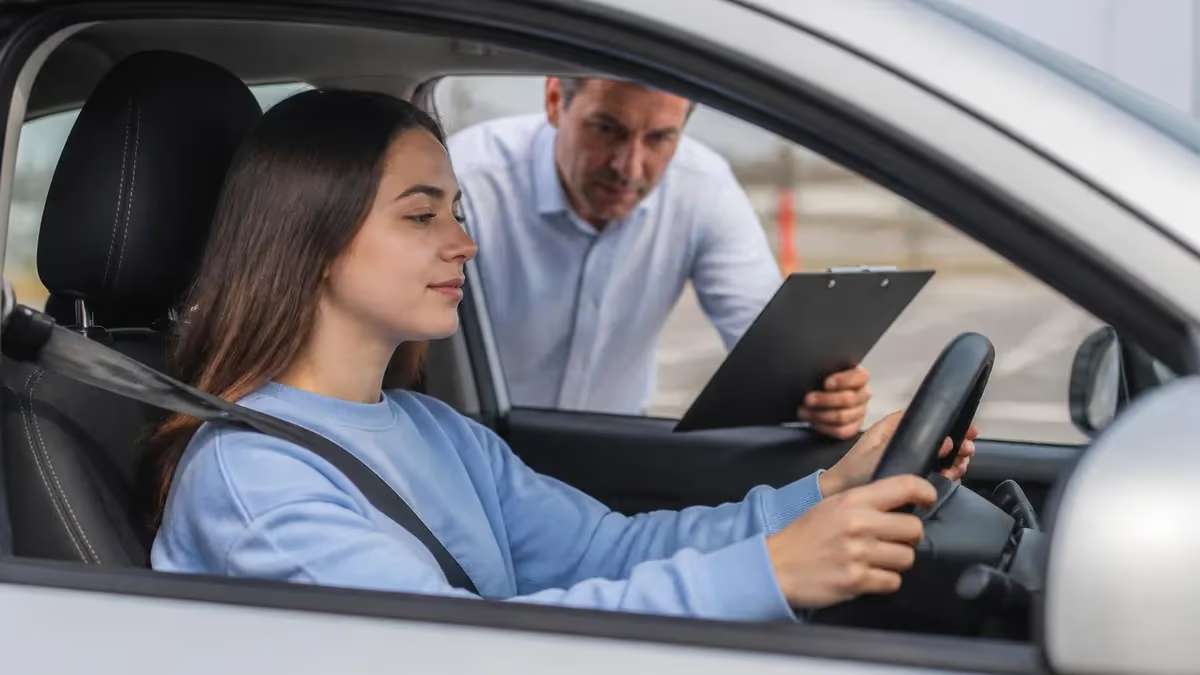
The maneuverability drivers test is one of two driving skills examinations every new Ohio driver must pass to earn a license, and for most applicants it is the part that feels the most intimidating. Unlike parallel parking, which many states use, Ohio replaced that classic test with a tighter, faster sequence inside a marked box that looks deceptively simple from the curb. You pull forward past two cones, reverse around one of them on command, then drive straight out — and the whole thing takes less than two minutes when you do it right.
Failing the maneuverability test means a re-test fee, a new appointment, and another nervous wait at the BMV. But the good news is that the maneuverability portion is highly predictable. The box is always the same dimensions. The cones are always placed the same way. The grading rubric never changes. If you understand the geometry and rehearse the steering inputs five or six times in an empty lot, you will pass.
This guide walks through the exact box layout, the steering technique examiners want to see, the point deductions that fail people most often, and how the maneuverability test connects to the rest of your BMV driving test day. We have also linked our free BMV practice test at the end so you can rehearse the written portion in the same sitting.
Maneuverability Test by the Numbers
The Ohio maneuverability box is a rectangle painted on the asphalt at every BMV driver exam station. For a standard passenger vehicle the box measures roughly nine feet wide by twenty feet long, with a single orange traffic cone placed in the center. Two more cones mark the entry line about twenty feet ahead of the box. You drive straight up the lane, pass both side cones, stop on command, then reverse around the center cone — first to one side, then back to a straight-line finish.
Examiners measure two things and only two things during the maneuverability run. First, did you hit a cone, drive over a line, or stop in the wrong place? Each of these is an automatic failure. Second, did you steer smoothly without excessive correction, check your mirrors during the reverse, and complete the sequence with reasonable control? Small steering corrections are fine. Stopping dead in the middle to "figure it out" is not.
Most students who fail the maneuverability test fail because they rush the reverse. The instinct is to crank the wheel hard and hope the back end lines up. The technique that actually works is the opposite — small, deliberate quarter-turn corrections while watching the cone through the rear side window, not the back window.

Parallel parking requires you to fit between two parked cars in a real-world space. Ohio's maneuverability test instead measures your ability to reverse around a single fixed point inside a precise box. It is faster, more predictable, and easier to rehearse — but it also has zero margin for error. One tire on the line ends the run.
Here is exactly what the examiner will ask you to do, step by step. You will start your vehicle pointed straight at the entry cones with the examiner seated in the passenger seat. On the verbal cue "begin when ready," you drive forward at a slow, steady speed until your front bumper has cleared the second pair of cones — that is roughly the length of one car past the entry markers. The examiner will say "stop" and indicate which side you should reverse toward, either right or left.
From the stopped position, you put the vehicle in reverse, turn to look over your right shoulder if you are going right (or left shoulder if going left), and slowly back the vehicle around the center cone. Your goal is to end up in a straight line, parallel to the original path, on the opposite side of the cone from where you started. Then you put the car back in drive and pull straight forward out of the box without touching any cones or crossing any lines.
The maneuverability sequence pairs naturally with the Ohio BMV driving test road portion, which always follows. Examiners do the maneuverability first because it is short and gives them an immediate read on your vehicle control before they let you on public roads.
The Three Phases of the Maneuverability Test
Drive straight forward between the entry cones at slow, steady speed. Stop only when the examiner says stop. Do not drift left or right inside the corridor between the cones. Maintain a clean, straight path with your tires aligned to the painted lane.
Reverse around the center cone, ending parallel to your original path on the opposite side. Use mirrors and direct vision through the rear quarter window. Make small steering corrections, not large hand-over-hand turns. Stop if you feel out of control and reset.
Shift to drive, pull straight forward out of the box. Stay inside the painted lines for the entire exit. No cone contact at any point. Examiner ends the maneuverability portion and you proceed to the road test if successful.
The single biggest mistake new drivers make on the maneuverability test is fixating on the wrong reference point. Watching the center cone through the back window does not work because by the time the cone disappears from view, you are already too close. Instead, you should watch the cone through the rear quarter window — the small triangular window behind the rear passenger door — while your body is turned to look over your shoulder.
Steering inputs during the reverse should be small and deliberate. Imagine the steering wheel divided into quarters. A normal correction during the maneuverability reverse is one quarter turn, held for one second, then back to center. If you find yourself spinning the wheel hand-over-hand during the reverse, you are over-correcting and the back end of the car will swing wildly. Slow down, stop if you must, and reset before continuing.
Your vehicle plays a bigger role than most people realize. A small sedan with a tight turning radius will complete the box with room to spare. A full-size pickup truck or SUV with a long wheelbase will barely fit. If you took your driver's training in a Corolla but show up to the test in a Tahoe, the box will feel much narrower than you remember.
Maneuverability Test Tips by Vehicle Type
Compact cars like the Corolla, Civic, or Sentra fit comfortably inside the maneuverability box with several inches of margin on each side. The challenge with small cars is the temptation to over-steer because the steering feels light and responsive. Keep your corrections gentle, use one quarter turn at a time, and trust the tight turning radius. Small sedans typically have the cleanest sight lines through the rear quarter windows, making it easier to track the center cone during the reverse phase of the test.
Scoring on the maneuverability test follows a strict deduction system. You start with a perfect score and lose points for every error the examiner observes. Any single critical error — hitting a cone, driving over a painted line, or putting the vehicle in the wrong gear — is an automatic fail regardless of point total. Lesser errors like rolling slightly past the stop point or making excessive steering corrections accumulate as point deductions.
Most examiners are not looking for perfection. They are looking for a driver who can recognize when something is going wrong and correct it calmly. If you start the reverse and realize you turned too sharply, stop the car. Pull forward six inches. Reset and try again. That kind of self-correction shows good driving judgment and rarely costs you points.
If you do fail the maneuverability portion, the examiner will end the test without proceeding to the road portion. You will need to schedule a new appointment, pay the re-test fee, and try again — usually after a minimum waiting period of seven days. Use that week to find an empty parking lot and rehearse with the same vehicle you will test in.

Hitting any cone, crossing any painted line with any tire, putting the car in the wrong gear (drive instead of reverse or vice versa), stalling a manual transmission, or stopping and refusing to continue all result in an immediate fail. The examiner will end the test on the spot.
One overlooked detail worth mentioning is the legal status of the maneuverability test if you have any disability or medical condition that affects mobility. The Ohio BMV makes reasonable accommodations under federal disability law, which can include modified test conditions, the use of adaptive vehicle equipment, or in rare cases waiver of the maneuverability portion entirely in favor of an alternative assessment.
If you have a documented condition that may affect your ability to perform the standard maneuverability sequence, contact the BMV at least two weeks before your scheduled test to request accommodation. The process typically requires a physician statement and may add one extra appointment to your timeline.
Finally, remember that the maneuverability test is not pass or fail in a vacuum — it is one component of an integrated driver licensing process designed to confirm you have the skills and knowledge to share Ohio roads safely with millions of other drivers. Approach the test with respect for that purpose, not as an obstacle to overcome.
Maneuverability Test Quick Facts
Preparation matters more for the maneuverability test than almost any other driving examination. Because the box dimensions are fixed and the cone positions never vary, you can recreate the exact test conditions in any empty parking lot. Bring three orange cones from a hardware store, measure out a nine-by-twenty rectangle with chalk or athletic tape, and practice the sequence ten or fifteen times in a single afternoon. Most students who do this pass on the first try.
Drive instructors recommend practicing the maneuverability test in the same vehicle you will use on test day. Different cars have different rear visibility, different turning radii, and different responses to steering input. Switching vehicles between practice and the actual test introduces variables your muscle memory has not accounted for, and that is where mistakes happen.
On the morning of your test, arrive at the BMV at least thirty minutes early. The maneuverability boxes are usually visible from the parking lot. Walk over and look at the actual box you will use — it will be slightly different from your practice setup, and seeing it in person before the test calms nerves significantly.
For drivers who are particularly anxious about the maneuverability portion, a small mindset shift helps. Instead of thinking about the test as a performance you have to nail on the first attempt, think of it as a series of small, sequential decisions — turn the wheel, check the mirror, ease off the brake, look over your shoulder, continue. Each of those individual actions is something you have done hundreds of times during practice. The test is just stringing them together in a slightly tighter space than usual.
Many driving instructors recommend doing a final practice session the morning of your test, no more than two hours before your appointment. A short fifteen-minute warm-up in an empty lot — three or four complete maneuverability runs, focusing on calm steering and mirror checks — primes your muscle memory and clears the rust off any skills you have not used in a few days. Show up at the BMV warmed up and the box will feel like an extension of practice rather than a foreign environment.
The fee for the Ohio maneuverability and road test combination is reasonable compared with other states, currently around twenty-five to thirty dollars depending on whether you are taking it for the first time or as a re-test. Bring exact change or a debit card — some smaller BMV deputy registrar locations do not accept credit cards or large bills. Plan for a thirty to forty-five minute total visit including paperwork, the maneuverability run, the road portion, and the photo for your temporary license.
Maneuverability Test Day Checklist
- ✓Valid temporary permit, signed by parent or guardian if under 18
- ✓Proof of completed driver's education (50-hour log signed)
- ✓Vehicle registration and current proof of insurance
- ✓Working headlights, taillights, brake lights, and turn signals
- ✓Functional seatbelts for driver and examiner
- ✓Windshield free of cracks in the driver's line of sight
- ✓Tires with adequate tread and proper inflation
- ✓No warning lights illuminated on the dashboard

Many students assume the maneuverability test is purely about car control and ignore the written portion entirely until they fail it. Ohio requires you to pass both the written knowledge exam and the driving test — including maneuverability and road portions — to receive a license. The written test covers traffic laws, signs, signals, and right-of-way rules. You can prepare for it with our free Ohio BMV practice test, which uses real questions pulled from the official Ohio Digest of Motor Vehicle Laws.
The order of testing matters. You take the written knowledge exam first, usually as soon as you turn fifteen and a half, which gives you your temporary permit. Then you practice driving for six months minimum under supervision. Only after the holding period and your completed driver's education hours can you schedule the maneuverability and road tests at a BMV deputy registrar location.
Ohio's Maneuverability Test vs Other States' Parking Tests
- +Fixed box dimensions never change — fully predictable
- +Faster than parallel parking, usually under two minutes
- +Can be practiced anywhere with three cones and tape
- +Tests core reverse-steering skills used in real driveways
- +No need to find or simulate parked cars for practice
- −Zero margin for error — one tire on a line is automatic fail
- −Box can feel cramped for full-size trucks and SUVs
- −No real-world parking application outside Ohio
- −Examiner stress can make a familiar sequence feel new
- −Re-test fees and waiting periods if you fail
Pros and Cons at a Glance
| Pros | Cons |
|---|---|
| Fixed box dimensions never change — fully predictable | Zero margin for error — one tire on a line is automatic fail |
| Faster than parallel parking, usually under two minutes | Box can feel cramped for full-size trucks and SUVs |
| Can be practiced anywhere with three cones and tape | No real-world parking application outside Ohio |
| Tests core reverse-steering skills used in real driveways | Examiner stress can make a familiar sequence feel new |
| No need to find or simulate parked cars for practice | Re-test fees and waiting periods if you fail |
If you have already passed the maneuverability test once and are renewing or transferring an out-of-state license, you may be exempt from the driving portion entirely depending on your circumstances. Drivers transferring from another US state typically only need to pass the vision test and possibly the written knowledge exam. Check the Ohio BMV website or call your local deputy registrar before scheduling to confirm what your specific situation requires.
One subtle thing examiners watch for is whether you adjust your mirrors and seat before starting the test. A driver who climbs into an unfamiliar position and immediately tries to maneuver almost always over-corrects. Take fifteen seconds at the start to set your mirrors so you can see the rear quarter panels, adjust your seat so your right foot reaches the brake and accelerator comfortably, and fasten your seatbelt before the examiner has to remind you.
The maneuverability test is not designed to be a trick. It measures one specific skill — controlled low-speed reverse around a fixed obstacle — that you will use thousands of times throughout your driving life. Every time you back out of a driveway, parallel park between two cars, or navigate a tight parking garage, you are using the same skills the maneuverability test measures. Treat the test as a checkpoint on a longer journey, not a final exam.
Sample BMV Practice Questions
Try these questions from our free BMV practice tests. The correct answer and an explanation follow each question.
How many hours of supervised driving must an Ohio teen permit holder complete before the road test?
- A. 20 hours
- B. 40 hours
- C. 50 hours
- D. 60 hours
Answer: C. 50 hours
Ohio requires 50 hours of supervised driving, including 10 hours at night.
Ohio law mandates that if you hit a deer and it dies, you must...
- A. Report the incident to the Ohio Department of Wildlife
- B. Contact local law enforcement and report the incident
- C. Leave the scene and report it later
- D. Move the deer to the side of the road
Answer: B. Contact local law enforcement and report the incident
In Ohio, if you hit a deer and it dies, you are legally required to contact local law enforcement to report the incident. This is important for official documentation of the accident, potential insurance claims, and proper disposal of the animal. Reporting ensures public safety and adherence to wildlife management regulations.
What is the BAC limit for drivers under 21 years of age in Indiana?
- A. 0.08%
- B. 0.04%
- C. 0.02%
- D. 0.00% — any detectable amount
Answer: C. 0.02%
Indiana enforces a 0.02% BAC limit for drivers under 21, making it virtually zero-tolerance for underage drinking and driving.
In Ohio, you can ________ after stopping at a red traffic signal on a two-way road.
- A. Make a U-turn
- B. Proceed straight
- C. Make a left turn
- D. Make a right turn
Answer: D. Make a right turn
In Ohio, as in most states, it is permissible to make a right turn on red after coming to a complete stop, provided there is no sign prohibiting it. Drivers must first stop, check for oncoming traffic and pedestrians, and then proceed cautiously if the way is clear. This rule helps maintain traffic flow while ensuring safety.
BMV Questions and Answers
The maneuverability test is, in many ways, a microcosm of how the Ohio BMV approaches driver education across the board. Every element of the test exists because crash data and roadway studies showed it correlated with real driving outcomes. Reverse control around fixed obstacles is one of the highest-risk skills for new drivers because residential driveway backing accidents involve a disproportionate share of injuries to children and pedestrians.
The state takes the maneuverability sequence seriously not because it is the most fun part of the licensing process but because it predicts which new drivers will hurt someone backing out of a parking spot in their first six months on the road.
Statistically, drivers who pass the maneuverability test on the first attempt have lower at-fault collision rates in their first year compared with drivers who needed two or three attempts. The correlation is not perfect, but it is strong enough that some insurance companies in Ohio offer small premium discounts for drivers who passed maneuverability on the first try and can document it. Ask your insurance agent if such a discount is available when you bind your first policy.
The maneuverability drivers test rewards preparation more than any other portion of the Ohio licensing process. Unlike the road test, where unexpected traffic and weather create real variables, the maneuverability box is identical at every test location and never changes. Every student who fails has the same regret afterward — they wish they had practiced more in an empty parking lot before showing up.
Build a habit of practicing for thirty minutes a day for the two weeks before your test. Bring a parent or driving instructor with you in the passenger seat to give honest feedback on whether you are stopping in the right place, turning the wheel smoothly, and ending up in the correct final position.
Record yourself on a phone camera mounted to the dashboard if possible — watching the footage afterward reveals steering habits you cannot feel from the driver's seat. By test day, the box will feel familiar and the examiner's instructions will sound like the same cues you have heard a hundred times in practice. That is the moment when nerves stop mattering and trained muscle memory takes over.
About the Author

Licensed Driving Instructor & DMV Test Specialist
Penn State UniversityRobert J. Williams graduated from Penn State University with a degree in Transportation Management and has spent 20 years as a certified driving instructor and DMV examiner consultant. He has personally coached thousands of applicants through written knowledge tests, skills assessments, and commercial driver licensing programs across more than 30 states.
Join the Discussion
Connect with other students preparing for this exam. Share tips, ask questions, and get advice from people who have been there.
View discussion (9 replies)