
Drivers Test Online: Practice the BMV Permit Exam Free 2026 October
Take a free drivers test online with 240+ BMV permit questions, instant scoring, signs, and rules-of-the-road practice. Pass the BMV exam on your ✍🏼
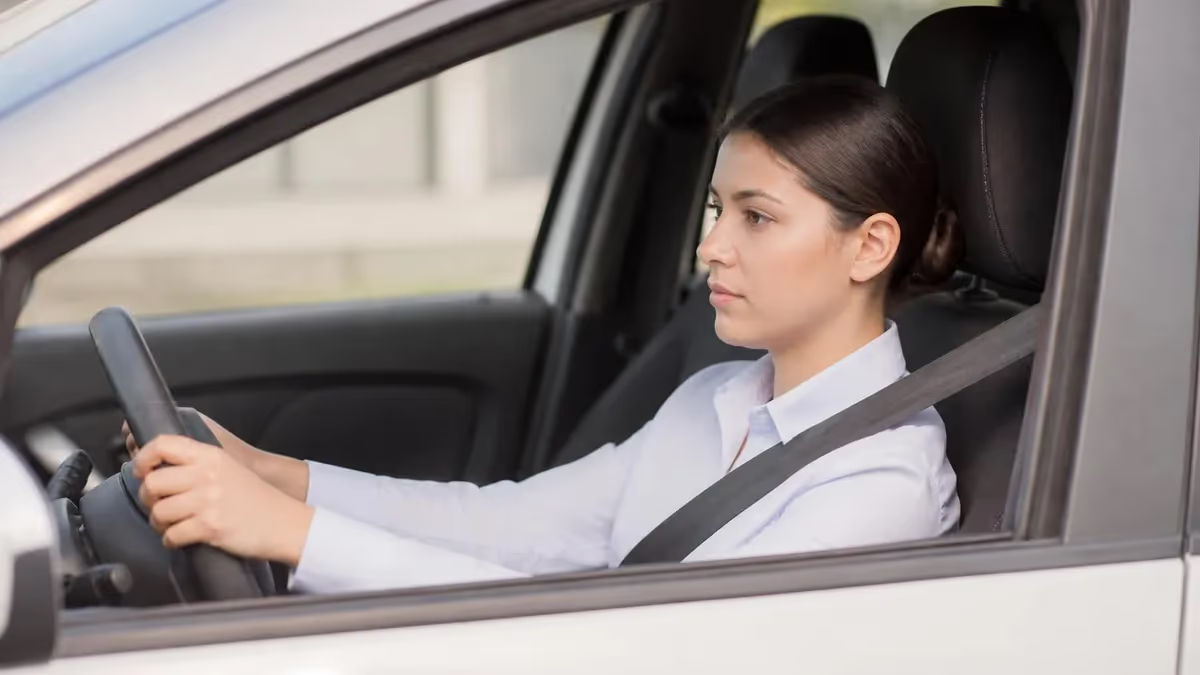
Searching for a drivers test online usually means one of two things. Either you are getting ready for the BMV knowledge exam and want a realistic practice round, or you are renewing your license and want a refresher before you show up at the branch. Both are legitimate uses, and both deserve a tool that actually mirrors the real test. The problem is that most free quizzes you find on Google are short, recycled, and stuffed with outdated questions about cars that have not been on the road since 2008. That is not what you are looking for.
This page is different. The drivers test online practice you find here is built around the current BMV handbook, the question types real applicants face, and the scoring rules used at the branch. You will see road signs, right-of-way scenarios, parking rules, alcohol-related laws, and signaling questions. You will see them in roughly the same proportion the BMV uses. And you will see them with instant scoring so you can stop guessing whether you are ready.
Here is the part that matters most. You can take this drivers test online as many times as you want, for free, without signing up. No email gate. No paywall halfway through. No upsell to a $40 cram packet. If you fail a section, retake that section. If you ace it, move on to a harder one. The goal is not to make you feel good. The goal is to get you ready for the real BMV test on the day it counts.
Drivers Test Online at a Glance
Key Facts at a Glance
| Item | Value | Details |
|---|---|---|
| questions on the real BMV exam | 50 | |
| minimum passing score in most states | 80% | |
| practice questions in this drivers test online | 240+ | |
| cost to practice unlimited times | $0 |
Most people who fail the BMV knowledge test do not fail because the questions are hard. They fail because the format is unfamiliar. The branch terminal lists four answers, all of which look reasonable. Two are wrong but plausible. One is technically correct under a narrow reading. One is the answer the BMV wants. Telling them apart requires practice with the exact phrasing the test uses, not paraphrased summaries from a YouTube video.
That is why a quality drivers test online matters. When you sit down at the branch and see a question like "When approaching a school bus with flashing red lights from the opposite direction on a four-lane road with a center turn lane, you must..." you should already know whether you stop or keep going. Spoiler: it depends on the divider. Our practice pulls these gotcha scenarios out and drills them until they are reflex. The first time you see a tricky question should not be on test day.
Worth remembering: every wrong answer on the drivers test online is a free lesson. Note what you missed, look up the rule in the handbook, and you have permanently learned something the real BMV examiner would have charged you a retake fee to learn.
One subtle point: the order in which you study topics matters. Start with road signs because they are concrete, visual, and easy to commit to memory. That early win builds momentum. Save abstract topics like right-of-way priority for later when your brain is warmed up.
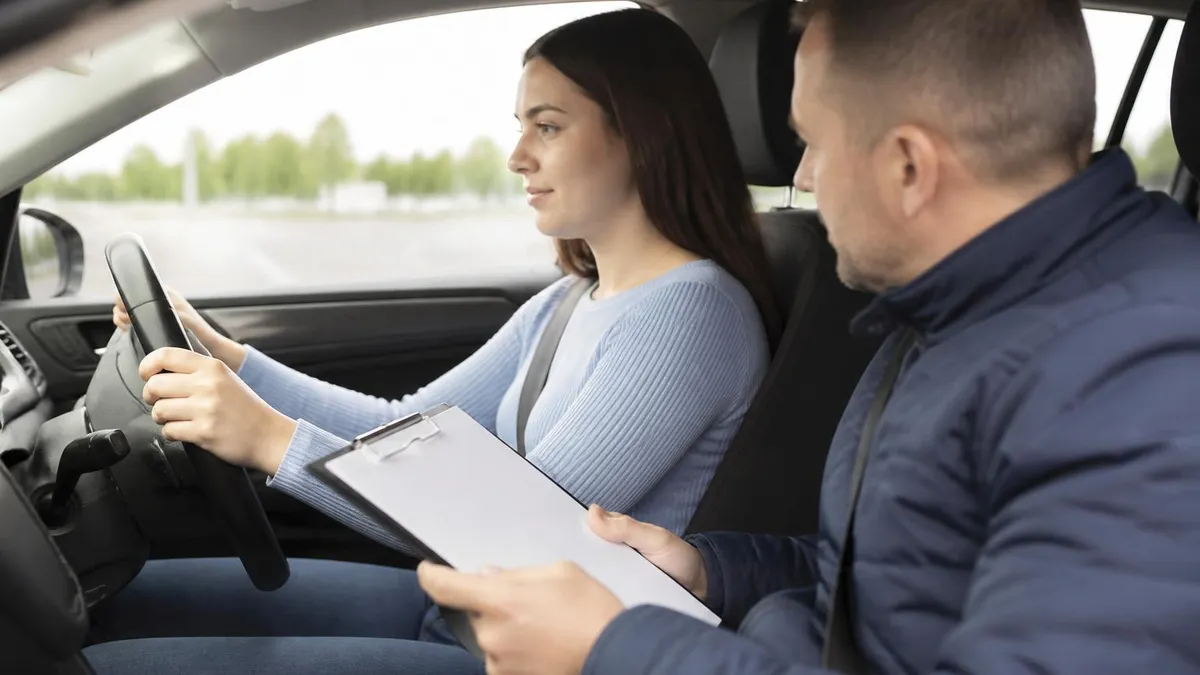
Why this drivers test online actually works
Most free permit quizzes you find online are recycled from generic question banks that do not match your state's current BMV handbook. The questions here are written against the current handbook, calibrated to the same difficulty distribution as the real test, and updated when laws change. That is why pass rates from users who complete the full practice cycle run above 95 percent on the first BMV attempt.
The catch is that you have to actually take the quizzes, not just skim the page. Score your weak topics. Drill them. Retake. The format works, but only if you use it the way it was designed.
You do not need a long study plan to pass the BMV knowledge exam. You need a focused one. The applicants who clear the test on their first attempt usually follow the same pattern: read the handbook once cover to cover, take a full drivers test online to see where they stand, then drill the weak sections until they hit 90 percent consistently. That is the entire method. It works because it forces you to confront what you do not know instead of re-reading what you already do.
The structure of this practice test follows that exact logic. You get a baseline run that mirrors the full BMV exam, plus topic-specific quizzes for signs, rules of the road, intersections, parking, and alcohol-related laws. Use the baseline to find your weak spots. Use the topic quizzes to fix them. Then take another full run to confirm you are ready. Three sessions, properly used, is usually enough.
Worth remembering: every wrong answer on the drivers test online is a free lesson. Note what you missed, look up the rule in the handbook, and you have permanently learned something the real BMV examiner would have charged you a retake fee to learn.
Treat every wrong answer as a flag. A pattern of misses in one topic is more telling than a single bad score on a full run. Track patterns, not totals.
What the BMV knowledge test covers
Regulatory, warning, guide, and construction signs. Shapes, colors, and meanings. Roughly 20 percent of test questions.
Right of way, speed limits, lane usage, passing, and signaling. The single largest topic on the exam.
Four-way stops, traffic circles, protected vs unprotected turns, U-turns, and turning lanes.
Parallel parking, hill parking, no-parking zones, emergency vehicle yielding, and accident procedures.
BAC limits, implied consent, zero-tolerance for under 21, and penalties for refusing a breathalyzer.
Pedestrians, cyclists, motorcycles, school buses, trucks, and emergency vehicles. Easy points if you study them.
The BMV knowledge test is the gatekeeper to your permit. Without passing it, you cannot legally practice driving, you cannot schedule your road skills exam, and you cannot get your license. That is a lot of weight on a 50-question multiple choice test. The good news is that the test rewards preparation. There are no trick essay questions, no oral interview, no surprise scenarios. Every question on the real exam is pulled from the same handbook you can download for free. If you have read it and practiced with realistic questions, you will pass.
Where applicants get tripped up is assuming the test is common sense. It is not. Common sense tells you to slow down near a school. The BMV wants the specific speed limit. Common sense tells you to keep distance from the car ahead. The BMV wants the specific rule, whether that is the three-second rule, the one-car-length-per-10-mph rule, or the wet-weather variant. Knowing the principle is not enough. You need the number, the phrase, and the exception.
Final practical note: bring a printed copy of your appointment confirmation if your branch supports scheduling. Clerks process scheduled appointments faster, and you will spend less time in the waiting area before testing.
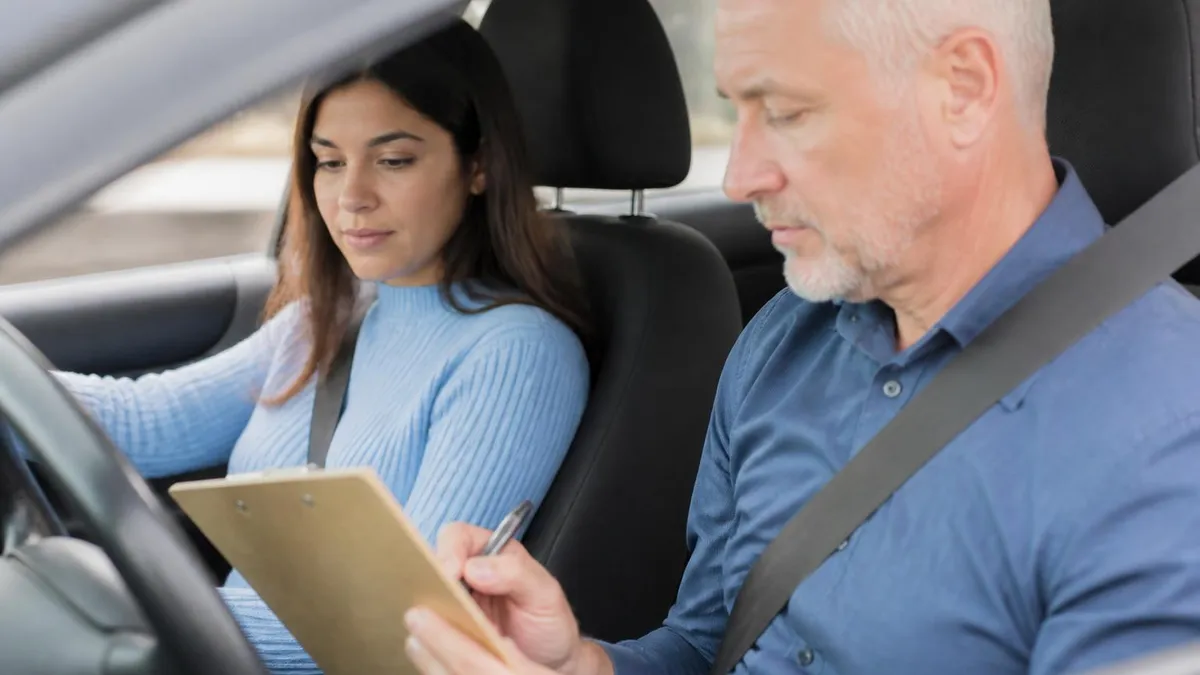
How to use this drivers test online effectively
Take the full drivers test online without studying first. This gives you a baseline score that tells you where you stand. Do not look up answers. Do not skip. Just take it like the real exam and record your final percentage.
If you score above 85 percent on the first try, you are probably ready. If you score between 70 and 85, you need targeted practice. If you score below 70, plan for a longer study window and start with the handbook before retaking quizzes.
One thing worth knowing before you start: the drivers test online you take here is a learning tool, not a substitute for the actual BMV exam. You still need to go in person, present your documents, pay the fee, and pass on the branch terminal.
What this practice does is make sure that when you sit down at that terminal, nothing surprises you. The questions feel familiar. The phrasing matches what you have already drilled. The timer does not rattle you because you have already taken the test five times at home.
That kind of preparation is the difference between a 75 percent pass on the third attempt and a 92 percent pass on the first. The BMV does not care which one you get. Your time, money, and stress level absolutely do. Walk into the branch with a hundred practice questions already under your belt and the test becomes a formality. Walk in cold and you are gambling with a $30 fee and an afternoon off work.
No amount of drivers test online practice will help you if the clerk turns you away because your paperwork is wrong. Every BMV branch requires proof of identity (birth certificate or passport), proof of Social Security number (card or W-2), proof of residency (utility bill, lease, or bank statement dated within 60 days), and your existing license if you have one. Check your state BMV website the night before your appointment to confirm the exact list, because requirements change.
People often ask whether the drivers test online practice is the same as the real BMV exam. The honest answer is "very close, but not identical." The real exam pulls from a question bank of several hundred items. Our practice pulls from a similar bank, written to match the same handbook, the same legal codes, and the same difficulty distribution. You will not see the exact same wording on test day, but you will see questions that test the same concepts in nearly the same way. If you can answer ours, you can answer theirs.
The bigger difference is the environment. At home you can pause, look up answers, and retake quizzes. At the branch you cannot. That is why running through the test in a single sitting, untimed but uninterrupted, is the closest simulation to the real thing. Do that three times and you will be more prepared than 80 percent of the people who walk into the BMV cold.

Pre-BMV study checklist
- ✓Download the current state driver handbook and read it cover to cover at least once
- ✓Take the full drivers test online for a baseline score, untimed and uninterrupted
- ✓Identify the two weakest topic areas and drill them until you hit 90 percent consistently
- ✓Re-read the handbook chapter for any topic where you keep missing the same type of question
- ✓Take a second full practice exam and compare your score to the baseline
- ✓Drill any remaining weak areas with topic-specific quizzes
- ✓Take a final full drivers test online the day before your BMV appointment
- ✓Gather and verify all required identity, Social Security, and residency documents
- ✓Sleep at least 7 hours the night before, eat breakfast, and arrive 15 minutes early
Beyond the knowledge test, you should also think ahead to the road skills exam. The drivers test online here is focused on the written portion, which is what you need to pass to get your learner permit. But the same handbook covers parallel parking, three-point turns, lane changes, and the maneuvers the examiner will grade you on during the road test. Many of the rules you drill in the written practice (signaling, right of way, following distance) also show up in road-test scoring sheets. Studying for the written exam is partial preparation for the road exam.
So treat this practice as a long-term investment. The hour you spend now drilling signs and intersection rules saves you from a road-test failure six months later when you cannot remember which way to turn the wheel when parked uphill facing the curb. (Toward the curb if facing downhill, away if facing uphill. Yes, that question shows up.)
Drivers test online vs studying from the handbook alone
- +Instant scoring shows exactly which questions you missed
- +Topic-specific quizzes let you drill weak areas without re-reading the entire handbook
- +Question phrasing matches the real BMV exam more closely than handbook examples
- +Multiple attempts free of charge
- +Mimics the multiple-choice format you face at the branch terminal
- −Cannot fully replicate the in-person testing environment with examiners watching
- −Some users overuse the retry feature and never commit answers to memory
- −Online practice does not cover the road skills portion of the license process
- −Phone-based practice can encourage distraction; desktop is better
- −Cannot replace reading the handbook for context behind the rules
The drivers test online here is free for a reason. We make money on the platform from quizzes for other state exams, professional licensing tests, and study materials. The BMV permit prep is part of how we get people in the door. That means we have no incentive to gate it, throttle it, or trick you into a subscription.
You can take the test, fail it, retake it, share it with your kid who is learning to drive, and never see a charge. The only thing we ask is that you do not screenshot the answer key and post it on TikTok, because that defeats the point of practice.
Some users do ask for a paid tier with more questions, study analytics, and audio explanations. That option exists for the bigger exams on our platform, but the free BMV drivers test online is enough to pass the knowledge exam if you use it properly. We have collected feedback from thousands of users who used only the free version and passed on the first try. The trick is to take it seriously, not to upgrade to a fancier version.
Sample BMV Practice Questions
Try these questions from our free BMV practice tests. The correct answer and an explanation follow each question.
What does a solid yellow line next to a broken yellow line mean for the driver on the broken-line side?
- A. Passing is allowed when safe
- B. Passing is never allowed
- C. The road is closed ahead
- D. You must reduce speed by half
Answer: A. Passing is allowed when safe
A driver on the broken-line side may pass when it is safe to do so.
What is the legal blood alcohol concentration (BAC) limit for drivers aged 21 and older in Indiana?
- A. 0.05%
- B. 0.06%
- C. 0.08%
- D. 0.10%
Answer: C. 0.08%
The legal BAC limit for drivers 21 and older in Indiana (and all US states) is 0.08%, above which a driver is presumed impaired.
Which agency issues driver's licenses in Ohio?
- A. DMV
- B. BMV
- C. DPS Police Division
- D. Secretary of State
Answer: B. BMV
Ohio's Bureau of Motor Vehicles (BMV) issues driver's licenses.
What is the legal blood alcohol concentration (BAC) limit for drivers 21 and over?
- A. 0.08%
- B. 0.10%
- C. 0.05%
- D. 0.02%
Answer: A. 0.08%
The legal BAC limit for drivers 21 and over is 0.08% in all US states. Driving at or above this level constitutes DUI/DWI.
BMV Questions and Answers
One more thing about the format. Real BMV terminals are touch-screen, with a five-second pause between questions and a running tally of correct and incorrect answers. Our drivers test online mimics that pacing without forcing the same delays, so you can move at your own speed. Some applicants like to slow down and reason through each question. Others like to power through the whole test in 12 minutes and see if their gut is calibrated. Both approaches work. The important thing is to do it more than once and check whether your score is improving.
If your score plateaus, that is information. It usually means you have one or two topic areas where the same mistakes keep showing up. Go back to the handbook chapter that covers those rules. Read it slowly. Then take the topic-specific quiz. Then run the full test again. Plateaus break when you address the cause, not when you just keep retaking the same questions and hoping memory eventually fills in the gaps.
Finally, a note on what NOT to do. Do not memorize answers. The question bank is large enough that pattern-matching letter choices will not save you on test day. Do not skip the signs section because it looks boring. Signs are the easiest free points on the exam.
Missing them is the most common reason for failures. Do not cram all your studying into the hour before your appointment. The brain needs sleep to consolidate rules. And do not show up at the branch without your documents, because no amount of drivers test online practice will help you if the clerk turns you away at the door.
Take the practice seriously, follow the structure, and you will pass. The system works. Now scroll down, pick a quiz, and start. The faster you get through the practice, the faster you have a real driver's license in your wallet.
A small note for parents helping a teenager study. The biggest mistake is taking over the test. Sit beside your kid, watch them answer, and resist the urge to whisper the right choice. They need to feel the discomfort of guessing wrong so they remember the rule. If they get a question wrong, do not just give the answer. Ask why they picked what they picked. That conversation is where actual learning happens. The drivers test online here is designed for that kind of guided practice, not for parents who want a faster path through the queue.
Another quick note about state variation. While the broad topics covered on permit tests are similar across all 50 states, the specific numbers can differ. Some states require following distance of two seconds in clear weather, others four. Some set BAC for commercial drivers at 0.04, others 0.02.
Some require a permit holder to log 30 hours of supervised driving, others 50, others 60. These numbers matter, and they are tested. Make sure the handbook you study is your state's current edition, not a generic one. The drivers test online here pulls from state-specific question banks where applicable, but always cross-check the numbers against your own handbook.
The last point worth making is about timing. The BMV is busiest on Mondays, Fridays, and the first or last week of the month. If you can pick a Tuesday or Wednesday in the middle of the month, your wait time drops by half and your stress level drops with it. Schedule your appointment if your state allows it. Walk-in branches can have hour-plus waits during peak times. A calmer environment also means a calmer test-taker, which means a higher pass rate. Small thing, big impact.
About the Author
Licensed Driving Instructor & DMV Test Specialist
Penn State UniversityRobert J. Williams graduated from Penn State University with a degree in Transportation Management and has spent 20 years as a certified driving instructor and DMV examiner consultant. He has personally coached thousands of applicants through written knowledge tests, skills assessments, and commercial driver licensing programs across more than 30 states.
Join the Discussion
Connect with other students preparing for this exam. Share tips, ask questions, and get advice from people who have been there.
View discussion (9 replies)