
Florida Drivers Road Test: Complete 2026 Guide With Pass Tips
Pass the Florida drivers road test on your first try. ❓ Maneuvers, scoring, vehicle requirements, common fails, and a step-by-step prep plan inside.
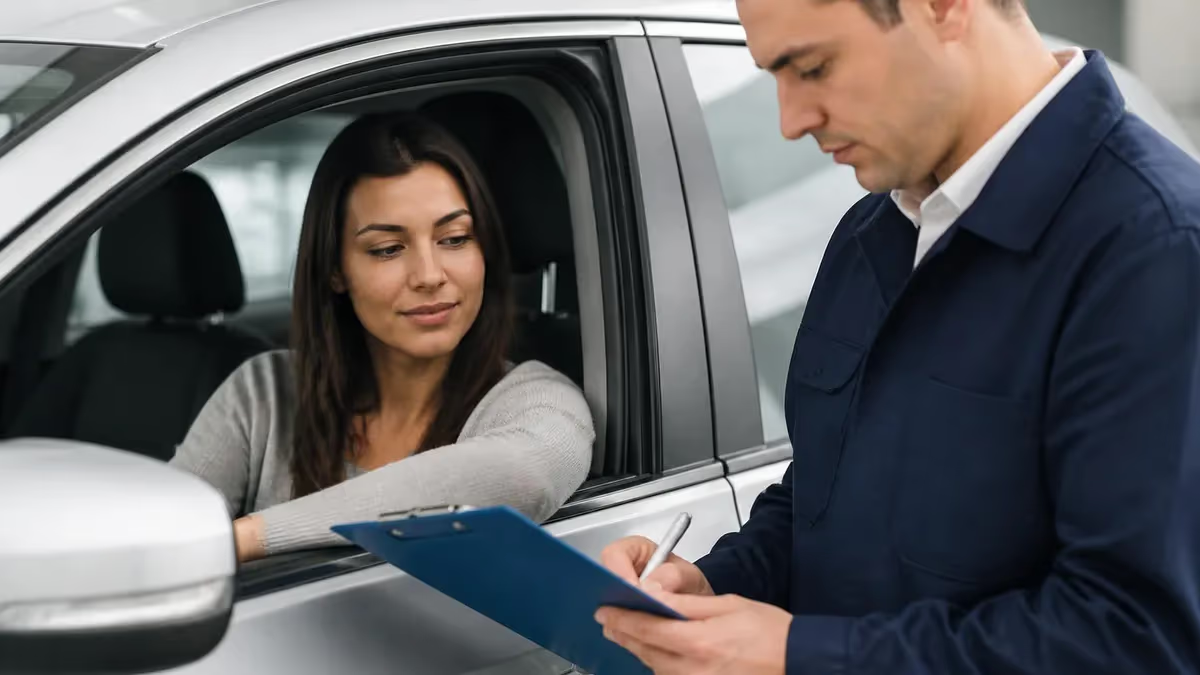
What the Florida Drivers Road Test Actually Measures
The Florida drivers road test isn't a paperwork checkbox. Examiners watch twelve to fifteen specific behaviors during a fifteen-to-twenty minute drive, and any one of them can drop you to a fail. Most first-time test-takers walk in expecting a quiz on parallel parking. They leave shocked that turn-signal timing and head-checks before lane changes are what actually sank them. Practice with the free BMV practice test on PracticeTestGeeks (7 questions with answer explanations).
Here's the truth nobody tells you upfront. The examiner isn't grading raw skill. They're grading habit. Did you check your mirrors before braking? Did your hands stay at 9-and-3? Did you stop fully — meaning the wheels stopped moving for a full beat — at the white line, not over it? These habit-level details are what separate the fifty-eight percent who pass from the rest.
Florida's exam follows a scoring rubric set by the Florida Department of Highway Safety and Motor Vehicles. The rubric splits into pre-drive (vehicle and identification check), basic control (starting, stopping, steering), and traffic skills (intersections, lane positioning, signaling). You get a points deduction for each minor error and an automatic fail for major ones — striking a curb hard, rolling a stop sign, or needing the examiner to physically intervene with the wheel or brake.
The pass rate for first-time Florida applicants hovers around fifty-eight percent. That's not because the test is unfair. It's because most teens (and plenty of adult license-transferees) prep for the wrong things. They practice three-point turns in an empty lot. They don't practice the boring stuff: full stops, smooth lane changes, and the head-check that the examiner is watching for every single time you move the wheel more than a few degrees.
Free BMV Study Tools
Interactive BMV resources on PracticeTestGeeks, free to start:
- BMV flashcards — review key terms and concepts card by card
- BMV study guide — topic-by-topic overview of what the exam covers
- BMV cheat sheet — one-page printable summary for last-minute review
What changed for BMV - Test in 2026
- New Florida driver license design launched September 30, 2026, featuring enhanced fraud protection with UV ink and optically variable features; existing licenses remain valid. (source)
- Teen driver curfew restrictions for age 16: 6:00 AM–11:00 PM (extended to 10:00 PM after three months); age 17: 5:00 AM–1:00 AM; exceptions apply for work-related driving or when accompanied by a licensed driver 21+. (source)
- Learner's permit requirement remains: minimum 12 months duration with 50 hours supervised driving (10 hours at night minimum) before road test eligibility. (source)
- License fees for 2026: initial license $48.00 (includes written test), road test retest $20.00. Knowledge test passing score: 80% (40 of 50 questions). (source)
Last verified: 2026-10-14 against Florida Department of Highway Safety and Motor Vehicles (FLHSMV).
- License fee: $48 (initial driver license covering written test and license issuance; verification: FLHSMV Fees).
- Road test retest fee: $20 (per official fee schedule; verification: FLHSMV Fees).
- Knowledge test passing score: 80% (40 of 50 multiple-choice questions; verification: FLHSMV Licensing Requirements).
- Learner's permit duration: Minimum 12 months or until age 18 (whichever comes first); verification: FLHSMV Teen Drivers.
- Supervised driving requirement: 50 hours total, with minimum 10 hours at night; verification: FLHSMV Teen Drivers.
- Teen curfew (age 16): 6:00 AM to 11:00 PM during first three months; then extended to 10:00 PM; verification: FLHSMV Teen Drivers.
- Teen curfew (age 17): 5:00 AM to 1:00 AM (exceptions for work-related driving); verification: FLHSMV Teen Drivers.
- License validity: Valid for 8 years from issuance; verification: FLHSMV Driver License Info.
Florida Road Test by the Numbers
Booking, Eligibility, and What to Bring
Before scoring matters, you have to be eligible — and you have to actually get in the door with the right paperwork. Florida tightened identification requirements after 2010, and showing up with the wrong combination of documents means rebooking, sometimes a month out.
Here's what's non-negotiable. You need a valid learner's permit held for at least twelve months (or until your eighteenth birthday, whichever comes first). You need a parent or guardian signature if you're under eighteen, plus a certified log of fifty hours of supervised driving, ten of which must be at night. Bring the original Form HSMV 71142 — photocopies will be rejected at the counter.
Your test vehicle has to pass its own inspection before you do. Working turn signals, brake lights, horn, windshield wipers, two outside mirrors, a functioning speedometer, and current registration plus insurance. If the examiner finds a burned-out brake bulb in the pre-drive walkthrough, you're done — they won't let you test. That's not a fail on your record, but it's a wasted trip and a new appointment.
You can book your test at any DMV service center or online through the official portal. Walk-ins are accepted at some locations but expect a three-to-five hour wait. Pre-booked appointments are almost always faster. If you're testing in Miami-Dade, Broward, or Orange County, book at least three weeks ahead — those offices run at near-capacity year-round.
Documents Checklist — Do Not Show Up Without These
- Learner's permit (held 12 months minimum, or until age 18)
- Proof of identity: birth certificate or U.S. passport
- Proof of Social Security number: SS card, W-2, or pay stub
- Two proofs of Florida residency: utility bill, lease, bank statement
- Parental consent form (HSMV 71142) if under 18
- Certified 50-hour driving log signed by parent/guardian
- Vehicle registration and insurance for the test car
- Test fee: $48 license fee + $20 test fee (varies by county)
The Three Phases of the Drive — What Examiners Look For
Every Florida road test follows the same skeleton. Pre-drive inspection, basic vehicle control, then traffic skills on public roads. Knowing the phases ahead of time isn't cheating. It's just being prepared, the way a job interview is easier when you know what questions are coming.
Phase one happens before the engine starts. The examiner walks around your vehicle, asks you to identify hand signals (yes, hand signals — left turn, right turn, slow/stop), and tests turn signals, brake lights, and the horn. They'll ask you to point to the parking brake and demonstrate it. Fail to identify the emergency flashers and you've lost points before you've even started the engine.
Phase two is the controlled portion. Most Florida test centers have a closed course or quiet adjacent street for this. You'll perform a three-point turn (or Y-turn), back up straight for about fifty feet while maintaining lane position, and — depending on the location — either parallel park or pull into a marked space. Parallel parking is increasingly being replaced in Florida with straight-line backing, but check your specific test center.
Phase three is the road portion. Twelve to fifteen minutes through residential streets, at least one four-way intersection, at least one lane change, and at least one stop on a hill or graded surface. The examiner gives you directions one step at a time ("at the next light, turn right"). They never test you with trick directions or sudden demands. If they ever say "pull over here, please" — that's the end. Don't panic. They just want a safe spot to wrap up scoring.
The Three Test Phases at a Glance
Vehicle inspection, hand signal identification, controls demonstration. Five minutes long. Lose points here for missing equipment knowledge or being unable to identify emergency flashers, parking brake location, or windshield wiper controls.
Three-point turn, straight backing for 50 feet, plus parking maneuver. Five to seven minutes on a closed course or quiet street. The examiner watches for smooth wheel control, proper shoulder checks, and clean transitions between forward and reverse.
Twelve to fifteen minutes in real traffic. Intersections, lane changes, stops, and hill starts. This is where most failures happen — rolling stops, missed blind spot checks, and improper lane positioning account for the majority of points lost.
The Eleven Auto-Fail Behaviors (Memorize These)
Florida's scoring sheet lists eleven behaviors that end the test instantly, no matter how well you've driven up to that point. Examiners aren't allowed to overlook them — the test ends, you exit the vehicle, and you re-book. Knowing these in advance is the single most useful prep move you can make.
The big ones are the obvious ones: striking another vehicle, mounting the curb hard enough to lose lane position, running a red light or stop sign, exceeding the speed limit by more than ten miles per hour, or any moment where the examiner has to grab the wheel or stomp the dual-controlled brake. The less-obvious ones bite people more often. Failure to yield right-of-way at an uncontrolled intersection. Driving in the wrong lane on a divided road. Coming to a stop in a live traffic lane without hazard reason.
The trickiest auto-fail in practice is the "refused command". If the examiner asks you to make a legal lane change and you refuse because you don't feel safe — and there's no actual hazard — that's a refusal to follow instructions, which is treated as a fail. The fix is to communicate. Say out loud: "I'd like to wait for the next opportunity." That converts the refusal into a defensive decision, which is fine.
Two more deserve a special call-out. Failure to look before lane change is technically a points deduction (-5) but doing it three times in one test is treated as a pattern and becomes a fail. Both hands off the wheel for more than two seconds in moving traffic is also a fail. Adjusting the radio? Both hands stay on. Reaching for a dropped item? Pull over first.
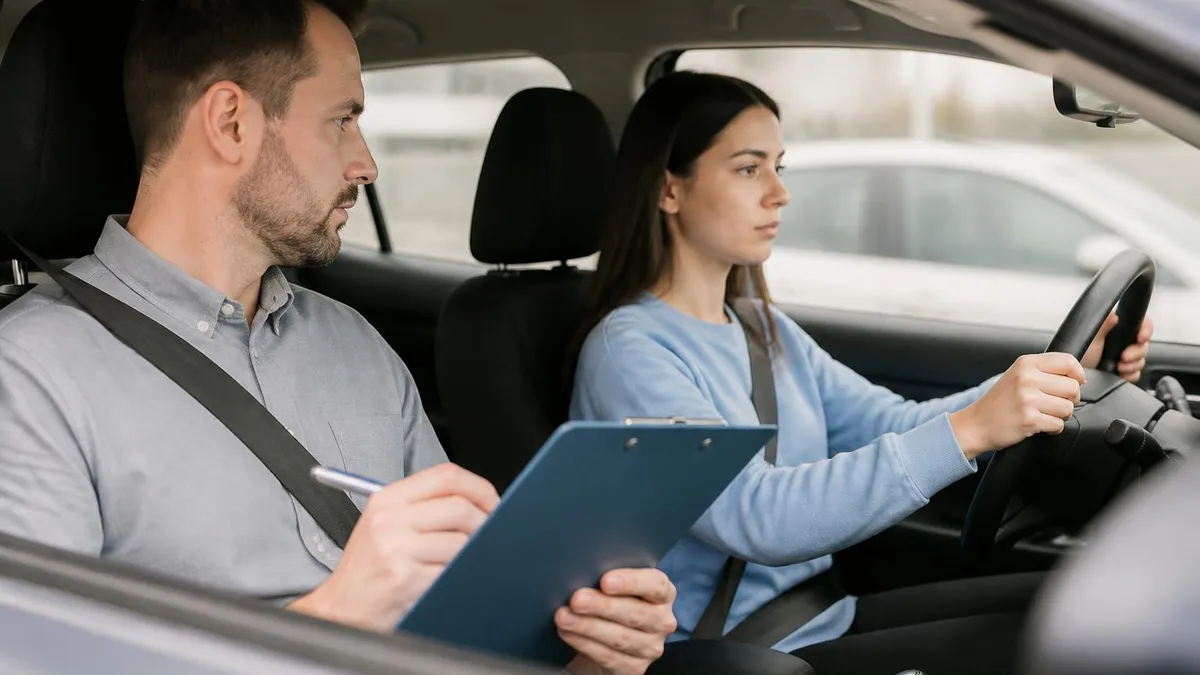
Maneuver Breakdown — What Examiners Score
Signal right, pull to curb, full stop. Signal left, check mirrors and over left shoulder, pull forward to about 80% of road width. Stop. Reverse with right-shoulder check, straighten wheels as you cross center. Stop. Signal left, pull forward into normal lane position.
Common fails: hitting the opposite curb, not checking blind spots, taking more than three movements.
The Real Reasons Florida Drivers Fail
If you ask any Florida driving instructor what causes the most road test failures, they won't say parallel parking. They'll say rolling stops. Drivers approach a stop sign, slow to two or three miles per hour, glance both ways, and ease through. Examiners catch this every time. A full stop means the wheels are no longer turning. Count one full second mentally before you accelerate.
Second on the failure list is poor speed management. Going five over isn't a fail by itself, but doing it consistently signals to the examiner that you don't watch your speedometer. Going five under in a 45 zone is just as bad — it signals nervousness, and impedes traffic. Match the posted limit within two miles per hour either direction.
Third is blind spot checks during lane changes. You can use your mirrors all day. The examiner wants to see your head turn. Quick, deliberate, over the shoulder — left for left changes, right for right changes — before the wheel ever moves. If you only mirror-check, you'll lose five points per occurrence. Three occurrences and you're done.
Fourth, and the silent killer, is improper lane positioning. On a road with multiple lanes, you should be in the right lane unless passing or preparing for a left turn. New drivers default to the middle lane because it "feels safe." It's not. It's wrong, and the examiner will note it. On two-lane roads, position your car so the left tire tracks the center line — not the middle of the lane, not hugging the right side. Examiners watch your tire placement constantly.
Fifth, and most preventable: over-correcting on turns. Steering should be smooth. Hand-over-hand is fine for tight turns; push-pull is fine for moderate ones. What's not fine is letting the wheel slip back through your hands after a turn. Always actively unwind the steering. Examiners watch your hands as much as the road.
Every Florida road test has a few moments where examiners essentially give you free points if you do the right thing. Use the parking brake when parking on any grade — even slight ones. Adjust your mirrors and seat before starting the engine, while the examiner is still settling in. Signal for every lane change, even when no other cars are visible. Look both ways at green lights before proceeding through. These small habits separate confident drivers from nervous ones — and examiners reward confidence with the benefit of the doubt on borderline calls.
The 30-Day Florida Road Test Prep Plan
You can't cram for this test. Driving is muscle memory, and muscle memory takes repetition over weeks, not days. But you can absolutely focus your last thirty days to hit the high-use practice areas.
Week one is awareness. Take a notebook into every drive with a parent or instructor. Note every time you forget to signal, every time you don't check a blind spot, every time you brake harder than you needed to. Don't try to fix anything yet — just notice. You'll be shocked how many habits you have that you never knew about.
Week two is intersections and stops. Drive routes that force you through twenty stop signs and ten traffic lights per session. Count one-Mississippi at every full stop. Practice both right-on-red and the protected/unprotected left turn. By the end of the week, full stops should feel automatic.
Week three is maneuvers. Find an empty lot with parking lines. Practice three-point turns, parallel parking, and straight backing for thirty minutes a day. Repetition matters more than variety. Better to perform parallel parking forty times in a week than to dabble in ten different skills.
Week four is mock tests. Have your supervising driver play examiner. They give you one direction at a time, sit silently, and grade you on the actual Florida scoring sheet (downloadable from the FLHSMV website). Run three full mock tests before your real one. The first will be ugly. The third should be passing.
Day-Before Test Checklist
- ✓Confirm appointment time and location
- ✓Gather all documents in a single folder
- ✓Walk around test vehicle: lights, signals, horn
- ✓Check tire pressure and fuel (at least quarter tank)
- ✓Clear personal items from passenger and back seats
- ✓Adjust mirrors and seat to your driving position
- ✓Plan to arrive 30 minutes early
- ✓Eat a normal meal — do not test hungry or overcaffeinated
- ✓Practice 3 stops, 3 lane changes, 1 parallel park morning of
- ✓Review the 11 auto-fail behaviors one final time
Test-Day Mindset — How to Stay Calm When It Counts
Half the people who fail the Florida road test would have passed if they hadn't been nervous. Your hands shake. You forget the order of operations. You signal then immediately turn without checking the blind spot. None of these errors happen during normal driving. They happen because adrenaline is high and the prefrontal cortex — the part of your brain that handles deliberate sequences — is suppressed.
There are concrete tactics for this. Box breathing works. Four seconds in, hold four, four seconds out, hold four. Do three cycles in the parking lot before you go in. It drops your heart rate by about ten beats per minute and re-engages the executive part of your brain.
Talking out loud while you drive helps too. "Checking mirrors, signaling right, head-check, changing lanes." It sounds robotic. It also keeps your sequence intact under stress. Examiners don't mind narration — many actually prefer it because it shows them you're processing each step.
Finally, treat the examiner as a passenger, not a judge. They're not trying to fail you. They want to get back to their desk and finish paperwork. If you drive like you'd drive a grandparent to the store — smooth, deliberate, slightly slower than normal — you will pass.
One more piece of test-day wisdom that almost nobody mentions. The examiner has done thousands of these. They have seen every nervous tic, every white-knuckled grip, every hesitant pause at a green light. If your nerves are obvious, they will actually go easier on you — not harder. So if you feel shaky, do not fake confidence. A small comment like "I'm a little nervous, but I'm ready" sets the tone honestly and humanizes you in their mind.
BMV Pros and Cons: Driving School vs. DMV Office
- +Driving school: familiar instructor, lower stress on test day
- +Driving school: known routes that students practice on repeatedly
- +Driving school: instant retake if you fail, often same day
- +Driving school: usually shorter wait times for appointments
- +Driving school: vehicle is pre-inspected and known to pass
- −Driving school: costs $75-150 per test vs. $20 at DMV
- −DMV: more rigorous, examiners stricter on edge cases
- −DMV: four-to-six week wait in major Florida counties
- −DMV: routes vary; you can't pre-drive them with an instructor
- −DMV: vehicle issues can cancel your test on arrival
Pros and Cons at a Glance
| Pros | Cons |
|---|---|
| Driving school: familiar instructor, lower stress on test day | DMV: more rigorous, examiners stricter on edge cases |
| Driving school: known routes that students practice on repeatedly | DMV: four-to-six week wait in major Florida counties |
| Driving school: instant retake if you fail, often same day | DMV: routes vary; you can't pre-drive them with an instructor |
| Driving school: usually shorter wait times for appointments | DMV: vehicle issues can cancel your test on arrival |
After the Test — Pass or Fail, What Happens Next
If you pass, the examiner signs your scoring sheet and walks you back inside. You'll take a photo, pay the licensing fee, and walk out with a temporary paper license. Your physical card arrives in seven to ten business days. The temporary is valid for driving alone immediately — you do not need to wait for the plastic.
If you fail, you get the scoring sheet showing exactly what went wrong. Florida law requires a fourteen-day waiting period before retesting at the same DMV. Some applicants jump to a different county office to retest faster — that's legal, but you'll still need a new appointment.
Failure isn't permanent and isn't logged on your driving record. About forty percent of Florida drivers need at least two attempts. Use the scoring sheet productively. Look at exactly which behaviors cost you points and spend the next two weeks targeting those specifically. Don't re-test until you've practiced the failure points enough that your hands do them without conscious thought.
One last note for parents and supervising drivers. The fifty-hour driving log isn't busywork. Florida cross-references it with examiner observations. If a teen shows up clearly under-practiced but with a perfectly completed log, examiners notice — and they'll add scrutiny to the test. Honest logs, honest preparation. The shortcut is to actually drive the hours.
For new drivers in their first year of licensure, Florida imposes restrictions worth knowing. No driving between 11 PM and 6 AM unaccompanied for the first three months after licensure (unless going to or from work). After three months, the curfew shifts to 1 AM to 5 AM. These rules are enforced — a citation in your first year can extend your provisional period and add restrictions you don't want.
Sample BMV Practice Questions
Try these questions from our free BMV practice tests. The correct answer and an explanation follow each question.
When approaching a stopped school bus with flashing red lights on a two-lane road, you must:
- A. Slow to 20 mph and proceed
- B. Stop and remain stopped until the lights stop flashing
- C. Pass on the left if no children are visible
- D. Honk and continue slowly
Answer: B. Stop and remain stopped until the lights stop flashing
You must stop and stay stopped until the red lights stop flashing and the bus moves.
On a road with a solid yellow line on your side, you may:
- A. Not pass another vehicle
- B. Pass if the road is clear
- C. Pass only large trucks
- D. Pass at any speed
Answer: A. Not pass another vehicle
A solid yellow line on your side of the center means passing is prohibited.
If there are fewer than four lanes on a street or road, a school bus is stopped with its red lights flashing. What is the correct answer to this?
- A. Only vehicles in the opposite direction must stop
- B. All vehicles can proceed with caution
- C. Vehicles in both directions must stop
- D. Only vehicles behind the bus must stop
Answer: C. Vehicles in both directions must stop
On a two-lane road or a road with fewer than four lanes, all vehicles traveling in both directions must stop when a school bus has its red lights flashing and stop arm extended. This law protects children who are entering or exiting the bus and may be crossing the road. Drivers must remain stopped until the bus lights are off and the stop arm is retracted.
What is the correct action when a school bus stops with its red lights flashing on a two-lane road?
- A. Pass on the left carefully
- B. Stop in both directions
- C. Slow to 10 mph and pass
- D. Only oncoming traffic must stop
Answer: B. Stop in both directions
On a two-lane road, traffic in both directions must stop when a school bus displays flashing red lights.
BMV Questions and Answers
Your Next Move
The Florida drivers road test rewards preparation in a way that's almost mathematical. Practice the eleven auto-fail behaviors until they're automatic. Drill full stops, blind spot checks, and smooth lane changes until they don't require conscious thought. Run three mock tests with a supervising driver scoring you against the official rubric. Show up rested, hydrated, and thirty minutes early with every document in order.
Do those things and you don't need luck. You'll be in the fifty-eight percent who pass first time — and you'll deserve it. The drivers who fail aren't bad drivers. They're under-prepared drivers who underestimated how specific the scoring rubric is. Don't make that mistake.
Use the practice quizzes on this site to nail down the written-knowledge side of road readiness. Combined with on-road practice, that's the prep stack that gets you a Florida license on the first try. The combination of written-test mastery and twenty hours of focused road practice in the final month is what separates first-time passers from the people who go back three times.
About the Author
Licensed Driving Instructor & DMV Test Specialist
Penn State UniversityRobert J. Williams graduated from Penn State University with a degree in Transportation Management and has spent 20 years as a certified driving instructor and DMV examiner consultant. He has personally coached thousands of applicants through written knowledge tests, skills assessments, and commercial driver licensing programs across more than 30 states.
Join the Discussion
Connect with other students preparing for this exam. Share tips, ask questions, and get advice from people who have been there.
View discussion (9 replies)