
Danville BMV Branch: Hours, Services, and How to Ace Your DMV Written Test
Plan your visit to the Danville BMV branch & ace your DMV written test. ✅ Hours, services, test tips, and free practice questions inside.

If you are preparing to take the DMV written test and planning a trip to the Danville BMV branch, having the right information before you walk through that door can save you hours of frustration. The Danville BMV branch serves residents across Vermilion County in Illinois and surrounding communities, offering a full range of driver licensing services including knowledge testing, license renewal, vehicle registration, and identification card issuance. Knowing exactly when the office is open, what documents to bring, and how the testing process works gives you a significant head start over unprepared applicants.
The DMV written test — sometimes called the DMV knowledge test or the driver license test — is a mandatory step for every first-time driver in the United States. In Illinois, this exam evaluates your understanding of traffic laws, road signs and markings, safe driving practices, and the rules that govern every public roadway. The Danville BMV branch administers this test on a walk-in basis during regular business hours, which means arriving early and being well-prepared dramatically increases your chances of passing on the first attempt. Studies suggest that roughly 40 percent of first-time test-takers fail due to inadequate preparation.
One of the smartest moves any new driver can make before visiting the Danville BMV branch is to complete an online dmv permit test session through a reputable practice platform. Online resources allow you to simulate the real exam, identify your weak spots, and build the confidence needed to perform well under pressure. Reviewing danville bmv hours alongside a thorough study plan ensures you arrive at the right time and with the right knowledge to pass on your first visit.
Understanding what the Danville BMV branch offers beyond just the written knowledge test is also important. The office handles title transfers, disability placard applications, commercial driver licensing support, and teen driving program enrollment. Each service has its own documentation requirements, and arriving without the correct paperwork is one of the most common reasons applicants must reschedule appointments. The branch staff can provide guidance, but they cannot waive legal requirements for identification, proof of residency, or Social Security number verification.
Traffic laws in Illinois are updated periodically, and the BMV written test reflects those changes. Since 2022, Illinois has revised several sections of its driver's manual related to distracted driving penalties, new speed limit zones near school construction areas, and updated procedures for yielding to emergency vehicles. Any applicant relying on an outdated manual or old practice questions risks encountering unfamiliar material on test day. Using a current, up-to-date practice test platform that mirrors the 2025–2026 Illinois driver knowledge test is essential for accurate preparation.
The Danville BMV branch is located on North Vermilion Street and maintains hours that align with state government office schedules. Most Illinois BMV branches open at 8:00 a.m. and close at 4:30 p.m. Monday through Friday, with some offices offering Saturday morning hours on a rotating basis. It is strongly recommended to call the branch directly or verify hours online before your visit, since holiday closures, staff training days, and unexpected scheduling changes can affect availability. Arriving at least 30 minutes before closing time ensures staff can complete your transaction without rushing.
Whether you are a teenager applying for your first learner's permit, an adult relocating from another state and needing to transfer your out-of-state license, or a senior renewing a long-held Illinois license, the Danville BMV branch is equipped to assist you. The driving knowledge test remains the gateway to every level of driving privilege in Illinois, making thorough preparation the single most important investment any applicant can make before walking through the branch doors.
Danville BMV & DMV Written Test by the Numbers
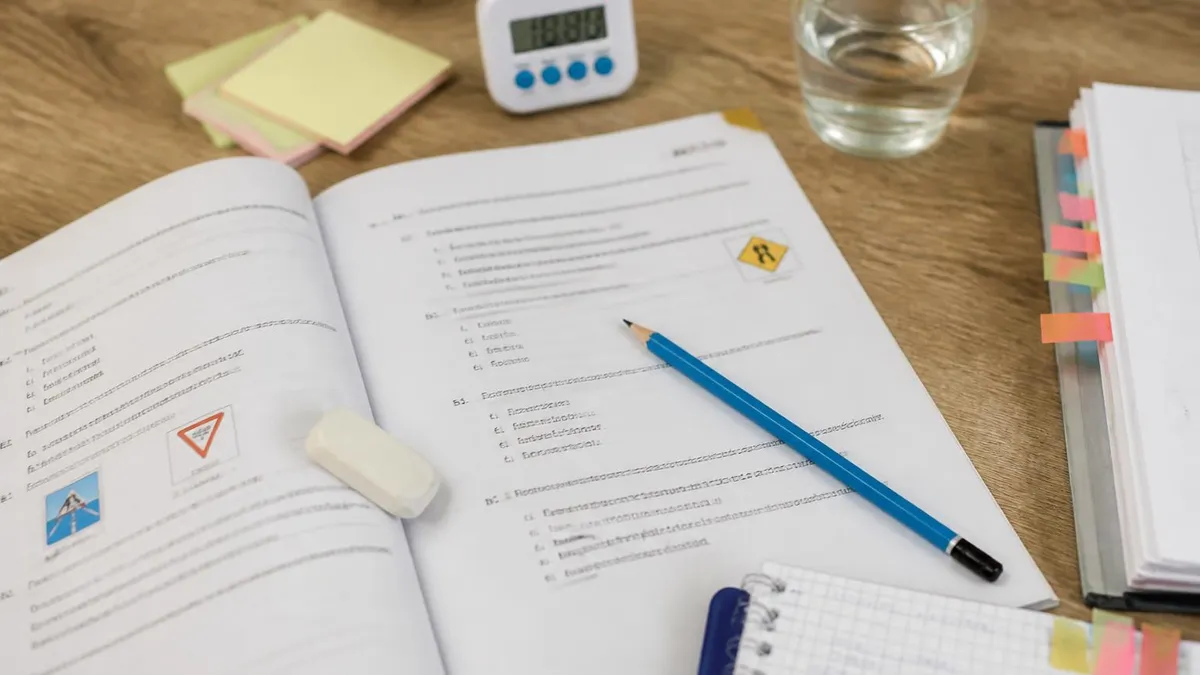
Danville BMV Branch Services Overview
The Danville branch administers the Illinois written knowledge test for learner's permits and first-time licenses. Walk-ins are accepted, but arriving early in the morning gives you the best chance of completing the process the same day without a long wait.
Illinois drivers can renew standard licenses at the Danville BMV location. You must bring proof of identity, current address, and Social Security information. Senior drivers aged 75 and older must complete a vision screening and a shortened road test at renewal.
The branch processes title transfers for newly purchased or gifted vehicles, handles registration renewals for Vermilion County residents, and issues license plates. Fees vary by vehicle type and weight. Bring your bill of sale, current insurance card, and prior title.
Illinois residents who do not drive can obtain a state ID card at the Danville branch. REAL ID-compliant cards require additional documentation including a certified birth certificate, Social Security card, and two proofs of Illinois residency such as utility bills or lease agreements.
The Danville BMV assists applicants seeking a Commercial Driver License (CDL) by administering CDL knowledge tests for Class A, B, and C licenses. Applicants must hold a valid Illinois driver's license and pass the appropriate combination of general knowledge and endorsement tests.
Preparing for the DMV knowledge test requires more than skimming the Illinois Rules of the Road handbook the night before your appointment. The test is designed to assess genuine understanding of traffic laws, not just memorized facts, and the questions are written to expose gaps in comprehension. Applicants who treat preparation as a multi-week process — studying a chapter at a time and reinforcing learning with practice questions — consistently outperform those who cram. Setting aside 20 to 30 minutes each day for two weeks is a realistic and effective schedule for most first-time test takers.
The Illinois DMV knowledge test consists of 35 multiple-choice questions drawn from the state's official driver manual. Topics include right-of-way rules, speed limits in different zones, alcohol and drug impairment laws, road signs and markings, and emergency vehicle procedures. You must answer at least 28 questions correctly — an 80 percent passing threshold — to earn your learner's permit or first-time license. Missing more than seven questions results in a failing score, at which point you must wait one business day before retesting at the Danville BMV branch.
One of the most effective study strategies is completing a dmv test online through a structured practice platform before your real exam. Online practice tests replicate the format of the actual exam, present questions in randomized order, and provide immediate explanations for both correct and incorrect answers.
This active learning approach — where you engage with feedback rather than passively rereading text — accelerates retention and helps you identify the specific rule categories where your knowledge is weakest. Many applicants discover they are more confident with road signs than with right-of-way laws, or vice versa, and can adjust their focus accordingly.
Road signs and markings form a significant portion of the Illinois knowledge test, and many applicants underestimate this section. The exam includes questions about the meaning of specific sign shapes and colors, pavement markings like yellow center lines versus white lane dividers, and the difference between regulatory signs (which carry legal force) and advisory signs (which are recommendations). A red octagon always means stop; a pennant-shaped yellow sign always means no-passing zone. Learning the visual language of road signs is a distinct skill from understanding written traffic laws, and both deserve dedicated study time.
Alcohol and impaired driving laws receive heavy emphasis on the Illinois DMV knowledge test, reflecting the state's commitment to reducing drunk-driving fatalities. You will be tested on the legal blood alcohol concentration (BAC) limit of 0.08 percent for standard drivers, 0.04 percent for commercial drivers, and the zero-tolerance policy of 0.00 percent for drivers under age 21. The test also covers implied consent laws, which state that by driving on Illinois roads you automatically consent to chemical testing if lawfully stopped. Refusing a breathalyzer carries automatic license suspension penalties that are often more severe than the DUI conviction itself.
Safe driving practices tested on the exam go beyond simple rule recall. Questions address defensive driving concepts such as following distance (the three-second rule for dry conditions, extending to six or more seconds in rain or snow), proper scanning techniques at intersections, and how to handle a tire blowout or brake failure.
The exam also tests knowledge of school bus stopping laws — Illinois requires drivers to stop for a school bus with its red lights flashing in both directions on undivided roads — and the rules for driving in work zones, where fines are doubled and license suspension is possible for egregious violations.
Using a driving test online platform that focuses specifically on Illinois content gives you a realistic preview of the questions you will face at the Danville BMV branch. Generic national practice tests often include questions that do not reflect Illinois-specific rules, such as the state's unique Teen Driving Law provisions under the Graduated Driver Licensing (GDL) program, which restricts nighttime driving and passenger limits for drivers under age 18.
Choosing a practice resource that is aligned with the current Illinois Rules of the Road manual ensures every hour of your preparation directly improves your performance on the actual exam administered at the Danville location.
Traffic Laws, Road Signs, and Safe Driving Practices
Illinois traffic laws cover a broad range of driving situations, from basic right-of-way rules at four-way stops to complex multi-lane highway merging procedures. At an uncontrolled intersection, the driver who arrives first has the right of way; when two vehicles arrive simultaneously, the driver on the left yields to the driver on the right. Speed limits are set by law and posted on signs, with default limits of 30 mph in urban areas and 55 mph on most rural roads unless otherwise posted.
Cell phone use while driving is strictly regulated in Illinois. Handheld device use is prohibited for all drivers, while drivers under age 19 may not use any mobile device — even hands-free — while operating a vehicle. Seat belt laws require all occupants to be buckled, and violations result in fines that increase with each subsequent offense. Understanding these laws in detail before your DMV knowledge test dramatically reduces the risk of answering traffic law questions incorrectly on the actual exam administered at the Danville BMV branch.

Walk-In vs. Appointment at the Danville BMV Branch
- +No advance planning required — walk in any time during business hours
- +Immediate service if you arrive early when the office opens at 8:00 a.m.
- +Flexibility to choose any available weekday that fits your schedule
- +No risk of missing a pre-booked appointment due to unexpected schedule changes
- +Knowledge test can be taken the same day without prior reservation in most cases
- +Branch staff can answer document questions on the spot before you begin testing
- −Wait times can exceed two hours during peak periods like lunch hour and end-of-month rushes
- −No guaranteed service window — you may arrive and be told testing slots are full for the day
- −Holiday closures and unexpected staff absences are not communicated in advance to walk-ins
- −Arriving without a required document sends you home to gather paperwork and return another day
- −Saturday hours at the Danville branch are limited and inconsistent — verify before making the trip
- −High-traffic periods such as back-to-school season see significantly longer wait times than usual
Test Day Checklist: What to Bring to the Danville BMV Branch
- ✓Bring your original Social Security card or a document showing your full Social Security number.
- ✓Carry a certified birth certificate or valid U.S. passport as primary proof of identity.
- ✓Provide two documents showing your current Illinois address (utility bill, bank statement, or lease agreement).
- ✓Bring your current out-of-state license if you are transferring driving privileges from another state.
- ✓Pay the applicable knowledge test or license application fee — check the current Illinois Secretary of State fee schedule.
- ✓Arrive at least 30 minutes before closing time to ensure staff can complete your transaction.
- ✓Review road signs and markings one final time the morning of your test using a practice app or flashcards.
- ✓Confirm the Danville BMV branch hours by phone or official website before leaving home.
- ✓Complete at least three full-length dmv practice tests online and score 90% or higher before your appointment.
- ✓If you wear corrective lenses, bring them — vision screening is part of the licensing process and you must wear them during driving.
80% Is the Magic Number — and Most People Who Fail Miss It by 2–3 Questions
Illinois requires an 80 percent passing score on the DMV knowledge test — just 28 correct answers out of 35. Most first-time failures miss the threshold by only two or three questions, which means a single focused study session targeting your weakest topic area could be the difference between passing and having to return for a second attempt at the Danville BMV branch.
Safe driving practices are not abstract concepts — they are specific, testable behaviors that the Illinois DMV knowledge test evaluates through scenario-based questions. Understanding the theory behind each rule helps applicants apply knowledge even when a question is phrased in an unfamiliar way. For example, understanding why the three-second following distance rule exists (it accounts for human reaction time of approximately 1.5 seconds plus vehicle stopping distance) makes it easier to answer questions about adjusting following distance in adverse weather conditions, where that buffer needs to extend significantly.
Intersections are the most dangerous locations on any road, accounting for a disproportionate share of all traffic crashes. The Illinois driver's manual dedicates significant attention to right-of-way rules at various intersection types: controlled intersections with traffic signals, uncontrolled intersections with stop or yield signs, and uncontrolled intersections with no signage at all. At an unmarked intersection where two roads of equal importance cross, the right-of-way goes to the vehicle on the right. When turning left across oncoming traffic, the turning driver must yield to all approaching vehicles before completing the turn, regardless of which driver arrived at the intersection first.
Highway driving introduces its own set of safe driving practices that are distinct from city driving. Merging onto a highway requires matching the speed of existing traffic before entering the travel lane — not stopping at the end of an on-ramp and waiting for a gap, which is both dangerous and illegal.
Lane changes on multi-lane highways require checking mirrors, signaling for at least two seconds, checking the blind spot by physically turning your head, and then executing the lane change smoothly without forcing other vehicles to adjust their speed. These techniques are tested on the driving knowledge test because highway driving involves higher speeds where small errors have severe consequences.
School zones and work zones receive special attention in the Illinois Rules of the Road manual and on the DMV knowledge test. Speed limits in school zones are typically 20 mph when children are present, and violations carry enhanced fines. Work zones present moving hazards — construction workers, shifted lanes, and heavy equipment — that require heightened attention.
Illinois law doubles fines for speeding in work zones, and a second conviction within two years can result in license suspension. The Danville BMV branch examiners are particularly thorough in testing these high-risk zone rules because violations in these areas have outsized consequences for public safety.
Weather-related driving adjustments form another critical section of safe driving practices tested on the Illinois knowledge exam. In rain, drivers should reduce speed, increase following distance, avoid sudden steering inputs, and be aware of hydroplaning — a condition where a film of water lifts the tire off the road surface, causing complete loss of steering control.
In snow and ice, the stopping distance can increase by ten times compared to dry pavement. If your vehicle begins to skid on ice, the correct response is to steer in the direction of the skid — counter-intuitive for many new drivers — and release the accelerator without braking until the vehicle regains traction.
Sharing the road with vulnerable road users is an increasingly emphasized topic on modern DMV knowledge tests. Cyclists have the right to use the full lane when necessary and must be given three feet of clearance when being passed. Pedestrians in a marked crosswalk always have the right of way, even if the driver has a green light.
Emergency vehicles with lights and sirens activated require all drivers to pull to the right edge of the road and stop — passing or blocking an emergency vehicle is a serious violation that can result in both fines and license points. Motorcyclists are entitled to the full width of their lane and must be given complete lane space rather than being squeezed by a following vehicle.
The online dmv permit test resources available through platforms like PracticeTestGeeks are specifically designed to reinforce all of these safe driving practice concepts through repeated exposure to realistic exam questions. By taking multiple full-length practice tests before your visit to the Danville BMV branch, you build both knowledge and test-taking fluency — the ability to read a question carefully, eliminate obviously wrong answers, and select the correct response with confidence rather than anxiety. This combination of content knowledge and exam strategy is what separates first-time passers from those who require multiple attempts.

Illinois updates its Rules of the Road manual periodically, and the DMV knowledge test at the Danville BMV branch reflects the most current version. Using a manual or practice test resource that is more than one year old may expose you to outdated rules, especially regarding distracted driving penalties, speed limit zones near construction areas, and graduated license restrictions for teen drivers. Always verify that your study materials reference the current Illinois Secretary of State driver's manual.
After passing the DMV written test at the Danville BMV branch, first-time applicants under age 18 enter Illinois's Graduated Driver Licensing (GDL) program, which restricts driving privileges in stages until the young driver builds experience. The first stage is the Instruction Permit, which requires the teen to drive only when accompanied by a licensed driver age 21 or older who sits in the front passenger seat. The permit holder must log at least 50 hours of supervised driving — including 10 hours at night — before advancing to the next stage.
The second GDL stage is the Graduated License, sometimes called a Restricted License, which allows unsupervised driving but with important restrictions. For the first 12 months, the teen driver cannot drive between 10:00 p.m. and 6:00 a.m. Sunday through Friday, or between 11:00 p.m. and 6:00 a.m. on Friday and Saturday nights.
Additionally, during the first 12 months, only one passenger under age 20 is permitted in the vehicle unless the teen driver is accompanied by a supervising adult. These restrictions exist because crash data consistently shows that teen drivers face dramatically increased risk with peer passengers and during late-night hours.
Adult applicants transferring an out-of-state license to Illinois may be eligible to waive the knowledge test if their prior state license is current and unexpired. However, applicants from certain states or with significant gaps in licensure may still be required to pass the DMV knowledge test at the Danville BMV branch. An applicant with a license that expired more than 12 months ago is typically required to complete both the knowledge test and a road test, regardless of their previous driving experience. Contacting the Danville branch before your visit to confirm your specific requirements can prevent a wasted trip.
Senior drivers in Illinois face additional requirements at renewal time that are worth understanding well in advance. Drivers aged 75 to 80 must renew every two years instead of the standard four-year cycle, and must pass a vision test at each renewal. Drivers aged 81 to 86 renew annually and must also complete a driving skills test at renewal.
Drivers aged 87 and older renew annually and must pass a road test at each cycle. The Danville BMV branch can administer vision screenings and written knowledge re-tests for seniors, but road tests require scheduling a separate appointment with a state-certified examiner.
Vehicle registration services at the Danville BMV branch follow Illinois's annual renewal schedule, with most registrations expiring on the vehicle owner's birthday month. Owners can renew by mail, online through the Illinois Secretary of State's website, or in person at the Danville branch.
In-person renewal is required when there has been a change in vehicle ownership, when the vehicle fails an emissions test and needs further documentation, or when a lost or stolen license plate needs replacement. Emissions testing requirements apply to vehicles in the greater Chicago metropolitan area and certain collar counties — Vermilion County residents are generally exempt from mandatory emissions testing.
The driver license test fee in Illinois is currently set by the Secretary of State's office and varies by license type. A standard Class D (passenger vehicle) license requires payment of the original issuance fee plus a photograph fee. Learner's permit fees are lower and apply toward the eventual license issuance.
Fee schedules are updated periodically, and the Danville BMV branch accepts payment by cash, check, or credit card for most transactions. Confirming the current fee for your specific transaction before your visit prevents the frustration of arriving without adequate payment — the branch cannot extend credit or hold your place while you leave to obtain payment.
For applicants who need to retake the driver license test after a first failure, the waiting period in Illinois is one business day. There is no additional fee for the first retest, but subsequent attempts may carry a small fee. Applicants who fail three times within a 12-month period may be required to complete a driver education course before being permitted to test again.
Using the time between attempts to complete targeted practice on the specific topics you missed is far more effective than simply rereading the entire manual — a focused review of the three or four subject areas where you made errors will close most of the gap on your score.
Practical preparation for the Danville BMV branch visit starts well before the morning of your appointment. The single most important step is completing the Illinois Rules of the Road handbook from cover to cover at least once, taking notes on rules you find surprising or counterintuitive.
Many applicants discover they have incorrect assumptions about specific traffic laws — for example, assuming that a flashing yellow light means slow down and proceed with caution, which is correct, but conflating it with a flashing red light, which means come to a complete stop as if it were a stop sign. These subtle distinctions are precisely what the DMV written test is designed to surface.
Building a consistent daily study routine in the two weeks before your test creates the kind of long-term memory consolidation that supports confident recall under pressure. Studying for 25 minutes per day is more effective than a single three-hour session the night before the exam — a finding supported by decades of cognitive science research on the spacing effect. Using a practice platform that tracks your performance over time allows you to see measurable improvement and identify when you have achieved consistent mastery of each topic area before walking into the Danville BMV branch with full confidence.
On the morning of your test, avoid cramming new material. Instead, do a brief 15-minute review of the topics you find most challenging, then focus on practical preparation: eating a light meal, arriving at the branch early enough to complete any paperwork without rushing, and bringing all required documents in an organized folder. Anxiety is one of the most common causes of careless errors on multiple-choice exams, and most anxiety stems from uncertainty — either about the content of the test or about logistical details like where to park or which line to stand in at the Danville BMV branch.
Reading each question carefully is the most important test-taking technique for the Illinois DMV knowledge test. Many questions include qualifiers like "except," "always," "never," or "only" that fundamentally change the correct answer. A question asking which of the following is NOT a reason to stop for a school bus requires you to identify the exception rather than the rule. Taking two or three seconds to reread the question before looking at the answer choices helps prevent the common mistake of answering the question you expected rather than the question actually asked.
After passing the knowledge test, the Danville BMV branch will issue your learner's permit or proceed with your license issuance immediately. Permit holders should begin supervised driving practice as soon as possible, while the rules and concepts from the knowledge test are still fresh. The 50-hour supervised driving requirement for teen GDL applicants takes approximately five to six months to complete at a realistic practice frequency, so starting promptly after permit issuance keeps the overall timeline on track.
Adult applicants receiving a new license can begin independent driving immediately, though practicing specific maneuvers — parallel parking, highway merging, and three-point turns — in low-traffic conditions helps build confidence before driving in unfamiliar or high-pressure environments.
Using a driving test online platform throughout the permit period, not just during initial preparation, reinforces the traffic laws and safe driving practices that were tested on the knowledge exam and must be applied in real driving situations. Many permit holders find that revisiting practice questions after accumulating supervised driving hours helps them connect abstract rules to concrete road experiences — for example, understanding the three-second following distance rule intellectually is different from actually applying it on a busy highway. This continuous learning approach builds the comprehensive driving knowledge that makes new drivers genuinely safer, not just licensed.
The Danville BMV branch, like all Illinois Secretary of State facilities, is committed to making the licensing process accessible and efficient for all residents of Vermilion County and surrounding communities. Staff are trained to assist applicants with questions about documentation requirements, fee schedules, and testing procedures. However, the branch cannot provide study assistance or allow reference materials during the knowledge test — that preparation is entirely the applicant's responsibility. Investing the time to prepare thoroughly is both the most respectful use of branch staff time and the strategy most likely to result in a successful first-visit outcome.
BMV Questions and Answers
DMV Driver's License Written Test Questions: Complete Study Guide and Practice Strategy for 2026

BMV Hours of Operation: Everything You Need to Know Before Your DMV Written Test
Ohio BMV Hours: Office Schedules, Online Services, and What to Know

Indiana BMV License Renewal Cost: Fees, Requirements, and How to Prepare for the DMV Written Test

BMV Driving Test Schedule: Everything You Need to Know About the DMV Written Test
About the Author
Licensed Driving Instructor & DMV Test Specialist
Penn State UniversityRobert J. Williams graduated from Penn State University with a degree in Transportation Management and has spent 20 years as a certified driving instructor and DMV examiner consultant. He has personally coached thousands of applicants through written knowledge tests, skills assessments, and commercial driver licensing programs across more than 30 states.
Join the Discussion
Connect with other students preparing for this exam. Share tips, ask questions, and get advice from people who have been there.
View discussion (9 replies)