
BLS Renewal Online: Complete 2026 October Guide for Healthcare Professionals
BLS renewal online in 2026 October: 🎓 AHA HeartCode vs Red Cross vs online-only providers, costs, skills checks, passing scores, and how to renew fast.
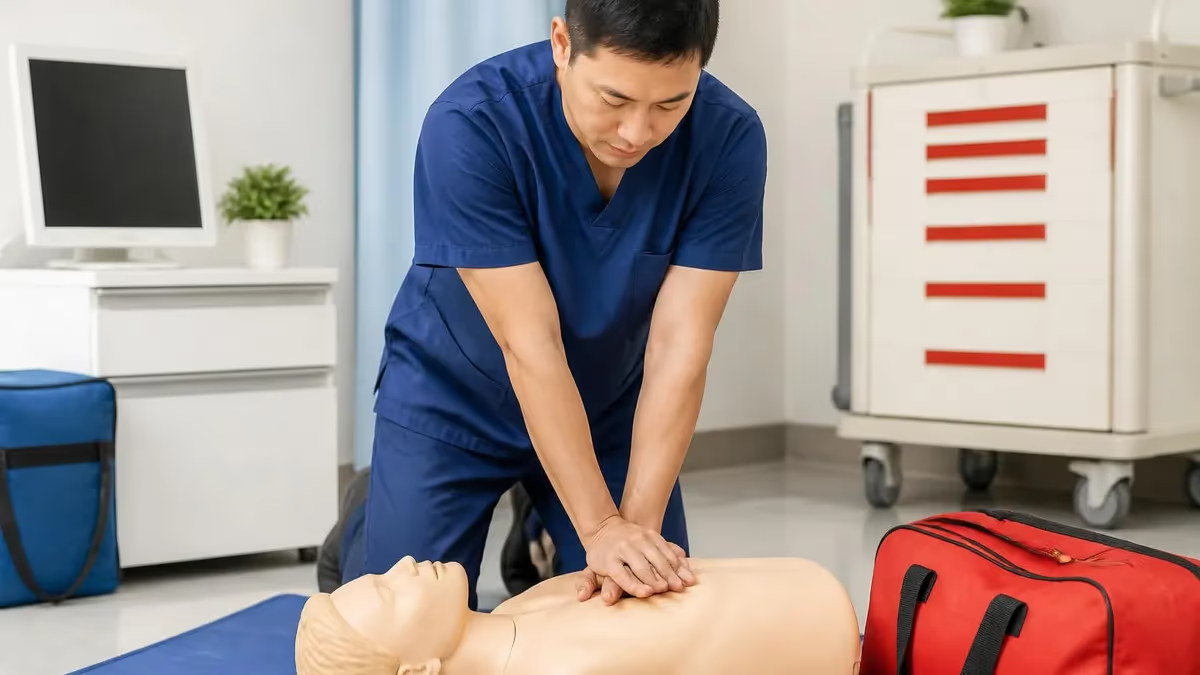
Your BLS certification is about to expire, you have a packed work schedule, and the idea of sitting through an eight-hour classroom session is enough to make you put off renewal until the last possible minute. That is exactly how lapses happen, and a lapsed card can keep you off the schedule until you re-certify. The good news is that BLS renewal online is now a legitimate, employer-accepted option for most healthcare professionals, and you can complete the entire process from your kitchen table on a Sunday afternoon.
Online BLS renewal blends asynchronous coursework, knowledge testing, and (depending on the provider) a remote or in-person skills check. The structure is designed to fit the realities of working clinicians: short modules you can pause, video demonstrations you can rewind, and a final assessment that proves you still know the algorithms cold. Done right, the whole thing takes two to three hours of focused time, costs roughly the same as a traditional class, and ends with a printable card you can hand to your manager that same day.
This guide walks you through every part of the renewal pathway — who qualifies, which providers your employer will actually accept, how the skills verification works, what to study before you log in, and the small details that catch people out. If you want a quick gut-check on your current readiness before paying for a course, work through a free BLS chain of survival quiz first.

BLS Renewal at a Glance
Key Facts at a Glance
| Item | Value | Details |
|---|---|---|
| Card validity | 2 yrs | |
| Typical total cost | $50–$120 | |
| Passing score required | 80%+ |
Online renewal is built for providers who already hold a current or recently expired BLS card. The American Heart Association, the Red Cross, and the major non-AHA training organizations all distinguish between "initial certification" (you have never been certified, or your card lapsed more than 30 days ago) and "renewal" (you are recertifying before expiration or within a short grace window). The renewal pathway assumes baseline competency, so it is shorter and more affordable than an initial course.
If your card expired more than 30 days ago, most employers and most providers will route you to an initial BLS course instead. There is no formal national rule, but hospital education departments tend to treat anything beyond a month-late as a fresh certification scenario. Check with your facility's HR or education team before paying for a renewal seat — getting this wrong wastes money and time.
Eligibility also depends on your role. Hospital nurses, paramedics, respiratory therapists, dental staff, medical assistants, lifeguards, and many allied-health professionals can renew online without issue. Some specialty roles — code team members, ICU nurses, ED techs — may have facility-level policies that require in-person skills checks regardless of what the national provider allows. When in doubt, email your nurse educator before you click "enroll."
Renew 60 to 30 Days Early
Most providers date your new BLS card from your original expiration, so renewing early loses you nothing and protects you from a lapsed-card scramble. Set a calendar reminder at 22 months from your most recent renewal date.
The American Heart Association does not offer a fully online BLS course. What it does offer is HeartCode BLS, a blended-learning program that pairs online coursework with a mandatory hands-on skills session. You complete the cognitive portion at home — videos, simulations, a final exam — and then schedule a skills check with an AHA-aligned instructor or a Voice Assisted Manikin (VAM) station, often hosted at a hospital, fire department, or training center.
HeartCode is what most US hospitals require if your employer specifies an "AHA card." The online portion takes roughly 1 to 2 hours. The skills session is typically 20 to 30 minutes. Your AHA eCard is issued after the instructor signs off on the skills component, and it is valid for two years from the issue date. Cost typically runs $30 to $40 for the online portion plus $40 to $80 for the in-person skills check, depending on the training center.
If you work in a hospital system, your employer probably has an internal AHA Training Center that runs HeartCode skills sessions on-site, sometimes for free. Ask your education department before paying out-of-pocket. Many systems also subsidize or fully cover the cost as part of mandatory annual training.
Three Renewal Pathways
Online cognitive portion at home plus an in-person or VAM skills check. Required by most US hospitals.
Online modules plus separate in-person skills check. Widely accepted, including at many hospitals and clinics.
NHCPS, ProCPR, ASHI, and similar. Faster and cheaper, but verify employer acceptance first.
Outside the AHA ecosystem, a number of training organizations offer fully online BLS renewal with a remote skills verification component or a self-attestation model. Providers in this category include the American Red Cross (online + in-person skills), the National Health Care Provider Solutions (NHCPS), ProTrainings, ProCPR, Save A Life by NHCPS, and the American Safety Health Institute (ASHI). Each issues a digital card that meets OSHA workplace standards and is accepted by a meaningful share of employers, particularly outside hospital systems.
The catch: not every employer accepts non-AHA cards. Hospitals, hospital-affiliated clinics, and many EMS agencies require an AHA or Red Cross card by policy. Dental offices, urgent care chains, fitness facilities, schools, daycares, and many corporate wellness programs accept any nationally recognized provider. Before you enroll with a less-familiar provider, ask your employer in writing which cards they accept. A screenshot of that confirmation is worth keeping in your employee file.
The American Red Cross sits in a middle category. It offers a blended-learning BLS renewal with an online module plus an in-person skills check, structured similarly to HeartCode. Its cards are widely accepted, including at many hospitals, though some institutions remain AHA-only. Red Cross digital credentials live in their cloud platform and can be shared via a verification link, which simplifies HR documentation.

Compare Your Options
The gold standard for hospital settings. Online portion runs $30 to $40, plus a separate $40 to $80 skills check at an AHA Training Center. Total time roughly 2 to 3 hours. Card valid 2 years from issue date. Required if your employer specifies an AHA card.
The renewal process itself is consistent across providers. You create an account, pay the course fee, and start the online modules. Content is organized around the BLS algorithms — adult, child, and infant CPR, choking relief, AED use, opioid emergencies, and team dynamics — with short video clips and check-your-understanding questions sprinkled throughout. Most platforms let you pause and resume across multiple sessions over several days.
After the modules, you take a knowledge exam. Standard passing scores are 80 to 84 percent. Questions test recall of compression depth and rate, ventilation ratios, AED pad placement, and recognition of when to start CPR versus when to assess for a pulse. If you fail, you typically get one or two retakes included; beyond that you may have to re-enroll. Reviewing a structured BLS certification resource the night before makes a massive difference here.
The skills component varies by provider. AHA HeartCode requires in-person hands-on verification with an instructor or VAM station. The Red Cross requires a separate in-person session. Some non-AHA providers use live remote video, where you demonstrate compressions on your own manikin or a firm cushion while an instructor watches. Others rely on employer attestation, where your supervisor signs off that they observed you performing CPR competently. Read the fine print before paying — a course with no skills component at all may not be valid in your state or workplace.
The single most common renewal mistake is paying for a course your employer will not accept. Email your HR or nurse educator and get written confirmation of which providers they recognize before you click enroll. Save the email in your employee file.
Even though renewal is short, the exam still trips people up. The most common failure points are pediatric compression-to-ventilation ratios when there are two rescuers, the timing of pulse checks (no more than 10 seconds), and the exact rate window for chest compressions (100 to 120 per minute). High-performance team concepts also show up — closed-loop communication, clear role assignment, minimizing interruptions to compressions to less than 10 seconds per cycle.
Spend 30 to 60 minutes the night before your renewal reviewing the AHA's current emphasis areas. The 2020 guidelines, still in force at the time of writing, emphasize early recognition of cardiac arrest, immediate high-quality CPR, rapid defibrillation, and post-cardiac-arrest care. Updates from the 2025 focused update around opioid-associated emergencies and the use of naloxone in lay-rescuer scenarios are also fair game.
Practice retrieval, not re-reading. Run through scenario-based questions on the free BLS CPR techniques quiz and the BLS airway management quiz. If you can answer 90 percent of those questions cold, you are ready. If you keep missing the same topic area — say, infant CPR or opioid response — focus your review there before logging into the renewal platform.
Day-Of Renewal Checklist
- ✓Confirm your employer accepts the provider you chose
- ✓Have your previous BLS card or eCard number ready
- ✓Set aside 2 to 3 hours of uninterrupted time
- ✓Use a desktop or laptop, not a phone
- ✓Have a stable internet connection (modules buffer if it drops)
- ✓Keep a notepad nearby for tricky algorithm details
- ✓Schedule any required skills check immediately after you pass
- ✓Download the PDF card and email it to HR the same day
Pricing varies more than you would expect. AHA HeartCode online runs $30 to $40 plus a separate $40 to $80 skills check fee, putting total cost in the $70 to $120 range. Red Cross blended courses are similar, typically $80 to $100 all-in. Fully online providers like NHCPS or ProCPR run $50 to $80 with no separate skills fee, since they bundle remote verification or use employer attestation.
Watch for hidden fees. Some providers charge extra for the printed card, for expedited card delivery, or for "premium" study materials that should be included in the base price. Reputable providers include the digital card, the printable PDF, and a wallet-sized version in the course fee. If a provider asks for an additional $15 to "release" your card after you pass, that is a red flag.
Employer reimbursement is worth chasing. Many hospitals, EMS agencies, and dental groups reimburse the full cost of BLS renewal once a year, provided you submit a receipt and a copy of the card within a defined window (often 30 to 60 days after renewal). Save the email receipt the moment you pay — it is far easier than trying to retrieve it weeks later.

Do not wait until the week your card expires. The smart move is to renew between 60 and 30 days before expiration. Most providers will date your new card from the original expiration, so you do not lose time by renewing early. This buffer also handles surprises — a failed exam, a delayed skills check appointment, or a last-minute work conflict.
If your card has already expired, act fast. Within the first 30 days, most providers will still let you renew rather than re-certify. Beyond 30 days, you are looking at an initial BLS course, which is longer and slightly more expensive. Beyond 60 to 90 days, some employers will pull you from patient-facing shifts entirely until you are re-certified.
Build a calendar reminder the day your new card arrives. Set it for 18 months out, then again at 22 months. That gives you a comfortable window to renew without the pressure of an imminent expiration. Pair the reminder with a note about which provider you used, what your login credentials were, and how much it cost — your future self will thank you.
Online BLS Renewal vs Traditional Classroom
- +Complete on your own schedule, including weekends and evenings
- +Pause and rewind any module as many times as you need
- +Often cheaper than a full classroom course
- +Digital card issued same day in most cases
- +Stack with other certification renewals to save time
- −Skills component may still require an in-person visit
- −Not all employers accept non-AHA online providers
- −Self-paced format requires real focus and discipline
- −Technical glitches can interrupt mid-module progress
- −Less peer feedback than a live classroom session
The biggest pitfall is paying for a course your employer will not accept. Verify in writing before you enroll. The second-biggest is assuming the online-only providers are interchangeable — they are not, and accreditation matters. Look for providers that are accredited by the Continuing Education Coordinating Board for Emergency Medical Services (CECBEMS, now CAPCE), the Commission on Accreditation for Pre-Hospital Continuing Education, or a state EMS office.
Another common mistake is treating renewal as a formality. The algorithms have changed over the years. Compression depth for adults is now at least 2 inches but no more than 2.4 inches. Ventilation timing for a patient with an advanced airway is one breath every 6 seconds. Opioid-associated emergencies now have their own algorithm. If you have not actively worked codes recently, take the modules seriously — the exam will catch you out otherwise.
Finally, do not skip the skills check if your provider requires one. A digital card with no skills component may not survive a JCAHO audit at a hospital, and if your employer discovers it during a credentialing review, you can be required to re-certify on your own dime. Pay the extra $50 for the in-person session if your workplace expects it.
Renewal Window Numbers That Matter
Once you pass, your digital card is usually issued within minutes (AHA, NHCPS, ProCPR) or within 24 to 48 hours (Red Cross). Download the PDF, print a copy for your physical wallet, and email a copy to your HR or education department right away. Most employers want both the card image and a verification link or QR code they can scan to confirm authenticity.
File the card in three places: your phone (as a PDF in a "credentials" folder), your work email (forwarded to yourself for searchability), and a cloud backup like Google Drive or Dropbox. Losing your card a week before a shift and scrambling to recover it is a stress you do not need. If your provider supports a digital wallet credential (Apple Wallet, Google Wallet), set that up too.
Mark the next renewal date in your calendar before you close the browser tab. Set the reminder for 60 days before expiration. While you are at it, consider whether other certifications — ACLS, PALS, NRP, TNCC — are coming due, and stack their renewals into the same week if possible. Batching renewals saves time and mental overhead.
Save the PDF to your phone in a credentials folder, email it to yourself at work for searchability, and store a backup copy in cloud storage. Losing your card the day before a shift is a stress you do not need.
If your role requires more than basic life support, look at the related certifications now rather than waiting. ACLS certification is required for nurses, paramedics, and physicians working with adult cardiac patients. PALS certification covers pediatric advanced life support and is standard in pediatric hospitals and many EDs. Some providers bundle BLS, ACLS, and PALS renewal at a discount, which is worth a look if all three are coming due in the same quarter.
For dental professionals, BLS is the most common requirement, though some states are starting to require ACLS for sedation providers. For lifeguards, the Red Cross Lifeguarding certification typically includes BLS-equivalent training, but the cards are not always interchangeable for hospital roles — verify before assuming. For new hires in non-clinical wellness or fitness roles, employers often accept a basic CPR/AED certification rather than a full provider-level BLS card.
Whatever your role, build your renewal plan around two things: what your employer requires, and what your state licensing board requires. Those are not always the same. A hospital might require AHA BLS even though your state board accepts any nationally recognized card. Always go with the stricter of the two requirements to avoid problems.
Your Renewal Timeline
Day 60 before expiration
Day 45 before expiration
Day 30 before expiration
Day 14 before expiration
Day 7 before expiration
Day 0 (expiration day)
BLS Questions and Answers
About the Author

Registered Nurse & Healthcare Educator
Johns Hopkins University School of NursingDr. Sarah Mitchell is a board-certified registered nurse with over 15 years of clinical and academic experience. She completed her PhD in Nursing Science at Johns Hopkins University and has taught NCLEX preparation and clinical skills courses for nursing students across the United States. Her research focuses on evidence-based exam preparation strategies for healthcare certification candidates.
Join the Discussion
Connect with other students preparing for this exam. Share tips, ask questions, and get advice from people who have been there.
View discussion (8 replies)