
Becoming a BLS Instructor: AHA & Red Cross Path Guide 2026 October
🎯 BLS Instructor course guide: AHA and Red Cross paths, Instructor Essentials, Training Center alignment, monitored teaching, costs, renewal, and how
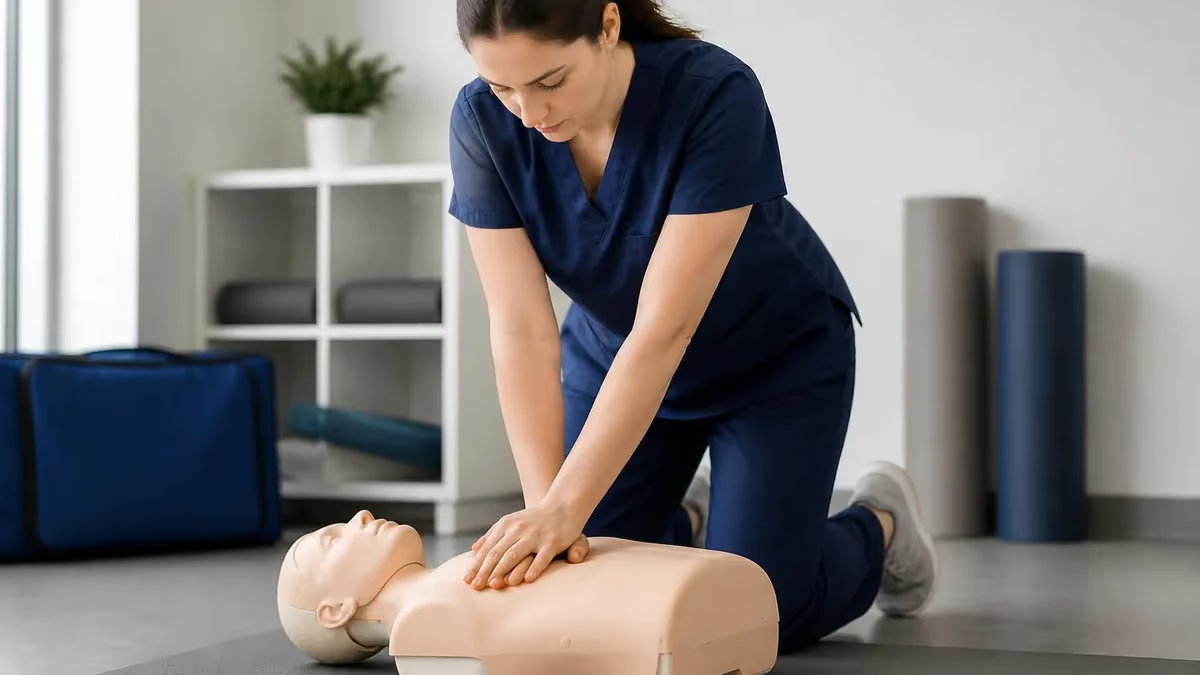
Ask any paramedic who runs CPR refreshers at the firehouse, or any nurse who teaches resuscitation on hospital orientation day, and they will tell you the same thing. The card that lets them stand at the front of the room is not glamorous.
It is a credential earned with a stethoscope draped over a chair, a manikin on a folding table, and a thick instructor manual that they read twice. The BLS instructor course is the part of the resuscitation training pipeline that almost nobody talks about publicly—and it is one of the most useful side credentials in healthcare and emergency services.
Here’s the short version. Two organizations dominate the U.S. market: the American Heart Association and the American Red Cross. Both will let you become a Basic Life Support Instructor if you already hold a current Provider card, complete their online Instructor Essentials course, align with a Training Center, and finish a monitored teaching assignment in front of a real student class. Neither path is hard if you stay organized. Both pay you back the first time you teach a class.
This guide walks through every step. Eligibility, online prerequisites, Training Center alignment, classroom mechanics, recertification rules, and the Red Cross parallel. We will also cover the question almost every candidate asks at some point—where will I actually teach once I have the card?—and the answer turns out to be less mysterious than people think.
By the end you will know which path matches your situation, what it costs, how long it takes, and which boxes to tick before you submit anything to the AHA Atlas system or the Red Cross Learning Center.

The BLS Instructor Marketplace by the Numbers
Those numbers map the marketplace better than any brochure. Around 18,000 American Heart Training Centers run BLS classes across the United States, and tens of thousands of active BLS Instructors keep that network alive. The course itself runs anywhere from four to eight hours of in-person teaching plus the online prerequisite, and a single instructor typically certifies 6 to 12 students per class depending on the room and the manikin count. Across a year, an active instructor at a Training Center site might run 20 to 50 classes—real volume, real income for those who want it.
The cost spread tells its own story. A new candidate can become a BLS Instructor for under $300 if their Training Center subsidizes Instructor Essentials and the materials, or push past $700 once you factor in independent purchase of the AHA Instructor Manual, the eCards subscription, manikins, AED trainers, and a personal Training Center fee. Recertification every two years adds another modest hit. None of it is prohibitive once you start teaching.
And then there is the regulatory pressure. State EMS bureaus, nursing boards, OSHA recordkeeping rules for first-aid responders, and healthcare facility credentialing committees all reference current BLS Provider cards on documentation. Somebody has to teach those students. The BLS Instructor card—particularly the AHA version—is what unlocks that role.
A BLS Provider is a clinician, first responder, or layperson trained to deliver high-quality CPR, use an AED, relieve foreign-body airway obstruction, and participate in team-based resuscitation. The card lasts two years. A BLS Instructor holds an additional credential that authorizes them to teach the BLS Provider course on behalf of an AHA Training Center or Red Cross Licensed Training Provider. To become an instructor you must already be a current Provider, complete Instructor Essentials online plus the in-person session, align with a Training Center, and finish a monitored teaching assignment under a Training Center Faculty observer. The instructor card also lasts two years and requires you to teach at least four BLS classes every two years to remain renewal-eligible.
Before anything else, you need a current Provider card. The American Heart Association rule is explicit: to enroll in the BLS Instructor Essentials course you must hold a current AHA BLS Provider card, or hold an instructor credential from another AHA-aligned discipline like ACLS or PALS. The Red Cross has the same gate—a current Red Cross BLS Provider certification is the minimum. There is no shortcut. If your card lapsed last month, renew it before applying to the instructor track. The Provider course gives you the muscle memory you will be passing to students.
The next gate is alignment with a Training Center. This is the piece that surprises most candidates. You do not become a BLS Instructor as a free agent. You align with an AHA Training Center (TC) that holds the issuing authority for instructor cards in your region.
The TC sponsors your candidacy, signs off on the monitored teaching, issues your instructor card after you complete the program, and remains your home for renewals and audits. Some TCs are large multi-state operations. Others are small, like a single fire department or a community college EMS program. Either works. What matters is the relationship.
How do you find one? AHA runs a public Training Center locator on their site. Call two or three TCs in your area and ask about their candidate pipeline. Each has its own fee structure, support level, and expectations. Some include the Instructor Manual and eCards subscription in their fee. Others want you to buy your own materials and just pay the alignment fee. Ask about monitored teaching opportunities—the busier the Training Center, the faster you finish.
The Five-Step Path to Becoming a BLS Instructor
AHA BLS Provider or Red Cross BLS Provider, whichever path you choose. Card must be current the day you enroll in Instructor Essentials and the day your instructor card is issued.
AHA Training Center (TC) or Red Cross Licensed Training Provider (LTP). The TC sponsors your candidacy, signs off your monitored teaching, and issues your instructor card. You cannot become an instructor as a free agent.
Online prerequisite (~3 hours, $36-$40) plus an in-person classroom session (4-6 hours, $75-$250) led by Training Center Faculty. Both halves are required.
Co-teach an entire BLS Provider course alongside a current instructor while a TCF observes you. Most candidates complete this in one class; some TCs require two.
After successful monitored teaching, your Training Center submits paperwork to the AHA Atlas system. Your formal BLS Instructor credential is issued, valid for two years, and you can start teaching solo.
Training Center Faculty teach Instructor courses (training new instructors). Regional Faculty teach TCF candidates. Both are advanced ladders earned after years of consistent instructor work and mentorship.

Once you have a current Provider card and a Training Center on the hook, you move to the formal prerequisite: BLS Instructor Essentials. This is a blended course. The first part is an online module hosted on the AHA eLearning portal that runs roughly two to three hours and costs about $36 to $40 depending on the period. It covers the AHA philosophy of resuscitation education, the Chain of Survival, the practice-while-watching method, course administration, debriefing technique, and the legal and ethical framework that surrounds instructor work.
The online module ends with a knowledge assessment that you must pass to print your completion certificate. Hold onto that certificate—you will hand it to your Training Center Faculty during the in-person classroom session. The classroom portion is the second half of Instructor Essentials.
It runs four to six hours in person, led by a Training Center Faculty (TCF) member. You practice teaching the actual BLS skill stations to a small group, get coached on your delivery, run timing drills, and walk through manikin setup and AED trainer use. By the end of the day, the TCF signs you off as ready to attempt your first monitored teaching.
One detail worth knowing: the AHA does not publish a standard fee for the in-person session. Each Training Center sets its own price. Expect $75 to $250 for the day, sometimes bundled with the alignment fee and sometimes separate. Ask before you commit.
AHA Path vs Red Cross Path
The American Heart Association BLS Instructor path is the dominant route in U.S. healthcare. You must hold a current AHA BLS Provider card, complete the BLS Instructor Essentials online module (~$40), attend an in-person Instructor Essentials session at a Training Center (4-6 hours, $75-$250), and finish monitored teaching under a Training Center Faculty (TCF). The Training Center then issues your card through the AHA Atlas system. Recognized across virtually every U.S. hospital, ambulance service, dental office, and EMS agency. Card lasts two years. Renewal requires teaching at least four BLS classes plus completing the Instructor Renewal course.
Now comes the part that intimidates new candidates more than anything else—the monitored teaching assignment. You will co-teach an entire BLS Provider course alongside a current, active AHA BLS Instructor while a Training Center Faculty member or your sponsoring instructor observes. The TCF watches your skill demonstrations, listens to your debrief, evaluates your timing, and checks whether you correctly assess students using the official AHA practice-while-watching method.
Most candidates finish monitored teaching in one full BLS class. Some Training Centers want you to monitor two classes, particularly if the first one had a small student count. The standard student-to-instructor ratio in a BLS class is 6:1, and the standard manikin-to-student ratio is also flexible but typically 1:3 or better. Once the TCF signs off your monitored teaching, you submit the paperwork to the Training Center, which then issues your formal AHA BLS Instructor card and adds you to the AHA Atlas roster. The card is good for two years.
One thing nobody tells you: the monitored teaching is the most enjoyable part of the program. You spend the day in a real classroom, around real students, watching the rhythm of a course you will soon run yourself. Many candidates leave that day already excited about teaching their first solo class the following week.
This is the rule that trips up the most candidates. To enroll in Instructor Essentials, your BLS Provider card must be current. To complete monitored teaching, your Provider card must still be current. To receive your instructor card, your Provider card must be current on the issue date. To renew your instructor card at the two-year mark, your Provider card must also be renewed. Plan both renewals on the same calendar. If your Provider card lapses at any step, you will not be able to receive or maintain your Instructor authorization until you re-test and re-certify as a Provider. Set calendar reminders 60 days before each expiration.
If the AHA path doesn’t fit your situation—maybe your hospital uses Red Cross, or your fire department contracts with a Red Cross provider—there is a parallel and equally legitimate route. The American Red Cross BLS Instructor program follows a similar shape: hold a current Red Cross BLS Provider card, complete the Red Cross Instructor Course online prerequisite, attend an in-person Instructor Course, and conduct your first co-taught class under the supervision of a Red Cross Instructor Trainer.
The structural difference is that Red Cross instructors align with a Licensed Training Provider (LTP)—the Red Cross term for what AHA calls a Training Center. The LTP holds your authorization to teach. You can also become an independent Red Cross Instructor without an LTP, though most candidates align because the LTP handles class registration, materials, eCards, and student record submission for you. Red Cross instructor authorizations also last two years, with renewal through completion of an Instructor Review course and a minimum class-teaching threshold.
So which one should you choose? Honest answer: pick the program your employer or community uses. A hospital that requires AHA BLS for all RN credentialing will not accept a Red Cross instructor running its in-house refreshers. A community fitness center that contracts Red Cross trainers will not invite an AHA-only instructor in. If neither dominates your area, the AHA card carries broader recognition across healthcare. The Red Cross card carries broader recognition in workplace, school, and community settings.

Pre-Application Checklist for BLS Instructor Candidates
- ✓Confirm your BLS Provider card is current and will remain current through the issue date of your instructor card
- ✓Decide between AHA and Red Cross based on what your employer, hospital, or community uses
- ✓Use the AHA Training Center locator (or the Red Cross LTP locator) to identify two or three nearby options
- ✓Call each Training Center and ask about candidate fees, materials included, and monitored teaching availability
- ✓Verify whether the TC supplies the AHA Instructor Manual or expects you to buy your own (~$40-$50)
- ✓Budget $400-$1,100 total startup, depending on TC bundling and your personal materials investment
- ✓Block off two days for in-person Instructor Essentials plus the monitored teaching class
- ✓Mark your two-year renewal date the moment you receive your card—and set a 60-day reminder
- ✓Decide upfront whether you want to teach 4 classes per cycle (minimum) or build a side income with 20+ per year
Here is where new instructors get surprised—the actual classroom mechanics of teaching a BLS course are not improvised. The AHA prescribes an exact sequence built around the practice-while-watching method, where students watch a short skill video, then immediately practice that skill on a manikin while the instructor circulates and gives individual feedback. No long lectures. No PowerPoint marathons. The video and the manikin do the heavy lifting. The instructor coaches, corrects, and assesses.
The full BLS Provider course runs about four hours of contact time for new students and roughly three hours for renewals. The skill stations include adult one-rescuer CPR with AED, adult two-rescuer CPR with bag-mask, child CPR with AED, infant CPR, choking relief for responsive and unresponsive victims of all age groups, and team-based resuscitation dynamics. The official AHA Instructor Manual gives you the exact script, exact timing, exact debrief questions, and exact assessment criteria. Stick to it the first few times. After 10 or 15 classes, you find your own rhythm but still hit every required objective.
The certification flow at the end of class matters too. Each student must pass two skill tests (adult one-rescuer CPR with AED, and adult two-rescuer CPR with bag-mask) and a written exam with at least 84% to receive their Provider eCard. As the instructor, you log results into AHA Atlas, the Training Center issues the eCards, and students get an email link to download their digital card. The whole back-end is paperless now, which used to be a slow paper-roster grind before 2020.
Becoming a BLS Instructor: Pros and Cons
- +Steady, year-round demand from hospitals, dental offices, EMS, schools, and corporate workplaces
- +Predictable startup cost ($400-$1,100) with fast payback after just two or three classes
- +Side income potential of $400-$1,080 gross per class for active instructors who run 1-3 classes per month
- +Curriculum is fixed and well-supported—no need to develop your own materials from scratch
- +Career ladder available through Training Center Faculty and Regional Faculty tracks for those who want it
- +Strong network of peers at most Training Centers—great for healthcare and EMS professionals
- −Must hold a current BLS Provider card at every step—lapse and you lose your authorization
- −Aligned to a single Training Center; transferring TCs requires paperwork and TC agreement
- −Recertification every two years plus a minimum of four taught classes per cycle
- −AHA and Red Cross do not cross-honor each other’s instructor cards—you teach one or the other
- −Material costs (manikins, AED trainers) add up if you want to run mobile or independent classes
- −Audit risk if class documentation is sloppy—clean recordkeeping is essential
Pros and Cons at a Glance
| Pros | Cons |
|---|---|
| Steady, year-round demand from hospitals, dental offices, EMS, schools, and corporate workplaces | Must hold a current BLS Provider card at every step—lapse and you lose your authorization |
| Curriculum is fixed and well-supported—no need to develop your own materials from scratch | Aligned to a single Training Center; transferring TCs requires paperwork and TC agreement |
| Career ladder available through Training Center Faculty and Regional Faculty tracks for those who want it | Recertification every two years plus a minimum of four taught classes per cycle |
| Strong network of peers at most Training Centers—great for healthcare and EMS professionals | AHA and Red Cross do not cross-honor each other’s instructor cards—you teach one or the other |
So what does ongoing life as a BLS Instructor look like? In short—teach. The AHA requires every BLS Instructor to teach at least four BLS Provider courses every two years to remain eligible for renewal. Most active instructors hit that number in their first three months because the demand for BLS is essentially nonstop. Hospitals need refreshers, dental offices need annual updates, dive shops need open-water rescue prerequisites, athletic departments need coach certifications, and corporate workplaces need OSHA-aligned first-aid responders.
Renewal itself is straightforward but specific. Within two years of your initial authorization, you must complete a BLS Instructor Renewal—an online refresher of the Instructor Essentials material plus, at some Training Centers, a brief check-off teaching session. You also must hold a current BLS Provider card on your renewal date. Some instructors miss this and lose their authorization for a month while they re-test as a provider. Avoid that. Mark both expiration dates on a calendar and schedule renewals 60 days early.
One other detail that catches people: Training Center Faculty (TCF) and Regional Faculty are separate, higher-level roles. A BLS Instructor teaches Provider courses. A TCF teaches Instructor courses (training new instructors) within a Training Center. A Regional Faculty teaches TCF candidates and audits Training Centers in their region. You climb that ladder by years of consistent instructor work, mentorship from a current TCF or RF, and a TCF candidacy process run by the AHA. Most BLS Instructors never need to go further—but the path exists if you want to make resuscitation education a career.
What does it actually cost, all-in, to become a BLS Instructor and teach your first class? Let’s lay out the realistic numbers. Provider course (initial or renewal): $60 to $120. Instructor Essentials online module: about $40. In-person Instructor Essentials classroom: $75 to $250. Training Center alignment fee: $0 to $200 depending on the TC’s structure.
AHA BLS Instructor Manual: $40 to $50 (some TCs include this). Manikins for your own teaching kit (optional but common): $200 to $400 for a basic adult/child/infant set. AED trainer: $100 to $250. eCards subscription (issued through the TC): $0 to $40 per year.
Total realistic startup: $400 to $1,100. If your TC bundles materials and absorbs alignment fees, you can stay under $300. If you go fully independent and buy your own manikins for in-home or mobile teaching, expect to hit the upper end. After that, you can charge $50 to $90 per student for a BLS Provider course, and a typical class of 8 to 12 students grosses $400 to $1,080. Two or three classes a month covers your kit. A dozen classes a month becomes a real second income.
This is why the BLS Instructor credential pays back faster than almost any other healthcare-adjacent certification. The course content is established, the demand is steady, and the materials investment is one-time. The only cap on income is how many evenings and weekends you want to spend at a fire department training room or a community college classroom.
A few honest cautions before you start. First, the AHA and Red Cross take their content protection seriously. You cannot record their videos, redistribute their materials, or use unofficial PowerPoint decks that recreate proprietary content. Stick to the official Instructor Manual and the official AHA eLearning platform. Knock-off instructor kits sold on hobby marketplaces almost always violate the AHA usage policy and can cost you your authorization.
Second, your instructor card is tied to your Training Center. If you change TCs, you transfer your authorization, but the new TC must agree to sponsor you. If you let your TC alignment lapse without transferring, your card effectively becomes inactive even before the printed expiration date. Always renew alignment first, then renew your instructor card.
Third, the practice-while-watching method works only if you respect the timing. Inexperienced instructors get chatty during the video segments and let students drift. Stick to the official rhythm: video, practice, brief debrief, next skill. Students learn faster, retention is better, and you finish on time. The AHA has spent two decades refining this method, and it works precisely as designed when you don’t freelance.
Finally, document everything. Class rosters, skill checks, written exams, eCard issuance dates, your own teaching log. When the AHA or Red Cross audits a Training Center, they sample instructor records. A clean log book makes that audit a five-minute conversation. A messy log book turns it into a multi-week scramble that can affect your renewal eligibility. Belt and suspenders. Same principle as everything else in resuscitation.
Sample BLS - Basic Life Support Practice Questions
Try these questions from our free BLS - Basic Life Support practice tests. The correct answer and an explanation follow each question.
A rescuer is performing CPR alone and is too fatigued to continue effective compressions. What is the best course of action?
- A. Switch to rescue breaths only and rest the arms
- B. Continue at a slower rate to conserve energy
- C. Call out for anyone nearby to take over compressions and continue until help arrives
- D. Stop CPR and wait for EMS
Answer: C. Call out for anyone nearby to take over compressions and continue until help arrives
The rescuer should call for someone else to take over while continuing CPR as best they can — stopping CPR significantly reduces survival chances.
During a pediatric cardiac arrest, a parent is present and becoming very distressed. The BEST team response is to:
- A. Ask the parent to lead compressions so they feel involved
- B. Have one team member briefly acknowledge the parent and assign another to support them away from the immediate area
- C. Ignore the parent and focus entirely on the patient
- D. Pause resuscitation to speak with the parent
Answer: B. Have one team member briefly acknowledge the parent and assign another to support them away from the immediate area
Designating one rescuer to support the family member maintains resuscitation quality while providing compassionate management of the emotional situation.
You see a teen kid lying on the ground in the hallway where you work at a high school. What is your initial course of action after establishing the safety of the situation?
- A. check for a pulse by palpating a carotid pulse
- B. check for breathing by scanning the victim's chest
- C. begin CPR with chest compressions using two hand technique
- D. check responsiveness by tapping the victim's shoulder and shouting "are you OK?"
Answer: D. check responsiveness by tapping the victim's shoulder and shouting "are you OK?"
After ensuring scene safety, the very first step in assessing an unresponsive person is to check for responsiveness. Tapping the victim's shoulder and shouting 'Are you OK?' helps determine if the person is conscious or unconscious. This initial assessment guides subsequent actions, such as calling for help or initiating CPR.
You release the baby's airway after 30 chest compressions, then search the child's mouth for the obstruction. You are able to take out a small toy that you see. (True or False) You'll perform a brachial pulse check as your next course of action.
- A. False
- B. True
Answer: A. False
False. After successfully removing an obstruction and providing rescue breaths, if the child is still unresponsive and not breathing normally, you should continue CPR. A pulse check is only performed if the child shows signs of life (e.g., starts breathing normally, moving, or responding). If the child remains unresponsive, CPR should continue until EMS arrives or the child recovers.
BLS Questions and Answers
About the Author

Registered Nurse & Healthcare Educator
Johns Hopkins University School of NursingDr. Sarah Mitchell is a board-certified registered nurse with over 15 years of clinical and academic experience. She completed her PhD in Nursing Science at Johns Hopkins University and has taught NCLEX preparation and clinical skills courses for nursing students across the United States. Her research focuses on evidence-based exam preparation strategies for healthcare certification candidates.
Join the Discussion
Connect with other students preparing for this exam. Share tips, ask questions, and get advice from people who have been there.
View discussion (8 replies)