
Hardest Bar Exam in the World: Which States and Countries Demand the Most?
Which bar exam is truly the hardest? 🎯 Discover pass rates, difficulty rankings, and what makes California's exam so brutal. Full global comparison inside.
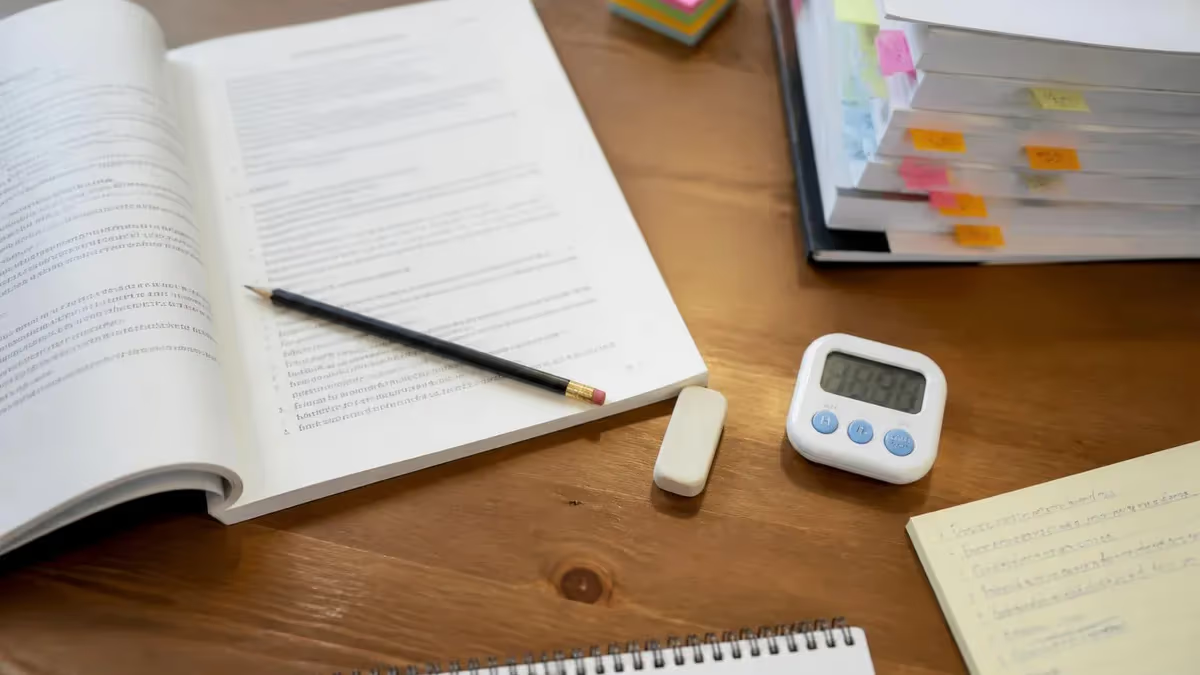
The hardest bar exam in the world is not a title any jurisdiction actively seeks, yet the competition for that grim distinction is fierce. For aspiring attorneys, the bar exam stands as the final gatekeeper between years of expensive legal education and the right to practice law. In the United States alone, the bar exam format, passing score, and first-time pass rate vary dramatically from state to state, creating a landscape where the same graduate might sail through one jurisdiction's test while failing another's. Understanding these differences is essential for any law student charting a career path.
California has long held the unofficial crown as the hardest bar exam in America. Its notoriously low pass rates — often hovering between 40 and 55 percent for first-time takers — reflect a two-day ordeal that tests a broader range of subjects than almost any other state. The California bar exam requires mastery of subjects not covered on the national Uniform Bar Exam, including Community Property, California Civil Procedure, and Professional Responsibility under California-specific rules. That added layer of state-specific doctrine makes preparation exponentially more demanding for candidates who studied under a general national curriculum.
Globally, the picture grows even more daunting. Japan's national bar exam, known as the Shiho Shiken, historically accepted fewer than three percent of candidates before recent reforms nudged that figure slightly higher. South Korea's bar exam, the Sisa, and China's National Judicial Examination — recently rebranded as the Legal Professional Qualification Examination — both demand years of preparation and carry pass rates that make the California bar look forgiving by comparison. These exams test not only legal doctrine but also the civil law traditions unique to each country, adding layers of complexity that common-law trained attorneys would find entirely foreign.
What makes a bar exam hard? The answer involves at least four variables: the breadth of subjects tested, the scoring threshold required to pass, the quality of the applicant pool, and the structure of the exam itself. An exam that tests 19 subject areas, requires a scaled score of 266 out of 400, and lasts two full days will predictably produce lower pass rates than a one-day exam covering 14 subjects with a 270 passing threshold on a 400-point scale — even if both use the same multiple-choice question format. Difficulty is a function of design choices, not accident.
The rise of the Uniform Bar Exam (UBE) has reshaped the American landscape considerably. Adopted by more than 40 jurisdictions, the UBE consists of the Multistate Bar Examination (MBE), the Multistate Essay Examination (MEE), and the Multistate Performance Test (MPT). Because scores are portable, a candidate who passes the UBE in one state can often transfer that score to another without retaking the exam.
This portability has made the UBE appealing to law students who want flexibility, but it has also shifted attention toward the handful of states — California chief among them — that have declined to adopt it, maintaining their own harder, state-specific exams.
Public fascination with the bar exam intensified when Kim Kardashian began publicly documenting her journey to pass the California bar exam through a law reader program rather than traditional law school. Her story drew millions of viewers into a conversation about how hard is the bar exam and whether the current system is equitable. Whether or not celebrity coverage changes policy, it has undeniably raised awareness of just how grueling even a partial attempt at bar passage can be, particularly in high-stakes jurisdictions where the exam's difficulty is an institutional feature rather than a bug.
This article ranks and explains the hardest bar exams in the world, breaks down what makes each one brutal, and provides actionable guidance for candidates who must face one of these tests. Whether you are a first-time taker researching your target jurisdiction or a repeat candidate analyzing where things went wrong, understanding the full landscape of global and domestic bar exam difficulty will sharpen your preparation strategy and set realistic expectations for the road ahead.
The Hardest Bar Exam — By the Numbers

How the Hardest Bar Exams Are Structured
A two-day exam with five one-hour essay questions, one 90-minute Performance Test, and 200 MBE multiple-choice questions. Candidates must master 19 subjects including California-specific Community Property and Civil Procedure rules not tested elsewhere.
A multi-stage national exam requiring a short-answer pre-screen, a long-form written examination covering civil law, criminal law, and constitutional law, and an oral interview. The entire process spans several months and tests deep doctrinal mastery.
Used in 40+ US states, the UBE combines a 200-question MBE, six MEE essay questions, and two MPT performance tasks over two days. Passing thresholds vary by state, with some requiring scores as high as 270 out of 400.
Introduced in 2012, South Korea's current bar exam allows law school graduates to sit for a five-subject written test. The pass rate typically runs 45–55%, but the depth of doctrinal knowledge required rivals any civil-law jurisdiction globally.
Covering criminal law, civil law, administrative law, commercial law, and procedural rules across a two-day computer-based exam and a subjective writing portion, China's exam is considered one of the world's most comprehensive legal licensing tests.
When ranking the hardest bar exams globally, most legal scholars and exam researchers point to a consistent cluster of jurisdictions where the combination of pass rate, subject breadth, and exam duration creates a uniquely punishing experience. Japan's historical bar exam deserves its place at or near the top of any honest ranking.
Before sweeping reforms restructured the Japanese legal education system in the early 2000s, the Shiho Shiken accepted fewer than three percent of all applicants — a figure that makes even California's notoriously low pass rates look generous. The exam demanded years of self-directed study with no formal law school requirement, effectively turning legal qualification into a test of endurance as much as intellect.
South Korea offers a fascinating parallel. The country replaced its older, open-admission bar exam with a graduate law school model in 2009, mirroring American and Japanese reforms. Today's Korean bar exam is restricted to graduates of accredited law schools and carries a pass rate that hovers around 50 percent. That number sounds manageable until you consider that Korean law school graduates spend three years in rigorous legal training before even sitting for the exam, meaning the 50 percent who fail are not ill-prepared — they simply faced a test designed to be genuinely difficult at every level of competence.
China's Legal Professional Qualification Examination, popularly known as the Falü Zhíyè Zīgé Kǎoshì, tests candidates across two separate days with both objective and subjective components. The objective portion uses multiple-choice questions covering an enormous range of Chinese domestic law, international law, and procedural rules. The subjective portion requires written analysis in essay and case-study format.
Historically, the combined pass rate for the full examination has run between 10 and 20 percent, though year-to-year variation is significant. The exam's sheer scope — candidates are expected to know domestic statutes, judicial interpretations, and administrative regulations across dozens of legal fields — makes thorough preparation a multi-year project.
Back in the United States, the debate over which state administers the hardest bar exam has intensified since the widespread adoption of the UBE. California remains the gold standard of difficulty, but several other states maintain reputations for brutal exams. Louisiana tests civil law principles alongside common law, reflecting its French and Spanish colonial heritage, making its bar exam unique in the entire country.
Nevada, despite using the UBE, sets its minimum passing score at 273 — one of the highest cut scores in the nation. Arkansas and Washington, D.C. round out lists of historically difficult jurisdictions based on combined first-time pass rate and score requirements.
One often overlooked factor in bar exam difficulty is the population of test-takers. California's low pass rate is partly a function of the state's large and diverse applicant pool, which includes a higher proportion of candidates from unaccredited law schools and foreign-trained attorneys than most other states. When researchers control for law school tier and LSAT scores, the difficulty gap between California and other jurisdictions narrows — but does not disappear. The exam itself is genuinely harder, not just harder because of who takes it.
The results of new york bar exam provide an instructive contrast with California. New York switched to the UBE in 2016, and its first-time pass rates improved noticeably in the years that followed. Candidates who had previously struggled with New York's idiosyncratic essay topics found the standardized UBE format more predictable, allowing targeted preparation to pay off more reliably. That shift illustrates an important principle: exam structure matters as much as subject difficulty. A test that rewards strategic preparation is functionally less hard than one that requires encyclopedic mastery of unpredictable topics.
For candidates who must face one of the world's hardest bar exams, the key takeaway from global comparisons is that raw difficulty is manageable when approached systematically. Every jurisdiction that publishes bar exam questions reveals patterns — favored topics, recurring fact patterns, preferred analytical frameworks — that well-prepared candidates can exploit. The hardest exams in the world are hard, but they are not random. They test specific bodies of knowledge in specific formats, and understanding that architecture is the first step toward passing.
California Bar Exam vs. UBE vs. International Bar Exams
The California bar exam is widely considered the hardest bar exam in the United States. It tests 19 subjects over two full days, including California-specific topics like Community Property, California Civil Procedure, and state Professional Responsibility rules. The exam includes five one-hour essay questions, a 90-minute Performance Test, and 200 MBE multiple-choice questions. First-time pass rates for ABA-accredited law school graduates typically run between 55 and 65 percent, while overall pass rates including all candidate types fall closer to 40 to 50 percent.
Preparation for the California bar exam generally requires 400 to 500 hours of dedicated study over an 8 to 10 week period. Most successful candidates use a commercial bar prep course, practice hundreds of multiple-choice questions, and write dozens of timed practice essays. The exam's breadth means that falling behind on even one subject area — particularly a California-specific topic that does not appear on the MBE — can tip a borderline candidate from passing to failing. Consistent daily practice across all tested subjects is the only reliable preparation strategy.

Is Sitting for the Hardest Bar Exam Worth It?
- +Passing a notoriously hard bar exam signals elite legal competence to employers and clients
- +California admission opens the largest legal market in the United States
- +High-difficulty exams with low pass rates create genuine barriers to entry that protect market value
- +Preparing for a hard exam builds legal analytical skills that improve practice quality throughout a career
- +Many hard jurisdictions like California have reciprocity or comity arrangements with other states
- +The credential itself becomes a differentiator on a resume in markets where most attorneys hold easier admissions
- −Failure rates above 50% mean most first-time takers in hard jurisdictions will need to retake the exam
- −Multiple attempts add direct costs — registration fees typically run $400 to $900 per attempt
- −Time spent retaking the exam delays career entry and full earning potential by months or years
- −Hard bar exams disproportionately disadvantage candidates from under-resourced law schools
- −Emotional toll of repeated failure can damage confidence and mental health significantly
- −Some employers view multiple failed attempts as a red flag, even after eventual passage
Bar Exam Preparation Checklist for the Hardest Jurisdictions
- ✓Register for a commercial bar prep course at least 10 weeks before exam day.
- ✓Create a daily study schedule that allocates time to every tested subject, not just your strengths.
- ✓Complete at least 1,500 timed MBE practice questions before the exam.
- ✓Write at least 30 full-length timed practice essays under realistic conditions.
- ✓Study released bar exam questions and sample answers from the target jurisdiction.
- ✓Memorize issue-spotting checklists for high-frequency topics like Contracts, Torts, and Evidence.
- ✓For California candidates, dedicate separate study sessions to Community Property and CA Civil Procedure.
- ✓Join a bar exam study group or find an accountability partner to maintain consistency.
- ✓Schedule at least two full-length practice exam simulations in the weeks before test day.
- ✓Plan your exam-day logistics — hotel, transportation, materials — at least two weeks in advance.
Pass Rate Alone Does Not Define Difficulty
California's 45% overall pass rate looks terrifying, but ABA-accredited law school graduates pass at roughly 60–65%. The exam is hard, but structured preparation targeting the right 19 subjects — especially California-specific topics — dramatically improves your odds. Focus on the subjects unique to your jurisdiction first, then reinforce the universal MBE subjects.
Understanding what makes an exam the hardest in the world requires looking beyond raw pass rates to the structural features that drive difficulty. Subject breadth is the most obvious factor. California tests 19 subjects; the UBE covers 14 on the MBE.
Every additional subject represents dozens of hours of additional study time, and more subjects mean more potential traps in essay questions that require candidates to spot issues across multiple areas of law simultaneously. A fact pattern that touches Contracts, Remedies, and Professional Responsibility simultaneously is simply harder to answer completely than one that sits cleanly in a single doctrinal box.
Scoring methodology is a second critical variable. California uses a system that combines raw MBE scores, scaled essay scores, and Performance Test scores according to a formula that has historically produced ambiguous cut lines. The state does not release detailed passing score distributions, which means candidates cannot easily benchmark their practice performance against a target number. That opacity adds psychological difficulty to the already substantial doctrinal challenge. By contrast, the UBE publishes detailed score percentile tables, allowing candidates to understand exactly where they stand and how much improvement they need.
Time pressure plays a surprisingly large role in bar exam difficulty. The California bar exam's essay component gives candidates 60 minutes per essay — enough time for a thorough but not leisurely analysis. The MBE gives candidates 1.8 minutes per question across 200 questions. Under those constraints, even well-prepared candidates make errors they would not make with unlimited time. Training under timed conditions is therefore not optional; it is the central skill the exam tests alongside doctrinal knowledge. Candidates who study extensively but never practice under time pressure discover this the hard way.
The quality and diversity of the applicant pool also shapes perceived difficulty. California's bar exam attracts a higher proportion of candidates from unaccredited law schools — institutions not recognized by the American Bar Association — than any other state. These candidates are, on average, less prepared than graduates of ABA-accredited schools. When they are included in overall pass rate calculations, they pull the aggregate figure down considerably. A candidate from an ABA-accredited school who studies properly is not facing the same odds as the raw pass rate suggests, though the exam itself remains objectively demanding.
Bar exam questions in hard jurisdictions also tend to be drafted more ambiguously than questions in easier exams. Hard jurisdictions use fact patterns that support multiple reasonable legal conclusions, rewarding candidates who can identify competing arguments and analyze them coherently rather than simply recite black-letter rules. This style of question drafting is particularly common in essay components, where graders look for analytical sophistication rather than rote memorization. The difference between a passing and a failing essay often comes down not to whether the candidate knew the rule but whether they applied it thoughtfully to a nuanced set of facts.
Reddit's bar exam community — a surprisingly rich resource for real-time candidate experience — frequently discusses the phenomenon of feeling prepared but still failing. Threads on how many times can you take the bar exam reveal that many repeat takers describe their failed attempts as instances where they knew the material but could not execute under exam conditions.
This gap between knowledge and performance is the defining feature of a hard bar exam. The test does not merely ask what you know; it asks whether you can deploy what you know under significant time and stress constraints — a skill that must be practiced as deliberately as any substantive legal doctrine.
International bar exams compound these domestic difficulties with language requirements, entirely different legal traditions, and in some cases strict limits on the number of attempts permitted. Japan's bar exam historically allowed unlimited retakes, but the psychological and financial cost of repeated attempts filtered out all but the most persistent candidates. China limits candidates to five total attempts, after which they are permanently barred from the profession. These structural constraints transform an already difficult exam into a high-stakes gamble, raising the perceived difficulty even further for candidates who understand that failure is not simply inconvenient but potentially career-ending.
Most jurisdictions require bar exam applications months in advance — California's deadline falls roughly four months before the exam date. Missing the deadline means waiting an additional six months for the next testing window. Additionally, some states impose character and fitness requirements that can result in candidates being barred from exam registration entirely, so confirm your eligibility status well before the application window opens.
Passing the hardest bar exam in the world demands a preparation strategy calibrated to the specific exam, not a generic study plan. The single most consequential decision a candidate makes is choosing the right commercial bar prep course. The two dominant providers — Barbri and Themis — offer comprehensive programs built around the MBE and UBE, but candidates sitting for California-specific exams need supplemental materials addressing the state's unique tested subjects. Several California-specific programs exist, and many successful repeat takers credit them with the targeted instruction that finally pushed their scores over the passing threshold.
Practice testing is non-negotiable. Candidates who pass difficult bar exams on their first attempt almost universally report completing a very large number of practice multiple-choice questions — often exceeding 2,000 by exam day. The goal of this volume is not simply to review substantive rules but to build automatic pattern recognition.
When you have seen a particular fact pattern presented in 15 different ways across hundreds of questions, the underlying rule becomes reflexive rather than effortful. Under time pressure, reflex beats deliberate retrieval every time. Investing in question banks that include detailed answer explanations is essential for this kind of learning to occur.
Essay writing practice requires a different approach. Many candidates make the mistake of reading sample essays and convincing themselves they could have written something similar. Passive reading does not build active writing skills. The only effective method is to set a timer, write a complete essay from a cold start, and then compare it — critically and honestly — against a model answer.
Over dozens of repetitions, this cycle builds the issue-spotting instinct, the organizational discipline, and the analytical vocabulary that graders reward. Candidates who do this consistently report that essays begin to feel less like creative challenges and more like structured templates they can execute reliably under pressure.
Mental health and physical preparation deserve more attention than most candidates give them. The bar exam preparation period typically spans 8 to 10 weeks of daily intensive study — a grueling stretch that can erode sleep, nutrition, and social connection if left unmanaged. Research on performance under stress consistently shows that candidates who protect their sleep, exercise regularly, and maintain at least minimal social contact outperform equally knowledgeable candidates who study more hours but neglect self-care. Building deliberate rest into your schedule is not a concession to weakness; it is a performance optimization strategy.
Many candidates who take the hardest bar exams in the world benefit from understanding how the exam is graded. California, for example, scales essay scores against the MBE performance of the same group of candidates in the same exam administration. This means your absolute essay score matters less than how your essays compare to your cohort's MBE performance. In practical terms, this scaling mechanism means that a strong MBE performance can compensate for merely adequate essays, and vice versa. Understanding this architecture helps candidates allocate preparation time rationally rather than treating every component as equally high-stakes in every scenario.
For candidates interested in tracking their progress against historical benchmarks, the new york bar exam released questions and sample essays provide an excellent free resource for calibrating your performance. Even candidates not sitting for the New York exam can benefit from practicing with these materials, since the MEE subject matter heavily overlaps with the MBE and with California's essay topics.
Diversifying your practice sources — rather than relying exclusively on a single prep provider's proprietary question bank — exposes you to a broader range of fact patterns and reduces the risk of being caught off guard by an unfamiliar issue framing on exam day.
The final weeks before the exam call for a shift in strategy. At this point, most candidates have covered the material multiple times, and adding new information carries diminishing returns. The focus should shift entirely to consolidation and simulation: reviewing condensed outlines, practicing under full exam conditions, and building confidence through repetition of material you already know.
Going into the hardest bar exam in the world feeling shaky on ten topics you crammed in the final week is worse than going in feeling solid on eighteen topics you have mastered over months. Depth of mastery beats breadth of coverage when you are within two weeks of exam day.
Practical tips from candidates who have passed the world's hardest bar exams share a consistent pattern of habits that separate successful first-time passers from repeat takers. The first and most universally cited habit is early and consistent engagement with practice questions rather than extended passive reading of outlines.
Candidates who start doing timed practice problems in week one of a ten-week prep period consistently report feeling more prepared by exam day than those who spend the first five weeks building a knowledge base before attempting questions. Testing yourself from the beginning forces active retrieval, which builds memory more durably than rereading.
The second habit is subject prioritization based on frequency, not comfort. It is tempting to spend extra time on subjects you enjoy or find easy. Bar exams reward breadth, not depth in a single area. Every high-frequency MBE subject — Contracts, Torts, Civil Procedure, Evidence, Constitutional Law, Real Property, and Criminal Law — deserves proportional attention.
In California, Community Property and Professional Responsibility demand additional focus because they are heavily tested in the essays and carry no MBE safety net. Candidates who build a rigorous study schedule around frequency data rather than personal preference consistently outperform those who let inclination drive time allocation.
Third, simulate the exam environment as early and as often as possible. This means sitting at a desk — not a couch — with a timer running, no music, no phone, and no access to notes. It means writing essays by hand if your target jurisdiction requires handwriting, or typing them if it uses a computer.
It means eating the same breakfast you plan to eat on exam day so your digestive system is accustomed to it under stress conditions. Elite athletes compete in the conditions they train in, and bar exam candidates should approach the simulation principle with the same rigor.
Fourth, use official released materials from your target jurisdiction exhaustively before moving to third-party questions. Every jurisdiction that releases past essays, sample answers, and examiners' analyses is giving you a direct window into what graders want. Reading an examiner's analysis of a model essay reveals not just the correct legal analysis but the organizational structure, the level of detail expected, and the tone of a passing response. This information is worth more than any number of practice essays evaluated by a generic rubric, because it reflects the actual preferences of the people scoring your work.
Fifth, manage your exam-day logistics with the same seriousness you bring to substantive preparation. Know where the testing center is and visit it in advance if possible. Confirm what identification documents are accepted and bring two forms. Pack your permitted supplies the night before — pencils, erasers, earplugs, and any approved snacks or beverages.
Arrive early enough to clear security and settle into your seat without rushing. The most common preventable source of exam-day performance degradation is logistical stress that could have been eliminated through advance planning. Hard exams demand peak cognitive performance; every unnecessary variable you eliminate increases the probability of that performance.
Finally, develop a post-exam protocol before you take the exam, not after. Decide in advance how you will handle the waiting period between exam completion and score release — typically eight to ten weeks for most jurisdictions. Will you allow yourself to decompress for two weeks before resuming other professional activities? Will you start a new job immediately?
Will you begin reviewing in case you need to retake? Having a plan reduces the anxiety of the waiting period and ensures that if you do receive a failing score, you are not starting the retake preparation process from a psychological low point. Resilience is a skill, and like every other skill the bar exam tests, it benefits from deliberate preparation.
The hardest bar exam in the world — whether it is California's sprawling two-day test, Japan's historically merciless Shiho Shiken, or China's comprehensive legal qualification examination — is a designed obstacle, not an arbitrary one.
Every jurisdiction that makes its bar exam hard does so from a stated rationale: protecting the public from underqualified practitioners, maintaining the prestige of the legal profession, or ensuring that only candidates with genuine mastery of a complex legal system earn the right to practice within it. Respecting that rationale, understanding the exam's architecture, and preparing with discipline and strategic intelligence is the path through it.
Bar Questions and Answers

California Bar Exam: Format, Pass Rate & Study Guide

TN Bar Exam Results: Everything You Need to Know About Tennessee's Bar Exam

Ohio Bar Exam: Complete Guide to Requirements, Format, and How to Pass
Bar Exam Practice Test PDF (Free Printable 2026)

UBE Bar Exam: Structure, Scores, States, and How to Pass
About the Author
Attorney & Bar Exam Preparation Specialist
Yale Law SchoolJames R. Hargrove is a practicing attorney and legal educator with a Juris Doctor from Yale Law School and an LLM in Constitutional Law. With over a decade of experience coaching bar exam candidates across multiple jurisdictions, he specializes in MBE strategy, state-specific essay preparation, and multistate performance test techniques.