
ARRT Tech Lookup: How to Verify Radiologic Technologist Credentials 2026 October
Use the ARRT tech lookup tool to verify any radiologic technologist's credentials instantly. Learn how it works, who can use it, and what results mean. 🎯
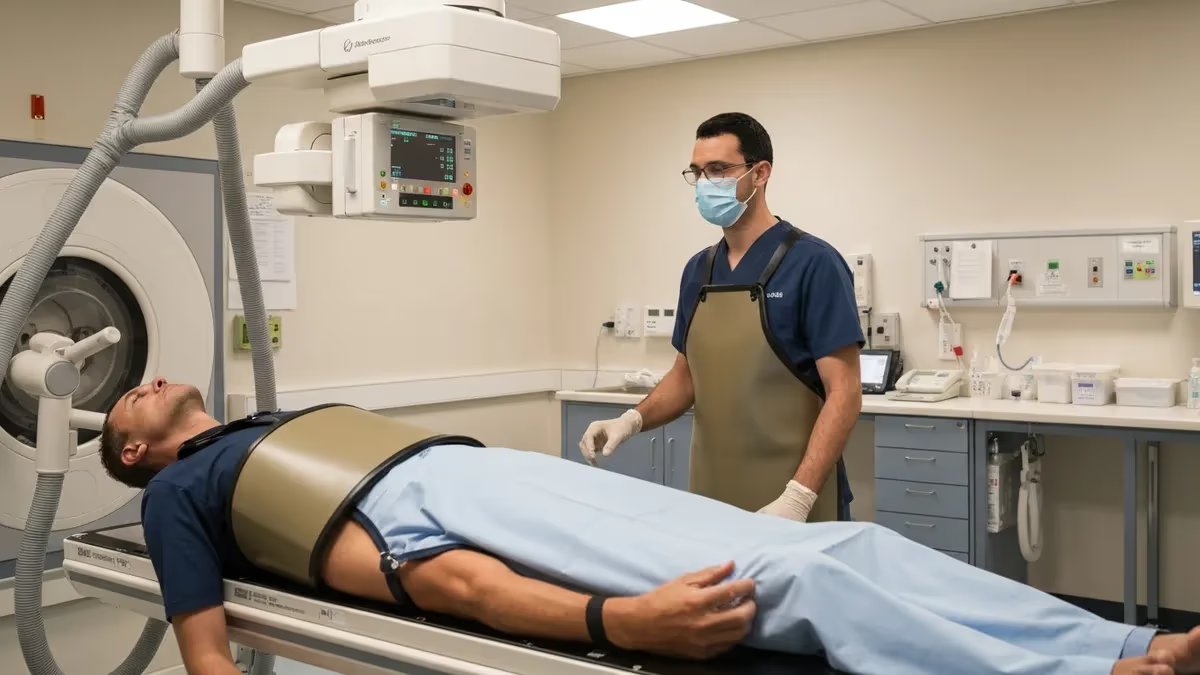
The ARRT tech lookup tool is one of the most practical resources available to employers, patients, and healthcare administrators working in medical imaging. If you have ever needed to confirm that a radiologic technologist holds valid ARRT certification before allowing them to perform procedures on patients, the ARRT tech lookup system provides a fast, authoritative answer drawn directly from ARRT's central registry. Understanding how to use this tool correctly — and how to interpret what it returns — saves time and protects patient safety across every radiology department in the country.
ARRT, the American Registry of Radiologic Technologists, was founded in 1922 and today credentials more than 350,000 radiologic technologists, nuclear medicine technologists, radiation therapists, and medical dosimetrists across dozens of specialty disciplines. Maintaining a public verification system is part of ARRT's mission to serve the public interest by ensuring that only qualified, ethically compliant individuals practice under an ARRT credential. The registry is updated in real time as certifications are earned, renewed, revoked, or allowed to lapse.
Employers conducting pre-hire screening frequently rely on the verification tool to cross-check a candidate's resume claims against official ARRT records. A technologist may list multiple credentials on an application, but only the ARRT database can confirm which of those credentials are currently active versus expired. Hiring managers who skip this step risk bringing on staff who cannot legally perform certain imaging procedures under state regulations that require active ARRT certification.
Patients also have the right to use the ARRT verification tool. If you are scheduled for an X-ray, CT scan, mammogram, MRI, or other imaging study, you can look up your technologist's name before or after your appointment to confirm that the person performing your exam holds legitimate credentials. Healthcare advocates frequently encourage patients to take this proactive step, particularly in outpatient and freestanding imaging centers where oversight may differ from a large hospital system.
State licensing boards routinely cross-reference their own records with ARRT's database during license renewal cycles. Many states have adopted ARRT certification as a prerequisite for state licensure, meaning a lapsed ARRT credential can trigger a cascade of compliance problems at the state level as well. Understanding how the federal registry and state licensure systems interlock is important for technologists who practice in states with mandatory licensure laws, which now represents the majority of U.S. states.
For the arrt verification lookup process to work effectively, you need to know the correct legal name of the individual you are searching. Nicknames, abbreviations, or middle-name variations can return no results even when a valid credential exists. ARRT stores records under the legal name on file at the time of initial registration, so searching by a preferred name or maiden name may require adjustments to yield accurate results.
This guide walks through every aspect of the ARRT credential verification system — from the mechanics of the search interface to understanding credential status codes, interpreting specialty discipline designations, and knowing what to do when a search returns unexpected results. Whether you are an employer, a patient, a credentialing specialist, or a technologist checking your own records, the information below gives you a complete picture of how the system works and why it matters.
ARRT Credential Verification by the Numbers

How the ARRT Verification System Works
Navigate to ARRT's Public Verification Page
Enter the Technologist's Legal Name
Filter by State or Credential Type (Optional)
Review the Results List
Interpret Credential Status Codes
Document and Archive the Verification
Once the ARRT verification tool returns results, interpreting what you see requires understanding the specific data fields the system displays. Each registrant record includes the person's full legal name, their credential status, the specific disciplines in which they hold certification, and the city and state on file with ARRT. Some records also display a registrant ID number, which can be useful for disambiguation when two technologists share very similar names and practice in the same geographic region.
The credential status field is the single most important piece of information on the verification page. An Active status confirms that the registrant is currently certified, has met all continuing education requirements, and is in good standing with ARRT's ethics standards. Technologists must complete 24 continuing education credits every two years to maintain active status, so Active status is a meaningful indicator that the individual is engaged in ongoing professional development and current with best practices in the field.
An Inactive status means the technologist was once certified but has not completed the required continuing education or has not paid renewal fees within the required timeframe. Inactive status does not indicate misconduct — it simply means the credential has lapsed due to administrative reasons. Technologists can reactivate an Inactive credential by completing outstanding CE requirements and submitting the appropriate reinstatement application to ARRT. Employers should not automatically disqualify a candidate with Inactive status, but they should not allow that individual to practice under an ARRT credential until reactivation is confirmed.
A Revoked status is significantly more serious. ARRT revokes credentials when an ethics investigation determines that a registrant has violated ARRT's Standards of Ethics in ways that warrant permanent removal of certification privileges. Revocation is a matter of public record, and ARRT's verification tool clearly displays this status. If a candidate's credential shows Revoked, employers should conduct additional investigation and consult their legal and compliance teams before making any hiring decision. State licensing boards also receive notification of revocations.
The discipline designations displayed alongside the credential status tell you exactly which imaging modalities the technologist is certified to perform. A technologist might hold the primary R.T.(R) credential in radiography plus post-primary certifications in computed tomography designated as R.T.(CT) and mammography designated as R.T.(M). Each discipline requires separate examination and continuing education. Verifying the correct disciplines is important because a technologist certified in radiography is not automatically authorized to perform CT scanning under their ARRT credential — those are distinct certifications.
When a search returns no results at all, the most common explanations are a name spelling discrepancy, a name change not yet updated in the ARRT system, or a search conducted for someone who never held ARRT certification. ARRT's system is case-insensitive, so capitalization is not the issue. Try variations of the name — for example, searching by last name only, or trying a maiden name if the technologist recently married. If you still find no record after multiple attempts, you can contact ARRT directly at 651-687-0048 during business hours for assistance.
It is worth noting that ARRT's public verification tool does not display every piece of information in a registrant's file. Detailed ethics history, exam scores, application dates, and CE completion records are not publicly visible. The public tool is designed to answer one essential question: does this person currently hold active ARRT credentials in the stated disciplines? For more detailed credentialing investigations, healthcare institutions can request primary-source verification directly from ARRT, which involves a formal request process and may require the registrant's written authorization.
ARRT Credential Types: What the Verification Tool Shows
ARRT's primary credentials represent the foundational certifications in each major imaging discipline. The most common is R.T.(R) for radiography, earned by passing the ARRT Radiography examination after completing an accredited program. Other primary credentials include R.T.(N) for nuclear medicine technology, R.T.(T) for radiation therapy, and R.T.(MR) for magnetic resonance imaging. Each primary credential requires completion of an accredited educational program and passing the corresponding ARRT certification examination before a candidate may sit for post-primary specialty exams.
When using the ARRT tech lookup tool, primary credentials appear first in the discipline field and are listed with their full parenthetical designation. A technologist holding the R.T.(R) credential in radiography has demonstrated competency across patient care, radiation safety, image production, and radiographic procedures as defined by ARRT's content specifications. Verifying that a new hire holds the correct primary credential for the department's imaging modalities is the baseline step in any credentialing workflow.
Pros and Cons of Relying Solely on the ARRT Tech Lookup Tool
- +Free to use with no account or subscription required
- +Available 24 hours a day, 7 days a week with real-time database access
- +Displays all current active disciplines and post-primary credentials in one view
- +Clearly flags revoked or suspended credentials to protect patient safety
- +Accepted by most state licensing boards as valid primary-source verification
- +Returns results instantly with no waiting period or processing delay
- −Does not display detailed ethics history or investigation outcomes beyond current status
- −Name variations and recent legal name changes can cause false negatives
- −Does not show exam scores, application history, or CE completion records
- −Cannot verify state-specific licensure — only ARRT federal certification status
- −No formal verification certificate or dated report is generated for audit files
- −Occasional system downtime during maintenance windows may disrupt urgent verifications
Pros and Cons at a Glance
| Pros | Cons |
|---|---|
| Free to use with no account or subscription required | Does not display detailed ethics history or investigation outcomes beyond current status |
| Displays all current active disciplines and post-primary credentials in one view | Name variations and recent legal name changes can cause false negatives |
| Clearly flags revoked or suspended credentials to protect patient safety | Does not show exam scores, application history, or CE completion records |
| Accepted by most state licensing boards as valid primary-source verification | Cannot verify state-specific licensure — only ARRT federal certification status |
| Returns results instantly with no waiting period or processing delay | No formal verification certificate or dated report is generated for audit files |
ARRT Verification Checklist for Employers and Credentialing Specialists
- ✓Obtain the technologist's full legal name exactly as it appears on their ARRT card or certificate.
- ✓Navigate to arrt.org and locate the 'Verify Credentials' section of the website.
- ✓Enter the first and last name in the search fields and submit the query.
- ✓If multiple results appear, filter by state or discipline to identify the correct registrant.
- ✓Confirm the credential status displays 'Active' before proceeding with hiring or scheduling.
- ✓Verify that the specific disciplines listed match the imaging modalities required for the position.
- ✓Check for any post-primary credentials relevant to the role (CT, MG, VI, MR, etc.).
- ✓Screenshot or print the results page with the date and time stamp clearly visible.
- ✓Save the verification documentation in the employee's credentialing file per your institution's retention policy.
- ✓Set a calendar reminder to re-verify credentials at the ARRT renewal cycle (every two years) to catch lapses.
Active Status Expires Every Two Years — Don't Skip Re-Verification
ARRT credentials must be renewed biennially, and a technologist who was Active at hire may become Inactive within 24 months if they do not complete continuing education requirements. Building a two-year re-verification cycle into your credentialing calendar is the single most effective way to catch lapsed credentials before they create a compliance gap in your imaging department.
When the ARRT verification tool does not return the expected results, the troubleshooting process follows a predictable sequence of steps. Begin by confirming that you have the correct legal name. Many technologists go by a preferred first name that differs from their legal name — a technologist known as Beth may be registered as Elizabeth, and a technologist who goes by Mike may appear in the system as Michael. Always ask candidates to provide their name exactly as it appears on their ARRT credential card before running a search.
Name changes due to marriage, divorce, or legal name change represent another frequent source of lookup failures. ARRT allows registrants to update their name on file, but the update requires submitting supporting documentation and may take several weeks to process. During the transition period, the old name remains in the system. If a technologist recently changed their name and the new name does not appear in the ARRT database, try searching under the previous legal name and ask the technologist to provide their ARRT registrant ID number for cross-reference.
Hyphenated last names occasionally create search complications because different institutions format them differently in their records. A technologist named Maria Rodriguez-Chen might be stored in ARRT's database as Rodriguez-Chen, Rodriguez Chen (with a space), or simply Chen depending on how the name was entered at time of application. Trying multiple formatting variations is a reasonable troubleshooting step before concluding that no ARRT record exists. The system does not penalize for additional searches.
If you are searching for a technologist who trained and was certified in another country before practicing in the United States, be aware that ARRT credentials apply specifically to certification administered through ARRT. International radiologic technologists who have not obtained ARRT certification will not appear in the ARRT database regardless of their credentials in their country of origin. Some international credentials are recognized through reciprocity or equivalency pathways, but those pathways ultimately result in issuance of a domestic ARRT credential — and only at that point will the individual appear in the verification system.
Technologists who hold credentials through other credentialing bodies, such as the Nuclear Medicine Technology Certification Board (NMTCB) or the American Registry of Magnetic Resonance Imaging Technologists (ARMRIT), will not appear in the ARRT database if they have never held ARRT credentials. These parallel credentialing organizations maintain their own separate verification systems. A hiring manager in a nuclear medicine department should understand which credential their state and institution recognize for each modality, since some states accept NMTCB certification as an alternative to ARRT for nuclear medicine practice.
Technical issues with the ARRT website itself, while uncommon, can occasionally return blank results or error messages. ARRT performs scheduled maintenance typically during overnight hours on weekends, and the verification tool may be temporarily unavailable during those windows. If you receive an error message or the page fails to load, wait a few hours and try again before assuming there is a problem with the registrant's credentials. ARRT also provides a phone verification option at 651-687-0048 for urgent situations where real-time web access is unavailable.
For institutions that process high volumes of credential verifications — large hospital systems, staffing agencies, and multisite imaging networks — ARRT offers a bulk verification service that allows authorized organizations to verify multiple registrants in a single request. This service requires a formal agreement with ARRT and is subject to their data use policies, but it significantly simplifies the credentialing workflow for organizations that regularly onboard large numbers of technologists.
ARRT credential cards can be reprinted by any registrant, and a card with an Active credential status printed on it does not reflect the current real-time status of that credential. Always run a live verification through the ARRT website or contact ARRT directly rather than relying on a card the candidate provides. Credential cards do not update automatically when a technologist's status changes to Inactive or Revoked.
The broader importance of ARRT credential verification extends well beyond the mechanics of running a database search. At its core, the verification system exists to protect patients from underqualified practitioners performing diagnostic imaging procedures. Radiation exposure, contrast agent administration, and invasive fluoroscopic procedures all carry inherent risks that are substantially reduced when performed by properly trained and credentialed professionals. The verification tool is one of the most accessible patient safety tools in the healthcare system, and using it consistently reflects a genuine commitment to quality of care.
Joint Commission accreditation standards explicitly require hospitals and outpatient imaging centers to verify clinical staff credentials through primary sources before granting clinical privileges. Primary-source verification means confirming credential status directly with the issuing organization — in this case, ARRT — rather than relying on documents provided by the applicant. The ARRT verification tool satisfies the primary-source requirement for ARRT credentials. Institutions that skip this step during the credentialing process risk adverse findings during accreditation surveys, which can jeopardize Medicare and Medicaid reimbursement eligibility.
State radiation control programs frequently conduct audits of imaging facilities to ensure that personnel operating radiation-producing equipment hold the appropriate credentials. Many states have enacted laws under the Consumer Assurance of Radiologic Excellence (CARE) Act framework, which established minimum standards for radiologic technologist education and credentialing. Under these frameworks, facilities that employ uncredentialed or lapsed-credential technologists can face civil penalties, equipment suspension orders, and in severe cases, facility closure. Proactive credential verification is far less expensive than reactive compliance remediation.
Malpractice insurance carriers also take a keen interest in credentialing practices. Facilities with documented, consistent credential verification protocols demonstrate risk management maturity that can influence premium rates and claims defensibility. In the event of an adverse patient outcome involving a radiologic procedure, plaintiffs' attorneys routinely subpoena credentialing files to determine whether the facility verified the technologist's qualifications before allowing them to practice. A gap in credential verification documentation can significantly weaken a facility's legal defense, even if the technologist in question held valid credentials at the time of the incident.
For technologists themselves, understanding the verification system is equally important. Your ARRT credential is a professional asset that represents years of education, clinical training, and examination preparation. Keeping that credential Active requires meeting the biennial continuing education requirement of 24 CE credits and paying the renewal fee before the deadline. ARRT sends reminder notices as the renewal deadline approaches, but the ultimate responsibility for maintaining the credential rests with the registrant. Allowing an Active credential to lapse creates administrative complexity, potential employment disruption, and in some states, a gap in state licensure eligibility.
Technologists can also use the ARRT verification tool to check their own records and confirm that their credentials display correctly. This is particularly useful after a name change, a recently completed CE cycle, or the addition of a new post-primary credential. Discrepancies between what the ARRT database displays and what the technologist believes to be true should be reported to ARRT's customer service team promptly. Processing delays for CE submission, name updates, or newly earned credentials can cause a temporary mismatch between the technologist's actual status and what the public verification tool shows.
Staying informed about your credential status is also important in the context of the broader ARRT ecosystem of continuing qualification requirements. Beyond the CE requirement, ARRT's Continuing Qualifications Requirements (CQR) program requires technologists in certain disciplines to complete structured self-assessment and targeted CE activities at defined intervals. CQR compliance is tracked separately from routine CE and appears in the registrant's ARRT account portal, though it is not currently visible through the public verification tool. Understanding the distinction between routine CE compliance and CQR compliance helps technologists avoid surprises when their renewal comes due.
Using the ARRT verification tool effectively is a skill that improves with practice, and building it into your standard operating procedures as a reflex — rather than an afterthought — changes the culture of credentialing in your department. The most effective credentialing programs treat verification not as a one-time onboarding checkbox but as an ongoing accountability practice. Re-verification at the two-year renewal cycle, combined with a mechanism for technologists to self-report credential changes, creates a layered system that catches problems early rather than during an accreditation survey or adverse event investigation.
Documentation practices surrounding ARRT verification vary across institutions, but best practice consistently points toward the same core elements: capture the registrant's full name as it appeared in the search, the date and time of the search, the credential status returned, the disciplines listed, and the name of the staff member who conducted the verification. Some institutions use a standardized verification form that collects all these fields in a single document; others rely on screenshots stored in the credentialing software. Either approach works as long as the documentation is timestamped and retained according to the institution's record retention policy.
Integrating ARRT verification into onboarding automation is increasingly common in large health systems that use credentialing management software platforms. These platforms can trigger an automatic ARRT verification check when a new technologist file is opened, flag credentials approaching their renewal date, and generate reports for department managers showing the current credential status of all imaging staff. While the automation does not eliminate the need for human review of verification results, it dramatically reduces the administrative burden and the risk of verifications being skipped during busy hiring periods.
For smaller imaging centers and rural facilities that handle credentialing manually, building a simple tracking spreadsheet can serve a similar purpose at much lower cost. A spreadsheet with columns for employee name, ARRT registrant ID, credential disciplines, credential expiration date, last verification date, and next scheduled verification date gives a small credentialing team complete visibility into the status of all imaging staff credentials. Setting a recurring calendar alert tied to the expiration date column ensures that re-verification happens proactively rather than reactively.
One area where technologists and employers sometimes encounter confusion is the relationship between ARRT certification and state licensure. ARRT certification is a national credential administered by a private nonprofit organization. State licensure is a government-issued authorization to practice within a specific state.
Most states require active ARRT certification as a condition of state licensure, but the two credentials are legally distinct. A technologist who allows their ARRT credential to lapse may simultaneously trigger a state license suspension in states where active ARRT status is mandated for license renewal. Employers in multi-state health systems must track both sets of credentials for technologists who rotate across state lines.
The ARRT website also provides educational resources about the verification process, including FAQs for employers and a dedicated credentialing resource section for healthcare administrators. ARRT's customer service team is trained to assist both technologists and employers with verification questions, name discrepancy resolution, and understanding status codes. Taking advantage of these resources before a compliance issue arises is a hallmark of a well-run credentialing program. The phone line at 651-687-0048 is staffed during regular Central Time business hours, Monday through Friday, and ARRT also offers online inquiry submission for non-urgent questions.
As the imaging landscape continues to evolve — with new modalities, expanded technologist scopes of practice, and growing demand for outpatient imaging services — the ARRT verification tool will only become more important as a foundational element of healthcare quality assurance. Facilities that embed consistent verification practices into their culture today are better positioned to adapt to changing regulatory requirements, accreditation standards, and workforce dynamics in the years ahead. The verification tool is free, fast, and authoritative — there is simply no good reason to skip it.
Sample ARRT - American Registry of Radiologic Technologists Practice Questions
Try these questions from our free ARRT - American Registry of Radiologic Technologists practice tests. The correct answer and an explanation follow each question.
Under HIPAA, a radiologic technologist may share a patient's imaging results with:
- A. The patient's employer upon request
- B. Another treating physician directly involved in the patient's care
- C. A family member without the patient's consent
- D. An insurance company's marketing department
Answer: B. Another treating physician directly involved in the patient's care
HIPAA permits disclosure of protected health information to other treating providers for the purposes of treatment without additional patient authorization.
When positioning a combative patient for imaging, the radiologic technologist should FIRST:
- A. Apply physical restraints immediately
- B. Administer sedation without physician order
- C. Communicate calmly and assess the cause of agitation
- D. Proceed quickly to minimize exposure time
Answer: C. Communicate calmly and assess the cause of agitation
De-escalation through calm communication and identifying the cause of agitation is the first priority before considering physical or chemical restraints.
A pregnant technologist should limit fetal dose to no more than how much over the entire gestational period, per NCRP?
- A. 1 mSv (0.1 rem)
- B. 5 mSv (0.5 rem)
- C. 10 mSv (1 rem)
- D. 50 mSv (5 rem)
Answer: B. 5 mSv (0.5 rem)
NCRP recommends the fetal dose not exceed 5 mSv (0.5 rem) over the entire gestation once pregnancy is declared.
A technologist's monthly dosimeter reading shows 5 mSv. Which action is most appropriate?
- A. No action needed; this is within annual limits
- B. Immediately notify radiation safety officer as this exceeds monthly limits
- C. Investigate work practices and potential sources of elevated exposure
- D. Discontinue working in radiation areas for the remainder of the year
Answer: C. Investigate work practices and potential sources of elevated exposure
5 mSv in one month is elevated (10% of the annual limit) and warrants investigation of work practices, even though it is not a regulatory violation.
Take the full ARRT - American Registry of Radiologic Technologists practice test
ARRT Questions and Answers

Mosby ARRT Review: The Complete Study Guide for Radiologic Technology Certification

ARRT Practice Test PDF (Free Printable 2026)

Is the ARRT Exam Multiple Choice? Complete ARRT Exam Format Guide 2026

How to Report CE Credits to ARRT: Complete Step-by-Step Guide

ARRT Credentials: Complete Guide to Types, Requirements & How to Earn Them
About the Author

Medical Laboratory Scientist & Clinical Certification Expert
Johns Hopkins UniversityDr. Sandra Kim holds a PhD in Clinical Laboratory Science from Johns Hopkins University and is certified as a Medical Technologist (MT) and Medical Laboratory Scientist (MLS) through ASCP. With 16 years of clinical laboratory experience spanning hematology, microbiology, and molecular diagnostics, she prepares candidates for ASCP board exams, MLT, MLS, and specialist certification tests.