
Mosby ARRT Review: The Complete Study Guide for Radiologic Technology Certification
Master the Mosby ARRT review with our complete study guide. Tips, practice questions, schedules & strategies to pass your radiologic technology exam. 🎯
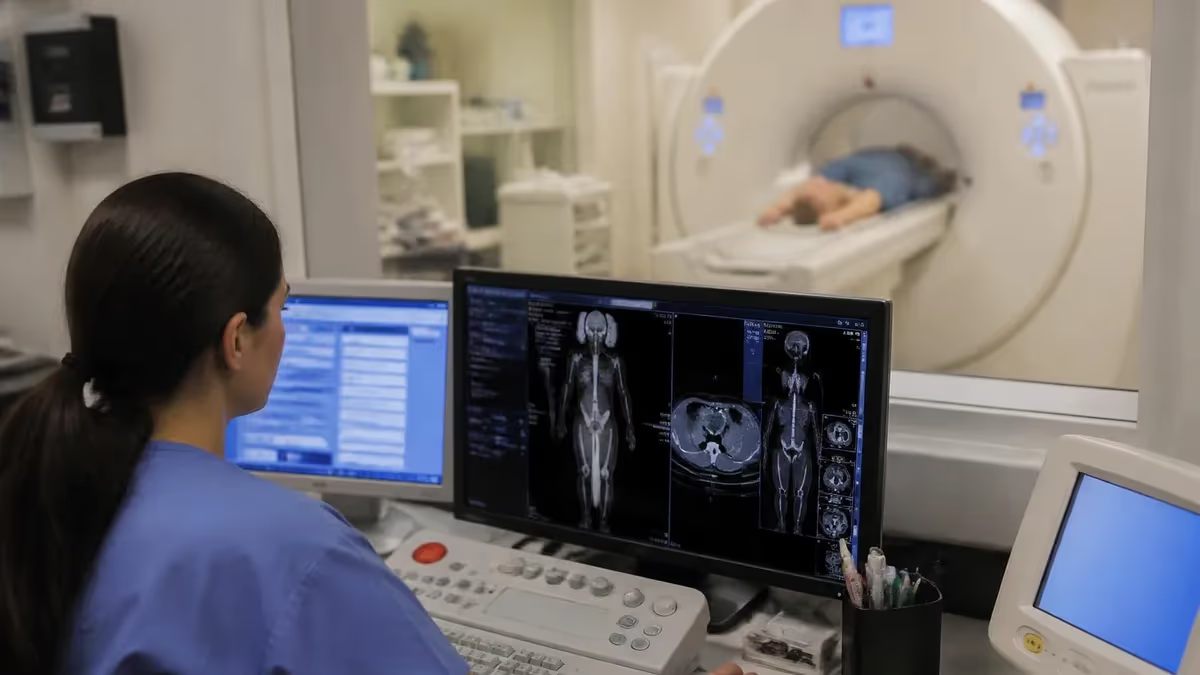
The Mosby ARRT review system has long been considered one of the most trusted and comprehensive resources for radiologic technology students preparing to sit for the American Registry of Radiologic Technologists certification exam. Whether you are a graduating radiography student or a working technologist seeking to add a new credential, understanding how to use Mosby's review materials effectively can be the difference between passing on your first attempt and needing to reschedule. This guide walks you through every element of the Mosby ARRT preparation approach so you can build a structured, confident path to exam day.
Radiologic technology certification is no small feat. The ARRT examination covers a broad range of content — from radiation physics and patient care to image acquisition, procedural positioning, and quality assurance. The depth and breadth of the exam demand that candidates use high-quality study resources rather than relying on memory alone. Mosby's review series, published under the Elsevier imprint, provides content-aligned question banks, detailed rationales, and full-length simulated exams that mirror the actual test blueprint set by the ARRT.
One of the key advantages of the Mosby ARRT preparation materials is that they are built around the official ARRT content specifications. This means every question, every chapter summary, and every practice scenario maps directly to the exam's weighted categories. When you study with Mosby, you are not wasting time on tangential content — you are drilling exactly what the ARRT expects you to know. This targeted alignment is especially valuable given how limited study time tends to be for students juggling clinical rotations and coursework.
A common misconception among ARRT candidates is that simply reading textbooks is sufficient exam preparation. In reality, active recall and spaced repetition — the mechanisms behind question-based studying — are far more effective at consolidating knowledge for high-stakes tests. The Mosby review workbooks and online question banks are specifically designed to drive this kind of active learning by presenting clinical scenarios, image-based questions, and application-level problem-solving rather than simple memorization prompts. This approach reflects how modern radiologic technologists actually think on the job.
If you want to explore what mosby arrt review resources pair with in terms of ongoing professional membership and credential maintenance, understanding the full ARRT ecosystem — from initial certification to continuing education and registration renewal — will help you plan your career from the moment you pass your boards. Mosby materials do not just prepare you for the exam; they lay a conceptual foundation you will draw on throughout your clinical career.
Many candidates wonder how long they should study before their ARRT exam. Research and anecdotal data from thousands of radiography graduates consistently suggest that 8 to 12 weeks of structured daily study — averaging 2 to 3 hours per day — is the sweet spot for first-time test takers. Using a resource like the Mosby ARRT review series during that window, combined with targeted practice quizzes and periodic full-length simulated exams, gives candidates the best statistical chance of passing on their first attempt.
Throughout this article, you will find a comprehensive breakdown of how to use Mosby review materials most effectively, which content areas deserve the most attention, how to build a realistic study schedule, and what supplemental resources — including free online practice tests — can sharpen your preparation. By the end, you will have a clear, actionable plan for turning study hours into exam-day success with the ARRT radiography certification.
ARRT Radiography Exam by the Numbers
Key Facts at a Glance
| Item | Value | Details |
|---|---|---|
| Total Exam Questions | 220 | 170 scored + 50 unscored pilot |
| Time Allowed | 3.5 hrs | Includes optional 30-min break |
| Scaled Passing Score | 75 | Out of 99-point scale |

8-Week Mosby ARRT Study Schedule
- ▸Read Mosby radiation protection chapters and summarize key concepts
- ▸Complete 50 practice questions on radiation physics and radiobiology
- ▸Review NCRP dose limits and compare to ALARA principles
- ▸Take a 30-question diagnostic quiz to identify weak areas
- ▸Study x-ray tube components, generator types, and automatic exposure control
- ▸Complete 60 Mosby QA and equipment questions with detailed rationale review
- ▸Create a formula sheet for mAs, kVp, and distance calculations
- ▸Practice image receptor and digital imaging concepts
- ▸Review image quality factors: density, contrast, detail, and distortion
- ▸Complete 75 image acquisition questions from Mosby question bank
- ▸Study digital imaging artifacts and their causes
- ▸Practice interpreting technique adjustment scenarios
- ▸Review patient assessment, vital signs, and contrast media reactions
- ▸Complete 60 patient care questions covering trauma and infection control
- ▸Study medical-legal concepts and patient rights
- ▸Review pharmacology relevant to radiologic procedures
- ▸Study positioning for chest, abdomen, and spinal procedures in Mosby
- ▸Complete 80 procedure questions with anatomy correlation
- ▸Draw and label key anatomical landmarks from memory
- ▸Review common positioning errors and how to correct them
- ▸Study upper and lower extremity projections with CR angles and SID
- ▸Complete 75 extremity and skull/sinus positioning questions
- ▸Practice identifying projections from image descriptions
- ▸Review pediatric and trauma positioning modifications
- ▸Take a complete 220-question timed practice exam
- ▸Score results by content category and identify weakest areas
- ▸Review all incorrect answers with Mosby rationales
- ▸Retake targeted quizzes on lowest-scoring categories
- ▸Complete a second full-length practice exam simulation
- ▸Review formula sheet, positioning landmarks, and dose limits
- ▸Focus last 3 days only on flashcard review and rest
- ▸Confirm exam logistics: test center, ID requirements, arrival time
Understanding the exact content weighting of the ARRT radiography examination is one of the most strategically important steps any candidate can take before opening their first study book. The ARRT publishes a detailed content specifications document that outlines exactly how many questions fall under each domain and sub-category. The Mosby ARRT review series is organized to mirror this blueprint precisely, which is why so many educators and program directors recommend it over generic anatomy or physics textbooks that were not written with the exam structure in mind.
The three major domains on the ARRT radiography exam are Radiation Protection, Equipment Operation and Quality Control, and Image Production. A fourth domain — Radiographic Procedures — covers the procedural and positioning content. Each of these domains carries a specific percentage weight in your final scaled score, meaning that some topics have a far greater impact on whether you pass than others. Spending equal time on every subject, regardless of its exam weight, is one of the most common — and most avoidable — study mistakes candidates make.
Radiation Protection typically accounts for approximately 14 to 17 percent of the total scored questions. This category includes radiation biology, dose measurement, protective devices, personnel dosimetry, and patient shielding techniques. Because radiation safety is both a regulatory and an ethical cornerstone of radiologic practice, the ARRT places particular emphasis on ALARA principles, NCRP recommendations, and occupational dose limits. Mosby's review dedicates entire chapters to these topics with practice questions that replicate the clinical scenario format the ARRT favors on the actual exam.
Equipment Operation and Quality Control covers approximately 14 to 15 percent of the exam and includes x-ray production, beam restriction, filtration, automatic exposure control systems, image receptor selection, and digital imaging quality assurance procedures. These questions are heavily calculation-oriented, requiring candidates to apply formulas for mAs, kVp compensation, and exposure index adjustments. Mosby's comprehensive review of these formulas, combined with worked examples and practice problem sets, makes this one of the most learnable sections of the exam for candidates who invest consistent study time.
Image Production — which includes image acquisition techniques, image processing, and image evaluation — typically accounts for the largest single block of questions, sometimes reaching 35 percent or more of the total exam. This reflects how central image quality decision-making is to the daily work of a radiologic technologist. Mosby's image production chapters are particularly well-regarded for their depth of coverage on digital imaging, including CR and DR systems, PACS integration, exposure index values, and artifact recognition — all areas that have grown in prominence on the ARRT exam as the field has transitioned away from film-screen technology.
Radiographic Procedures make up the remaining substantial portion of the exam, covering patient positioning for every major body region — including the thorax, abdomen, upper and lower extremities, vertebral column, and skull. Position questions require candidates to identify the correct patient orientation, central ray angle, source-to-image distance, and the specific anatomical structures demonstrated on each projection. The Mosby ARRT review workbooks include detailed positioning diagrams, radiographic images for comparison, and clinical scenario questions that test positioning judgment in realistic patient care contexts.
One of the most valuable features of Mosby's ARRT preparation system is its category-by-category performance tracking. When you complete practice questions, the system records your accuracy by content area and generates a breakdown showing exactly where your performance falls below the level needed to pass. This data-driven approach allows you to pivot your study time dynamically rather than following a rigid schedule that ignores your personal knowledge gaps. Candidates who consistently use performance analytics to guide their daily study sessions tend to see larger score improvements than those who study by chapter order alone.
Mosby ARRT Study Strategies by Learning Style
Visual learners benefit most from Mosby's extensive use of anatomical diagrams, radiographic images, and positioning illustrations throughout its review content. When studying positioning chapters, draw skeletal diagrams from memory and label the key anatomical landmarks rather than simply reading descriptions. Color-code your notes by content domain — one color for radiation protection, another for equipment, a third for procedures — so your brain builds spatial associations between topics and their exam categories.
Supplement your Mosby study sessions by creating hand-drawn positioning charts that show patient orientation, central ray angle, and image receptor placement for each projection. Keep a dedicated notebook of image quality comparison examples showing underexposed versus overexposed films, motion blur artifacts, and grid cutoff patterns. Visual learners who build this kind of reference library during their prep period report that they can mentally recall the images during exam questions, which significantly speeds up their answer selection process.
Mosby ARRT Review: Strengths and Limitations
- +Directly aligned with ARRT official content specifications and exam blueprint
- +Detailed rationales for every practice question explain both correct and incorrect answers
- +Comprehensive coverage of digital imaging, CR, DR, and PACS systems
- +Full-length timed practice exams simulate actual test conditions accurately
- +Category-based performance tracking helps identify and prioritize weak content areas
- +Written by experienced radiologic technology educators and clinical practitioners
- −Higher price point compared to free online question banks or borrowed textbooks
- −Online access codes are tied to one user and expire after a set period
- −Some candidates find the written chapters dense and prefer more visual formats
- −Question bank may not fully replicate the newest item types added in recent ARRT updates
- −Requires disciplined self-study structure; less effective without a personal schedule
- −Limited coverage of specialty modalities like CT, MRI, or mammography for non-radiography tracks
ARRT Exam-Day Preparation Checklist
- ✓Confirm your testing appointment date, time, and Pearson VUE testing center address at least one week out.
- ✓Verify that your ARRT Authorization to Test (ATT) letter is accessible and has not expired.
- ✓Bring a valid, unexpired government-issued photo ID with a signature that matches your ARRT application.
- ✓Plan to arrive at the testing center at least 30 minutes before your scheduled appointment time.
- ✓Avoid studying new material the evening before — focus only on light review of your formula summary sheet.
- ✓Get at least 7 to 8 hours of sleep the night before and eat a balanced meal before the exam.
- ✓Leave all personal items — phones, smartwatches, notes, and study materials — in your car or locker.
- ✓Use the optional tutorial time at the start of the exam to settle nerves before the scored questions begin.
- ✓Flag difficult questions for review rather than spending excessive time on a single item during the exam.
- ✓After finishing, note which content areas felt weakest so you have targeted focus if a retake is needed.
The ARRT Uses Scaled Scoring — Raw Percentages Do Not Directly Equal Your Score
The ARRT radiography exam is scored on a scale of 1 to 99, and the passing score is 75. This scaled score is NOT a raw percentage of questions answered correctly. The ARRT uses item response theory (IRT) to adjust for question difficulty, meaning a score of 75 may require answering roughly 70 to 75 percent of scored questions correctly depending on the specific exam version administered. Always aim for higher than the minimum — candidates who score well above passing have a larger buffer against the statistical uncertainty in how each exam is calibrated.
The ARRT radiography examination has a first-time pass rate that hovers around 90 percent for candidates who graduate from accredited radiologic technology programs, according to data historically published by the ARRT.
However, this aggregate number can be misleading if you interpret it as meaning the exam is easy — it reflects the fact that most first-time candidates have completed rigorous academic programs with clinical hours and structured exam preparation. Candidates who take the exam without adequate preparation or who underestimate the depth of the content specification often find themselves in the smaller subset who do not pass on the first attempt.
Pass rates also vary meaningfully by state, program type, and whether the candidate is a first-time or repeat tester. Repeat candidates — those who have previously failed the ARRT exam — face additional scheduling requirements and must demonstrate ongoing preparation before being allowed to retest.
For this reason, investing heavily in quality resources like the Mosby ARRT review system before your first attempt is far more efficient than relying on a second or third attempt to accumulate enough knowledge through test-taking experience alone. The cost savings, both in retest fees and in delayed career entry, make thorough first-time preparation a financially sound strategy.
The difficulty level of the ARRT exam is considered moderate to high for candidates without structured preparation, but manageable for those who follow a consistent study plan over 8 to 12 weeks. The most challenging aspect for most candidates is not any single content area but rather the breadth of topics covered and the application-level nature of many questions.
Unlike straightforward recall questions that ask you to define a term, ARRT questions frequently present a clinical scenario and ask you to determine the correct action, positioning modification, or technique adjustment — skills that require deeper conceptual understanding than simple memorization can provide.
Radiation physics questions tend to be among the most anxiety-inducing for candidates who feel mathematically underprepared. The inverse square law, the fifteen percent rule for kVp compensation, mAs calculations, and half-value layer problems are all regularly tested. Mosby's review materials include worked calculation examples with step-by-step solutions, which is particularly helpful for candidates who need to rebuild their confidence in applied math before the exam. Practicing these calculations under timed conditions — rather than just reading through them — is essential for developing the fluency needed to solve them quickly during the actual exam.
Image production and image evaluation questions are the second area where candidates often feel unprepared, particularly those who trained primarily on digital systems without deep exposure to the underlying physics of image quality. The ARRT expects candidates to understand not just how to acquire an image but why certain technique factors produce certain results — and what to do when the result is suboptimal. Questions about exposure index values, S-numbers, deviation index, and the relationship between receptor exposure and image noise are increasingly common on modern ARRT exams as digital radiography has become universal in clinical settings.
Patient care and professional ethics questions are sometimes underestimated by candidates who assume they are straightforward or common-sense in nature. In reality, these questions can be quite nuanced, covering topics like informed consent, scope of practice, contrast media reactions and management, sterile technique, venipuncture complications, and medical-legal responsibilities. The Mosby ARRT review devotes substantial coverage to these areas with scenario-based questions that test judgment rather than recall — a format that catches many candidates off guard if they have not practiced this style of question during their preparation period.
Radiographic positioning remains the content area that most candidates feel most prepared for, largely because it overlaps directly with clinical training. However, the ARRT tests positioning at a level of precision that goes beyond general familiarity — asking about specific central ray angles to the nearest degree, exact anatomical landmarks for centering, and the precise structures demonstrated on less common projections like the AP axial Towne for the occipital bone or the Fuchs method for the dens.
Mosby's positioning chapters are particularly thorough in this level of detail, which is one reason radiography educators consistently recommend it for exam preparation rather than general anatomy resources.
You must receive an Authorization to Test (ATT) letter from the ARRT before you can schedule your examination at a Pearson VUE testing center. ATT letters are issued only after the ARRT verifies your graduation from an accredited program and confirms your ethics review is cleared. ATT letters have an expiration date — typically 90 days — and the exam must be completed within that window. Missing the ATT expiration means reapplying and paying the application fee again, so schedule your exam as soon as you receive your ATT and feel adequately prepared.
Building a final preparation strategy in the last two weeks before your ARRT exam requires a fundamentally different mindset than the earlier phases of your study plan. The goal in the home stretch is no longer to learn new information — it is to consolidate, reinforce, and calibrate what you already know so that it surfaces quickly and reliably under test conditions. Candidates who spend the final week trying to cram new chapters or tackle unfamiliar topics often arrive at the testing center feeling overwhelmed rather than confident, which degrades performance even when underlying knowledge is solid.
In the final two weeks, shift your study sessions toward exclusively completing timed practice blocks and reviewing the performance analytics from those sessions. Take at least one complete 220-question simulated exam during this period, score it by category, and spend your remaining days targeting the categories where your accuracy falls below 70 percent. For most candidates, this means one or two content areas — perhaps radiation physics calculations, or specific positioning projections — rather than broad across-the-board review. Laser-focused last-minute study is far more efficient than trying to re-read entire Mosby chapters at this stage.
Sleep is one of the most underrated performance variables for high-stakes exams. Research in cognitive psychology consistently shows that sleep consolidates memory more effectively than any study technique, and that sleep deprivation impairs both recall speed and decision-making quality — both of which are essential for a timed, high-stakes exam like the ARRT. Candidates who prioritize 7 to 8 hours of sleep in the three nights before their exam consistently outperform candidates of equivalent knowledge who sacrifice sleep for last-minute cramming. Build your final week schedule around protecting sleep, not compromising it.
Nutrition and physical wellbeing matter more than most candidates expect in the context of exam performance. A protein-rich breakfast on exam day stabilizes blood glucose and maintains cognitive focus throughout the 3.5-hour testing session more effectively than a high-sugar meal that leads to energy crashes. Staying hydrated during the exam — the testing center allows breaks — prevents the fatigue and reduced concentration that dehydration causes even at mild levels. These practical physiological factors are rarely discussed in ARRT study guides but have a measurable impact on how well your preparation translates to actual exam performance.
Many successful ARRT candidates report that their greatest performance advantage came from taking the Pearson VUE tutorial seriously at the start of the exam. The tutorial familiarizes you with the interface — how to flag questions for review, how to navigate between items, and how to access the on-screen calculator for physics problems.
Spending five full minutes on the tutorial rather than clicking through it in 30 seconds pays dividends throughout the exam by eliminating interface uncertainty so you can focus entirely on content. This is a zero-cost strategy that many candidates overlook because they practiced on Mosby's interface rather than the actual Pearson VUE format.
Time management during the ARRT exam is a skill that must be practiced, not improvised. With 220 questions and approximately 3.5 hours of total time, you have roughly 57 seconds per question. In reality, some questions will take 10 seconds and others will take 90 — the key is maintaining a running pace check rather than getting lost in difficult items.
A practical rule followed by high-scoring candidates: if you have not resolved a question within 75 seconds, flag it and move on. Return to flagged items only after completing all other questions, when you have accumulated context clues from other items that may help resolve the difficult ones.
After the exam, regardless of how you feel about your performance, resist the urge to discuss specific questions with classmates or online communities. The ARRT testing agreement prohibits sharing exam content, and discussing questions — even with good intentions — creates both ethical and legal exposure. Instead, note the general content areas that felt unfamiliar so you have actionable intelligence if a retake becomes necessary.
Most candidates who prepare thoroughly with resources like the Mosby ARRT review system and follow a structured study schedule find that they pass on their first attempt — and can begin their careers as registered radiologic technologists with the credential that opens doors across the United States.
Supplementing your Mosby ARRT review with free online practice questions is one of the highest-value additions you can make to your study plan without increasing your budget. While the Mosby question bank is comprehensive, exposure to different question styles and wording patterns from multiple sources builds the cognitive flexibility needed to handle unfamiliar phrasings on the actual exam. Sites like PracticeTestGeeks offer ARRT-aligned practice questions across all content categories, allowing you to drill specific domains — equipment operation, image acquisition, patient care — in short focused sessions that fit around busy clinical and academic schedules.
When using online practice questions as a supplement to Mosby, approach them with the same analytical rigor you would apply to any test: always read the rationale for every question you answer, not just the ones you get wrong. Even when you answer correctly, the rationale may reveal a nuance or an edge case in the content that the question surface did not make obvious. Over dozens of practice sessions, this habit of reading all rationales — correct and incorrect — dramatically broadens your conceptual understanding of each content area compared to candidates who only review their mistakes.
One powerful but underused study technique for the ARRT exam is error journaling. After each practice session, write down every question you answered incorrectly and the specific reason you got it wrong — was it a content gap, a misread of the question, a calculation error, or a positioning detail you had not encountered before?
After two weeks of journaling, review your error log to identify recurring patterns. If you notice that you consistently miss questions involving automatic exposure control troubleshooting or pediatric positioning modifications, those become explicit targets for your next study sessions. Error journaling transforms random practice into a self-directed feedback loop.
Group study sessions can accelerate preparation for certain ARRT content areas, particularly radiographic positioning. Working with one or two study partners to quiz each other on positioning projections — one person naming the projection and another describing the patient position, central ray angle, and key anatomy demonstrated — builds recall speed and exposes gaps that solo studying might miss. Positioning questions on the ARRT exam often hinge on a single detail like the central ray degree or the specific film size required, and peer quizzing is highly effective at locking in these precise details through repetition and social accountability.
Flashcards remain one of the most efficient tools for memorizing the precise numerical values that appear on the ARRT exam — dose limits, technique factors, positioning angles, and physics constants. Digital flashcard platforms allow you to create a study deck aligned with Mosby's content categories and use spaced repetition algorithms to surface the cards you struggle with more frequently than the ones you consistently answer correctly.
Building your flashcard deck as you progress through Mosby chapters — rather than trying to create everything at once — distributes the effort and ensures the cards are created while the content is freshest in your mind.
Professional mentorship from a credentialed radiologic technologist who has recently passed the ARRT exam is an often-overlooked resource for candidates in their final preparation weeks. A mentor can offer insight into which content areas felt most heavily tested, how the pacing of the actual exam compared to practice sessions, and how to manage exam anxiety in the Pearson VUE environment. Many radiography programs maintain alumni networks specifically for this purpose, and reaching out to recent graduates through your program coordinator can connect you with mentors willing to share their preparation experience and exam-day tips.
Finally, remember that passing the ARRT exam is the beginning of your professional journey, not the end of your learning. Registered radiologic technologists are required to complete 24 continuing education credits every two years to maintain their certification, and the ARRT's ongoing professional development framework ensures that credentialed technologists stay current with evolving imaging technologies and patient care standards. The study habits, discipline, and content mastery you build during your Mosby ARRT review preparation will serve you not just on exam day but throughout a career that continues to grow in clinical scope, technological complexity, and professional responsibility.
Sample ARRT - American Registry of Radiologic Technologists Practice Questions
Try these questions from our free ARRT - American Registry of Radiologic Technologists practice tests. The correct answer and an explanation follow each question.
A patient requires a series of fluoroscopic images for a gastrointestinal study. The principle of 'Justification' in radiation protection is best demonstrated by which of the following actions?
- A. Using the tightest possible collimation to the area of interest.
- B. Ensuring the lead apron is correctly placed on the patient.
- C. Confirming that the potential diagnostic benefit of the exam outweighs the radiation risk involved.
- D. Keeping the fluoroscopy time as short as possible.
Answer: C. Confirming that the potential diagnostic benefit of the exam outweighs the radiation risk involved.
The principle of Justification requires that any decision to use ionizing radiation should do more good than harm. This means verifying that the medical procedure is necessary and that the potential diagnostic benefits for the patient outweigh the potential risks from the radiation exposure. The other options relate to the principle of Optimization (ALARA).
Under HIPAA, a radiologic technologist may share a patient's imaging results with:
- A. The patient's employer upon request
- B. Another treating physician directly involved in the patient's care
- C. A family member without the patient's consent
- D. An insurance company's marketing department
Answer: B. Another treating physician directly involved in the patient's care
HIPAA permits disclosure of protected health information to other treating providers for the purposes of treatment without additional patient authorization.
According to the National Council on Radiation Protection and Measurements (NCRP), the annual effective dose limit for occupational exposure to a radiologic technologist is:
- A. 1 mSv (0.1 rem)
- B. 5 mSv (0.5 rem)
- C. 150 mSv (15 rem)
- D. 50 mSv (5 rem)
Answer: D. 50 mSv (5 rem)
The NCRP recommends an annual effective dose limit for occupational exposure of 50 mSv (5 rem). This limit is set to minimize the risk of stochastic effects over a worker's career. The limit for the general public is significantly lower.
When performing a cross-table lateral projection of the cervical spine on a trauma patient, what is the most critical anatomical landmark to ensure is included on the image for it to be considered diagnostically complete?
- A. The sella turcica.
- B. The spinous process of C2 (axis).
- C. The top of the T1 vertebral body.
- D. The mastoid tips.
Answer: C. The top of the T1 vertebral body.
For a trauma cross-table lateral cervical spine radiograph to be considered complete and adequate for diagnosis, it must visualize all seven cervical vertebrae (C1-C7) and the C7-T1 junction. Failure to include the top of the T1 vertebral body is a common error and can lead to missed fractures or dislocations at this critical junction.
Take the full ARRT - American Registry of Radiologic Technologists practice test
ARRT Questions and Answers

ARRT Membership: Complete Guide to Joining, Renewing, and Maximizing Your Registration

ARRT Practice Test PDF (Free Printable 2026)

How to Apply for ARRT Certification: Complete Step-by-Step Guide

ARRT Passing Score: What You Need to Know to Pass the Registry Exam

How to Report CE Credits to ARRT: Complete Step-by-Step Guide
About the Author

Medical Laboratory Scientist & Clinical Certification Expert
Johns Hopkins UniversityDr. Sandra Kim holds a PhD in Clinical Laboratory Science from Johns Hopkins University and is certified as a Medical Technologist (MT) and Medical Laboratory Scientist (MLS) through ASCP. With 16 years of clinical laboratory experience spanning hematology, microbiology, and molecular diagnostics, she prepares candidates for ASCP board exams, MLT, MLS, and specialist certification tests.