
ALCPT Forms and Levels — Complete Guide to ALCPT Test Versions 2026
Pass your ALCPT Forms and Levels exam on the first attempt. Practice questions with detailed answer explanations, hints, and instant scoring. ✍🏼

What Are ALCPT Forms?
The American Language Course Placement Test (ALCPT) exists in multiple parallel versions called forms. Each form is a distinct set of 100 questions, but all forms are built to test the same English language skills at the same level of difficulty. Think of forms as different editions of the same exam — the specific questions differ, but the content domain and scoring scale remain identical across all versions. Practice with the free ALCPT - American Language Course Placement practice test on PracticeTestGeeks (800+ questions with answer explanations).
A form is identified by a number or alphanumeric code assigned by the Defense Language Institute English Language Center (DLIELC), which develops and maintains all ALCPT materials. Test administrators select which form to administer based on availability, scheduling needs, and whether a student has previously taken a particular version. From a test-taker's perspective, one form is fully interchangeable with another: your score on Form A carries the same meaning as the same numerical score on Form B.
Multiple equivalent forms have been the standard design of ALCPT since its introduction, allowing U.S. military language training programs to administer the test repeatedly to large groups without students having an unfair advantage from prior exposure to the same questions.
Why Multiple Forms Exist
The existence of multiple ALCPT forms solves three practical problems that any large-scale standardized test program must address:
- Preventing memorization: If only one version existed, students could share questions after testing, giving later test-takers an unfair edge. Multiple forms make item-sharing far less useful because there is no guarantee of overlap.
- Enabling retesting: Military training pipelines frequently require a student to retest — to requalify, to attempt a higher placement, or after remediation. Administering a different form at each attempt ensures the retest is a genuine measure of English ability, not memory of previously seen questions.
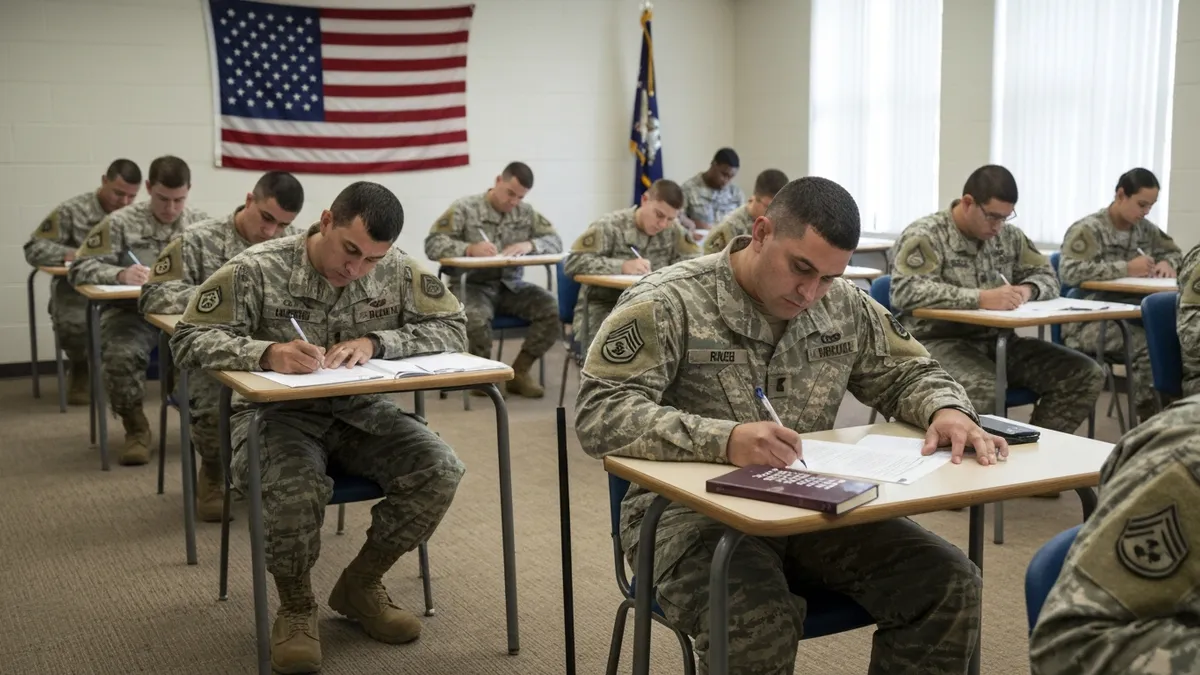
- Supporting large cohorts: Training centers process many students simultaneously. Different forms can be administered in the same room at the same time, preventing copying and allowing testing to scale.
DLIELC uses a statistical process called equating to ensure that each new form is calibrated to the existing score scale. Before a new form is released operationally, it is field-tested and its items are statistically analyzed so that a score of, say, 75 on the new form reflects the same English proficiency level as a 75 on any previously used form. This is the technical foundation that makes forms truly interchangeable.
You can continue preparing with the alcpt test, which includes answer explanations for every question.
- The ALCPT contains 100 multiple-choice questions. (Defense Language Institute English Language Center)
- ALCPT forms 1–150 contain 66 listening questions. (Defense Language Institute English Language Center)
- ALCPT forms 1–150 take approximately 75 minutes including directions and materials handling. (Defense Language Institute English Language Center)
- ALCPT forms 151 and higher take approximately 70 minutes including directions and materials handling. (Defense Language Institute English Language Center)
- Students may take only one end-of-level ALCPT for each completed level. (Defense Language Institute English Language Center)
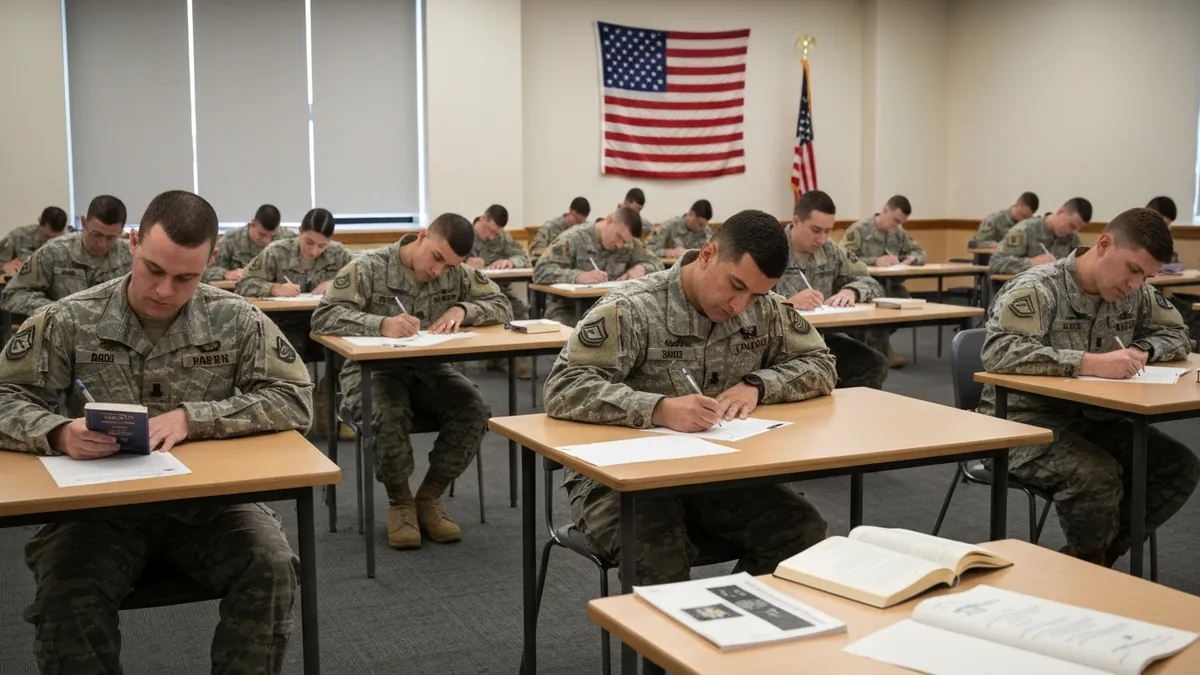
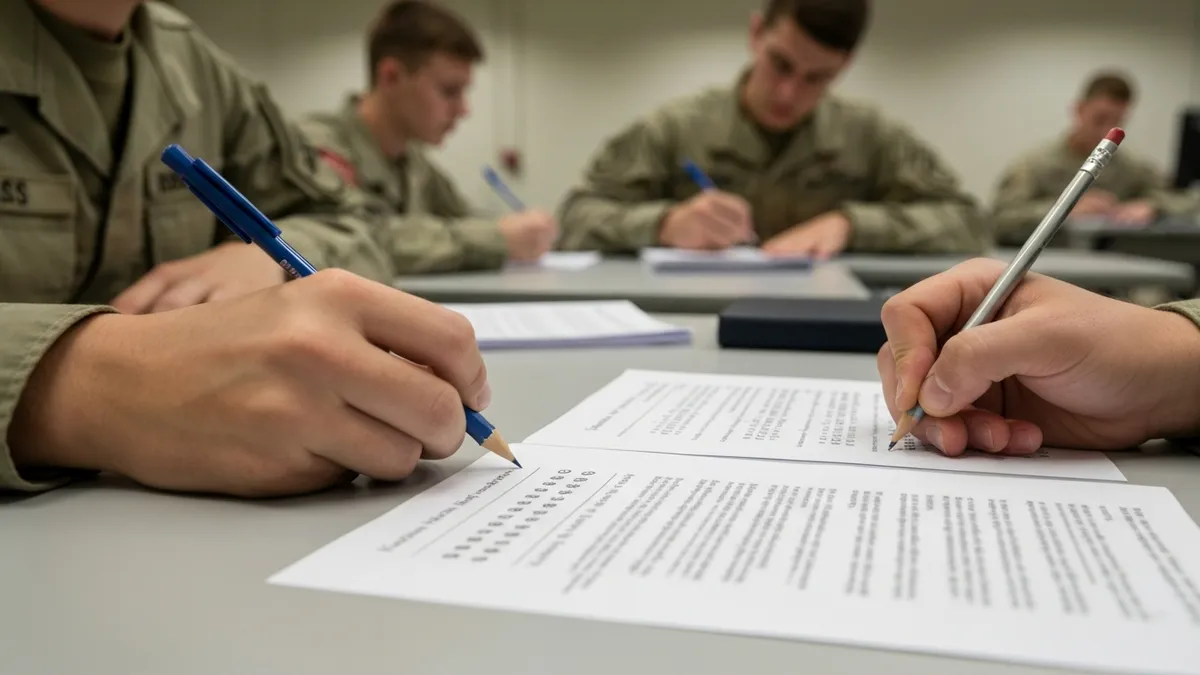
- The ALCPT is administered in a testing room using an answer sheet, pencils, and a test booklet. (Defense Language Institute English Language Center)
- The ALCPT is intended for approved military and government English language training programs worldwide. (Defense Language Institute English Language Center)
Facts verified Oct 16, 2026 against Defense Language Institute English Language Center. Dates that have passed are removed automatically.
ALCPT Exam at a Glance
| Item | Detail | Official source |
|---|---|---|
| Number of questions | 100 multiple-choice questions | Defense Language Institute English Language Center |
| Number of questions (Forms 1–150 — Listening) | 66 listening questions | Defense Language Institute English Language Center |
| Number of questions (Forms 1–150 — Reading) | 34 reading questions | Defense Language Institute English Language Center |
| Number of questions (Forms 151 and higher — Listening) | 50 listening questions | Defense Language Institute English Language Center |
| Number of questions (Forms 151 and higher — Reading) | 50 reading questions | Defense Language Institute English Language Center |
| Time limit (Forms 1–150) | Approximately 75 minutes including administration | Defense Language Institute English Language Center |
| Time limit (Forms 151 and higher) | Approximately 70 minutes including administration | Defense Language Institute English Language Center |
| Time limit (Forms 151 and higher — Reading) | 35 minutes | Defense Language Institute English Language Center |
| Retake policy | One end-of-level test per completed level | Defense Language Institute English Language Center |
| Delivery | Paper test administered in a testing room | Defense Language Institute English Language Center |
| Eligibility | Approved military and government English language programs | Defense Language Institute English Language Center |
Facts verified Oct 16, 2026 against Defense Language Institute English Language Center. Dates that have passed are removed automatically.
Free ALCPT - American Language Course Placement Test Study Tools
Interactive ALCPT - American Language Course Placement Test resources on PracticeTestGeeks, free to start:
- ALCPT - American Language Course Placement Test practice test — 800+ questions with instant scoring and answer explanations
- ALCPT - American Language Course Placement Test flashcards — review key terms and concepts card by card
- ALCPT - American Language Course Placement Test study guide — topic-by-topic overview of what the exam covers
- ALCPT - American Language Course Placement Test cheat sheet — one-page printable summary for last-minute review
Practical Implications: Forms, Retesting, and Your Score
Understanding forms helps you set realistic expectations before your ALCPT appointment.
You will likely not choose your form
Form assignment is entirely the responsibility of the testing administrator or program office. Test-takers do not request or select a specific form. The administrator selects the form based on the testing session schedule and records of which forms individual students have already taken.
Studying for a specific form is counterproductive
Because all forms cover the same skills and are calibrated to the same difficulty, there is no strategic advantage to seeking out questions from a particular form. The best preparation strategy focuses on the underlying skills — listening comprehension and English grammar/usage — rather than any specific item set. Our ALCPT Complete Guide and Listening Section Guide cover the skill-based preparation approach in detail.
Your score is comparable across attempts
If you scored 65 on your first ALCPT attempt and 72 on a retest using a different form, the 7-point improvement reflects real growth in English proficiency — not a difference between an easy form and a hard form. This comparability is the entire point of the equating process. For a full breakdown of what different score levels mean for placement and training assignments, see our ALCPT Score Guide and Score Interpretation page.
Form numbers are not public
DLIELC does not publicly publish a list of current operational form numbers. The number of forms in active rotation and their identifiers are internal to the testing program. What is publicly known is that multiple forms exist, all are equivalent, and the structure (75 Listening + 25 Reading/Usage = 100 total questions) is constant.

ALCPT Checklist
- ✓Focus on listening skills — 75 of 100 questions are audio-based Listening Comprehension items
- ✓Practice English grammar and usage for the 25-question Reading/Usage section
- ✓Use timed practice sessions to build stamina for the full 100-question format
- ✓Train with realistic audio at varying speeds, since listening passages vary in accent and pace
- ✓Review ALCPT-style question formats: short conversations, statements, and sentence completion
- ✓Do not chase specific form questions — all forms test the same competencies
- ✓Understand the score scale: scores range from 0 to 100, with placement thresholds typically at 55, 70, and 85
- ✓Complete at least 3–4 full-length practice tests before your appointment to build test-taking confidence
ALCPT Pros and Cons
- +ALCPT has a defined, publicly available content blueprint — candidates know exactly what to prepare for
- +Multiple preparation pathways (self-study, courses, coaching) accommodate different learning styles and schedules
- +A growing ecosystem of study resources means candidates at any budget level can access quality preparation materials
- +Clear score reporting allows candidates to identify specific strengths and weaknesses for targeted remediation
- +Professional recognition associated with strong performance provides tangible career and academic benefits
- −The scope of tested content requires substantial preparation time that competes with existing professional or academic commitments
- −No single resource covers the full content scope — candidates typically need multiple study tools for comprehensive preparation
- −Test anxiety and exam-day performance variability mean preparation effort does not always translate linearly to scores
- −Registration, preparation, and potential retake costs accumulate into a significant financial investment
- −Content and format can change between exam versions, making older preparation materials less reliable
Pros and Cons at a Glance
| Pros | Cons |
|---|---|
| ALCPT has a defined, publicly available content blueprint — candidates know exactly what to prepare for | The scope of tested content requires substantial preparation time that competes with existing professional or academic commitments |
| Multiple preparation pathways (self-study, courses, coaching) accommodate different learning styles and schedules | No single resource covers the full content scope — candidates typically need multiple study tools for comprehensive preparation |
| A growing ecosystem of study resources means candidates at any budget level can access quality preparation materials | Test anxiety and exam-day performance variability mean preparation effort does not always translate linearly to scores |
| Clear score reporting allows candidates to identify specific strengths and weaknesses for targeted remediation | Registration, preparation, and potential retake costs accumulate into a significant financial investment |
| Professional recognition associated with strong performance provides tangible career and academic benefits | Content and format can change between exam versions, making older preparation materials less reliable |
Sample ALCPT - American Language Course Placement Test Practice Questions
Try these questions from our free ALCPT - American Language Course Placement Test practice tests. The correct answer and an explanation follow each question.
Read: 'The ALCPT is a standardized listening test developed by the Defense Language Institute. It consists of 100 questions and is administered in approximately 35 minutes. The test is scored from 0 to 100, and a score of 70 or above is generally considered sufficient for assignment to English-language training programs.' How many questions are on the ALCPT? (A) 50 (B) 75 (C) 100 (D) 120
- A. 50
- B. 75
- C. 100
- D. 120
Answer: C. 100
The passage directly states that the ALCPT 'consists of 100 questions.'
Read the passage: 'All personnel must complete their annual physical fitness test by March 31. Those who fail may retest once within 30 days. A second failure results in administrative action.' How many days does a soldier have to retest after failing?
- A. 30 days
- B. 31 days
- C. 60 days
- D. 90 days
Answer: A. 30 days
The passage states that those who fail may retest once within 30 days.
Read the notice: 'Employees who complete the safety course by Friday will be considered for the weekend shift bonus.' What is implied for employees who do not complete the course by Friday?
- A. They will be fired.
- B. They will not be eligible for the bonus.
- C. They must retake the entire training program.
- D. They will work extra hours without pay.
Answer: B. They will not be eligible for the bonus.
The notice states completion by Friday is required 'to be considered,' implying those who miss the deadline are ineligible.
Choose the correct word to complete the sentence: 'Each of the recruits _______ required to pass the physical fitness test.'
- A. are
- B. were
- C. is
- D. have been
Answer: C. is
'Each' is an indefinite pronoun that is always singular, so it takes the singular verb 'is', regardless of the plural noun that follows in the prepositional phrase.
Take the full ALCPT - American Language Course Placement Test practice test
📝 How many questions are on the ALCPT?
Every ALCPT form has exactly 100 multiple-choice questions. These split into 75 Listening Comprehension questions and 25 Reading/Usage questions. The total is always 100, no matter which form you are assigned.
START ALCPT PRACTICE TEST🎧 What are the two sections of the ALCPT?
The ALCPT has two parts: Listening Comprehension (75 audio questions) and Reading/Usage (25 written grammar and vocabulary questions). The listening section always comes first and is played once from an audio recording.
START ALCPT PRACTICE TEST🏛️ Who makes the ALCPT test?
The ALCPT is developed and maintained by the Defense Language Institute English Language Center (DLIELC) at Joint Base San Antonio-Lackland, Texas. DLIELC writes every form, field-tests it, and equates it before operational use.
START ALCPT PRACTICE TEST📊 How is the ALCPT scored?
The ALCPT is scored on a 0 to 100 scale, where your score equals the number of questions answered correctly out of 100. Scores are directly comparable across forms because all forms are statistically equated to the same difficulty.
START ALCPT PRACTICE TEST🎯 What ALCPT score do I need to pass?
The ALCPT has no universal pass mark; required scores depend on the program. A score of 70 or above is commonly used as the threshold for entry into English-language training, but each program and country sets its own minimum requirement.
START ALCPT PRACTICE TEST🔄 What is an ALCPT form?
A form is one complete version of the ALCPT — a distinct set of 100 questions identified by a number or code. Many forms exist in parallel, but all test the same skills at the same difficulty, so one form is fully interchangeable with another.
START ALCPT PRACTICE TEST⚖️ Are all ALCPT forms the same difficulty?
Yes. Before any form is used operationally, DLIELC field-tests it and applies statistical equating so all forms sit on the same difficulty scale. A score of 75 on one form means the same English proficiency as a 75 on any other form.
START ALCPT PRACTICE TEST⏱️ How long does the ALCPT take?
The ALCPT is a short, timed test that takes roughly 35 to 60 minutes depending on administration. The listening section is paced by the audio recording, while the reading/usage section is completed within a set time limit set by the administrator.
START ALCPT PRACTICE TEST🙋 Can I choose my ALCPT form?
No. Form assignment is entirely the responsibility of the testing administrator or program office. Test-takers cannot request a specific form, and administrators usually assign a different form for a retest to maintain test security.
START ALCPT PRACTICE TEST📚 How should I study for the ALCPT?
Because all forms cover the same skills, there is no advantage to chasing a specific form. Focus preparation on listening comprehension and English grammar and vocabulary, then rehearse the 100-question format with timed practice tests.
START ALCPT PRACTICE TESTALCPT Forms and Levels Questions and Answers
Official Resources
- DLIELC ALCPT Testing — the official ALCPT testing page from the Defense Language Institute English Language Center, which develops and distributes every ALCPT form.
- DLIELC Testing Information — general guidance from DLIELC on its English-language placement and proficiency tests, including the ALCPT.
- Defense Language Institute English Language Center (DLIELC) — the U.S. Department of Defense organization at Joint Base San Antonio-Lackland that authors and maintains the ALCPT.



How this page was made: written with AI tools and published by Nathan Beja, founder of Practice Test Geeks, who is responsible for its content. Exam facts are checked against the official sources listed below. Not reviewed by a subject-matter expert. Editorial policy
Sources & references
Exam facts on this page (fees, format, dates, passing scores) are checked against these official sources; the date is our last check. Editorial policy
- dlielc.edu — Test delivery, exam format, retake policy, time limit, eligibility · verified Oct 2026