
Australian Defence Force: Complete Training Guide & Entry Requirements 2026
Complete Australian Defence Force training guide covering entry requirements, ✅ aptitude tests, fitness standards, and career paths. Prepare with free practice...
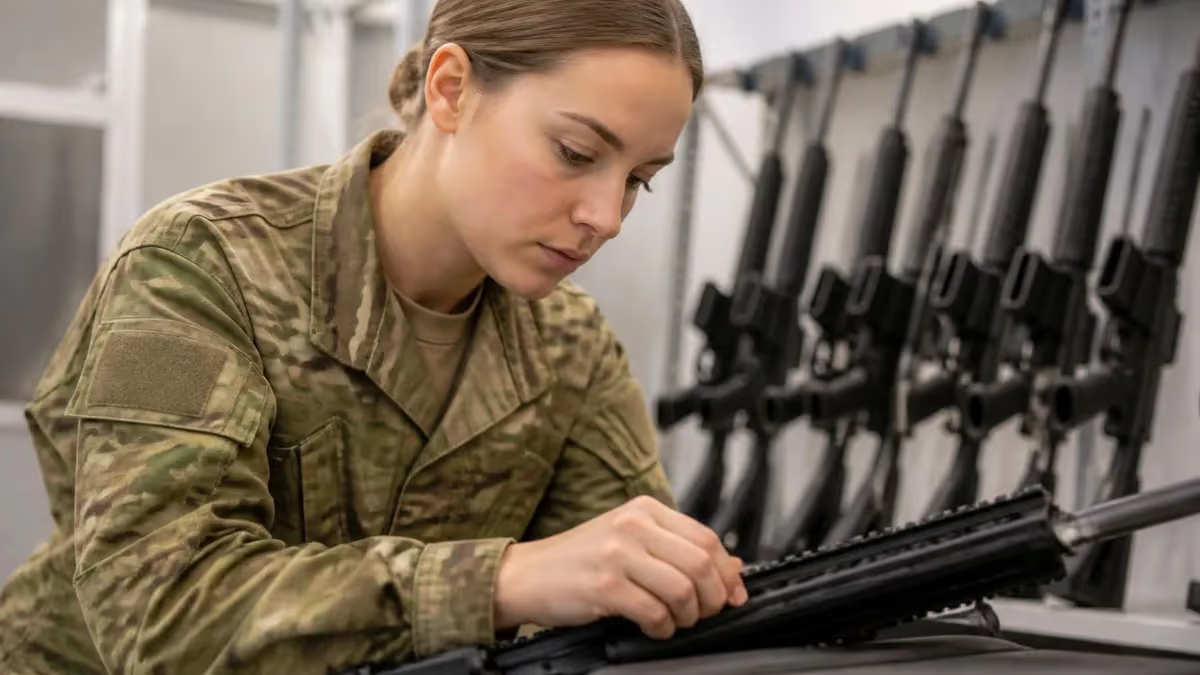
The australian defence force represents one of the most respected military organizations in the Asia-Pacific region, offering thousands of Australians a pathway to a meaningful, well-compensated, and challenging career in service to their country. Whether you are considering enlisting as a soldier, sailor, or airperson, or pursuing an officer commission through the Australian Defence Force Academy, understanding the full scope of entry requirements, aptitude testing, and training pipelines is absolutely essential before you begin your application. Many candidates underestimate how competitive and comprehensive the selection process truly is.
The ADF selection process evaluates candidates across multiple domains simultaneously, including cognitive aptitude, physical fitness, medical health, and personal character. Cognitive testing in particular surprises many first-time applicants because it covers mechanical reasoning, verbal skills, mathematical ability, abstract reasoning, and spatial awareness in a timed format. Scoring well across all these subsets is critical because the ADF uses your composite score to match you with eligible roles — a low score limits your options significantly and may bar you from certain technical or officer-level positions entirely.
Physical fitness standards for ADF entry are demanding and non-negotiable. You will be expected to complete a standardized fitness assessment that tests aerobic capacity, muscular endurance, and overall functional strength. The exact benchmarks vary by role, sex, and age group, but candidates who arrive underprepared consistently struggle to pass even the baseline fitness test on their first attempt. Starting a structured physical conditioning program at least three to four months before your assessment date is strongly recommended by current ADF recruiters and successful enlistees alike.
Beyond the aptitude test and fitness assessment, ADF applicants undergo a thorough security clearance process that examines your financial history, criminal record, associations, and overseas travel. This background investigation can take several months to complete and is one reason why starting the application process early — often up to a year before your intended start date — is wise. Any past legal issues, even minor ones, must be disclosed honestly; attempting to conceal information is grounds for immediate disqualification and a permanent bar from re-applying.
Medical standards for ADF entry are equally stringent. A defence force medical officer will evaluate your vision, hearing, cardiovascular health, musculoskeletal integrity, and overall medical history. Conditions that may be manageable in civilian life — such as mild asthma, corrected vision, or prior orthopedic injuries — can affect eligibility depending on the specific role you are targeting. It is worth requesting a copy of the ADF's medical intake standards and reviewing them honestly against your own health history before investing significant time in test preparation.
Many applicants use practice resources to prepare for the cognitive and knowledge-based portions of ADF selection, and this preparation genuinely pays off. Studies of military aptitude testing consistently show that candidates who complete structured practice sessions perform meaningfully better than those who attempt the test cold. Practice tests help you familiarize yourself with question formats, manage the time pressure of timed sections, and identify subject areas where you need additional study. Using a combination of timed practice tests, subject review, and targeted drilling gives you the best chance of achieving a competitive composite score.
This guide covers everything you need to know about ADF entry requirements, the aptitude test format, fitness expectations, the application timeline, and the best strategies for preparing effectively. Whether you are in the early stages of considering a military career or are already deep in the application process, the information here will help you navigate the ADF pathway with confidence and give you the best possible foundation for success on test day and beyond.
Free ADF - Australian Defence Force Study Tools
Interactive ADF - Australian Defence Force resources on PracticeTestGeeks, free to start:
- ADF - Australian Defence Force practice test — 100+ questions with instant scoring and answer explanations
- ADF - Australian Defence Force flashcards — review key terms and concepts card by card
- ADF - Australian Defence Force study guide — topic-by-topic overview of what the exam covers
- ADF - Australian Defence Force cheat sheet — one-page printable summary for last-minute review
ADF by the Numbers

ADF Entry Requirements Overview
- ▸Confirm citizenship and age eligibility (17–55 years depending on role)
- ▸Gather identity documents: passport, birth certificate, Medicare card
- ▸Review ADF medical intake standards against your health history
- ▸Download and read the official ADF Aptitude Test candidate guide
- ▸Complete a 2.4 km run to benchmark your current aerobic level
- ▸Test push-up and sit-up maximums against ADF entry standards
- ▸Identify fitness gaps and design a 12-week conditioning plan
- ▸Begin daily stretching and mobility work to prevent injury
- ▸Complete two full timed mechanical reasoning practice tests
- ▸Review basic physics principles: levers, pulleys, gears, forces
- ▸Brush up on arithmetic, fractions, ratios, and percentages
- ▸Practice abstract pattern recognition with timed drills
- ▸Submit online application through the ADF Careers portal
- ▸Prepare for the Suitability Interview with structured STAR responses
- ▸Research your preferred roles: duties, training pipelines, promotion paths
- ▸Request reference letters and notify your referees in advance
The ADF Aptitude Test — formally known as the Australian Defence Force Aptitude Assessment — is a computer-based battery of cognitive tests administered at official ADF Career Centres. It is one of the most consequential steps in the entire selection process because your composite score directly determines which roles you are eligible to apply for. The test is not designed to measure what you already know; rather, it assesses your underlying cognitive potential, reasoning speed, and ability to process and apply information under time pressure.
The test is divided into several distinct sections, each targeting a different cognitive skill. Mechanical reasoning questions evaluate your understanding of physical and mechanical concepts — how gears interact, how pulleys change the direction of force, how levers create mechanical advantage, and how basic electrical circuits function. These questions are particularly relevant for applicants targeting engineering, aviation, armoured corps, or technical trade roles. Even applicants who did not study physics formally can improve substantially with targeted practice because most mechanical reasoning concepts follow predictable patterns once you learn to recognize them.
Verbal and language sections of the ADF test assess your reading comprehension, vocabulary range, and ability to identify logical relationships between words and passages. These sections test whether you can quickly extract the main point from a paragraph, identify implied meaning, recognize analogies, and apply correct grammar. Strong performance in the verbal section correlates with success in roles that require written reporting, command communication, intelligence analysis, and public affairs work. Preparing by reading broadly and practicing verbal reasoning drills measurably improves scores.
Mathematical sections cover arithmetic, algebra, data interpretation, and basic geometry at approximately the Year 10 to Year 11 curriculum level. You will need to calculate percentages, interpret graphs and tables, solve word problems involving rates and ratios, and work with basic geometric formulas. The time pressure is real — you do not have unlimited time to work through lengthy calculations, so developing mental math fluency and learning efficient problem-solving shortcuts is a high-value preparation strategy. Candidates who practice under timed conditions consistently outperform those who practice at leisure.
Abstract reasoning and spatial visualization are two additional sections that many candidates find challenging because they are difficult to prepare for through traditional study. Abstract reasoning tests your ability to identify visual patterns, recognize rules that govern sequences of shapes, and predict the next element in a series. Spatial visualization requires you to mentally rotate three-dimensional objects, identify cross-sections, and interpret technical diagrams. Regular exposure to practice problems in both areas has been shown to improve performance because these skills respond well to pattern familiarity even if the underlying cognitive capacity is relatively fixed.
After the aptitude test, candidates typically receive their scores shortly after completing the assessment. Scores are expressed as percentiles relative to the ADF applicant pool and mapped to role eligibility. If your score falls below the threshold for your target role, you may be offered alternative roles that your score supports, or you may request to re-sit the test after a mandatory waiting period — typically three months.
Understanding the full test format before you sit for the first time is therefore critically important; there is no advantage to going in unprepared when the outcome has such long-lasting consequences for your role options.
Preparation timelines vary by starting point, but most structured resources recommend eight to twelve weeks of consistent practice. This means completing full timed practice tests at least twice per week, reviewing every incorrect answer to understand the reasoning behind the correct solution, and actively tracking your progress across each section so you can direct additional effort where it will have the greatest impact. Candidates who follow this approach typically see meaningful score improvements compared to their baseline, giving themselves a wider range of role eligibility and a stronger overall application.
ADF Practice Test Questions
Prepare for the ADF - Australian Defence Force exam with our free practice test modules. Each quiz covers key topics to help you pass on your first try.
ADF Mechanical Reasoning
ADF Exam Questions covering ADF Mechanical Reasoning. Master ADF Test concepts for certification prep.
ADF Military History and Traditions
Free ADF Practice Test featuring ADF Military History and Traditions. Improve your ADF Exam score with mock test prep.
ADF - Australian Defence Force Abstract Pa...
ADF Mock Exam on - Australian Defence Force Abstract Pattern Recognition. ADF Study Guide questions to pass on your first try.
ADF - Australian Defence Force Abstract Re...
ADF Test Prep for - Australian Defence Force Abstract Reasoning Puzzles. Practice ADF Quiz questions and boost your score.
ADF - Australian Defence Force ADF Psychol...
ADF Questions and Answers on - Australian Defence Force ADF Psychological Assessment. Free ADF practice for exam readiness.
ADF - Australian Defence Force ADF Recruit...
ADF Mock Test covering - Australian Defence Force ADF Recruitment Process. Online ADF Test practice with instant feedback.
ADF - Australian Defence Force General Ser...
Free ADF Quiz on - Australian Defence Force General Service Knowledge. ADF Exam prep questions with detailed explanations.
ADF - Australian Defence Force Numerical R...
ADF Practice Questions for - Australian Defence Force Numerical Reasoning Problems. Build confidence for your ADF certification exam.
ADF - Australian Defence Force Numerical R...
ADF Test Online for - Australian Defence Force Numerical Reasoning Skills. Free practice with instant results and feedback.
ADF - Australian Defence Force Physical Fi...
ADF Study Material on - Australian Defence Force Physical Fitness Standards. Prepare effectively with real exam-style questions.
ADF - Australian Defence Force Verbal Reas...
Free ADF Test covering - Australian Defence Force Verbal Reasoning Skills. Practice and track your ADF exam readiness.
ADF Military Aptitude & Cognitive Assessment
ADF Exam Questions covering Military Aptitude & Cognitive Assessment. Master ADF Test concepts for certification prep.
ADF Test Preparation Strategies
Mechanical reasoning is the section that most frequently surprises first-time ADF test takers because it requires applied physics knowledge rather than pure math or verbal skill. The most efficient way to prepare is to study the six core mechanical concepts repeatedly tested: levers and torque, gears and gear ratios, pulleys and mechanical advantage, springs and elasticity, fluid pressure, and basic electrical circuits. Each of these has a predictable question format once you have seen it a few times, which means practice volume directly translates to score improvement.
The best preparation combines conceptual review with high-volume timed practice. Start by reading a concise physics primer covering each of the six core topics, then immediately shift to working through practice questions under realistic time conditions. Many candidates make the mistake of studying theory extensively but never simulating the timed pressure of the actual test, which means they have the knowledge but cannot access it quickly enough during the real assessment. Plan to complete at least three to four full timed mechanical reasoning practice tests in the two weeks before your test date.

Is an ADF Career Right for You? Advantages and Challenges
- +Highly competitive salary and allowances package starting above the national median wage
- +Fully subsidized education pathways including ADFA university degrees and trade qualifications
- +Exceptional job security with guaranteed employment for the duration of your service commitment
- +Access to world-class fitness facilities, health care, and dental benefits at no personal cost
- +Unique opportunities for international deployment, overseas postings, and joint exercises with allied forces
- +Fast-tracked leadership development and career advancement based on merit and performance
- −Frequent relocation postings that disrupt family stability and social networks
- −Mandatory service obligations mean you cannot simply resign if personal circumstances change
- −Physical and psychological demands of operational service can have long-term health consequences
- −Rigid hierarchical culture may feel restrictive to individuals who thrive in autonomous work environments
- −Separation from family during extended deployments or remote postings can strain relationships
- −Transition to civilian employment after service requires deliberate career planning and retraining investment
Pros and Cons at a Glance
| Pros | Cons |
|---|---|
| Highly competitive salary and allowances package starting above the national median wage | Frequent relocation postings that disrupt family stability and social networks |
| Fully subsidized education pathways including ADFA university degrees and trade qualifications | Mandatory service obligations mean you cannot simply resign if personal circumstances change |
| Exceptional job security with guaranteed employment for the duration of your service commitment | Physical and psychological demands of operational service can have long-term health consequences |
| Access to world-class fitness facilities, health care, and dental benefits at no personal cost | Rigid hierarchical culture may feel restrictive to individuals who thrive in autonomous work environments |
| Unique opportunities for international deployment, overseas postings, and joint exercises with allied forces | Separation from family during extended deployments or remote postings can strain relationships |
| Fast-tracked leadership development and career advancement based on merit and performance | Transition to civilian employment after service requires deliberate career planning and retraining investment |
ADF Application Checklist: Are You Ready to Apply?
- ✓Confirm you meet the citizenship requirement — Australian citizen or eligible permanent resident
- ✓Verify your age falls within the eligible range for your target role (typically 17–55 years)
- ✓Complete a full mock ADF aptitude test to establish your baseline cognitive score
- ✓Start a structured 12-week physical conditioning program targeting the ADF fitness standards
- ✓Collect all required identity documents: passport, birth certificate, and proof of residency
- ✓Review the ADF medical standards document and honestly assess any potential health eligibility concerns
- ✓Research at least three specific ADF roles that match your interests and aptitude test score requirements
- ✓Prepare three to five structured STAR (Situation, Task, Action, Result) interview responses
- ✓Notify your personal referees and confirm they are willing to participate in the background check process
- ✓Submit your expression of interest through the official ADF Careers website to initiate formal recruitment
Your Aptitude Score Determines Your Role Options — Prepare Accordingly
ADF aptitude test scores are used directly to filter which roles you can apply for, and a low score cannot be overcome by strong fitness results or interview performance alone. Candidates who invest 8–12 weeks in structured test preparation consistently score higher than those who sit the test without preparation, opening access to a broader range of technical and officer-track roles with better long-term career prospects.
Once you have successfully cleared the aptitude test, fitness assessment, medical evaluation, and security clearance, you will progress to the formal training pipeline for your chosen role. Initial Entry Training — sometimes called recruit training or basic training — is the foundational phase that all ADF members complete before proceeding to role-specific instruction. The duration and intensity of this phase vary significantly across the three services: Army, Navy, and Air Force each run distinct programs that reflect the unique operational demands of their respective environments.
Army recruit training is conducted at Kapooka in New South Wales and runs for approximately 80 days. This program focuses on developing soldiers' physical resilience, weapons handling proficiency, field craft skills, and the mental toughness required to function effectively under stress. The Kapooka program has a demanding attrition rate, and candidates who arrive in poor physical condition or with unrealistic expectations about military life frequently struggle to complete it. Entering Kapooka with a high level of physical fitness and a solid understanding of what military service actually involves is one of the most reliable predictors of successful completion.
Navy recruit training takes place at HMAS Cerberus in Victoria and spans approximately eleven weeks. The naval training curriculum emphasizes seamanship, safety at sea, basic navigation principles, team coordination in confined shipboard environments, and the physical standards necessary for service aboard vessels in demanding sea states. Navy recruits also begin developing their understanding of the rank structure, naval traditions, and the operational culture of the maritime environment — all of which form a core part of their professional identity throughout their service career.
Air Force initial training occurs at RAAF Base Edinburgh in South Australia and runs for approximately six weeks before recruits proceed to mustering-specific training. The Air Force training philosophy places a strong emphasis on technical competence, attention to detail, and the precision required in aerospace environments where errors have potentially catastrophic consequences. Air Force mustering training following initial instruction can range from a few months to well over a year for highly technical roles such as aircraft maintenance, avionics, or air traffic control, reflecting the complexity of the skills involved.
Officer training pathways differ substantially from enlisted training. The Australian Defence Force Academy in Canberra is the primary pathway for officers, offering a three-year undergraduate degree combined with military leadership training. Graduates then proceed to single-service officer training before taking up their first substantive roles. Alternatively, direct entry officer schemes exist for professionals with existing qualifications in fields like medicine, law, engineering, and chaplaincy — these pathways allow the ADF to bring in experienced civilians at ranks commensurate with their professional background and expertise.
After completing initial and role-specific training, ADF members are posted to their first unit where they begin the practical phase of their career. Early career postings are closely supervised and structured to build competence progressively, with junior personnel working under the guidance of experienced non-commissioned officers and officers who provide mentorship, performance feedback, and professional development opportunities. Regular performance assessments drive promotion decisions, and individuals who demonstrate leadership potential are identified early and offered accelerated development programs.
Long-term career development in the ADF is built around a combination of technical specialization and leadership broadening. Members are typically required to balance deepening expertise in their specific trade or branch with progressively more complex leadership responsibilities as they advance through the ranks. The ADF invests heavily in the professional development of its members through funded training courses, secondments to allied defence forces, and graduate education opportunities — many ADF members complete postgraduate degrees in areas like strategic studies, international relations, and engineering while serving.
The ADF selection process — from initial application to receiving a formal offer — typically takes between nine and twelve months when all clearances and assessments are factored in. Security clearance processing alone can take three to six months. Do not quit your current employment or make irreversible personal decisions based on an expected start date until you have received and accepted a formal written offer from ADF Careers.
Succeeding in the ADF aptitude test requires more than simply showing up and hoping for the best — it demands a structured, disciplined approach to preparation that mirrors the methodical mindset the ADF itself values in its members. The candidates who perform best consistently share one characteristic: they treat the preparation phase with the same seriousness they plan to bring to their military career. This means setting a realistic preparation schedule, committing to it daily, monitoring their progress honestly, and adjusting their approach when a particular strategy is not yielding results.
Time management during the aptitude test itself is one of the most critical skills to develop before test day. Many sections have per-question time allocations that are uncomfortably short, particularly for candidates accustomed to working through problems at their own pace.
Developing the habit of moving on from a question you cannot immediately solve — rather than fixating on it while the clock runs down — is a trained skill that practice tests develop. Experienced test-takers know that leaving a difficult question and returning to it at the end is almost always a better strategy than spending three minutes on one item and missing five easier ones as a result.
Military history and traditions knowledge is another component that appears in some ADF selection contexts, including the general knowledge and background knowledge sections that may be included in certain role assessments. Understanding the major campaigns, battles, and organizational history of the Australian Defence Force demonstrates respect for the institution you are seeking to join and signals that your interest in military service is genuine rather than circumstantial.
Reading broadly about Australian military history, from Gallipoli through to modern operations in Afghanistan and the Middle East, enriches your understanding of what service actually means and prepares you to discuss it credibly in interview contexts.
The suitability interview is a structured behavioral assessment conducted by an ADF recruiter and is designed to evaluate your motivation, resilience, communication skills, and understanding of military life. Interviewers use the STAR framework to probe specific past experiences and assess how you have handled challenges, conflicts, failures, and high-pressure situations. Vague or generalized answers perform poorly — the strongest candidates come prepared with three to five detailed, specific examples from their life experience that demonstrate relevant qualities. Preparing these examples in advance and practicing them aloud significantly improves your delivery and confidence during the actual interview.
Physical preparation deserves as much structured attention as cognitive preparation. ADF fitness standards are demanding, and the test day is not the time to discover that you needed another month of training. The standard fitness assessment typically includes a 2.4-kilometre run (timed), maximum repetition push-up and sit-up tests, and sometimes a beep test or shuttle run.
Specific benchmarks depend on age, sex, and role, but as a general target, being able to run 2.4 km in under 11 minutes, complete 30 or more push-ups, and perform 45 or more sit-ups in a minute puts you in a competitive position for most general enlistment roles.
Nutrition and sleep in the weeks before both your fitness assessment and aptitude test are factors that candidates frequently overlook but that research consistently shows have measurable impacts on performance. Inadequate sleep impairs working memory, slows processing speed, and reduces the ability to handle novel problems — all of which hurt aptitude test scores. Arriving at your test date having slept at least seven to eight hours for the preceding week, eating regular balanced meals, and avoiding alcohol or other substances that impair cognitive recovery gives you a tangible performance advantage over less prepared competitors.
Finally, maintaining a positive but realistic mindset throughout the application process is important. The ADF selection process is deliberately challenging and can span a year or more — during which you may experience delays, requests for additional documentation, or the need to resit assessments.
Candidates who persist through setbacks and treat each stage as a learning opportunity rather than a personal rejection consistently have better outcomes than those who allow frustration to undermine their commitment. The qualities the ADF is looking for — resilience, adaptability, and sustained motivation — are exactly the qualities that the application process itself tests and rewards.
Building strong study habits in the final weeks before your ADF aptitude test can meaningfully separate you from the large field of candidates competing for a limited number of positions in high-demand roles. One of the most effective study techniques validated by cognitive science research is spaced repetition — rather than cramming all your practice into the days immediately before the test, spreading practice sessions across several weeks allows the brain to consolidate learning more durably.
A candidate who practices mechanical reasoning for forty minutes every second day for six weeks will almost always outperform someone who spends twelve hours practicing in the two days before the test.
Active recall is another evidence-based technique that dramatically improves retention compared to passive review. Instead of re-reading notes or watching explainer videos, force yourself to retrieve information from memory by answering practice questions without looking at the answers first. This process of effortful retrieval strengthens the neural pathways associated with that knowledge and makes it more accessible under the time pressure of the actual test. Flashcards, timed quizzes, and practice tests all implement active recall effectively — review-based study does not.
Peer study groups can be surprisingly effective for ADF aptitude preparation, particularly for candidates preparing with friends or fellow applicants. Explaining a mechanical reasoning concept to someone else — such as how a block-and-tackle pulley system multiplies force — forces you to articulate your understanding clearly and exposes gaps you might not notice when reviewing material alone. The collaborative accountability of a study group also helps maintain consistency in your preparation schedule during the weeks when motivation naturally dips.
Mock test conditions matter enormously. When you do full timed practice tests, replicate the actual test environment as closely as possible: sit at a desk rather than on a couch, use only the materials you will have on test day, silence your phone, and start and stop each section according to the official time limits without pausing. Candidates who have consistently practiced under real conditions report feeling significantly more comfortable and less anxious during the actual assessment, which itself improves performance by allowing them to allocate full cognitive resources to the problems rather than managing test anxiety.
Reviewing incorrect answers is more valuable than completing additional practice tests without reviewing. Every error contains diagnostic information about a gap in your knowledge or reasoning process. When you get a question wrong, do not simply note the correct answer and move on — instead, understand exactly why the correct answer is right and why your chosen answer was wrong, whether that reflects a conceptual misunderstanding, a calculation error, a misread of the question, or a time-pressure decision that did not serve you. This analytical approach transforms practice tests from score-measurement exercises into genuine learning opportunities.
Maintaining physical fitness throughout your cognitive preparation period is not just about meeting the fitness test standards — regular aerobic exercise has well-documented positive effects on cognitive performance, memory consolidation, and mood regulation. Running, cycling, swimming, or other sustained aerobic activities performed three to four times per week improve the brain's executive function, which is the cognitive capacity most directly associated with performance on aptitude tests. Candidates who are both physically fit and cognitively prepared hold a compound advantage over those who prepared for only one dimension of selection.
On the day of your aptitude test, arrive early, bring the required identification documents, and eat a balanced meal two to three hours beforehand — not immediately before, as post-meal blood sugar fluctuations can impair concentration. Stay hydrated. During the test, read every question carefully before answering, manage your time section by section rather than question by question, and trust the preparation you have invested. Anxiety is normal and manageable; the candidates who have prepared thoroughly find that the test feels challenging but fair rather than overwhelming and impossible. Your preparation is your best asset on test day.
Sample ADF - Australian Defence Force Practice Questions
Try these questions from our free ADF - Australian Defence Force practice tests. The correct answer and an explanation follow each question.
The tradition of the 'slouch hat' with a turned-up brim is most famously associated with which service of the Australian Defence Force?
- A. Royal Australian Navy
- B. Australian Army
- C. Royal Australian Air Force
- D. It is worn equally by all three services for ceremonial duties
Answer: B. Australian Army
The slouch hat, formally known as the 'Hat, Khaki, Fur Felt', is an iconic symbol of the Australian Army. Its tradition dates back to the late 19th century and it became widely recognised as the headwear of the Australian 'Digger' during World War I.
A 22-year-old female candidate is applying for a general entry role in the Royal Australian Navy (RAN). She completes 8 push-ups, 25 sit-ups, and achieves a beep test score of 6.5. Based on the minimum PFA standards, which component has she successfully passed?
- A. Push-ups only
- B. Beep test only
- C. Push-ups and Sit-ups only
- D. All components
Answer: D. All components
The minimum PFA requirement for a female RAN candidate is 6 push-ups, 20 sit-ups, and a beep test score of 6.1. The candidate's performance of 8 push-ups, 25 sit-ups, and a 6.5 beep test score exceeds all three minimum standards.
Which of the following is NOT one of the three services that constitute the Australian Defence Force?
- A. Royal Australian Navy (RAN)
- B. Australian Army
- C. Australian Border Force (ABF)
- D. Royal Australian Air Force (RAAF)
Answer: C. Australian Border Force (ABF)
The Australian Defence Force is comprised of three services: the Royal Australian Navy (RAN), the Australian Army, and the Royal Australian Air Force (RAAF). The Australian Border Force is a separate federal law enforcement agency responsible for border control and is part of the Home Affairs portfolio, not the Defence portfolio.
Which of the following lists correctly identifies the core values of the Australian Defence Force?
- A. Honesty, Loyalty, Duty, Mateship
- B. Service, Courage, Respect, Integrity, Excellence
- C. Pride, Commitment, Honour, Strength
- D. Professionalism, Leadership, Teamwork, Dedication
Answer: B. Service, Courage, Respect, Integrity, Excellence
The ADF's core values are officially stated as Service, Courage, Respect, Integrity, and Excellence. These values guide the conduct, character, and decision-making of all members.
ADF Questions and Answers


About the Author

Educational Psychologist & Academic Test Preparation Expert
Columbia University Teachers CollegeDr. Lisa Patel holds a Doctorate in Education from Columbia University Teachers College and has spent 17 years researching standardized test design and academic assessment. She has developed preparation programs for SAT, ACT, GRE, LSAT, UCAT, and numerous professional licensing exams, helping students of all backgrounds achieve their target scores.
Join the Discussion
Connect with other students preparing for this exam. Share tips, ask questions, and get advice from people who have been there.
View discussion (9 replies)