
Wound Care Nurse Certification: Complete Guide to WOCN, WCC & CWCN in 2026 September
💡 Complete wound care nurse certification guide: WOCN, WCC, CWCN requirements, costs, exam prep, salary boost & step-by-step path to credentialing.
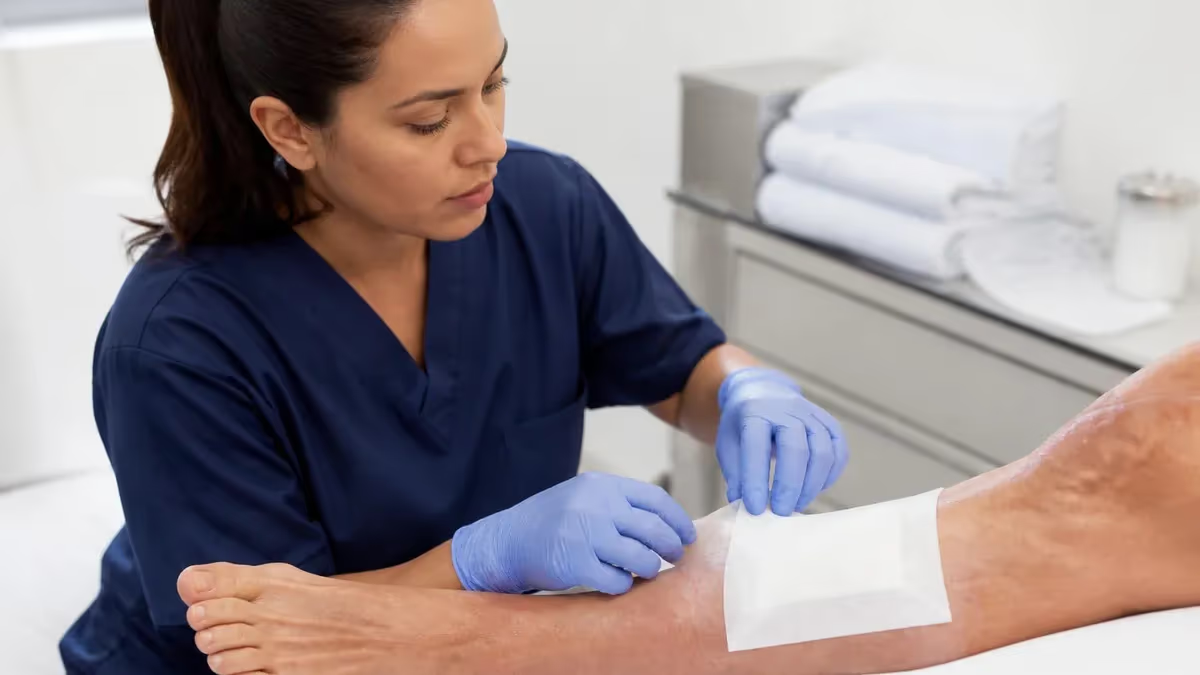
Pursuing a wound care nurse certification is one of the smartest career moves a registered nurse can make in 2026. Demand for credentialed wound clinicians has surged as the U.S. population ages, diabetes rates climb past 38 million adults, and pressure injuries cost hospitals over $26 billion annually. Whether you work in acute care, long-term care, home health, or outpatient wound care wound care clinics, earning a recognized credential separates you from generalist RNs and unlocks specialty pay differentials averaging $8,000 to $15,000 per year.
This guide walks through every legitimate certification pathway available to nurses in the United States, including the gold-standard CWOCN through the Wound, Ostomy and Continence Nursing Certification Board (WOCNCB) and the popular WCC offered by the National Alliance of Wound Care and Ostomy (NAWCO). We cover eligibility, education routes, exam blueprints, recertification cycles, costs, employer reimbursement strategies, and what to study to pass on your first attempt.
The wound care field rewards specialization in a way few other nursing niches do. A certified wound care nurse manages complex pressure injuries, diabetic foot ulcers, venous leg wounds, surgical dehiscence, and skin tears with measurable outcomes. Hospitals increasingly require certification for wound team leads, and Medicare reimbursement audits favor facilities staffed with credentialed clinicians. Certification is no longer a nice-to-have — it is fast becoming the baseline standard for wound consultative practice across most health systems.
Before you choose a pathway, you need to understand the difference between board certification (WOCNCB, ABWM) and certificate programs (WCEI Skin & Wound Care Course). Board certification follows the standards set by the Accreditation Board for Specialty Nursing Certification (ABSNC) and the National Commission for Certifying Agencies (NCCA). Certificate programs grant a course completion title but may carry the same NCCA-accredited credential at the back end, like the WCC. The distinction matters for employer recognition and Magnet recognition documentation.
Most candidates spend 8 to 16 weeks preparing once they meet eligibility. The exams are pattern-heavy, scenario-driven, and built around evidence-based standards like the WOCN Society guidelines, NPIAP staging criteria, and the WUWHS consensus documents. Memorizing dressing brands will not pass you — understanding wound bed preparation, TIMERS principles, and the legal scope of practice for autonomous wound assessment will. Expect roughly 150 to 185 multiple-choice questions across a three-hour testing window, with pass rates ranging from 64% to 78% depending on the credential.
This article gives you the complete roadmap: who qualifies, what each acronym actually means, how exam content is weighted, and how to build a study plan that fits around 12-hour shifts. By the end, you will know exactly which certification matches your career goals, whether it pays for itself, and how to register for the next available test window in your state.
We have structured the guide to match how working nurses actually learn — bite-sized prose with practice quiz checkpoints so you can self-assess as you go. Bookmark this page, and use the table of contents to skip directly to the section relevant to your current decision point, whether that is choosing a credential, calculating cost, or scheduling your exam date.
Wound Care Nurse Certification by the Numbers

Major Wound Care Certification Pathways Compared
The gold-standard credential covering wound, ostomy, and continence. Requires graduation from a WOCN-accredited education program (WOC-EP) plus BSN. Recognized for Magnet hospital documentation.
Wound Care Certified credential through the National Alliance of Wound Care and Ostomy. Open to RNs, LPNs, PTs, and physicians. Requires the Skin & Wound Management Course plus passing exam.
Certified Wound Care Nurse, the wound-only sub-credential from WOCNCB. Ideal for nurses who do not work with ostomy or continence patients. BSN and approved education hours required.
Certified Wound Specialist through the American Board of Wound Management. Multidisciplinary — open to RNs, MDs, DPMs, and PTs with three years of wound experience.
Certified Wound Care Associate, an entry-level ABWM credential for clinicians with less experience. Useful for LPNs, MAs, and new wound team members building toward full CWS status.
Eligibility requirements vary dramatically between credentialing bodies, and choosing the wrong pathway can cost you months of preparation. The WOCNCB demands the most rigorous prerequisites: an active unrestricted RN license, a bachelor's degree in nursing (BSN minimum, though associate-degree pathways exist with extended clinical hours), and completion of one of three approved routes. Most candidates pursue the traditional route, which requires graduation from an accredited WOC Nursing Education Program (WOC-EP) within the last five years. These programs run 8 to 16 weeks and combine didactic coursework with 40 hours of supervised clinical practicum under a certified preceptor.
The NAWCO WCC has the most accessible entry point in the entire field. It accepts RNs, LPNs, LVNs, physical therapists, occupational therapists, MDs, DOs, podiatrists, nurse practitioners, and physician assistants. Applicants need an active license, three years of patient care experience, and completion of the WCEI Skin & Wound Management Course (a 5-day intensive or extended online format). This breadth makes WCC the most common credential held by floor nurses and case managers shopping for high-quality wound care products in their daily caseload.
The American Board of Wound Management offers two tiers. The CWCA requires only a high school diploma and three years of full-time wound care experience, making it the most inclusive credential available — popular with medical assistants, LPNs, and clinical support staff. The CWS, by contrast, requires a clinical doctorate or master's degree in a health profession, or a bachelor's plus three years of wound-specific clinical experience. CWS holders typically move into wound team leadership, consulting, or product specialist roles within the industry.
Beyond academic credentials, all certification bodies require documented clinical experience. WOCNCB applicants pursuing the experiential route must log 1,500 hours of direct wound care nursing within the prior five years. NAWCO requires three years of qualifying patient-care experience but does not specify a wound-hours minimum — your education course covers the standardization gap. ABWM specifies that experience must be in direct wound assessment, treatment planning, or wound consultation rather than peripheral roles like coding or supply management.
Most candidates underestimate the documentation phase. Expect to gather employer verification letters, transcripts sealed and mailed directly from your nursing school, copies of CE certificates, and a notarized attestation of practice hours. WOCNCB applications routinely take six to eight weeks for review, and incomplete submissions reset the clock. Start gathering documents the day you commit to a credential — do not wait until you finish your education program. Build a digital folder organized by certifying body requirements and update it quarterly.
State scope-of-practice rules also affect eligibility for autonomous wound debridement. Approximately 24 states permit certified RNs to perform sharp conservative debridement under standardized procedures, while others restrict it to APRNs or physicians. Check your state board of nursing position statement before assuming your credential allows hands-on debridement. This matters for job descriptions, malpractice coverage, and your eventual day-to-day practice in long-term care or home health settings.
Finally, military and federal nurses follow slightly different routes. The VA and DoD recognize all four major credentials but offer the most paid training support for the WOCNCB pathway through tuition assistance and Federal Employee Education Reimbursement programs. If you serve in a federal facility, talk to your nurse executive about contracted slots before paying out of pocket — many roles allocate annual training dollars specifically for wound and ostomy certification.
Wound Care Certification Practice Test Questions
Prepare for the Wound Care Certification Exam exam with our free practice test modules. Each quiz covers key topics to help you pass on your first try.
Wound Care Certification Beginner's Guide
Wound Care Certification Exam Questions covering Beginner's Guide. Master Wound Care Certification Test concepts for certification prep.
Wound Care Certification Knowledge
Free Wound Care Certification Practice Test featuring Knowledge. Improve your Wound Care Certification Exam score with mock test prep.
Wound Care Certification MCQ
Wound Care Certification Mock Exam on MCQ. Wound Care Certification Study Guide questions to pass on your first try.
Wound Care Certification Practice
Wound Care Certification Test Prep for Practice. Practice Wound Care Certification Quiz questions and boost your score.
Wound Care Certification
Wound Care Certification Questions and Answers on Wound Care Certification. Free Wound Care Certification practice for exam readiness.
Wound Care Certification Trivia
Wound Care Certification Mock Test covering Trivia. Online Wound Care Certification Test practice with instant feedback.
Wound Care Certification Atypical Wound Et...
Free Wound Care Certification Quiz on Atypical Wound Etiologies. Wound Care Certification Exam prep questions with detailed explanations.
Wound Care Certification Dressings and Top...
Wound Care Certification Practice Questions for Dressings and Topical Agents. Build confidence for your Wound Care Certification certification exam.
Wound Care Certification Exam Wound Care C...
Wound Care Certification Test Online for Exam Wound Care Certification Debridement Methods and Indications. Free practice with instant results and feedback.
Wound Care Certification Exam Wound Care C...
Wound Care Certification Study Material on Exam Wound Care Certification Infection Management and Antimicrobials. Prepare effectively with real exam-style questions.
Wound Care Certification Pressure Injury P...
Free Wound Care Certification Test covering Pressure Injury Prevention. Practice and track your Wound Care Certification exam readiness.
Wound Care Certification Systemic Factors ...
Wound Care Certification Exam Questions covering Systemic Factors Affecting Healing. Master Wound Care Certification Test concepts for certification prep.
Major Wound Care Certification Bodies
The Wound, Ostomy and Continence Nursing Certification Board offers the most respected wound nursing credentials in the United States. WOCNCB administers the CWOCN (tri-specialty), CWCN (wound only), COCN (ostomy only), and CCCN (continence only). All exams follow a 120-question, computer-based format delivered through PSI testing centers across all 50 states with rolling registration windows throughout the year.
WOCNCB credentials are ABSNC-accredited and explicitly recognized by Magnet Recognition Program documentation requirements. Hospitals pursuing or maintaining Magnet status often require WOCNCB-credentialed nurses on wound teams, which makes these certifications highly portable. The board reports first-time pass rates between 68% and 78% across its credentials, with the CWCN consistently scoring at the higher end due to its narrower scope.

Is Wound Care Nurse Certification Worth the Investment?
- +Average salary boost of $8,000 to $15,000 per year for certified RNs
- +Strong job security driven by aging population and chronic wound prevalence
- +Career mobility into outpatient clinics, industry, telehealth, and consulting roles
- +Eligibility for wound team lead and director-of-nursing-specialty positions
- +Higher reimbursement and Medicare audit support for credentialed facilities
- +Professional recognition through Magnet and Joint Commission documentation
- +Access to specialized CE, conferences, and a robust professional community
- −Upfront cost of $1,200 to $4,500 including course, exam, and study materials
- −Significant time commitment of 8 to 16 weeks of focused preparation
- −Five-year recertification cycle requires ongoing CE investment
- −Some employers do not offer differential pay despite the new credential
- −Scope-of-practice restrictions vary by state, limiting autonomous debridement
- −Highly competitive exam with first-time fail rates between 22% and 32%
Pre-Exam Preparation Checklist for Wound Care Certification
- ✓Verify your RN/LPN license is active, unrestricted, and in good standing with your state board
- ✓Confirm your clinical hours meet the specific credential threshold (1,500 hrs WOCNCB or 3 yrs NAWCO)
- ✓Order sealed academic transcripts directly from your nursing school registrar
- ✓Complete and document an approved Skin & Wound Management or WOC-EP education program
- ✓Gather a notarized employer verification letter detailing role and wound-care responsibilities
- ✓Purchase the WOCN Society Core Curriculum textbook (current edition) and a question bank
- ✓Schedule two full-length practice exams during the final three weeks of study
- ✓Review NPIAP pressure injury staging criteria and 2024 international consensus updates
- ✓Memorize the TIMERS framework and wound bed preparation principles cold
- ✓Submit your application 8 to 12 weeks before your target exam window to allow processing
- ✓Reserve a quiet PSI or Prometric testing center within commuting distance of home
- ✓Print your authorization-to-test letter and bring two forms of government-issued ID on exam day
Match the credential to your scope of practice, not the cheapest course
The most expensive mistake candidates make is enrolling in a course before deciding which credential they actually need. A WCEI Skin & Wound Course leads efficiently to WCC but does not satisfy WOCNCB's WOC-EP requirement. Audit your job description, talk to your nurse manager about employer-recognized credentials, and pick the credential first. Then enroll in its matching education pathway.
Cost is the second-biggest barrier candidates face after time, and the price range for full certification varies more than most nurses realize. A WCC pathway typically runs $1,200 to $1,800 total — roughly $895 for the WCEI online course, $325 for the NAWCO exam fee, and another $200 to $400 for study materials and practice question banks. The full CWOCN pathway through an accredited WOC-EP program is significantly steeper, with tuition between $3,800 and $5,200, plus the $395 WOCNCB exam fee and approximately $250 for the practicum supplies and travel.
Return on investment is one of the most favorable in nursing specialties. Certified wound nurses report base salary increases averaging $4 to $7 per hour, which translates to $8,000 to $14,500 annually for a full-time employee. Many large hospital systems pay a flat certification differential of $1,500 to $3,500 per year on top of the hourly bump. Outpatient wound clinics and home health agencies often offer signing bonuses of $5,000 to $10,000 specifically for credentialed candidates, recovering the entire certification cost within the first paycheck cycle.
Employer reimbursement is the most underutilized cost-management strategy. Approximately 78% of acute-care hospitals offer at least partial tuition reimbursement for clinical specialty certifications, but only 41% of eligible nurses request it. Submit a formal proposal to your nurse manager that includes a business case: improved HCAHPS pressure injury scores, lower hospital-acquired pressure injury rates, reduced wound-related readmissions, and stronger Joint Commission documentation. Frame the certification as a facility investment, not a personal expense, and most managers will champion the reimbursement request through HR.
The Department of Veterans Affairs runs the most generous federal program, covering 100% of approved certification costs for VA-employed nurses, including exam fees, study materials, course tuition, and renewal cycles. Active-duty military nurses access similar funding through the Nurse Corps Continuing Education Programs and Tuition Assistance. Indian Health Service, Public Health Service, and Bureau of Prisons facilities offer equivalent programs. If you work for any federal employer, do not pay out of pocket without first exhausting your training-budget allocation.
Tax benefits also help defray the cost when employer reimbursement is not available. Education expenses required to maintain or improve skills in your current profession are typically deductible as unreimbursed employee business expenses on Schedule A or as a self-employed business expense on Schedule C for travel nurses and contractors. Course tuition, books, exam fees, mileage to testing centers, and even hotel costs for required practicum travel can qualify. Talk to a tax professional who works with healthcare clients before filing.
Beyond direct costs and tax breaks, consider opportunity cost: nurses who delay certification typically delay the wage increase by the same period. The mathematical case for getting certified sooner rather than later is decisive. A nurse who waits 18 months to begin the WCC pathway loses roughly $12,000 to $20,000 in differential pay during that delay window — far exceeding the entire upfront investment. Treat certification scheduling with the same urgency you give to retirement contributions.
When you are ready to commit, schedule your education program and exam date in the same week. Studies on adult learners show that candidates with a fixed exam date complete preparation 28% faster than those who study open-ended. Pay the deposit, mark the calendar, and tell your manager. The accountability and sunk cost create the focus needed to finish the program. Pair this with a structured study plan and you'll dramatically increase your first-time pass odds.

WOCNCB application windows are tied to specific testing cycles — late submissions push you to the next window, which may be three months away. NAWCO WCC applications must be submitted within five years of completing your approved Skin & Wound Course, or you must retake the course. Calendar both your application deadline and your education-course expiration date the day you enroll.
Recertification keeps your credential active and your clinical skills current, and every major wound certification operates on a five-year cycle. The WOCNCB requires 60 contact hours of continuing education plus an active license and current practice within the wound specialty. At least half of those hours must be specific to wound, ostomy, or continence content rather than general nursing topics. Candidates who fail to complete CE hours can opt for re-examination, but most professionals find the CE pathway far more cost-effective and educationally rewarding.
The NAWCO WCC follows similar requirements: 60 contact hours over five years, with 30 hours specifically in wound topics and the rest in related clinical areas. NAWCO publishes an approved CE provider list including WCEI, Medline University, and the Symposium on Advanced Wound Care. Many certified nurses use their annual conference attendance to bank 18 to 24 hours in a single trip, especially the SAWC Spring and Fall events, which offer hands-on workshops on biofilm management, advanced debridement, and lymphedema therapy.
Career growth after certification follows three predictable arcs. The first is vertical movement within the hospital — wound nurse to wound team lead to director of skin integrity programs. The second is outpatient mobility, where credentialed nurses transition into hospital-based outpatient wound centers, home health, or hyperbaric oxygen therapy programs. These roles typically offer better hours, lower physical strain, and signing bonuses for new hires. The third pathway moves into industry — wound product manufacturers, medical device companies, and consulting firms aggressively recruit credentialed clinicians for clinical specialist roles paying $115,000 to $160,000.
Many certified nurses also pursue cross-credentialing to broaden their scope. A WCC-certified nurse might add the DWC (Diabetic Wound Certified) to specialize in lower extremity ulcers, or the OMS to handle complex ostomy cases. ABWM offers cross-recognition pathways for clinicians holding NAWCO or WOCNCB credentials, allowing accelerated CWS qualification. Each additional credential typically adds another $3,000 to $6,000 in differential pay and significantly broadens your job market. Some nurses also venture into wound care near me consulting roles offering home assessments directly to patients and families.
Telehealth has become the fastest-growing practice setting for certified wound nurses. Post-pandemic adoption of asynchronous wound photography and remote consultation has created a national market for credentialed reviewers. Companies like Net Health, Swift Medical, and Tissue Analytics employ certified wound clinicians for image grading, treatment plan review, and physician consultation backup. These roles typically pay $45 to $75 per hour for part-time work and are ideal for nurses easing toward retirement or balancing family obligations.
Leadership pathways extend to academic and policy roles. Certified wound nurses with graduate degrees often move into adjunct faculty positions teaching wound modules in BSN, MSN, and DNP programs. The WOCN Society and Association for the Advancement of Wound Care (AAWC) recruit credentialed members for guideline development, position statements, and government affairs committees. These volunteer roles raise your profile, lead to speaking invitations, and frequently convert into paid consulting opportunities with manufacturers and payers.
Finally, the entrepreneurial path is increasingly accessible. Independent wound consultants contract directly with long-term care facilities, assisted living communities, and home health agencies that lack in-house specialists. Hourly contract rates of $85 to $150 are common, and a part-time consulting practice working 10 hours per week generates supplemental income exceeding $40,000 annually. Several states require business licensing and additional malpractice coverage, but the autonomy and earning potential make this one of the most attractive long-term outcomes of certification.
Practical exam-day preparation often determines pass-or-fail outcomes more than knowledge alone. Begin your final two-week countdown by switching from new content acquisition to active recall. Stop reading the textbook cover-to-cover and start drilling 50 to 100 questions per day from a credible bank like the WOCN Society core test bank, NAWCO sample exams, or the WoundEducators question library. Track your performance by domain — wound assessment, dressings, infection management, support surfaces, and legal-ethical practice — and spend extra time on your two weakest areas.
Master the NPIAP pressure injury staging system to the level of automatic recognition. Roughly 18% of all wound certification exam questions involve staging, etiology differentiation, or the distinction between pressure injuries and moisture-associated skin damage. Memorize the difference between deep tissue pressure injury and stage 4, between Kennedy terminal ulcer and unstageable, and between pressure injury and medical-device-related pressure injury. These are the highest-frequency item types on every wound exam blueprint published since 2022.
Dressing selection logic is the second-highest-frequency content area, accounting for approximately 22% of exam items. Build a mental decision tree organized by wound bed appearance (granulating, sloughy, necrotic, infected), exudate level (none, minimal, moderate, heavy), and periwound condition (intact, macerated, fragile, contaminated). Practice selecting between hydrocolloids, foams, alginates, hydrogels, silver dressings, collagen, and negative pressure wound therapy for textbook scenarios. Know the indications, contraindications, and wear time for each major category cold.
Plan your test day logistics three days before the exam. Drive to the testing center during the same time of day as your appointment to anticipate traffic and parking. Review the PSI or Prometric test-day rules, including the prohibited item list — no watches, no phones, no scratch paper, no water bottles in the testing room. Bring two government-issued IDs with your exact registered name, including a primary photo ID and a secondary credit card or other accepted document. Mismatches cause same-day cancellation with no refund.
Sleep is more important than the final cram session. Stop studying 18 hours before your exam appointment. Sleep researchers consistently show that memory consolidation during the final pre-test night improves recall accuracy by 12% to 18% compared to candidates who study through the night. Eat a moderate-protein breakfast, avoid excessive caffeine, and arrive 30 minutes before check-in. Treat the test like a 9-to-5 job: punctual, prepared, and emotionally regulated. Anxiety burns working memory and reduces pattern recognition.
During the exam, follow a two-pass strategy. On pass one, answer every question you know within 45 seconds and flag any item that requires deeper analysis. On pass two, return to flagged items with your remaining time, applying elimination logic and trusting first instincts when between two answers. Do not change answers without a defensible reason — research shows that nurses who second-guess on the WOCNCB and WCC exams reduce their scores by an average of 4 percentage points per session, often dropping them from a passing band to a fail.
After you finish, follow up immediately on your results. Most computer-based exams provide a provisional pass/fail result within minutes of completing the test, with official scoring confirmation by mail within four to six weeks. If you pass, update your LinkedIn profile, your hospital credentialing file, your malpractice carrier, and your state board notification within 30 days. If you do not pass on the first attempt, do not panic — most boards allow retesting within 90 days, and second-attempt pass rates exceed 85% when candidates analyze score reports carefully and target weak domains.
Wound Care Questions and Answers

About the Author

Registered Nurse & Healthcare Educator
Johns Hopkins University School of NursingDr. Sarah Mitchell is a board-certified registered nurse with over 15 years of clinical and academic experience. She completed her PhD in Nursing Science at Johns Hopkins University and has taught NCLEX preparation and clinical skills courses for nursing students across the United States. Her research focuses on evidence-based exam preparation strategies for healthcare certification candidates.