
WHMIS Signs & Symbols: Complete WHMIS 2015 Study Guide for AIX Safety Certification
Master WHMIS signs, symbols & hazard classes. 🎯 Covers AIX Safety V3 quiz answers, pictograms, labels & certification prep. Free practice tests included.

WHMIS signs are the visual language of workplace chemical safety in Canada, and understanding them is the single most important skill you need before sitting the AIX Safety WHMIS 2015 V3 certification quiz. Every warehouse shelf, laboratory bench, and industrial worksite is governed by a system of standardized pictograms, labels, and Safety Data Sheets that tell workers exactly what hazards they face and how to protect themselves. If you have been searching for whmis 2015 aix safety v3 quiz answers, this guide covers every sign, symbol, and concept that appears on the exam.
WHMIS — which stands for Workplace Hazardous Materials Information System — was modernized in 2015 to align with the Globally Harmonized System (GHS) of Classification and Labelling of Chemicals. That update replaced the old WHMIS 1988 hatched-border symbols with a new set of red-bordered pictograms featuring bold black icons.
Workers who trained under the old system often need a refresher because the 2015 signs look different, cover new hazard classes, and appear on updated Safety Data Sheet formats. If you need a quick reference on what does whmis stand for and how each symbol maps to a hazard class, our dedicated guide has the full breakdown.
The nine GHS-aligned pictograms used in WHMIS 2015 include the flame, flame over circle, exploding bomb, corrosion, skull and crossbones, exclamation mark, gas cylinder, environment, and health hazard symbols. Each icon signals a specific category of danger — from flammable liquids and oxidizers to acute toxicity and respiratory sensitizers. AIX Safety training modules test your ability to match each sign to the correct hazard class, so memorizing the shapes and their meanings is non-negotiable before exam day.
Beyond pictograms, WHMIS signs extend to the entire label system applied to product containers. A compliant WHMIS 2015 label must display the product identifier, hazard pictograms, signal words (Danger or Warning), hazard statements, precautionary statements, and supplier contact information. Workplace labels — used on decanted or transferred products — follow a slightly simplified format but must still communicate the product name, safe-handling instructions, and reference to the SDS. Exam questions frequently test whether candidates can identify which elements are required on a supplier label versus a workplace label.
Safety Data Sheets (SDS) are the detailed companion documents to product labels. Structured across 16 standardized sections, the SDS covers everything from chemical composition and first-aid measures to disposal requirements and regulatory information. Section 2 specifically lists hazard identification, including the pictograms and signal words that appear on the label, making it a critical section for workers and exam candidates alike. Understanding how signs on a container connect to the corresponding SDS section is a core competency tested in every AIX Safety WHMIS training module.
This study guide is designed to give you both the conceptual grounding and the practical test-taking confidence you need. We walk through every WHMIS 2015 pictogram in detail, explain the hazard classes behind each sign, cover label requirements, and provide practice strategies aligned with the AIX Safety V3 quiz format. Whether you are a first-time candidate or renewing an expired certificate, the sections below will help you approach every question methodically and leave no symbol unrecognized when the clock is running.
One important note before diving in: WHMIS compliance is a legal requirement under the Canada Occupational Health and Safety Regulations and provincial equivalents. Employers must ensure that all workers who handle or may be exposed to hazardous products receive WHMIS education and training. Passing the AIX Safety quiz demonstrates that training, but your real goal is to internalize these signs so deeply that you recognize a hazard at a glance on the shop floor — long before you ever look at an SDS. Let this guide be the foundation for both exam success and genuine on-the-job safety.
WHMIS 2015 by the Numbers

WHMIS 2015 Hazard Classes Overview
Covers flammable gases, aerosols, oxidizing gases, gases under pressure, flammable liquids, flammable solids, self-reactive substances, pyrophoric materials, self-heating substances, water-reactive chemicals, oxidizing liquids, and organic peroxides. The flame and exploding bomb pictograms dominate this class.
Includes acute toxicity, skin corrosion and irritation, serious eye damage, respiratory or skin sensitization, germ cell mutagenicity, carcinogenicity, reproductive toxicity, specific target organ toxicity, and aspiration hazard. These use the skull, exclamation mark, corrosion, and health hazard pictograms.
The environmental hazard class covers substances that are acutely or chronically hazardous to the aquatic environment. In Canada, inclusion of the environment pictogram on WHMIS labels is optional under federal law, but many suppliers include it for full GHS alignment.
A uniquely Canadian WHMIS hazard class retained from WHMIS 1988. It covers organisms or toxins that can cause disease in people or animals. The biohazard symbol — three interlocking arcs — is not a GHS pictogram and is specific to Canadian WHMIS labeling requirements.
Understanding every WHMIS pictogram at a glance is the fastest path to a passing score on the AIX Safety V3 quiz. Let's walk through all nine GHS symbols and the one uniquely Canadian addition in detail, because the exam frequently presents images of pictograms and asks you to name the hazard class or describe the protective actions required. Rote memorization of shapes alone is not enough — you need to understand the underlying hazard so you can answer scenario-based questions correctly.
The flame pictogram — a fire icon inside a red diamond border — applies to flammable gases, flammable aerosols, flammable liquids, flammable solids, self-reactive substances, pyrophoric solids and liquids, self-heating substances, and water-reactive chemicals. Any product with this symbol must be kept away from ignition sources, stored in approved flammable storage cabinets, and handled with anti-static precautions where relevant. AIX Safety questions about this pictogram often involve identifying which products require it and what storage conditions apply.
The flame over circle pictogram indicates oxidizing hazards. Oxidizers accelerate combustion in other materials, meaning a product bearing this symbol can intensify a fire even without being flammable itself. Common oxidizers include hydrogen peroxide at high concentrations, chlorine compounds, and nitric acid. Workers handling oxidizers must ensure these products are never stored near flammables. The exam tests whether candidates understand the distinction between a flammable product and an oxidizer — two different symbols with two very different risk profiles.
The exploding bomb pictogram covers explosives, self-reactive substances of Types A and B, and organic peroxides of Types A and B. Products in this category can detonate under certain conditions of heat, shock, or friction. This pictogram is rare on everyday workplace chemicals but appears in mining, construction, and specialty manufacturing. Understanding that self-reactive substances and organic peroxides — not just traditional explosives — can carry this symbol is a detail the AIX Safety quiz specifically tests.
The skull and crossbones signals acute toxicity at the most severe levels — categories 1, 2, and 3 for oral, dermal, and inhalation routes. A product with this symbol can cause death or serious injury from a single or short-term exposure. The exclamation mark, by contrast, represents less severe acute toxicity (category 4), as well as skin irritation, eye irritation, and respiratory tract irritation.
Candidates often confuse these two symbols; remember that the skull means immediately life-threatening, while the exclamation mark means harmful but at a lower severity level. For a comprehensive review of all symbols, check out aix safety whmis 2015 practice materials that include labeled diagrams for each pictogram.
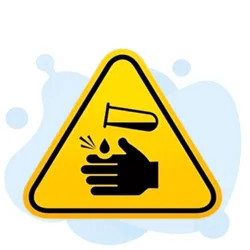
The corrosion pictogram depicts a liquid dropping from a test tube onto a surface and a hand, showing damage to both materials and skin. It applies to substances that cause skin corrosion (category 1), serious eye damage (category 1), and corrosion to metals. Strong acids like hydrochloric and sulfuric acid, as well as strong bases like sodium hydroxide, carry this symbol. Workers must use appropriate PPE — chemical-resistant gloves, face shields, and aprons — whenever handling corrosive products. The SDS Section 8 specifies exact PPE requirements for each product.
The gas cylinder pictogram applies to all gases under pressure, including compressed gases, liquefied gases, dissolved gases, and refrigerated liquefied gases. Products with this symbol present hazards from the physical pressure of the container as well as the chemical properties of the gas itself. A pressurized cylinder that is damaged or heated can become a projectile.
The health hazard pictogram — showing a silhouette with a starburst on the chest — covers carcinogens, mutagens, reproductive toxicants, respiratory sensitizers, and specific target organ toxicants with more severe systemic effects. This symbol is one of the most important for long-term worker health protection and frequently features in exam scenarios about chronic exposure limits.
The environment pictogram shows a dead fish and tree, indicating aquatic hazards. Though optional on Canadian WHMIS labels, it appears on many imported products following global GHS requirements, and the AIX Safety training includes it for completeness. Finally, the biohazard symbol — three overlapping circles in a trefoil pattern — is the one WHMIS-specific pictogram with no GHS equivalent. It marks biohazardous infectious materials, a class unique to Canada's WHMIS framework. Hospital labs, biotech facilities, and veterinary clinics commonly encounter products bearing this symbol.
WHMIS Symbols: Supplier Labels, Workplace Labels & SDS
A supplier label is the mandatory label applied to a hazardous product by the manufacturer or importer before it is sold in Canada. Every supplier label must include six core elements: the product identifier (name), hazard pictograms in red-bordered diamonds, the appropriate signal word (Danger or Warning), hazard statements describing the nature and degree of hazard, precautionary statements explaining safe handling and emergency response, and the supplier's name, address, and phone number. Missing any of these six elements is a compliance violation under WHMIS 2015 regulations.
The signal word on a supplier label tells workers immediately how serious the hazard is. "Danger" is reserved for the most severe hazard categories — for example, a flammable liquid with a flash point below 23°C (Class 3, Category 1) carries "Danger," while a liquid with a higher flash point may carry "Warning." When a product has multiple hazards, the signal word for the most severe hazard is the one that appears on the label; you never list both "Danger" and "Warning" on the same product. AIX Safety quiz questions regularly present label scenarios and ask candidates to select the correct signal word.

WHMIS 2015 vs. WHMIS 1988: What Changed?
- +Globally harmonized pictograms make signs recognizable internationally
- +Standardized 16-section SDS format is easier to navigate than old MSDS
- +Two clear signal words (Danger/Warning) replace ambiguous risk phrases
- +Hazard statements are standardized text codes (H-codes) worldwide
- +Precautionary statements (P-codes) provide clear, actionable instructions
- +Digital SDS access is now explicitly permitted under WHMIS 2015
- −Workers trained on 1988 symbols must learn an entirely new pictogram set
- −The 2015 system dropped the biohazard symbol from the GHS set (Canada retained it separately)
- −Environmental pictogram is optional in Canada, creating labeling inconsistency
- −Some hazard classes (e.g., combustible dusts) have no specific GHS pictogram
- −Transition period ended in 2018, but older MSDS formats still circulate in some workplaces
- −More hazard categories per class means more nuanced classification decisions for suppliers
Pros and Cons at a Glance
| Pros | Cons |
|---|---|
| Globally harmonized pictograms make signs recognizable internationally | Environmental pictogram is optional in Canada, creating labeling inconsistency |
| Two clear signal words (Danger/Warning) replace ambiguous risk phrases | Some hazard classes (e.g., combustible dusts) have no specific GHS pictogram |
| Hazard statements are standardized text codes (H-codes) worldwide | More hazard categories per class means more nuanced classification decisions for suppliers |
WHMIS Certification Study Checklist
- ✓Memorize all nine GHS pictograms and the biohazard symbol with their hazard class names.
- ✓Learn the difference between the skull-and-crossbones and exclamation mark symbols.
- ✓Identify the six mandatory elements required on every WHMIS 2015 supplier label.
- ✓Understand when a workplace label is required versus when the same-shift exemption applies.
- ✓Know the titles of all 16 SDS sections and which section covers PPE (Section 8).
- ✓Distinguish between the signal words Danger and Warning and know which hazard categories each applies to.
- ✓Review the two uniquely Canadian hazard classes: biohazardous infectious materials and combustible dusts.
- ✓Understand employer obligations for SDS accessibility and maximum update frequency (3 years).
- ✓Practice identifying hazard classes from product scenarios, not just from pictogram images.
- ✓Complete at least two full practice quizzes timed to simulate the AIX Safety exam conditions.
The Exclamation Mark Is One of the Most Tested Symbols
The exclamation mark pictogram covers four different hazard categories: less-severe acute toxicity (category 4), skin irritation (category 2), eye irritation (category 2A), and respiratory tract irritation. AIX Safety quiz questions often present a list of hazards and ask which pictogram applies — if you see "skin irritant" or "harmful if swallowed," the answer is almost always the exclamation mark, not the skull and crossbones. Knowing this distinction alone can save you from several wrong answers on the exam.
WHMIS label requirements and SDS content are tested together in the AIX Safety V3 quiz because they form a unified information system. The label on a container is the first alert — it tells a worker immediately whether a product is dangerous and at what level. The SDS is the deep dive — it provides the full technical picture that safety officers, emergency responders, and medical personnel need. Understanding how these two tools work together is the mark of a truly WHMIS-competent worker, not just someone who memorized symbols for an exam.
Supplier labels must remain legible and firmly attached to the product container at all times. If a label becomes damaged, defaced, or falls off, the employer is legally responsible for replacing it before the product is used again. This might seem like a minor administrative point, but the AIX Safety training emphasizes it because damaged labels are a common real-world safety failure. Workers who encounter an unlabeled or illegibly labeled container must stop using the product and report it to their supervisor immediately — they should never assume they know what a chemical is based on color or smell alone.
The SDS hazard identification section (Section 2) lists the classification of the substance, the label elements including pictograms and signal words, and any other hazards not captured by the GHS classification system. This last element — "other hazards" — can include properties like dust explosion potential, a hazard that has no dedicated GHS pictogram but represents a very real workplace danger in industries like woodworking, grain handling, and pharmaceutical manufacturing. Canada's WHMIS system requires suppliers to disclose these hazards even without a specific symbol to represent them.
First-aid measures in Section 4 of the SDS describe the immediate actions required if a worker is exposed to the hazardous product. These instructions are specific to the route of exposure: skin contact, eye contact, inhalation, and ingestion each have their own first-aid protocol.
The AIX Safety quiz sometimes presents a scenario — for example, a worker splashes a corrosive liquid on their arm — and asks what the correct first-aid response is. The general answer for skin or eye contact with most hazardous chemicals is immediate flushing with large amounts of water for 15 to 20 minutes, followed by seeking medical attention. The specific SDS always takes precedence over general rules.
Precautionary statements on WHMIS labels are divided into four categories: prevention (how to avoid exposure), response (what to do if exposure occurs), storage (how to store the product safely), and disposal (how to dispose of the product and its container). These are standardized P-codes under the GHS system, which means the same P-code means the same thing on a product label in Canada as it does in Europe or Australia.
This international standardization is one of the major benefits of the 2015 WHMIS update and a key reason why the change was made. For workers who use aix safety whmis answers to study, cross-referencing P-codes with their full text is an efficient way to build a mental reference library for exam day.
Storage requirements on the SDS (Section 7) complement the precautionary storage statements on the label. While the label might say "store in a cool, dry place away from heat sources," the SDS goes further by specifying temperature ranges, incompatible materials to avoid storing nearby, container material requirements, and ventilation standards. For example, flammable liquids must be stored in grounded, bonded containers in approved flammable storage cabinets, away from ignition sources and oxidizers. The AIX Safety training tests these storage rules because improper storage is a leading cause of chemical workplace incidents.
Transport information (Section 14 of the SDS) links WHMIS classification to Transportation of Dangerous Goods (TDG) regulations. While WHMIS governs hazardous products in the workplace, TDG governs how those same products move between locations. A product classified as a flammable liquid under WHMIS is also classified as a dangerous good under TDG, and different placards and documentation are required during transport. The AIX Safety V3 quiz does not test TDG in depth, but it does expect candidates to understand that WHMIS and TDG are separate regulatory systems that may both apply to the same product in different contexts.

WHMIS does not have a single nationally recognized certificate issued by one authority. AIX Safety and other training providers issue completion certificates, but these are certificates of training completion — not government-issued licenses. Employers must ensure workers receive WHMIS education and site-specific training, and training must be renewed whenever new hazards are introduced or at intervals determined by the employer. A certificate from one employer does not automatically satisfy the requirements at a new workplace with different hazardous products.
Preparing strategically for the AIX Safety WHMIS 2015 V3 quiz means understanding not just what the signs mean, but how exam questions are written. AIX Safety questions are designed around real workplace scenarios, which means they test your ability to apply WHMIS knowledge rather than simply recall definitions. A question might describe a worker finding an unlabeled container and ask what the correct procedure is, or it might show a label with a missing element and ask whether it is compliant. This application-level thinking requires a deeper understanding than flashcard memorization alone can provide.
One of the most effective study strategies is to practice with actual WHMIS 2015 labels and SDS documents from common workplace chemicals. Pull up the SDS for a product like acetone, sodium hydroxide, or compressed nitrogen, and work through each of the 16 sections deliberately. Identify the pictograms you would expect to find on the label, check what signal word is used, and read the precautionary statements in full. This real-world exposure to authentic documents gives you pattern recognition that generic study materials cannot replicate — you begin to see how the classification system translates into label elements automatically.
Time management during the AIX Safety quiz is straightforward because the test is not heavily timed in the same way a professional certification exam might be. However, candidates who are not well-prepared often spend too long on pictogram identification questions, which should be answered quickly if the symbols are properly memorized. Reserve more time for scenario-based questions that require you to apply multiple pieces of WHMIS knowledge simultaneously — for example, a question that asks you to identify both the correct pictogram and the appropriate PPE for a specific chemical hazard scenario.
The whmis 2015 aix safety certification process through AIX Safety typically involves watching a series of training modules followed by a multiple-choice quiz. The quiz usually contains between 20 and 40 questions, and a passing score of 70 to 80 percent is required depending on the module version. Questions are drawn from a question bank, so the exact set of questions varies between attempts. This means that thorough understanding across all WHMIS topics — not just the most common ones — is necessary to consistently pass, especially if you need to retake the quiz.
One area where candidates frequently lose points is the distinction between hazard classes and hazard categories. A hazard class is the broad type of hazard — for example, "flammable liquids." Within that class, there are multiple categories (1 through 4 for flammable liquids) that represent increasing severity.
Category 1 is the most dangerous, Category 4 the least. This counterintuitive numbering — where a lower number means a higher danger — trips up many first-time WHMIS test takers. When a question asks about the most severe category of a particular hazard class, the answer is always Category 1, not the highest number.
Practice tests are the single best preparation tool available for the AIX Safety WHMIS quiz. Working through scenario questions under timed conditions trains your brain to retrieve information quickly and apply it correctly under pressure. Each practice question you answer incorrectly is an opportunity to identify a gap in your knowledge and fill it before the real exam. After completing a practice set, always review every question — including the ones you got right — to understand the reasoning behind each answer. This review process is where deep learning happens, transforming superficial recall into durable understanding.
Finally, remember that the goal of WHMIS signs, labels, and training is not the certificate itself — it is the protection of your health and safety in the workplace. Every symbol you learn to recognize, every SDS section you can navigate confidently, and every precautionary statement you follow correctly translates directly into a safer work environment for yourself and your colleagues. The AIX Safety quiz is a checkpoint, but genuine WHMIS competency is a lifelong professional skill that makes every workplace you enter a little safer.
Practical tips for acing the AIX Safety WHMIS V3 quiz begin with organizing your study time around the most heavily tested topics. Based on the structure of AIX Safety modules, pictogram identification consistently accounts for the largest share of questions, followed by label element requirements, SDS section knowledge, and employer/worker responsibilities. If you have limited study time, prioritize these four areas in that order and you will be positioned to pass even if your knowledge of less-tested topics is thinner.
Create a simple reference chart listing all ten WHMIS 2015 symbols (nine GHS plus biohazard), the hazard class or classes each covers, and the key associated hazard types. Draw the shapes by hand rather than just reading about them — the physical act of drawing the flame, skull, corrosion image, and other icons reinforces visual memory in a way that passive reading cannot. Many successful WHMIS candidates report that hand-drawing the symbols once or twice was the single study technique that made pictogram questions feel effortless on exam day.
For SDS questions, use the mnemonic "I Can Feel Heat, Fire Burning Heavily: Every Section Tests Regulatory Details" to remember the rough order of SDS sections: Identification, Composition, First Aid, Handling and Storage, Fire Fighting, Biological Hazards (stability and reactivity), Hazard Identification (Section 2 comes second, remember), Exposure Controls, Safety (physical/chemical properties), Toxicological information, Regulatory information, and Disposal. While this mnemonic is imperfect, anchoring the SDS structure to a memorable phrase dramatically reduces the number of questions you will miss about which section covers which topic.
On exam day, read every question carefully before selecting an answer. AIX Safety questions frequently contain qualifiers like "always," "never," "must," and "may" that significantly change what the correct answer is. For example, "workers must consult the SDS before using a new chemical for the first time" is a true statement, but "employers must always post a physical copy of the SDS in the work area" is false because digital access is permitted. These subtle distinctions are where well-prepared candidates distinguish themselves from those who only studied the broad concepts.
If you encounter a question about a specific chemical you are not familiar with, use your knowledge of the pictogram on the label as your primary guide. The WHMIS system is designed so that a trained worker can identify the correct protective actions for any hazardous product based on its label alone, without needing to know the product by name. A product bearing the flame pictogram requires fire prevention measures; a product bearing the skull requires immediate medical attention if ingested. Applying this systematic logic will help you answer scenario questions even for unfamiliar products.
Review your workplace's own WHMIS program as part of your preparation if you are taking the AIX Safety quiz in an employment context. Employers are required to have a written WHMIS program that describes how workers access SDS documents, how labels are managed on transferred products, how training is delivered and documented, and how the program is reviewed. Understanding your employer's specific procedures alongside the general WHMIS regulations ensures that your training is both exam-ready and genuinely applicable in your actual workplace.
After passing the AIX Safety quiz and receiving your completion certificate, the learning does not stop. WHMIS is a living system — suppliers update SDS documents when new hazard information emerges, new products with novel hazard profiles enter the workplace, and regulations are periodically updated.
Build the habit of consulting the SDS for any new product before you use it for the first time, even if you are experienced with similar chemicals. This simple habit, reinforced by thorough WHMIS training, is what separates truly safe workers from those who rely on familiarity and assumption — the two conditions most likely to lead to a preventable workplace chemical incident.
Sample Workplace Hazardous Materials Information System Practice Questions
Try these questions from our free Workplace Hazardous Materials Information System practice tests. The correct answer and an explanation follow each question.
Which WHMIS 2015 label element uses symbols to instantly communicate hazard categories visually?
- A. Signal words
- B. Hazard statements
- C. Pictograms
- D. Precautionary statements
Answer: C. Pictograms
Pictograms are standardized symbols enclosed in a red diamond border that visually convey the type of hazard at a glance.
A drum is labeled with the WHMIS 2015 exclamation mark (!) pictogram. What type of hazard does this symbol indicate?
- A. Explosive materials
- B. Acute toxicity (fatal or toxic) at low doses
- C. Less severe health hazards such as skin/eye irritation or sensitization
- D. Environmental hazards
Answer: C. Less severe health hazards such as skin/eye irritation or sensitization
The exclamation mark pictogram indicates less severe but important health hazards including skin/eye irritation, skin sensitization, and acute toxicity at higher dose levels.
Under WHMIS 2015, which section of a Safety Data Sheet addresses first-aid measures?
- A. Section 2
- B. Section 4
- C. Section 6
- D. Section 8
Answer: B. Section 4
Section 4 of a WHMIS 2015 Safety Data Sheet is dedicated to first-aid measures, describing what to do after potential exposure.
According to WHMIS 2015, how long is a supplier Safety Data Sheet considered current before it must be updated?
- A. 1 year
- B. 2 years
- C. 3 years
- D. 5 years
Answer: C. 3 years
Suppliers must review and update their SDS at least every 3 years or whenever significant new hazard information becomes available.
Take the full Workplace Hazardous Materials Information System practice test
WHMIS Questions and Answers

WHMIS Quiz Answers: Complete WHMIS 2015 AIX Safety V3 Practice Guide

How to Get WHMIS Certification: Complete Study Guide & Training Prep
WHMIS Practice Test PDF (Free Printable 2026)

WHMIS Symbols and Meanings: Complete Guide to WHMIS 2015 Pictograms

WHMIS 2015 Symbols Quiz: Complete Study Guide & AIX Safety Certification Prep
About the Author

Educational Psychologist & Academic Test Preparation Expert
Columbia University Teachers CollegeDr. Lisa Patel holds a Doctorate in Education from Columbia University Teachers College and has spent 17 years researching standardized test design and academic assessment. She has developed preparation programs for SAT, ACT, GRE, LSAT, UCAT, and numerous professional licensing exams, helping students of all backgrounds achieve their target scores.